


Digital & AI Transformation

The Geneva Association. 2023.
Assessing the Potential of Decentralised Finance and Blockchain Technology in Insurance.
Author: Ruo (Alex) Jia. August.
Ruo (Alex) Jia, Director New Technologies and Data, The Geneva Association
Associate Professor of Insurance, Peking University
Decentralised finance (DeFi)1 and blockchain technology2 have the potential to improve the efficiency of traditional insurance, enable new business models and open up new opportunities in insurance. They may also improve the accessibility, affordability and attractiveness of insurance and make insurance more inclusive. Case studies and empirical evidence, however, suggest that the potential benefits of DeFi and blockchain applications in insurance (DeFi/blockchain insurance hereafter) have not yet been fully realised.
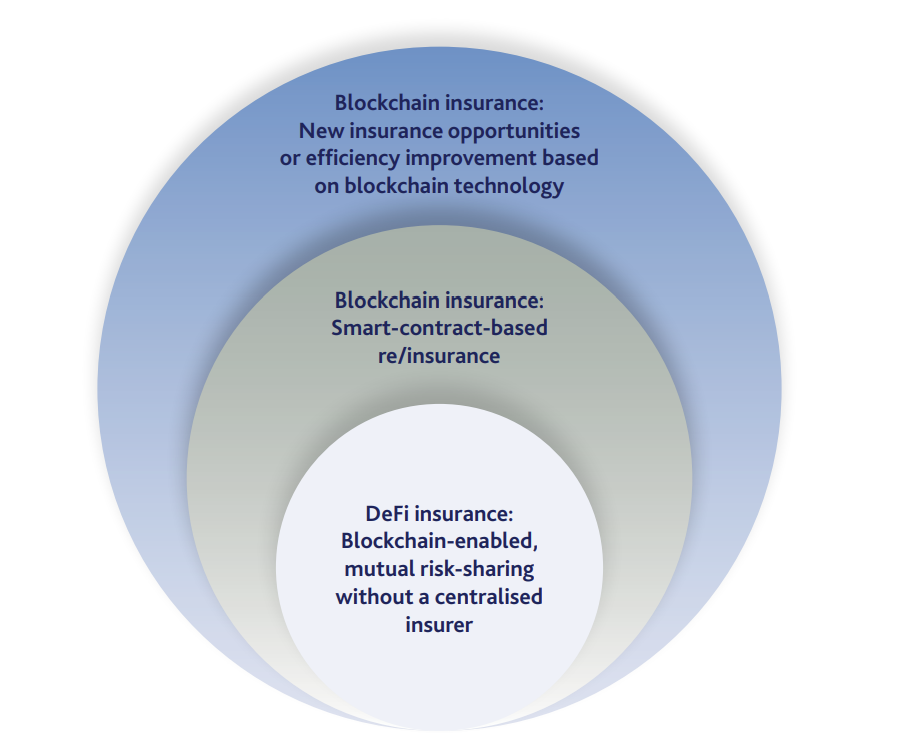
DeFi/blockchain insurance has three layers, defined from the supply side, as shown in Figure 1.3 In the narrowest sense, DeFi insurance refers to a blockchain-enabled, mutual risk-sharing arrangement without a centralised financial intermediary. More broadly, blockchain insurance includes insurance products that use smart contracts and/ or other blockchain techniques as the means to deliver conventional insurance services. In the broadest sense, blockchain insurance also includes insurance activities that use blockchain techniques to improve operational efficiency and/or to develop new business opportunities.
FIGURE 1: DEFI/BLOCKCHAIN INSURANCE
Source: The Geneva Association
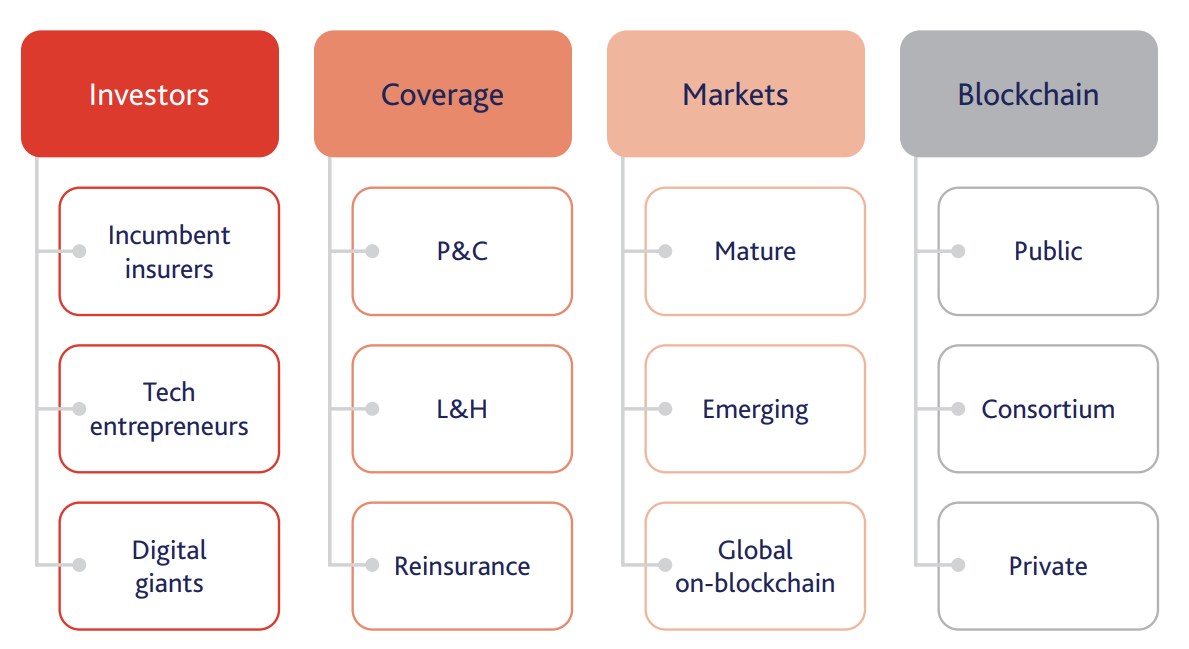
Figure 2 provides an overview of the DeFi/blockchain insurance marketplace. DeFi/blockchain insurance investors mainly include incumbent insurers, tech entrepreneurs and digital giants.4 In terms of coverage, DeFi/blockchain insurance provides property & casualty (P&C) insurance, life & health insurance and reinsurance. It has been developed in both mature and emerging markets and, importantly, some applications purely serve the global online market. Regarding the blockchain technology, DeFi/blockchain insurance has been developed based on public, consortium and private blockchains.
FIGURE 2: DEFI/BLOCKCHAIN INSURANCE MARKETPLACE
Source: The Geneva Association
DeFi/blockchain insurance is mainly present in large, competitive markets; remains niche; and is concentrated in specific non-life segments such as crypto-related risks. The expected efficiency gains and new business opportunities have not yet materialised, and enthusiasm about and confidence in investing in DeFi/blockchain insurance have suffered from recent crypto failures. So far, DeFi/blockchain insurance has neither driven major growth of the insurance market nor significantly improved financial inclusion.
DeFi/blockchain insurance may narrow the insurance protection gap for low-income populations through semi-formal microinsurance programmes.5 Conventional informal insurance used by un(der)insured people includes family protection and various community-based, mutual risk-sharing programmes. It is decentralised, flexible, disintermediated, non-regulated and relies on local, trusted networks. By contrast, the modern, centralised, formal insurance model is highly intermediated, commercially driven and establishes trust based on capital, professionalism and reputation. The lower people’s income, the more they tend to choose informal insurance for risk management.
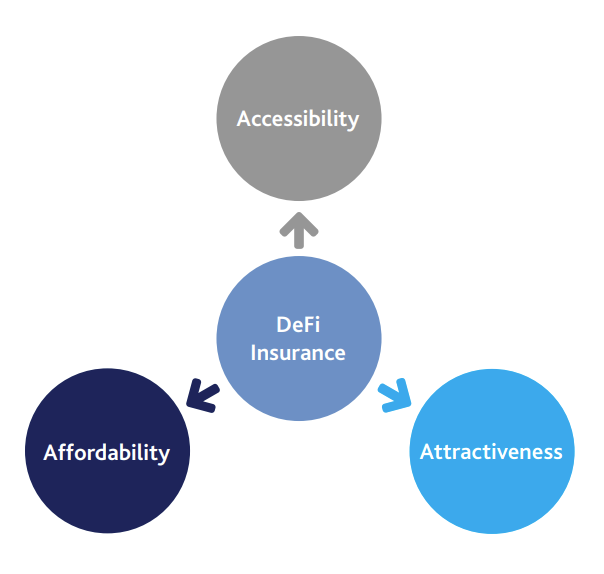
DeFi/blockchain enables peer-to-peer insurance solutions that meet the demands of un(der)served socio-economic groups. Such groups in the context of insurance usually include those that are geographically remote, or have low incomes or poor financial literacy. Their protection gaps include agricultural risk, health/ maternal risk and longevity risk. DeFi insurance enables such individuals to form a risk pool without the approval or involvement of insurance intermediaries. Insurance services can be provided completely online, from underwriting to claims, greatly improving the accessibility of insurance to individuals living in remote areas. The operational costs associated with insurance may also be reduced, improving the affordability of insurance for low-income populations. Finally, the fact that DeFi/ blockchain insurance products could be purchased via smartphone applications or mobile phone networks improves the customer experience and attractiveness of insurance coverage for individuals with poor financial literacy. Figure 3 illustrates the ‘Triple-A Impact’ of DeFi/ blockchain insurance on financial inclusion. Cryptos are particularly useful for inclusive insurance targeted at the unbanked population (i.e. individuals without a bank account). Smart contracts are also expected to improve the trust between un(der)served individuals and DeFi/ blockchain operators and developers.
FIGURE 3: THE ‘TRIPLE-A IMPACT’: HOW DEFI/BLOCKCHAIN IMPROVES FINANCIAL INCLUSION IN INSURANCE
Source: The Geneva Association
The consensus among regulators and re/insurers is that digital technology/insurtech should play a critical role in improving the inclusivity of insurance.6 However, in practice, it remains unclear whether – and if yes, how and to what extent – DeFi/blockchain will facilitate it. This due to its very early stage of development and the immaturity of the technology.
In the short term, and practical hurdles notwithstanding, addressing specific pain points in insurance, such as issues around trust, operational cost and transparency, should be the major focus for DeFi/blockchain insurance. This will require the development and implementation of DeFi and blockchain technology in close collaboration with other insurtechs, using appropriate management approaches. Technically, however, this will not be straightforward as blockchain is generally not a technology that can be easily explored to patch existing IT systems.
In the long term, DeFi/blockchain technology could become an integral part of the insurance value chain. It could become a resource, platform and ecosystem for building new business models and seizing new opportunities. In the long run, insurers may recognise blockchain as a new ecosystem, i.e. a new surface for building and selling insurance products, which could insure both pure on-blockchain risks and off-chain conventional risks. Ultimately, it could also formalise the current informal risk-sharing systems used by the un(der)insured and narrow the insurance protection gap.
Realising the potential benefits of DeFi/blockchain insurance comes with regulatory, business and technical hurdles and risks. These include regulatory caution about the experimental nature of DeFi/blockchain insurance, the immaturity of the blockchain ecosystem, the lack of digital literacy, issues with scalability and integration with legacy IT systems, and data privacy concerns.
Incumbent re/insurers should carefully balance the shortterm cost of investing in technology with the long-term potential of DeFi/blockchain insurance. They should dynamically weigh the pros and cons of DeFi/blockchain insurance by continuing to test the waters with pilots due to: 1) the potential of DeFi insurance to disintermediate and transform traditional insurance business models, at least in the long run and 2) the potential new revenues generated by providing improved services (e.g. risk assessment, pricing, risk management, claims management).
For incumbent re/insurers, starting with a DeFi/blockchain insurance pilot that addresses pain points of existing business models or developing a new line of business in a new market are likely to be valid strategic options. Startups should identify business opportunities where DeFi/ blockchain technology has a competitive advantage, such as crypto-related covers and e-credit insurance in supply chain finance.
Feng 2023.
IAIS 2018.
Schmit 2022.
Swiss Re 2020.
In our increasingly interconnected world, where rapid technological development continues to reshape the global landscape, decentralised finance (DeFi) supported by blockchain technologies has emerged as both an opportunity and challenge for the insurance industry. We are pleased, with this report, to provide an analysis of key considerations for insurers.
DeFi and blockchain technologies are ushering in a new era of smoother customer experience and easier claims management. By facilitating inclusive insurance solutions, they may play a transformative role in empowering underserved communities. They also enable policyholders to share data more securely with insurers and others – protecting sensitive information in transactions and fortifying the industry against fraudulent activities.
The positive knock-on effects of DeFi and blockchain technologies for insurance customers are coming into focus. We call this the potential ‘Triple-A Impact’: enhanced Accessibility, with insurance services provided completely online; improved Affordability, as a result of reduced operational costs for insurers; and increased Attractiveness, with a simpler customer experience. Faster and more reliable claims processing and increased data transparency can, conceivably, foster greater trust in insurers.
However, alongside the attraction of DeFi and blockchain, we must be mindful of their nascent nature and inherent risks. Issues around regulatory compliance, scalability and cyber vulnerabilities are top of mind.
To support insurers in navigating these challenges, this report explores real-word use cases and lessons already learned from early adopters, and projects how DeFi/blockchain in insurance may develop. We hope that the report guides insurers and insurtechs in harnessing the full potential of DeFi and blockchain technologies while managing related challenges with prudence and foresight.
Jad Ariss
Managing Director
Geneva Association
Decentralised finance (DeFi)1 and blockchain technology2 have the potential to improve the efficiency of traditional insurance, enable new business models and open up new opportunities in insurance. They may also improve the accessibility, affordability and attractiveness of insurance and make insurance more inclusive.
Specifically, DeFi/blockchain technologies could reduce administrative costs and streamline insurance processes by eliminating the need for intermediaries; increase transparency by enabling transparent and immutable records, thus enhancing trust and reducing fraud in insurance transactions; and improve accessibility and inclusivity by facilitating underserved populations’ participation in risk-sharing arrangements and access to coverage that was previously unavailable to them.
Case studies and empirical evidence, however, suggest that the potential benefits of DeFi and blockchain applications in insurance (DeFi/blockchain insurance3 hereafter) have not yet been fully realised. DeFi/blockchain insurance is mainly present in large, competitive markets; remains niche; and is concentrated in specific non-life segments such as crypto-related risks. The expected efficiency gains and new business opportunities have not yet materialised, and enthusiasm about and confidence in investing in DeFi/blockchain insurance have suffered from recent crypto failures. So far, DeFi/blockchain insurance has neither driven major growth of the insurance market nor significantly improved financial inclusion.
What is the outlook for DeFi and blockchain in insurance? In the short term, and practical hurdles notwithstanding, addressing specific pain points of existing insurance practices, such as issues around trust, operational cost and transparency, should be the major focus for DeFi/ blockchain insurance. This will require the development and implementation of DeFi and blockchain technology in close collaboration with other insurtechs, using appropriate management approaches. Technically, however, this will not be straightforward as blockchain is generally not a technology that can be easily explored to patch existing IT systems.
In the long term, based on observations from other financial sectors, DeFi/blockchain technology could become an integral part of the insurance value chain. It could become a resource, platform and ecosystem for building new business models and seizing new insurance opportunities. Insurers may come to recognise blockchain as a new ecosystem, i.e. for building and selling insurance products, which could insure both pure on-blockchain risks and off-chain conventional risks. Ultimately, it could also formalise the current informal risk-sharing systems used by the un(der) insured and narrow the insurance protection gap.
Realising the potential benefits of DeFi/blockchain insurance comes with regulatory, business and technical hurdles and risks. These include regulatory caution about the experimental nature of DeFi/blockchain insurance, the immaturity of the blockchain ecosystem, the lack of digital literacy, issues with scalability and integration with legacy IT systems, and data privacy concerns.
Incumbent re/insurers should carefully balance the shortterm cost of investing in technology with the long-term potential of DeFi/blockchain insurance. They should dynamically weigh the pros and cons of DeFi/blockchain insurance by continuing to test the waters with pilots due to: 1) the potential of DeFi insurance to disintermediate and transform traditional insurance business models, at least in the long run and 2) the new revenues generated by providing improved services (e.g. risk assessment, pricing, risk management, claims management), which are likely to emerge for incumbent re/insurers that actively invest in the DeFi/blockchain transformation, similar to banks generating new revenues from off-balance-sheet services.
For incumbent re/insurers, starting with a DeFi/blockchain insurance pilot that addresses the pain points of existing business models or developing a new line of business in a new market are likely to be valid strategic options. Startups should identify business opportunities where DeFi/ blockchain technology has a competitive advantage, such as crypto-related covers and e-credit insurance in supply chain finance.
Decentralised finance (DeFi) and blockchain technology can address traditional pain points in insurance, such as lack of trust, high transaction costs and the tension between confidentiality and transparency. Ultimately, DeFi and blockchain could potentially transform the insurance industry by reducing operational costs, facilitating the development of new business models and opening up new insurance opportunities, for example in inclusive insurance.4,5
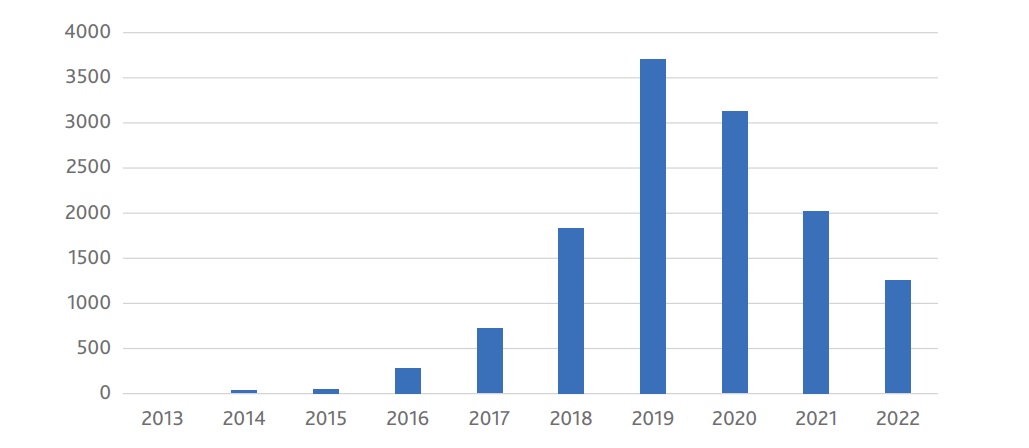
DeFi and blockchain technology have undergone rapid development in the past decade, including in insurance applications. As shown in Figure 1, the number of newly granted blockchain insurance patents has increased significantly in recent years. Between 2019 and 2021, during the crypto boom, there was much optimism around DeFi/blockchain developments in insurance and blockchain insurance patents peaked during that time. In 2022, however, when crypto markets experienced major devaluation and failures, the outlook on DeFi/blockchainrelated markets became more pessimistic and the number of blockchain insurance patents dropped. Global venture funding for blockchain and crypto companies reached a record high in Q1 2022 but then declined for three straight quarters due to the crypto winter coupled with rising interest rates and macroeconomic pressures.6 Investors were reluctant to continue financing DeFi/blockchain insurance technologies given the uncertainty around nearterm profitability and scalability prospects.
FIGURE 1: NUMBER OF BLOCKCHAIN INSURANCE PATENTS GRANTED IN THE PAST DECADE
Source: Patsnap Analytics7
DeFi and blockchain technology are expected to improve financial infrastructure in ways that could increase demand for insurance.8 For example:
Identity verification. DeFi and blockchain technology offer solutions to people who have no legal identity and enable identification of individuals without revealing private information.
Monetary transfers. Digital wallets based on a public blockchain enable remote and instantaneous monetary transfers to and from the unbanked.
Peer-to-peer connection. DeFi/blockchain bridges the geographical gap between individuals with similar financial needs.
Automated contract execution. Blockchain-based smart contracts9 enable automated execution of financial transactions without human interference, which not only reduces operational costs but also enhances trust among stakeholders.
These DeFi/blockchain-based advancements enable additional access to and improve the affordability of insurance. DeFi/blockchain applications could also simplify insurance, making it more attractive.
On the flip side, recent failures of DeFi/blockchain pilots in insurance suggest that the short-term hurdles and risks must not be underestimated. In 2022, B3i, the re/insurance industry’s blockchain initiative, became insolvent due to failure to raise new capital. This highlights the challenges associated with achieving expected efficiency gains and profitability in mass adoption in the short term.
The crashes of stablecoin10 TerraUSD and crypto exchange FTX have also challenged overall confidence in the DeFi system in the short term. The Terra crash resulted from design failure and reflects the immaturity of blockchain technology. The FTX scandal suggests that traditional pain points, such as agency problems,11 incompetence and fraud, are also present in self-proclaimed decentralised systems.12
These developments have led insurers and investors to doubt:
Given the potential benefits and opportunities of DeFi/ blockchain applications in insurance and the risks and challenges they pose, it is important to thoroughly assess the impact of DeFi/blockchain on insurance and what it will take to harness DeFi/blockchain technology for a more efficient and inclusive insurance market. With that in mind, this report analyses current developments in DeFi/blockchain insurance and assesses its potential as well as business and regulatory implications. Existing studies on DeFi/blockchain insurance are largely qualitative discussions of its benefits and challenges; evidence-based case studies or empirical analyses are lacking. This report aims to fill this gap.
We also briefly discuss the new risks introduced by applications of DeFi/blockchain technologies in various industries and the potential insurance coverage for them. Insuring blockchain-related risks falls under the scope of cybersecurity and cyber insurance, and therefore will not be covered in this paper.
The rest of the report is structured as follows. Section 2 describes the concepts and key features of DeFi/blockchain insurance and compares it with conventional insurance. Section 3 analyses three representative DeFi/blockchain insurance cases in practice and reports empirical evidence regarding the impact of DeFi/blockchain on the development and inclusiveness of insurance. Section 4 analyses the potential of DeFi/blockchain technology for more inclusive insurance. Section 5 addresses the risks and challenges associated with DeFi/blockchain insurance. Section 6 concludes with business and regulatory recommendations.
Box 1: Failure of TerraUSD and FTX and the implications for DeFi/blockchain insurance
2022 was an excessively hazardous year for cryptos. Two events had a significant impact on DeFi/blockchain: the collapse of TerraUSD/LUNA, a large stablecoin, in May; and the bankruptcy of the once third-largest crypto exchange, FTX, in November. These major failures have had negative shortand medium-term effects on DeFi and DeFi/blockchain insurance, but may help shape DeFi/blockchain insurance in the long run.
TerraUSD failure. Launched in 2018, TerraUSD (UST) was once the largest non-collateralised stablecoin. Unlike fiatbacked or crypto-collateralised stablecoins, TerraUSD maintained its dollar value through a simple arbitrage algorithm: UST 1 USD 1 worth of LUNA. LUNA is the companion coin of Terra, designed to balance and maintain the value of Terra. The collapse of TerraUSD was caused by a substantial drop in LUNA, a common volatility in the crypto market, making it impossible to maintain TerraUSD’s dollar value. Consequently, on 7 May 2022, the price of UST fell to 35 cents and the price of LUNA further fell to a few cents by 12 May 2022. The two cryptocurrencies fell into a downward spiral due to their inherent design defect: the absence of collateralisation through either physical or digital assets. When UST was depegged from USD 1, Luna Foundation Guard, the non-profit organisation responsible for overseeing Terra’s ecosystem, deployed USD 3.5 billion from its reserves to repeg UST to the U.S. dollar. However, the reserve buffer was quickly exhausted. On 25 May 2022, a new LUNA was issued, called Terra 2.0 by investors, and UST and LUNA decoupled.
Collapse of FTX. Established in 2017, FTX was a centralised exchange for buying and selling cryptos. The failure of FTX was triggered by an article published on 2 November 2022 stating that Alameda Research, a trading firm affiliated with FTX and owned by FTX Chief Executive Sam Bankman-Fried, held a significant amount of FTX’s exchange token, FTT, which was used as collateral for Alameda liabilities. This led Binance, a leading crypto exchange, to announce that it was to sell all of its FTT holdings. On 11 November 2022, FTX filed for Chapter 11 bankruptcy protection. Failure of internal controls, missing fiduciary responsibilities for clients and concentrated holding of own FTT cryptos were the main drivers of FTX’s collapse.
Implications for DeFi and DeFi/blockchain insurance. The failures of TerraUSD and FTX reminded people of the fragility of DeFi products and ecosystems. Such concerns are harmful for DeFi/blockchain insurance in the short and medium term. This is confirmed by the negative reactions of cryptocurrency prices: Bitcoin dropped by 18% in May 2022 and 20% in November 2022; Ethereum dropped by 27% in May 2022 and 23% in November 2022. On a brighter note, however, the mistakes made in both cases – design errors in smart contracts and corporate governance failures – became visible and addressable in a new market. None of them point to structural flaws of DeFi or DeFi/blockchain insurance.
Contributed by Prof. Dr. Tong YU, University of Cincinnati
DeFi/blockchain insurance can be defined in three layers, as shown in Figure 2.13 These concepts are defined from the supply side, i.e. how DeFi/blockchain technologies enable more effective risk sharing and more efficient insurance supply. Section 2.3 also briefly discusses the new risks induced by applications of DeFi/blockchain technologies in various industries and potential insurance coverage for these risks.
FIGURE 2: DEFI/BLOCKCHAIN INSURANCE
Source: The Geneva Association
In the narrowest sense, DeFi insurance refers to a blockchain-enabled, mutual risk-sharing arrangement without a centralised financial intermediary, for example peer-to-peer insurance using tokens14 for premium and claims payments and operating on a public blockchain (e.g. Ethereum) – so-called tokenised or token-based insurance.15 This narrow concept of DeFi insurance is also known as decentralised insurance. It allows users to transact directly with each other on the blockchain, in theory eliminating the need for an intermediary third party.16 Such peerto-peer DeFi insurance is not linked to any incumbent insurance company and serves a group of policyholders with similar insurance needs. The case of Nexus Mutual discussed in Section 3.2 reflects this concept.
Such DeFi insurance systems involve two steps. First, the participants exchange risks with each other to achieve risk diversification via the blockchain. Then, they transfer the risks beyond the risk-bearing capacity of participants to third parties, e.g. via reinsurance.17 The total value locked (TVL)18 in DeFi insurance remains very small at just above USD 500 million (as of October 2022), accounting for 0.5% of the TVL in the entire DeFi ecosystem.19
DeFi insurance can be described by the following eight features:20
FIGURE 3: FEATURES OF DEFI INSURANCE
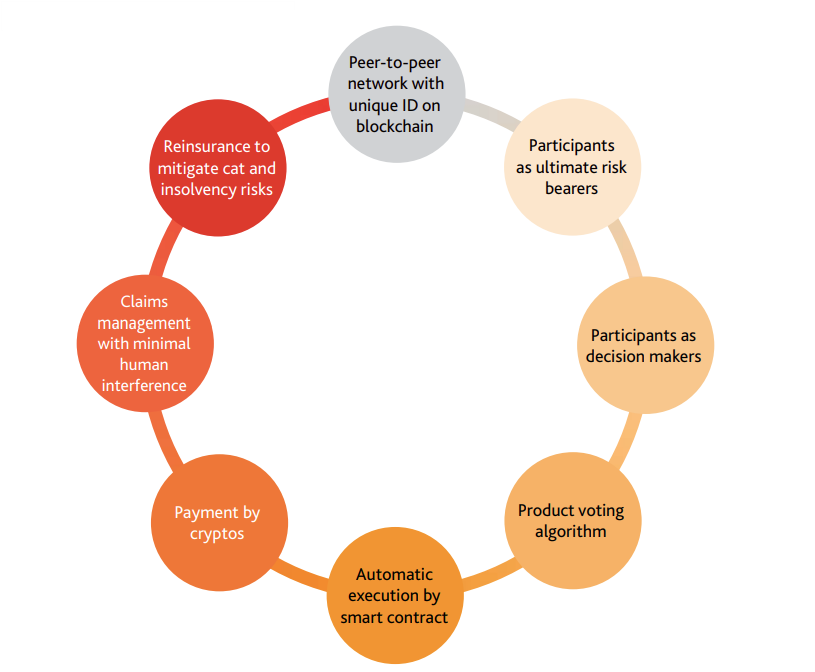
Source: Alwis and Jinasena21
In a broader sense, blockchain insurance includes insurance products that use smart contracts and/ or other blockchain techniques as the means to deliver conventional insurance services, for example parametric cover and health insurance. The smart contract automates the settlement of claims, excluding any human interference, and therefore improves the trust between policyholders and insurers. In the health insurance context, a blockchain connects policyholders (i.e. patients), hospitals and re/insurers by sharing patients’ medical information without revealing their identities, improving transparency among stakeholders. The case of B3i discussed in Section 3.3 is an example of this broader concept.
In the broadest sense, blockchain insurance also includes insurance activities that use blockchain techniques to improve operational efficiency and/or to develop new business opportunities. Blockchain technology can be applied to any part of the insurance value chain; for example, to improve internal information sharing and to verify identities22 and claims. Decentralised, country-level pension databases may improve information sharing as well as data security. Blockchain technology can also facilitate supply chain finance and its associated credit insurance, and be used to explore crypto-related risk coverage and new types of services such as financing brokerage receivables. Annchain (ZQAlink) described in Section 3.4 is a case in point for this concept.
The original and most well-known application of blockchain is Bitcoin, so-called Blockchain 1.0. Bitcoin gave rise to many different cryptocurrencies, crypto assets and stable coins, which secure online payments through a distributed ledger system without a bank or other financial intermediaries. Cryptos can be part of mainstream insurance services and used as tools for premium and claims payments as well as invested assets for pioneering insurers. Cryptos have experienced a few boom and bust cycles. The value of bitcoin, which partially reflects market demand and business acceptance of blockchain applications, peaked in 2021 and then plummeted following the collapse of TerraUSD and FTX.23
Blockchain 2.0 (e.g. the Ethereum) enables smart contracts. For insurance, the contract has always been the core product. It is the promise sold and provides peace of mind for policyholders. The complexity of insurance contracts and their policy terms, however, make it difficult for consumers, and sometimes even regulators, to understand and make best use of the cover, limiting insurance demand and supply. Consumers often perceive insurance as opaque and inflexible. As such, the potential benefits of smart contracts extend to all parties in the insurance system, including customers, insurers and regulators. The spectrum ranges from transforming text to code to the all-important automation of insurance processes, from quotations, policy administration and claims to contract renewal. It is also worth noting that smart contracts and their enabling Blockchain 2.0 technology have made signficant progress on energy efficiency: Bitcoin (i.e. Blockchain 1.0) has been blamed for consuming a huge amount of energy; Blockchain 2.0 has largely reduced this problem.
Figure 4 summarises the potential benefits of smart contracts for customers, insurers and regulators.24
FIGURE 4: POTENTIAL BENEFITS OF SMART CONTRACTS
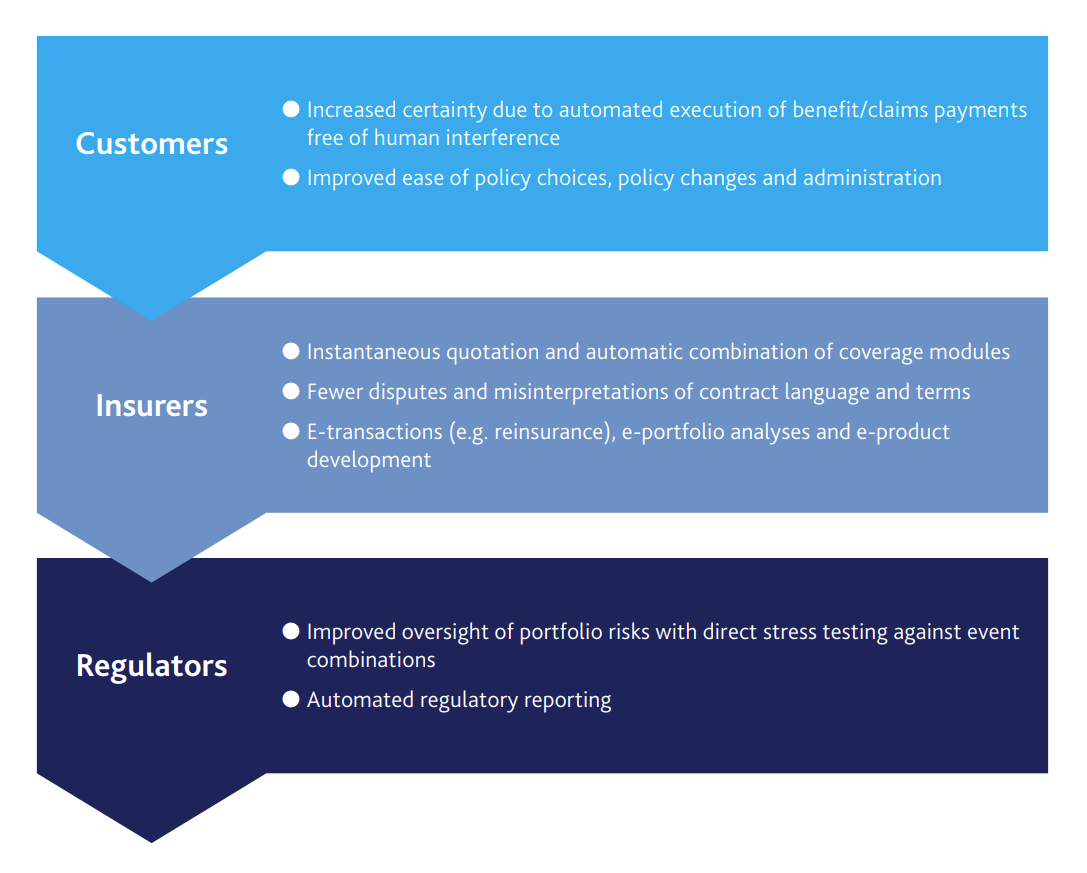
Source: Goodenough and Salkind
As the foundation of DeFi/blockchain insurance, smart contracts are expected to improve the trust between transaction parties and the efficiency of business transactions. Smart contracts can also mitigate moral hazard (e.g. parametric insurance) and help with fraud detection, process automation and operational efficiency. They also allow for instantaneous and automatic execution of claims payments, which improves the customer experience.25 Certain regulations could also be codified into smart contracts, which would enable firms to monitor compliance, and even complete regulatory reporting in an automated way.26
Blockchain and insurance connect individuals as part of a network. They also share the objective of building trust among individuals.27 Blockchain facilitates efficient, encrypted and untampered information sharing among stakeholders of insurance. Using health insurance as an example, hospitals and doctors can upload medical bills and diagnoses on a blockchain that is connected to insurers, policyholders and potentially reinsurers and brokers/agents, without revealing the name or ID number of the policyholder. Identity verification for payment of the claim can be carried out by protocols (smart contracts) on the blockchain. Blockchain technology thus addresses traditional pain points such as issues around privacy and transparency when it comes to decisions on claims and validation of medical records.
The modern, centralised insurance business model is a formalisation of the informal, mutual risk-sharing arrangements in ancient civilizations. Merchants across the Mediterranean Sea, for example, shared the loss of a ship among several shipowners based on mutual trust and without a centralised intermediary. Similar risk-sharing arrangements are known from caravans on the ancient silk road.28 Compared to this model, centralised insurance has three major advantages:
However, three pain points affect the centralised insurance model:
DeFi and blockchain technology could potentially revive mutual risk-sharing by addressing and easing some of the pain points mentioned above.32 For example, blockchainbased identity and evidence systems improve the efficiency and effectiveness of verifying underwriting information and claims, making exchange of information between parties easier. This offers a way to reduce information asymmetry, improve trust and transparency between policyholders and insurers, and ultimately reduce the transaction costs of insurance. DeFi/blockchain insurance may also improve the accessibility and customisation of insurance products.33
Currently, there are two opposite views on DeFi/blockchain insurance and how it compares to the centralised insurance business model. Optimists believe that DeFi/blockchain may revolutionise the insurance industry in general and inclusive insurance in particular due to its reliance on decentralised networks of computers around the world, instead of existing centralised banking and insurance systems.34 It is possible (and to some experts, very likely) that DeFi/blockchain will increase in use in the mainstream banking/insurance industry, generate a new wave of disintermediation in the sector and potentially establish a new decentralised banking/insurance ecosystem in parallel to and in competition with the existing financial system in the long run. As DeFi/blockchain may significantly reduce transaction costs in insurance, it will likely expand insurance services to the un(der)served population, and therefore narrow protection gaps and promote financial inclusion. Box 2 outlines opportunities for improving claims and underwriting processes in insurance using DeFi/ blockchain technolgoies (and smart contracts in particular).
Box 2: How can DeFi/blockchain technologies benefit claims and underwriting?
Smart contracts offer potential opportunities for claims automation via straight-through processing whereby, under certain conditions defined in the smart contract, claims payments are automatically fulfilled. All data used to support the claim is immutable, trusted and verified through consensus on the blockchain. This could include off-chain data such as medical records, or other health data such as biometrics or genomics. Specific blockchain implementations known as oracles enable this blending of off-chain data with transactional on-chain data, most notably ChainLink.
In traditional blockchains (e.g. Bitcoin), the double-spend problem was solved in a decentralised fashion without an intermediary (i.e. a bank). This is analogous to making the same claim twice in an insurance context. Solving the problem in this way ensured trust by reducing occurrences of fraud, waste and abuse.
Underwriting risk can be distributed among multiple parties with varying risk tolerances in the form of multi-party ‘legal smart contracts’, enabling increased access to coverage. This has the potential to displace large intermediaries as dominant risk underwriters. Similar to how blockchain (Bitcoin) enables transactions between the unbanked, it can offer coverage to the world’s uninsured population.
Contributed by a DeFi/blockchain insurance expert (anonymous)
Pessimists believe that the volatility and failures of cryptos and DeFi/blockchain insurance initiatives undermine investor confidence.35 Retail investors and coverage buyers – and likely many institutional ones – lack robust knowledge about DeFi insurance, in particular its protocols, governance and claims management mechanisms. Investors and coverage buyers are not protected by insurance regulation either: there is no solvency regulation for DeFi ‘insurers’. And there are no insurance guarantee funds. It is therefore likely that after a boom – if not a bubble – in crypto asset inflation, investors and coverage buyers will realise the potential risks of the DeFi insurance system and will continue to rely on the conventional insurance business model.
DeFi and blockchain technologies and their applications may also introduce new risks, related to protocols, wallets and metaverses and for smart contract creators, smart contract users, custodians, protocol contributors, white hats and blockchain designers. Demand for insurance is high among these ‘pure players’.
Corresponding new types of insurance coverage would include wallet insurance, custodian insurance, smart contract insurance and errors and omissions (E&O) insurance for blockchain companies. This coverage may or may not use blockchain technology, i.e. it could involve traditional insurance products that cover the new risk exposures of DeFi/blockchain technologies. In this sense, the applications of DeFi/blockchain technologies could generate new business opportunities for insurance companies. Demand for DeFi/blockchain risk coverage could be more tangible and mature compared to using DeFi/blockchain technologies to improve insurance supply, and thus also draw the attention of incumbent re/insurers.
Figure 5 provides an overview of the DeFi/blockchain insurance marketplace. DeFi/blockchain insurance investors mainly include incumbent insurers, tech entrepreneurs and digital giants.36 In terms of coverage, DeFi/blockchain insurance provides property & casualty (P&C) insurance, life & health insurance and reinsurance. It has been developed in both mature and emerging markets and, importantly, some applications purely serve the global online market. Regarding blockchain technology, DeFi/blockchain insurance has been developed based on public, consortium and private blockchains.
FIGURE 5: DEFI/BLOCKCHAIN INSURANCE MARKETPLACE
Source: The Geneva Association
This section investigates three representative business cases of DeFi/blockchain insurance, which capture various characteristics of the diverse marketplace. B3i aimed to improve efficiency and was invested in by incumbent international re/insurers. During its life span, it provided reinsurance coverage, mainly operated in mature markets and was developed on a consortium blockchain. Nexus Mutual, a tokenised, decentralised, peer-to-peer insurance business model, is a tech enterprise independent of incumbent insurance players. It provides crypto-related risk coverage (P&C), serves the global online and on-blockchain market37 and runs on a public blockchain. ZQAlink explores new insurance opportunities. Its investors comprise digital giants and incumbent insurers, and it provides new credit insurance coverage (P&C) in an emerging market on a consortium blockchain.
Nexus Mutual is a DeFi insurance (alternative) protocol/ platform,38 where DeFi users purchase coverage against potential losses related to crypto assets in a digital account. It aims to share risks among individuals in a decentralised manner, i.e. without the need for a centralised insurance company. Nexus Mutual is built on Ethereum, a public blockchain 2.0. By the end of 2022, Nexus Mutual held about two thirds of the global market for on-blockchain coverage.39
Nexus Mutual provides three types of coverage:40
Instead of using publicly tradable cryptos (e.g. ETH, the cryptocurrency on the Ethereum), Nexus Mutual creates its own token, NXM, and uses it for premium and claims payments, as well as a voting basis for underwriting and claim decisions. Nexus Mutual is owned by its members – those who invested in NXM – similar to conventional mutual insurers owned by policyholders. Members of Nexus Mutual can:
Figure 6 illustrates the business model of Nexus Mutual. Nexus Mutual is halfway on its strategic journey to becoming fully decentralised. For the time being, it is a semi-decentralised platform that connects risk takers to exchange risks. The centralised element of Nexus Mutual is product development. Pricing, underwriting and claims management are, in essence, semi-decentralised, where specialists make the decisions and passive policyholders delegate responsibility to them (under a fully decentralised model policyholders would jointly make the decisions by a voting mechanism). Insurance governance is also semidecentralised, where a centralised advisory board is given the power to set the maximum exposure to a risk and to punish fraudulent claims assessors. The financing process is decentralised. This semi-decentralised model matches current business needs.
The advantages of Nexus Mutual’s DeFi insurance business model are:
FIGURE 6: BUSINESS MODEL OF NEXUS MUTUAL
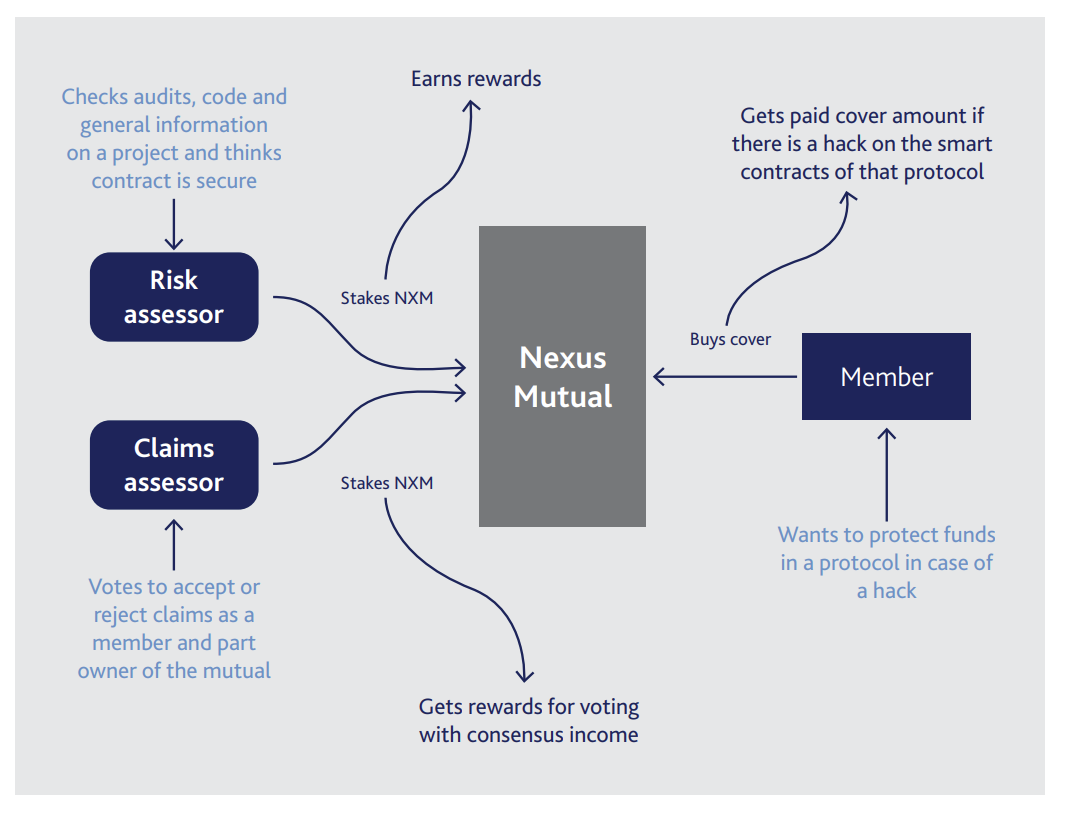
Source: Nexus Mutual42
The disadvantages of such a DeFi insurance model may include:
At least at this stage, there is limited evidence to suggest that Nexus Mutual would have the competitive edge in insuring conventional risks or replacing traditional insurers. The underwriting and pricing of traditional insurance are complex and require meticulous calculations by a team of specialised underwriters and actuaries. The next version of Nexus Mutual’s underwriting model (‘V2’) will move in this direction, with specialists making decisions and passive holders delegating responsibility to them. The next step may involve the switch towards an automated administrative system combined with a capital pool, similar to ‘reinsuranceas-a-service’. It remains to be seen whether Nexus Mutual and similar tokenised insurance businesses can genuinely disrupt traditional insurance business models.
B3i (‘The Blockchain Insurance Industry Initiative’) was the lighthouse blockchain initiative in insurance supported by major re/insurance industry investors until 2022. B3i was a collaboration between incumbent re/insurers to explore the potential of using blockchain technologies with the vision of improving efficiency, i.e. to develop, at least in the initial stage, an end-to-end solution on blockchain for more efficient reinsurance transactions, enabling faster access to reinsurance with less operational risks.43
B3i was founded in October 2016 as an insurance industry consortium, originally consisting of five re/insurers: Aegon, Allianz, Munich Re, Swiss Re and Zurich. In 2018, B3i formed a company named B3i Services in Zurich, which was supported by 21 re/insurer investors in 2020. In July 2022, however, B3i announced its insolvency after failing to raise new capital of USD 20 million. During its existence, B3i raised a total of USD 22.7 million over three rounds of funding.44
The main projects developed under B3i were:45
1) B3i Re. Creating reinsurance smart contracts on the blockchain platform was a key area of focus for B3i from the very beginning. It aimed to simplify the information flow and reduce the reconciliation processes among parties, including agents, brokers and re/insurers, and improve fraud prevention. The solution enabled electronic placement and administration of reinsurance treaties, from structuring the submission to negotiating, binding, endorsing and technical accounting. In April 2022, the first and only legally bound CAT XL reinsurance contract on the blockchain was placed by Allianz and Swiss Re.46
2) Reinsurance solution for nuclear pools. In 2021, B3i was appointed to develop a blockchain-based application to manage the interpool risk and governance processes of six nuclear pools in Europe. The solution was designed to accelerate financial closing, with a shared database to improve risk analysis and audit performance.
3) B3i Fluidity. This was an insurance platform that provided services and components used to build and distribute applications. External applications integrated into the platform included Ritablock, a technical accounting solution that integrates with existing mainstream reinsurance accounting platforms to automate reconciliation processes, and Claimshare, which aimed to enhance insurers’ fraud detection systems by sharing and processing claims and other types of data confidentially.
B3i also expanded into maritime reinsurance and climate risk modelling. In early 2022, a collaboration was announced with RiskStream, another blockchain initiative, to explore a use case application that automates parametric homeowners’ insurance. Most of these projects were believed to be in an initial stage.
Though B3i’s bankruptcy came as a surprise to the insurance industry, it should not have been entirely unforseen considering the normal cycle of innovation. The bankruptcy indicated that the business case was not sufficiently profitable or scalable to continue at that point in time.
Factors that may have contributed to B3i’s failure include:
FidentiaX is another blockchain-based insurtech startup that failed earlier than B3i. Similar to B3i, FidentiaX heavily relied on the onboarding of incumbent insurance companies to make their insurance marketplace work, instead of making a more self-contained product. The incumbents were reluctant to change their tech and the FidentiaX project failed due to lack of confidence from investors.48
Set up in 2013, ZhongAn was China’s first online insurance company, founded by digital giants and incumbent insurers including PingAn, Tencent and Alibaba. In 2016, ZhongAn founded ZhongAn Technology, a wholly-owned subsidiary specialised in designing and implementing technology solutions. ZhongAn Technology incubated AnnChain, an enterprise blockchain, and its application ZQAlink, a tech provider specialised in financial information security. The latter focuses on providing integrated supply chain finance solutions on the AnnChain platform, combining its experience in supply chain business use cases, FinTech and insurance.49 As ZQAlink and ZA Tech are tech firms, they are not subject to insurance regulation. Instead of direct underwriting, they partner with licenced insurance companies to issue insurance policies.
E-credit insurance
Traditionally, supply chain finance and credit insurance suffered from a lack of supply chain visibility, laborious and inefficient processing of manual paperwork, regulatory and compliance-related barriers, and risk of fraud. Blockchain technology enhances existing processes through information sharing, digitalising previously paper-based documentation, increasing authenticity in trade and improving Know-Your-Customer (KYC) checks.
E-credit insurance built on AnnChain and provided by ZQAlink is a platform that manages credit and guarantee insurance for insurance companies. E-credit insurance targets small and medium-sized banks, which are willing to provide supply chain finance to firms but are reluctant to offer uncollateralised loans without lengthy and reliable credit records. ZQAlink captures the full business transaction details of the borrowers on the blockchain and shares this blockchain-based credit record with insurance companies. Based on the immutable records on the blockchain, insurance companies underwrite e-credit insurance covering the borrowers’ credit risk, enabling banks to issue credit loans. The estimated market size of potential coverage offered (i.e. outstanding loan amounts) is up to CNY 5–10 billion.50
Regulation also requires insurance companies to establish an end-to-end system covering the entire credit insurance value chain, including anti-fraud, credit risk assessment, credit risk tracking, and other substantive audit and monitoring functions. ZQAlink draws from ZhongAn’s risk management expertise to meet those requirements.
Insurance commission financing
ZQAlink designed a platform for ZhongAn where upstream suppliers (insurance brokers and agents) could easily access loans based on their commission receivables. The platform is connected with ZhongAn’s internal business system to obtain insurance orders and receivable data from suppliers. Brokers and agents on the platform are able to initiate financing online based on their receivables. After automated risk control reviews, the platform can directly connect to partnering banks, which can review and grant loans online automatically.
AnnChain and the blockchain service provided by ZQAlink may improve information transparency among participants across the supply chain and thus improve both the access to finance and the operating efficiency of upstream and downstream enterprises. The larger-scale application of this service faces challenges, however, such as lack of standardisation in using blockchain in supply chain finance, and, even more importantly, reluctance to share proprietary information. Insurance companies, for example, may have concerns about sharing business orders and receivable data with ZQAlink as a third-party service provider.
Table 1 summarises the three case studies described above to give a snapshot of the DeFi/blockchain insurance market in 2022.
TABLE 1: SUMMARY OF DEFI/BLOCKCHAIN INSURANCE CASES
| Nexus Mutual | B3i | AnnChain (ZQAlink) | |
|---|---|---|---|
| Goals | Provide an alternative model to insurance, covering risks related to crypto assets and protocols | Improve the operational efficiency of the traditional reinsurance business | Explore new business opportunities in supply chain finance |
| Investors | Tech entrepreneurs | Incumbent international re/insurers | Digital giants and incumbent insurers |
| Coverage | P&C | Reinsurance | P&C |
| Market | Global on-blockchain | Mature | Emerging |
| Blockchain | Public | Consortium | Consortium |
| Clients | Individuals or entities who seek protection for their crypto assets | Wholesale: Re/insurance companies | Businesses with demand for supply chain finance |
| Advantages | Blockchain’s suitability for crypto-related coverage Transparency, with real-time reporting of capital position and risk exposures | Simplifies the information flow and reconciliation processes among parties Addresses the pain points of reinsurance transactions | Addresses the pain points embedded in the supply chain finance process |
| Challenges | Knowledge barriers to entry High concentration risk Scalability Investment is subject to systemic risks | Uncertainty of profitability and scalability Lack of focus Complex governance Difficult to integrate insurers’ legacy systems | Lack of standardisation in using blockchain in supply chain finance Scalability |
Source: The Geneva Association
Nexus Mutual, the market leader in public, blockchain-based DeFi insurance, offers mixed prospects. On the one hand, its business model achieves the goal of semi-decentralised operation, has effectively provided more than 8,000 insurance coverages for crypto-related risks, has paid over 150 claims, has maintained its solvency and continuously attracts capital investment.51 On the other hand, it remains very small compared to conventional insurance operations due to distribution challenges, struggles to expand into off-chain lines of business and suffers from the ripple effects of major crypto failures.
Blockchain solutions such as the Nexus Mutual proposition are moving more towards augmented, decentralised business models, with the inclusion of ‘risk assessor’ and ‘claims assessor’ roles. While fully automated solutions are alluring, there are limitations to growth and scalability, as evidenced by Nexus Mutual’s challenges with distribution through a single channel (their website). The inclusion of specialised underwriters and actuaries in their new underwriting model ‘V2’ is intended to overcome this challenge; however, to truly disrupt the traditional insurance business model, DeFi insurance players may consider further automation of these underwriting functions in the future.
Contributed by a DeFi/blockchain insurance expert (anonymous)
B3i’s insolvency suggests that re/insurers are not yet ready for the mass deployment of blockchain-based transactions. B3i was designed to address pain points in the reinsurance business, including information sharing, communication, accounting and claims management but, as discussed above, failed as a result of pursuing too many (unclear) goals and adopting a complex consortium governance structure. Many insurance companies continue to believe in the potential of blockchain technology, such as smart contracts in parametric insurance. However, balancing the costs and benefits and making these projects progressively profitable and scalable remains challenging.
With AnnChain (ZQAlink), insurers and digital giants are aiming to open up new insurance business opportunities using blockchain technology. It successfully identified credit insurance demand in a blockchain-enabled supply chain finance business model and anticipates high growth in the coming years. However, it remains to be seen whether this blockchain-enabled credit insurance model can be replicated across other lines of business.
As evidenced by the failure of B3i, consortium blockchains do not seem to provide material benefits over existing technologies for incumbent insurance companies. The use of public blockchains may be a more promising approach given their benefits, such as a credibly-neutral settlement layer, transparency and interoperability.
Another lesson learned from the case studies is that DeFi/blockchain insurance should be problem driven rather than technology driven and focus on efficiency problems or exploring new business opportunities in the insurance industry. Future DeFi/blockchain insurance solutions for new business opportunities should reduce knowledge barriers, e.g. digital literacy, to achieve the intended benefits of transparency and gaining economies of scale.
Looking holistically at the DeFi/blockchain insurance initiatives undertaken by insurtechs, big tech and incumbent re/insurers, common features that contribute to their success include setting realistic goals, avoiding scope creep, effective governance and addressing specific pain points of existing business practice. Common challenges include scalability and short-term profitability. DeFi/blockchain initiatives ‘fail’ without quick return on investments, which are important for attracting continuous investment.
The existing literature documents a positive and causal impact of cryptocurrency value (measured by bitcoin price) on financial inclusion (measured by the number of depositors per 1,000 adults).52 Research also argues that blockchain-based micropayment systems and international capital transfer systems may potentially improve financial inclusion and alleviate poverty.53 However, whether and to what extent DeFi/blockchain promotes the development of insurance markets and inclusive insurance in particular remains unclear due to a lack of empirical evidence.
This report fills the gap by empirically analysing the relationship between 1) the growth and maturity of an insurance market and the degree of DeFi/blockchain insurance development and 2) the level of financial inclusion in insurance and the degree of DeFi/blockchain insurance development. We approximate the level of DeFi/blockchain insurance development in a market by the number of blockchain insurance patents obtained (using 170 patent databases from around the world). The measures of insurance market development and financial inclusion in insurance are obtained from Swiss Re and the International Monetary Fund (IMF),54 respectively. The market-year-level sample contains data from 18 markets over 10 years (2012–2021). Figure 7 shows the distribution of blockchain insurance patents over the 18 markets.
The results of the market-year panel regression analysis show that DeFi insurance and its underlying blockchain technology are mainly developed in large and/or competitive non-life insurance markets.55 DeFi/blockchain insurance has not yet had a significant impact on the life insurance sector or on financial inclusion in insurance. It has also not yet led to major growth in the insurance industry (see the table in the Appendix for detailed results of the regressions).
FIGURE 7: BLOCKCHAIN TECHNOLOGY DEVELOPMENT BY MARKET, 2012–2021
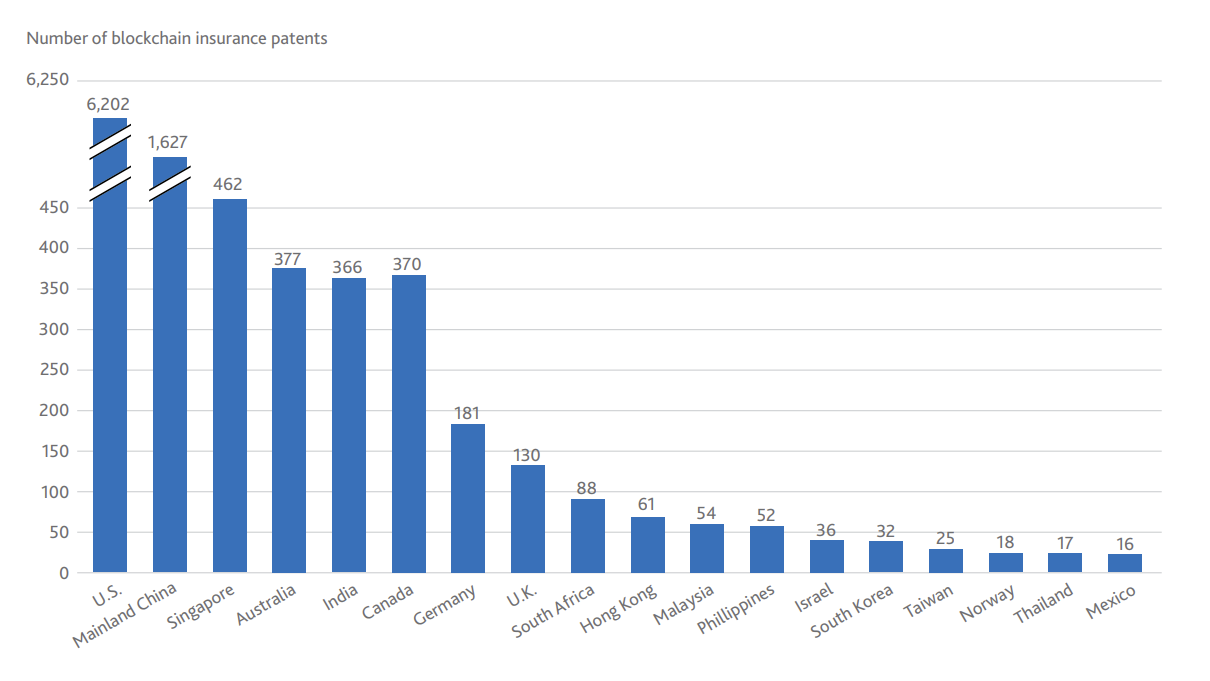
Source: Patsnap Analytics56
Given the mixed results from the case studies and empirical evidence, the fundamental question is whether DeFi/ blockchain insurance will disrupt the existing insurance market, or result in the creation of a new market. In the short term, as the crypto market grows and given its volatile nature, demand for insurance covering risks arising from cryptos is expected to persist. DeFi/blockchain technology is not yet powerful enough to become a game changer in more important segments of insurance, which would require re/insurers to shift their existing business practices to DeFi/blockchain insurance. In the medium term, DeFi/blockchain insurance is likely to remain focused on events where specialist claims assessment and/or privacy considerations are less of an issue, e.g. parametric cover, natural catastrophes and cryptospecific risks.
This section examines various DeFi/blockchain-based inclusive insurance solutions as well as the opportunities and challenges associated with improving the accessibility, affordability and attractiveness of insurance coverage. It illuminates the potential contributions of DeFi/blockchain to addressing protection gaps via revolutionary approaches to payments, distribution and trust. It remains to be seen, however, when the socio-economic conditions will be ready to deliver this promise in underdeveloped or developing regions.
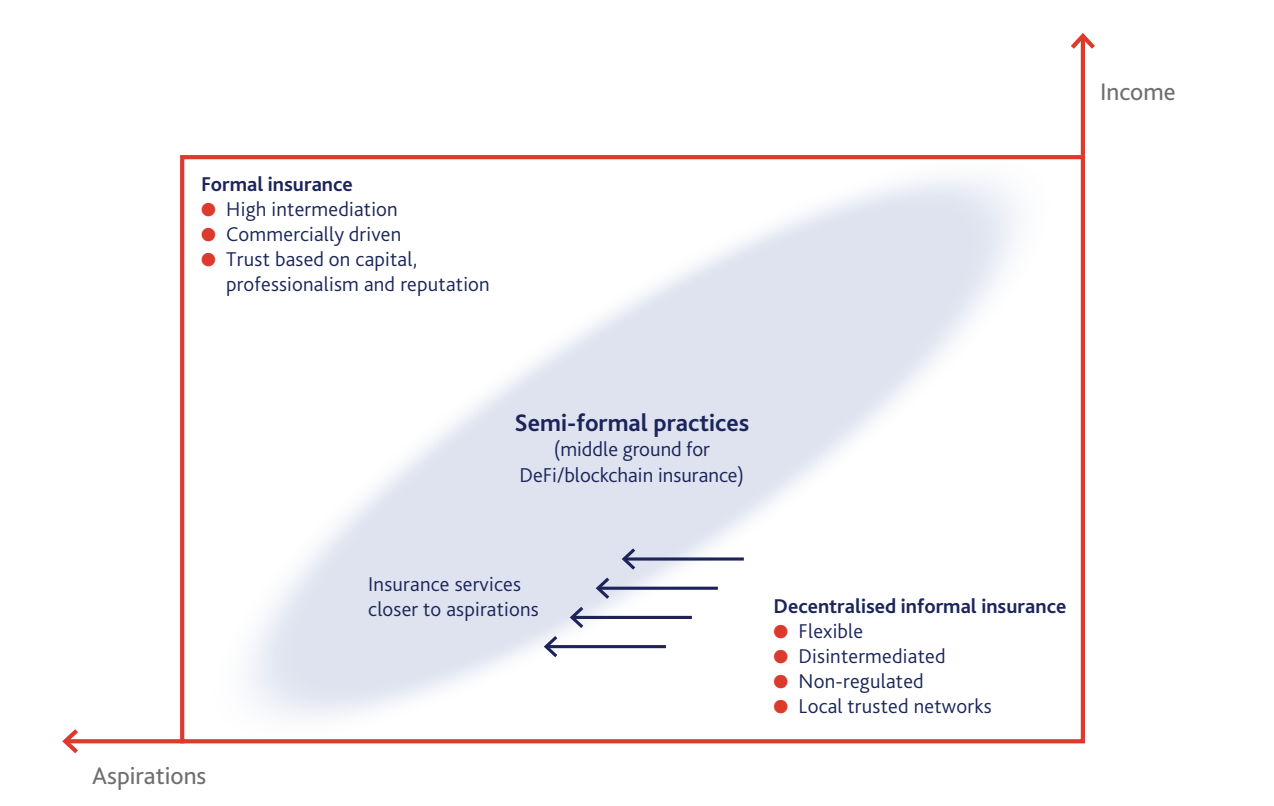
FIGURE 8: HOW DEFI/BLOCKCHAIN POTENTIALLY PROMOTES FINANCIAL INCLUSION IN INSURANCE
Source: Larios-Hernandez57
As Figure 8 illustrates, DeFi/blockchain insurance may potentially narrow the insurance protection gap for low-income populations through semi-formal microinsurance programmes.58 Conventional informal insurance used by un(der)insured people includes family protection and various community-based, mutual risksharing programmes. They are decentralised, flexible, disintermediated, non-regulated and rely on local, trusted networks. By contrast, the modern, centralised, formal insurance model is highly intermediated, commercially driven and establishes trust based on capital, professionalism and reputation. The lower people’s income, the more they tend to choose informal insurance for risk management. The arrows in Figure 8 show that the DeFi/ blockchain-based, semi-formal insurance model matches well with the existing habits and practices of un(der)insured individuals. It is governed by participating peers or socially oriented organisations.59 Therefore, DeFi/blockchain technology would increase the sophistication of informal insurance and therefore contribute to financial inclusion.
DeFi/blockchain enables peer-to-peer insurance solutions that meet the demands of un(der)served socio-economic groups. Such groups in the context of insurance usually include those that are geographically remote, or have low incomes or poor financial literacy. Their protection gaps include agricultural risk, health/maternal risk and longevity risk. DeFi insurance enables such individuals to form a risk pool without the approval or interference of insurance intermediaries. Insurance services can be provided completely online, from underwriting to claims, greatly improving the accessibility of insurance to individuals living in remote areas. A DeFi/blockchain system may also reduce the operational costs associated with insurance, thus improving the affordability of inclusive insurance for low-income populations. Finally, purchasing a DeFi/ blockchain insurance product via smartphone applications or mobile phone networks can be as simple as buying other goods online, which improves the customer experience and attractiveness of insurance coverage for individuals with poor financial literacy. Figure 9 illustrates the ‘Triple-A Impact’ of DeFi/blockchain insurance on financial inclusion.
FIGURE 9: THE ‘TRIPLE-A IMPACT’: HOW DEFI/BLOCKCHAIN IMPROVES FINANCIAL INCLUSION IN INSURANCE
Source: The Geneva Association
Taking rural India as an example, it is believed that blockchain technology has the potential to connect people to local and global supply chains by: 1) delivering financial products and services digitally to their doorsteps, 2) cutting down the costs of engaging in financial transactions and 3) providing more suitable products.60 Therefore, it could solve the problems of geographical access, high costs and inappropriate or inadequate financial services.
Cryptos are particularly useful for inclusive insurance targeted at the unbanked population (i.e. individuals without a bank account). Business practice in Africa and Latin America shows that insurance products with premiums paid via prepaid cell phones are growing quickly.61 In 2017, two thirds of unbanked adults globally owned a mobile phone.62 It is thus reasonable to expect that insurance services can be expanded to cover the unbanked population with digital wallets accessible via their mobile phone networks. Premium and claims payments can be made in any digital currency that the insurer and policyholder are willing to accept, including different types of cryptos and central-bank-issued digital currency. The digital wallet or prepaid cell phone account play the role of a bank account, which circumvents the barrier of bank access and improves the accessibility of risk transfer and insurance coverage for the unbanked population. Cryptos therefore enable insurers’ direct contribution to financial inclusion, independent of the availability of a banking system.
The features of smart contracts are expected to improve the trust between un(der)served individuals and DeFi/ blockchain operators/developers. One important application of smart contracts is parametric insurance, which mitigates moral hazard and improves the availability of insurance in rural areas. Besides, smart contracts are believed to have a major positive impact on fraud detection and process automation, which will reduce insurers’ operational costs and thus improve the affordability of insurance products.63 Last but not least, smart contracts enable instantaneous and automatic execution of claims payments (possibly using cryptos on a DeFi/blockchain network), which improves the customer experience.64
The consensus among regulators and re/insurers is that digital technology/insurtech should play a critical role in improving the inclusivity of insurance.65 The International Association of Insurance Supervisors (IAIS) defines the term ‘digital inclusive insurance’ as insurance that utilises digital mechanisms to improve outreach and delivery,66 the core elements for increasing accessibility of insurance services to un(der)served populations. However, in practice, it remains unclear whether DeFi/blockchain will facilitate inclusive insurance – and if yes, how and to what extent. This is partly because DeFi/blockchain insurance is still at a very early stage of development compared to other insurtech applications such as big data, artificial intelligence and the Internet of Things, and partly because blockchain technology remains immature, making its development hard to predict.
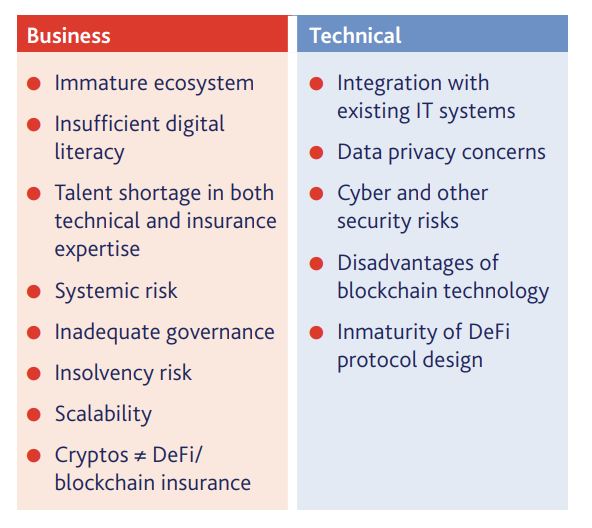
Realising the potential benefits of DeFi/blockchain insurance comes with regulatory, business and technical hurdles and risks (see Box 3 and Figure 10).67 This section summarises these challenges.
Legal and regulatory uncertainties
The varying treatment of smart contracts and lack of consensus on their equivalence to traditional insurance contracts create legal uncertainties and hinder the widespread adoption of smart-contract-based insurance. There is also uncertainty around which jurisdiction’s laws would apply in the context of global blockchain-enabled DeFi insurance solutions, specifically when disputes arise regarding smart contract fulfilment. Consensus is even lacking between insurance practitioners, technicians and legal experts on these issues.
“DeFi/blockchain insurance differs significantly from traditional forms of insurance. The regulatory challenge in this space is huge and, to a large extent, still unexplored.”
Expert involved in the B3i initiative
The regulatory dimension includes crypto regulation, data-privacy risk, tax compliance and money laundering risk. Some expert interviewees consulted for this research consider regulation as the most important hurdle and risk for DeFi/blockchain insurance.
Given its experimental nature, detailed and specific regulation on technology use can be a double-edged sword: on the one hand, it may help prevent events like the demise of TerraUSD or FTX; on the other hand, it may discourage the development of DeFi/blockchain insurance. Fundamentally, regulators should carefully balance the regulation and promotion of DeFi/blockchain insurance. It will be necessary for regulators to conceptually accept and practically engage in this.68
DeFi/blockchain inclusive insurance should also be regulated to address some of the concerns around decentralised informal insurance. DeFi/blockchain insurance is expected to perform better than the decentralised informal insurance network by charging fair rates, improving trust and avoiding nefarious acts.
FIGURE 10: BUSINESS AND TECHNICAL HURDLES AND RISKS IN DEFI/BLOCKCHAIN INSURANCE
Source: Schuetz and Venkatesh, IIS, and Saeed and Arshed69
Box 3: Regulatory considerations for DeFi/blockchain insurance
The IAIS70 highlights the following concerns around specific dimensions of DeFi/blockchain risks.
a) Operational risk, including the immutability of blockchain, IT risk, governance challenges and concentration risk regarding dependencies on external application suppliers. b) Data privacy, data protection compliance risk and potential tension with the right to be forgotten and the immutability characteristic of blockchain technology. c) Cyber risk: the distributed nature of blockchain technology could provide additional points of entry for hackers, calling for strong cyber governance. d) Unclear regulatory approach: should protection covers on DeFi/blockchain space be considered ‘insurance’ and how should they be regulated?
The Financial Stability Board (FSB)71 also noted the systemic risk and governance risk of DeFi/blockchain applications. DeFi/blockchain could reach a point where such risks represent a threat to global financial stability due to its scale, structural vulnerabilities and increasing interconnectedness with the traditional financial system. The decentralised governance of DeFi makes it difficult to identify the individual or entities responsible for meeting regulatory obligations. In an extreme decentralised case, there may be no single person or entity that could be held responsible for the functioning of the protocol, although, as of today, DeFi/blockchain insurance has not yet reached that level.
What type of regulation should be in place? A technology-neutral approach would leverage existing regulatory frameworks that apply to the underlying core activities.72 In practice, this means that the same rules apply to the same types of activities or risks, regardless of the technology used. Switzerland’s FINMA, for example, applies the same rules to DeFi/blockchain applications as it does to traditional financial market intermediaries.73 Rather than developing DeFi/ blockchain-specific regulation, the issuance of guidance and regulatory bulletins would support supervisors on how to apply existing regulatory frameworks.
As DeFi/blockchain insurance may eliminate the need for an intermediary, it can be incompatible with some existing regulatory frameworks, particularly those designed for systems with financial intermediaries at their core. Regulators should pay special attention to aspects that are incompatible with existing laws and regulations. Regulatory sandboxes might be used to encourage DeFi/blockchain pilots and to assess potential risks in a safe, controlled environment.
Contributed by Dennis Noordhoek, Director Public Policy and Regulation, The Geneva Association
Business hurdles and risks
Technical hurdles and risks
Box 4 summarises some of the core considerations for the future of DeFi/Blockchain insurance.
Box 4: Core considerations for the future of DeFi/Blockchain insurance
Systemic risk and market volatility. DeFi insurance solutions are exposed to the volatility of cryptocurrencies, which can impact their stability and reliability. For example, claims payments in Ethereum tokens are not likely to be preferable to customers given the volatility of cryptocurrency markets. Stablecoins may hold promise, however, sentiment needs to improve following the crash of UST (Terra stablecoin). Institutional investor interest (Blackrock) may introduce much needed stability to markets. Some tokenised DeFi insurance solutions are exposed to the volatility of major crypto assets and their own created tokens. Major recent failures in crypto markets will likely slow down the development of DeFi/blockchain insurance due to reduced confidence in the overall crypto system.
Governance and accountability. Robust governance mechanisms are needed to ensure the transparency and accountability of and trust in DeFi insurance systems. Will a decentralised voting system always make good decisions? Major active players may collude with each other and dominate underwriting, claims and other business decisions in favour of themselves. A voting system may also result in nobody taking responsibility and longer response times. Blockchain is not a silver bullet for bad actors and governance mechanisms will need to be in place to ensure integrity and trust is upheld, at least until more automated ways to mitigate risks are developed.
Need for empirical evidence. Though this report has attempted to provide empirical evidence on the impact of DeFi/ blockchain technologies on the insurance market and financial inclusion, further empirical studies are required to assess the long-term impact and viability of DeFi/blockchain insurance given that existing studies are largely qualitative.
Source: The Geneva Association, with contribution from an anonymous expert
This report analyses the opportunities and challenges associated with DeFi/blockchain insurance and its potential to improve the efficiency of traditional insurance, enable new business models and make insurance more inclusive. DeFi and blockchain technology is mainly present in large, competitive markets and its applications in insurance remain limited and concentrated in niches of the non-life sector, such as crypto-related risks. The theoretical benefits of DeFi/blockchain insurance have not yet been realised or empirically observed. As shown by the case studies discussed, short-term challenges will remain significant and expectations for DeFi/blockchain insurance in the near future should be lowered. Confidence in investing in decentralised finance has also suffered from recent failures and scandals. Altogether, DeFi/blockchain insurance remains a niche that has so far neither driven major growth of the insurance market nor significantly improved financial inclusion in insurance.
The failure and struggles of DeFi/blockchain insurance initiatives offer the insurance industry and investors an important lesson: in order to realise the expected efficiency gains and business growth, all participating parties need to be in the DeFi/blockchain ecosystem, which may take much longer than anticipated.
What is the outlook for DeFi and blockchain in insurance? Addressing specific pain points of existing insurance practices should be the major focus in the short term. However, technically this will not be easy as blockchain is generally not a technology that can be easily explored to patch existing IT systems. In the longer term, insurers may recognise blockchain as a new ecosystem, i.e. for building and selling insurance products, which could insure both pure on-blockchain risks and off-chain conventional risks. DeFi and blockchain technology may also become a platform on which new business models can be built to formalise the informal risk-sharing system currently used by un(der)insured people (as shown in Figure 8), and therefore narrow the insurance protection gap. In tandem with developing ecosystems, we may see successful DeFi/ blockchain business models for inclusive insurance at scale in the coming decades.
To realise the long-term, potential benefits of DeFi/blockchain insurance, we offer the following recommendations for re/insurance incumbents, insurtech startups, and regulators and supervisors.
Re/insurance incumbents
The rationale for conventional insurers to invest in DeFi/blockchain insurance in the long term is at least two-pronged:
1) The development of DeFi/blockchain insurance is hard to predict and the current players are mostly technology companies operating in insurance. A no-regret strategy for incumbent insurance companies would be to keep cautiously investing in the DeFi/ blockchain insurance ecosystem as DeFi insurance has the potential, in the long run, to disintermediate the insurance industry and transform the traditional insurance business model. The first move might be to identify a specific pain point in existing business practice that DeFi/blockchain technology has the potential to address. Coordinating regulatory, business and technological considerations will be a fundamental successful factor for DeFi/blockchain insurance.
2) The banking system has experienced a wave of capital-market-driven disintermediation in recent decades. However, loans continue to be originated. In response to disintermediation, banks have shifted from commercial banking to investment banking services. In a potential future dominated by DeFi/blockchain insurance, risks will still be shared among participants and transferred to third parties. Insurance services will remain in high demand for risk assessment, pricing and claims management. Thus, a new services-based revenue source is likely to emerge for incumbent insurers actively investing in the DeFi/blockchain transformation.
For incumbent, international re/insurance players, starting with a pilot in a new line of business or a new market would be an appropriate strategy. Partnerships between re/insurance incumbents and blockchain technology firms can mitigate the issue of insufficient digital literacy. Talent who understand both the insurance business and blockchain technology will be critical. An innovative technical and business model will also be needed to overcome the challenge of integrating legacy IT systems.
DeFi/blockchain insurance startups
It is important for startups to identify business opportunities where DeFi/blockchain technology has a competitive advantage. Crypto-related covers and e-credit insurance in supply chain finance are proven examples. Meeting customer demand for simplicity and transparency by reducing the complexity of existing DeFi/blockchain insurance products will be crticial – continuously refining the product to improve user friendliness is likely to be the best way forward, which might be a gradual and long process. Refining the technology and developing sustainable DeFi/blockchain insurance programmes with proper incentives for policyholders and investors will be critical.
Regulators and supervisors
Enhanced data privacy, cybersecurity laws and regulations, and technical advancements are crucial to the success of DeFi/blockchain insurance based on public and consortium blockchains. The legal recognition of smart contracts in general as equivalent to conventional contracts could drive massive growth of blockchain applications, including DeFi/ blockchain insurance.
As DeFi/blockchain technologies are at an early stage of adoption in the insurance industry, most jurisdictions are still exploring policy and supervisory responses and have thus not yet developed targeted regulatory frameworks. A technology-neutral approach, with special attention given to aspects that are incompatible with existing laws and regulations, would provide the best balance between innovation, consumer protection and financial stability.
These recommendations underscore the unpredictability of DeFi/blockchain developments. A no-regret strategy for insurance companies would be to continuously evaluate the readiness of the ecosystem and cautiously invest in transforming traditional business models, while keeping propositions and engagement easy for customers. There is also a clear need for regulators to create a legal/regulatory ecosystem for the recognition of smart contracts, ensuring data privacy and cybersecurity protections are made available to insurance contracts.
IMPACT OF BLOCKCHAIN INSURANCE PATENTS ON THE INSURANCE MARKET AND ON FINANCIAL INCLUSION IN INSURANCE
| (1) | (2) | (3) | (4) | (5) | (6) | (7) | (8) | |
| Variables | Ln (Total premiums) | Ln (No. of insurers per 100K people) | Penetration non-life | Density life | Premium growth | Ln (Policies per capita) | Ln (Life policies per 1,000 people) | Ln (Non-life policies per 1,000 people) |
| Ln (Patent) | 0.022 * | 0.020 ** | 0.161 ** | -0.003 | -0.092 | 0.004 | 0.014 | 0.044 |
| Population growth | -0.005 | -0.009 | -0.066 | 0.031 | -5.17 * | -0.274 | -0.015 | -0.796 |
| Unemployment rate | 0.037 ** | -0.009 | 0.002 | 0.077 *** | -1.782 | -0.005 | -0.009 | -0.010 |
| Inflation | -0.020 | -0.022 ** | 0.036 | -0.032 | -1.143 | 0.004 | -0.004 | 0.002 |
| Interest rate | 0.038 | 0.032 * | 0.033 | 0.061 * | -0.393 | 0.010 | 0.000 | -0.031 |
| GDP growth | -0.002 | -0.004 | -0.001 | 0.004 | 0.143 | -0.012 | -0.003 | -0.028 |
| Market fixed effects | Yes | Yes | Yes | Yes | Yes | Yes | Yes | Yes |
| Year fixed effects | Yes | Yes | Yes | Yes | Yes | Yes | Yes | Yes |
| R2 | 0.99 | 1.00 | 0.87 | 0.99 | 0.30 | 0.99 | 0.99 | 0.98 |
| Observations | 180 | 130 | 180 | 180 | 180 | 54 | 73 | 54 |
| No. of markets | 18 | 12 | 18 | 18 | 18 | 5 | 7 | 5 |
Notes: The table reports the impact of blockchain-insurance-related patents on indicators of insurance market development and financial inclusion in insurance. Linear market-year panel fixed effects models are estimated. *, ** and *** represent statistical difference from 0 at 90%, 95% and 99% confidence levels, respectively.
Source: The Geneva Association
Deloitte 2022.
Fang et al. 2023.
Feng 2023.
FINMA 2021.
Harvey et al. 2021.
IAIS 2018.
Jia et al. 2023.
PANews 2020.
Schmit 2022.
Skogh 1989.
Swiss Re 2017.
Swiss Re 2020.