

Financial Inclusion

The Geneva Association. 2023.
The Value of Insurance in a Changing Risk Landscape.
Author: Kai-Uwe Schanz. November.
Kai-Uwe Schanz, Head of Research & Foresight and Director Socio-economic Resilience, The Geneva Association
Contributing authors:
Alex Braun, Professor, Institute of Insurance Economics, University of St. Gallen
Martin Eling, Professor, Institute of Insurance Economics, University of St. Gallen
Christoph Jaenicke, Research Associate, Institute of Insurance Economics, University of St. Gallen
Aleksandar Jovanović, Visiting professor, ETH Risk Center, Swiss Federal Institute of Technology Zurich
Hélène Schernberg, Executive Director, ETH Risk Center, Swiss Federal Institute of Technology Zurich
Pieralberto Treccani, Research Support Manager, The Geneva Association
Today’s economies and societies are facing a transformation of risk, which is reflected in many of the major events of the past few years. The COVID-19 pandemic was a major systemic shock, affecting most of humanity at the same time, and with long-term implications for risk perception and management. A similarly unimaginable geopolitical shift was the return of war and its long-term effects in Europe. Climate risks are also seemingly spiralling out of control while public and private intangible assets and data are under increasing threat from cyberattacks.
This new global risk landscape is a significant test of insurers’ capacity for financial loss absorption, and insurance companies have to be mindful of potential challenges to their traditional value proposition of risk transfer. This discussion has gained momentum in the context of an increasing gap between what stakeholders expect the industry to do and what it is (technically) able to do.
This emerging gap can be explored through a novel approach to representing and understanding risks. This approach adds a dynamic perspective to the established conception of risk as a function of hazard, exposure and vulnerability. Based on these dynamic risk components, we provide a framework for representing risk as a set of shared features, based on novelty (new risk sources and consequences), the changing nature of existing risks (in terms of frequency and severity), knowledge gaps (involving aspects like complexity, uncertainty or communication) and risk governance (management complexity, uncertainty and pace of change).
We put the spotlight on a number of (emerging) risks which present challenges to insurability and traditional risk transfer, namely intangible and systemic risks. Examples of intangible risks include loss of reputation and general cyber risks such as data breaches. Systemic risks, defined as risks that have the potential to cause economic and societal losses that are sufficiently significant to result in the breakdown of an entire (economic) system, can arise both with tangible (e.g. climate change and cyberattacks on physical assets) and intangible characteristics (e.g. large-scale business interruption as a result of a pandemic). In the presence of systemicity, the fundamental mechanism of risk pooling and redistribution – spreading the losses of the few among the many unaffected by disaster – no longer works.
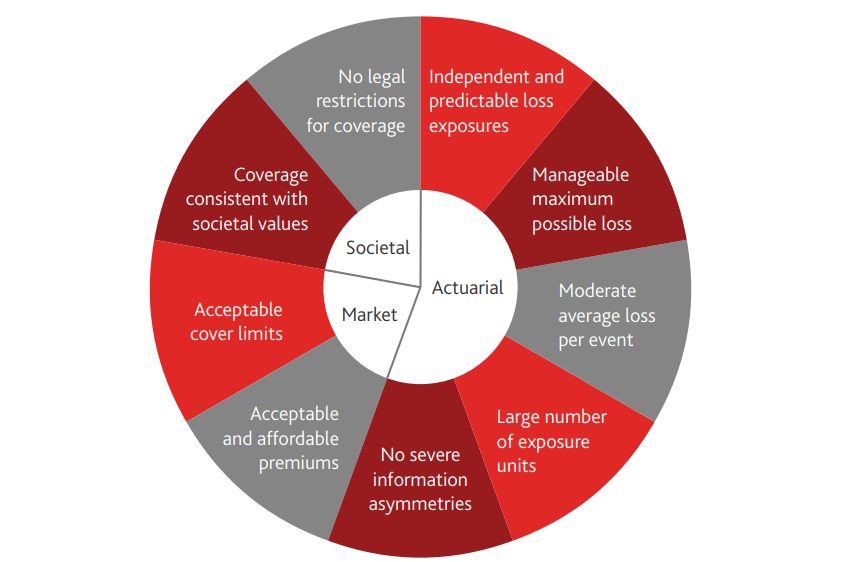
FIGURE 1: THE FUNDAMENTAL CRITERIA OF INSURABILITY
Source: The Geneva Association, based on Berliner1
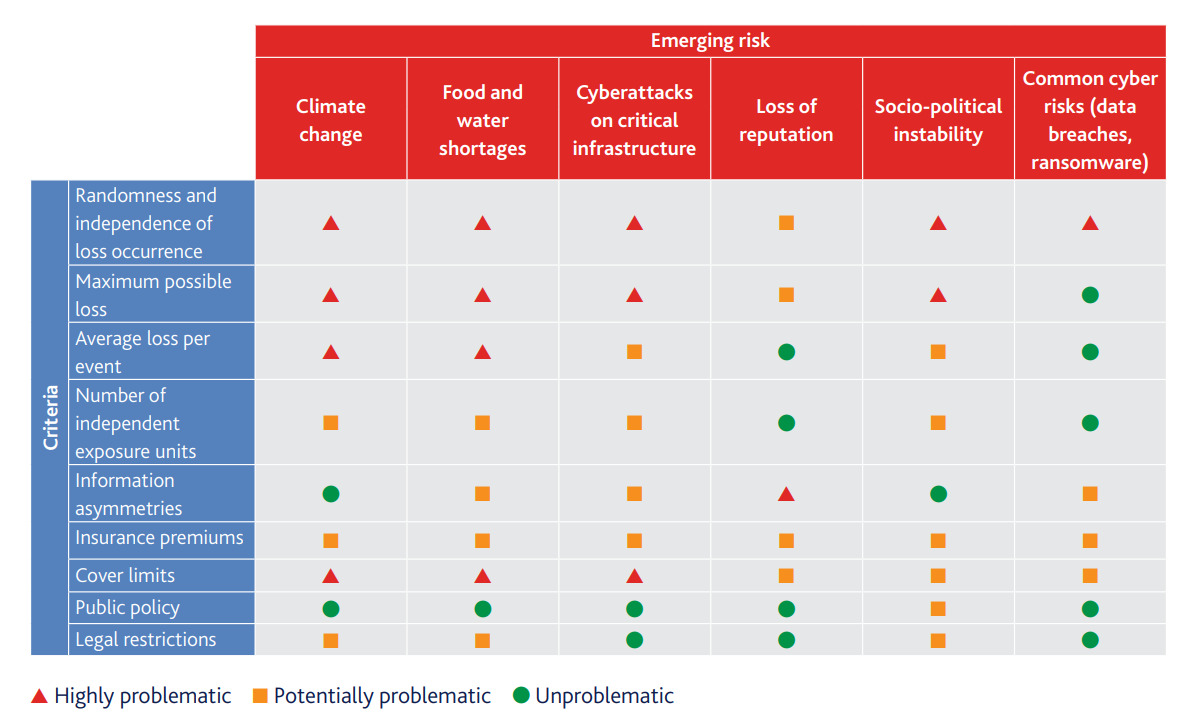
Against this backdrop, the traditional core of the insurance industry’s customer and societal value – the absorption of financial risks – as well as its prerequisites are under the spotlight (Figure 1). For climate and cyber risks, for example, we identify major obstacles to insurability such as a lack of randomness and independence as well as highly problematic loss potentials (Table 1). For intangible risks such as loss of reputation, key insurability challenges include information asymmetries and loss measurement.
TABLE 1: INSURABILITY OF EMERGING RISKS
Source: Institute of Insurance Economics (University of St. Gallen) and The Geneva Association
In response to the changing risk landscape and mounting challenges to insurability, an increasing number of insurers are launching customer propositions that go beyond their traditional role of absorbing financial risk. We propose three specific avenues for insurers to maintain or even expand their relevance:
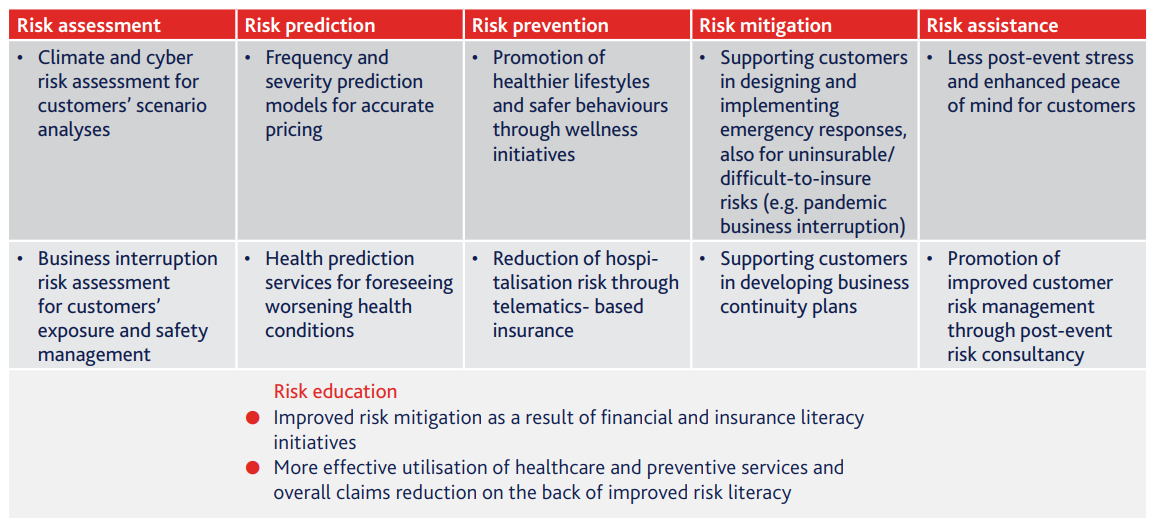
1) Provision of additional risk services, namely risk assessment, prediction, prevention, mitigation, assistance and education (Figure 2).
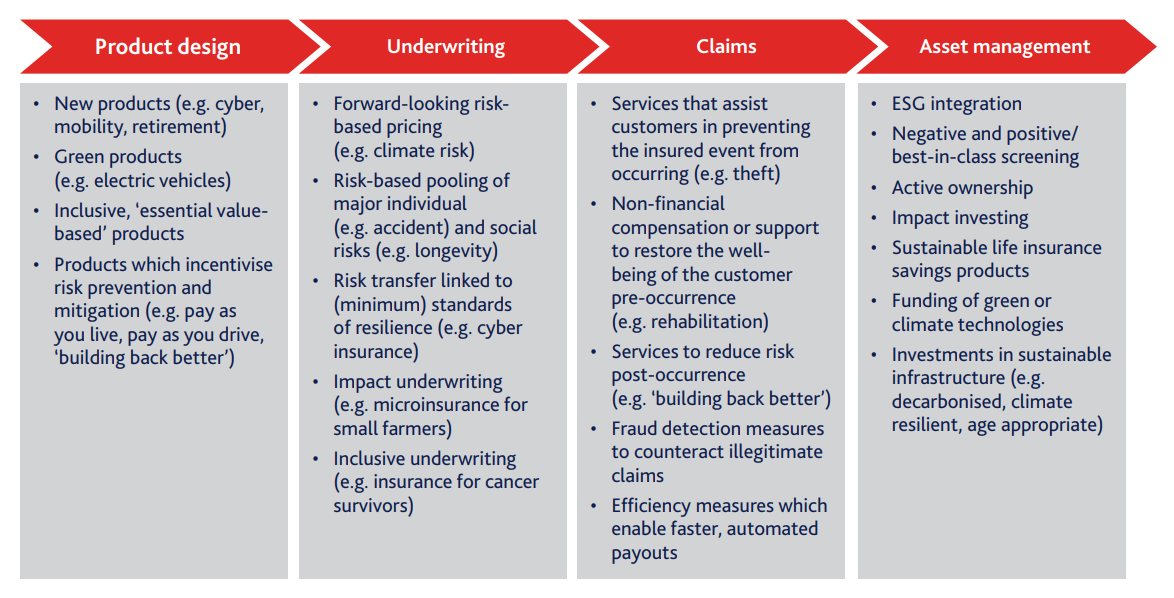
2) Provision of dedicated risk and investment products which promote sustainable development, especially related to product design, underwriting, claims and asset management (Figure 3).
3) Engagement in public-private partnerships (PPPs) which address the largest and most complex risks modern societies are facing. This can range from enabling commercial risk transfer to replacing it by removing extreme and volatile risk from the insurance market.
FIGURE 2: RISK SERVICES BEYOND RISK TRANSFER
Source: The Geneva Association
FIGURE 3: SUSTAINABILITY-DRIVEN PROPOSITIONS ALONG THE INSURANCE VALUE CHAIN
Source: The Geneva Association
Through these propositions, insurers can effectively leverage their unique capabilities such as risk expertise, strong relationships with insureds and investees as well as their long-term risk and investment perspective. This strategic shift beyond traditional risk transfer allows insurers to contain the cost of risk and, as such, preserve insurability. It also responds to evolving customer expectations, enhances the overall customer experience and increases engagement.
To empirically substantiate these findings, The Geneva Association commissioned an online customer survey, capturing perspectives from customers in the world’s six largest insurance markets: the U.S., China, the U.K., Japan, France and Germany. In each market, a sample of about 1,000 economically, regionally and demographically representative insurance policyholders were polled – approximately 900 retail customers and 100 commercial customers in total, representing companies with up to 250 employees. The survey was conducted in the second quarter of 2023 and yielded the following key findings:
In conclusion, the voice of the customer seems to corroborate the main conclusions of the research: people and businesses are concerned about the future availability and affordability of certain types of insurance. They also want their insurers to collaborate more with governments to mitigate emerging insurability issues.
However, the survey results also suggest a sober and realistic perspective on additional risk services offered by insurers. On the one hand, levels of customer interest are significantly higher than levels of actual usage, indicating a certain potential for such services. On the other hand, the results suggest that that the current and future role of additional risk services as a determinant of insurance purchasing decisions should not be overestimated.
Risk transfer is expected to remain at the core of insurers’ customer and societal value. Having said this, insurers should respond to the increasing challenges to insurability by providing a broader spectrum of risk services in order to contain the cost of risk and respond to evolving customer needs. The determination and creativity with which they do so will allow them to convince customers of the value of these propositions and to monetise them.
Berliner 1982.
‘Risk’ is more than an ubiquitous term in insurance parlance. From car accidents to sickness, we all encounter – if not experience – the embodiment of risk every day. But risk is changing.
With the COVID-19 pandemic, we saw the manifestation of a global, systemic risk, affecting many people and businesses around the world at the same time. This brought to light a hard-but-important truth for the insurance industry and society: while insurance remains relevant for a broad range of risks, there are risks today which are too big – which cause financial losses too great – for insurers to bear alone. Unfortunately, the list of these types of risks is growing.
What does the future of insurance look like in a world with more widespread, interconnected and hard-to-predict risks? How should insurers respond to the growing prevalence of intangible risks, such as those linked to the rise of the digital economy? This year, as The Geneva Association marks its 50th anniversary, we set out to answer these questions through our research and an insurance customer survey.
This report explores specific risks that are already – or may prove – challenging to insure given their damage and loss potential and their unpredictability. Climate and cyber risks stand out. According to our survey, insurance customers do not take insurance in these areas for granted. They see an important role for governments in keeping insurance available and affordable.
More than 80% of respondents to our survey are interested in insurance offerings which go beyond traditional risk transfer, such as risk prevention services. However, only 30 – 50% of them take advantage of such services already. Insurers should proactively work to close this gap.
We also see significant opportunities for insurers to strengthen their profiles as promoters of sustainability: on the insurance side, by offering ‘green products’, such as coverage for electric or hydrogen vehicles, for example; on the investment side, with impact investing and by funding new climate technologies.
The takeaway for insurers is clear: their value proposition is changing because risk is changing. Insurance customers and society welcome a greater role for insurers than just paying claims, and there is promising evidence that insurers will fulfil those expectations.
Jad Ariss
Managing Director
Geneva Association
Today’s economies and societies are facing a transformation of risk, which is reflected in many of the major events of the past few years. The COVID-19 pandemic was a major systemic shock, affecting most of humanity at the same time, with long-term implications for risk perception and management. A similarly unimaginable geopolitical shift was the return and long-term effects of war in Europe. Climate risks are also seemingly spiraling out of control, while public and private intangible assets and data are under increasing threat from cyberattacks.
This new global risk landscape is a significant test of insurers’ capacity for financial loss absorption. Insurance companies are increasingly mindful of potential challenges to their traditional value proposition of risk transfer. This discussion has gained momentum in the context of an increasing gap between what stakeholders expect the industry to do and what it is technically able to do.
In order to explore this emerging gap, this report introduces a novel approach to representing and understanding risks that adds a dynamic perspective to the established conception of risk as a function of hazard, exposure and vulnerability. It views the risk landscape as a collection of all visible features of modern risks, such as sources, drivers, events and consequences. On that basis, we put the spotlight on a number of emerging risks which present challenges to insurability and traditional risk transfer, namely intangible and systemic risks. Examples of intangible risks include loss of reputation and general cyber risks such as data breaches. Systemic risks can arise with both tangible (e.g. climate change and cyberattacks on physical assets) and intangible characteristics (e.g. large-scale business interruption as a result of a pandemic). In the presence of systemicity, the fundamental mechanism of risk pooling and redistribution – spreading the losses of the few among the many unaffected by disaster – no longer works.
Against this backdrop, we investigate the traditional core of the insurance industry’s customer and societal value – the absorption of financial risks – using a set of nine criteria of insurability, with actuarial, market and societal dimensions. For climate and cyber risks, for example, we identify major obstacles to insurability such as a lack of randomness and independence as well as highly problematic loss potentials. For intangible risks such as loss of reputation, key insurability challenges include information asymmetries and loss measurement.
In response to a changing risk landscape and mounting challenges to insurability, an increasing number of insurers are launching customer propositions that go beyond their traditional role of absorbing financial risk. Our report introduces three specific avenues for insurers to maintain or even expand their customer and societal relevance, in addition to their existing core role of absorbing financial risk:
Through these propositions, insurers can effectively leverage their unique capabilities such as risk expertise, strong relationships with insureds and investees as well as their long-term risk and Investment perspective. This strategic shift beyond traditional risk transfer allows insurers to contain the cost of risk and, as such, preserve insurability. It also responds to evolving customer expectations, enhances the overall customer experience and increases engagement.
To empirically substantiate the findings of this report, The Geneva Association commissioned a global customer survey, capturing the perspectives of both retail and commercial insurance buyers from the world’s six largest insurance markets (the U.S., China, Japan, U.K., France and Germany).
The results confirm the relevance of the insurability debate. Both retail and commercial buyers express concerns about the future availability and affordability of certain types of cover, especially in areas such as longevity, natural catastrophe and commercial cyber and business liability risk. Most customers are in favour of PPPs aimed at promoting the availability and affordability of insurance. Regarding additional risk services, encouragingly, the difference between levels of actual usage (about 30–50%) and interest (more than 80%) suggests a certain potential for such services offered by insurers, especially in prevention and assistance.
While the second half of the 20th century was a period of relatively stable socio-economic development, the 21st century has so far involved elevated complexity, uncertainty and vulnerability due to geopolitical power shifts, rapid technological transformation, increasing interconnectivity and consequential dissemination of risk.1 As early as 2003, the Organisation for Economic Co-operation and Development (OECD) highlighted the future importance of systemic risks2 in the shape of interconnected global supply chains and climate change, for example.3 Other, more recent examples include irreversible loss of biodiversity and essential ecosystem services as well as pandemics and antimicrobial resistance.4 The expansion of intangible assets and their prevalence in today’s digitalised societies is also driving up risk and uncertainty. While climate change exacerbates physical damage, the rise of intangible assets throws up new challenges and risks, such as the loss or destruction of data and reputational damage.5
Against this backdrop, societies are facing a transformation of risk which is reflected in many of the major events of the past few years and the overall risk sentiment emerging from recent surveys: a global pandemic that took more than two years to bring under control, an unimaginable geopolitical shock with the return of war in Europe, new macroeconomic realities (i.e. the return of inflation and the end of ‘easy money’) and a looming environmental crisis. In fact, climate action failure, cost-of-living crises, the erosion of social cohesion and the rapid ageing of populations have all been identified as the most relevant long-term risks with potentially systemic characteristics.6 At the same time, public and private intangible assets and data are under increasing threat from cyberattacks.7
Protecting against large and global-scale tail risks is particularly challenging. It puts to the test both insurers’ capacity for financial loss absorption and their risk assessment and quantification ability. Therefore, insurers have to be mindful of potential challenges to their traditional value proposition (i.e. financial risk absorption) for customers and society at large, a discussion that gained momentum in the context of pandemic risk and the increasing gap between what stakeholders expect the industry to do and what it is technically able to do.8
While the traditional risk transfer function will remain crucial, not least with necessary product innovation and continued growth of insurable physical risks, 9, 10 other areas such as risk assessment, risk prevention, risk education and risk sharing with the public sector will gain in prominence.
Against that backdrop, this report explores and classifies the key sources, drivers and consequences of the changing physical and non-physical risk landscape, investigates the implications for insurability and illuminates the evolving nature of the insurance industry’s economic and societal value in the face of larger and different risks that increasingly defy the criteria of traditional risk transfer. Finally, we present the results of a global survey on customers’ risk perceptions and their appetite for insurance services beyond claims payments.
The economic and societal value of insurance is a function of the relevance of insurers’ business models to the main risks that individuals, households and businesses are facing. Starting from this premise, this section examines the major changes to the risk landscape that have occurred since the beginning of the 21st century. As a first step, we introduce a novel approach to representing and understanding (emerging) risks and their dynamics. On that basis, we will zoom in on two risk shifts – and some of their concrete manifestations – which we consider particularly important for the future value of insurance, namely the growing prevalence of intangible and systemic risks.
Several organisations develop lists of emerging risks,12 analyse their possible causes, adverse consequences and contexts, and publish those analyses in widely read reports.13 Lists, however, typically do not provide a structured, let alone dynamic, understanding of the distinct characteristics of emerging risks and their relationships. Therefore, we propose a different concept, which views the risk landscape as the dynamic collection of all visible features of modern risks. It is based on the established conception of risk as a combination of hazard, exposure and vulnerability14 but offers an original dynamic perspective on risk by introducing the terminology of the International Organization for Standardization,15 with ‘hazard’ being equivalent to ‘risk source’ and ‘consequences’ of a risk event being the result of exposure and vulnerability.
2.1.1 The dynamic components of risk
A risk exists in relation to something humans value. It affects human objectives that are either tangible (e.g. human lives, livelihoods, assets, supply chains) or intangible (e.g. reputation). In this spirit, the ISO defines risk as the effect of uncertainty on human objectives or a situation where objectives are threatened and where the outcome is uncertain. More specifically, risk has three components:16
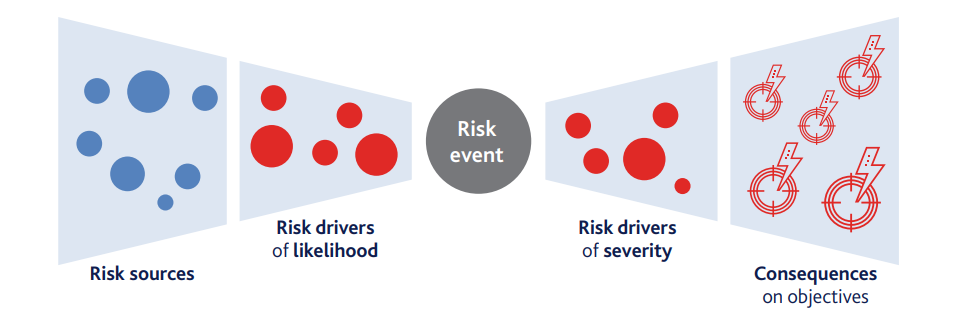
Risk is typically measured by the likelihood, i.e. the frequency of risk events, and the severity of the consequences. Both can change over time, which is why we also consider risk drivers, defined as contextual elements that, without causing risks, affect their likelihood and/or severity. Risk drivers can include knowledge, complexity, social dynamics (e.g. technological innovation and diffusion, population dynamics or globalisation), environmental change, competing interests, values and religions, or inadequate risk governance and management.17
Figure 1 depicts the relationship between risk sources, events and consequences, and the influence of risk drivers relating to likelihood and severity.
FIGURE 1: THE DYNAMIC COMPONENTS OF EMERGING RISK
Source: ETH Risk Center
2.1.2 Representing the risk landscape
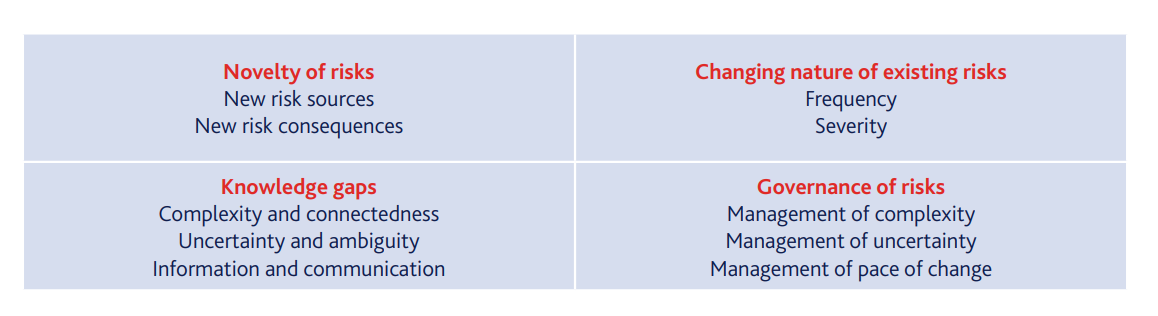
Based on these dynamic risk components, we provide a framework for representing risk as a set of shared features, based on four categories:
These four categories are divided into 10 subcategories. Each corresponds to a set of issues common to emerging risks, both in terms of their nature and context. These issues encompass risk sources, events, consequences and related risk drivers.
The subcategories were selected based on their potential for explaining the risk landscape in finer detail and, possibly, for predicting its evolution. While the resultant framework may contain overlaps and blurred boundaries, it offers the potential to improve existing taxonomies of emerging risks, the lack of which hinders risk communication (see Figure 2).
FIGURE 2: A NOVEL REPRESENTATION OF EMERGING RISK
Source: ETH Risk Center and The Geneva Association
Category 1: Novelty of risks
The first aspect in this category is the novelty of risk sources. Most new sources of risk are man-made.18 They often arise from innovation and progress (e.g. disruptive technologies), social and cultural dynamics (e.g. new lifestyle habits) or human impacts on the environment (e.g. the use of natural resources). For example, autonomous vehicles can trigger new liability risks.19 In this context, the rate of emergence of new risk sources is an important consideration.
The second aspect captures new risk consequences. As society evolves, so does the range of assets it values. In an increasingly virtual world, non-tangible assets such as digital data, intellectual property and online reputation have become increasingly significant – and vulnerable. An example of new risk consequences are natural disasters that can damage servers, data centres and communication networks, which can lead to loss of digital assets, data or communication services.
Category 2: Changing nature of existing risks
Existing risks can increase in frequency. For example, the number of data breaches in the U.S. reached an all-time high in 2021.20 They can also increase in severity. This is especially true as humans transform the natural and man-made environment – including society itself, at an unprecedented scale – leading to growing exposures and vulnerabilities. For instance, urban areas are more vulnerable to heatwaves than other landscapes due to the urban heat island effect, which traps heat and exacerbates the effects of high temperatures. Even though air conditioning mitigates these risks, the consequences of heatwaves are becoming more severe due to increased urbanisation.21
Major drivers for such amplification include:
A powerful illustration of the effect of these risk drivers is the frequency of weather and climate-related disasters, which has multiplied by a factor of five in the past four decades.23
Category 3: Knowledge gaps
Knowledge-related risk drivers can also amplify emerging risks.24 One example is complexity, which we define as the difficulty of establishing causal relationships among sources of risk, risk events and their consequences. For example, the emergence of a new disease can trigger risks such as the spread of misinformation, panic and hoarding behaviour, and the global-level breakdown of supply chains for essential goods and services. Based on current risk knowledge, these cascading effects are hard to measure and predict.
Another knowledge-related risk driver is uncertainty and ambiguity. While the former arises from the unreliability of scientific assumptions regarding the relationship between risk sources, risk events and consequences,25 the latter is a reflection of social and political debates surrounding risks and their management. For example, there was significant uncertainty surrounding the COVID-19 virus at the onset of the pandemic, e.g. around its transmission mechanisms, fatality rate, economic losses (and their funding) and the effectiveness of different public health measures to control its spread. This uncertainty led to delays in implementing effective public health measures, such as social distancing and mask mandates, as policymakers and the public waited for more information to clarify the situation. Ambiguity is related to uncertainty and arises when stakeholders have divergent values, priorities, prior beliefs and assumptions. For instance, risks related to climate change have become a polarising issue, with some individuals prioritising immediate economic, social and political concerns over the long-term risks. Like uncertainty, ambiguity has the potential to delay risk management and precautionary measures.
The uneven distribution of information among stakeholders can also hinder risk assessment, management and policymaking,26 and poor communication can amplify the consequences of risks. This was demonstrated in the delayed response to Hurricane Katrina in 2005, when the lack of communication between responders contributed significantly to failures.27 Another increasingly relevant aspect of informationand communication-related issues is the phenomenon of ‘truth decay’, i.e. the diminishing role of facts and analysis in public life.28 This is a risk driver that can undermine public policy decisions and create cynicism and apathy on an unpredictable scale.
Category 4: Governance of risks
Governance is the process of dealing with emerging risks. As such, it is a major determinant of their consequences.
Many emerging risks are global, systemic and require the adoption of international approaches.29 Yet, it is unclear whether global entities such as the World Health Organization (WHO) or the International Monetary Fund (IMF) and World Bank can singlehandedly deliver effective governance and leadership during pandemics and financial crises, respectively.
A lack of governance for the management of risk complexity makes it difficult to coordinate the response, allocate resources and ensure efficient delivery, particularly at the international and cross-sectoral levels.
The insufficient management of uncertainty is another governance-related risk driver. Uncertainty is either reducible or irreducible. Reducible uncertainty, by definition, can be addressed through further research and data acquisition. Irreducible uncertainty, on the other hand, cannot be resolved, or not within a relevant time frame. It is sometimes synonymous with ‘deep uncertainty’.30
Any sound governance of uncertainty should promote the capture, dissemination and use of knowledge that serves to either reduce uncertainty or improve the management of deep uncertainty.31
A final governance-related risk driver is slow adaptation to change. Recent crises, during which some emerging risks materialised, show that many contemporary risks emerge at a higher, often unprecedented, speed than before. New regulation or international standards may take years to be agreed, published, implemented and enforced. Practically, this means that an emerging risk that materialises in a few weeks can remain without response for months or even years.
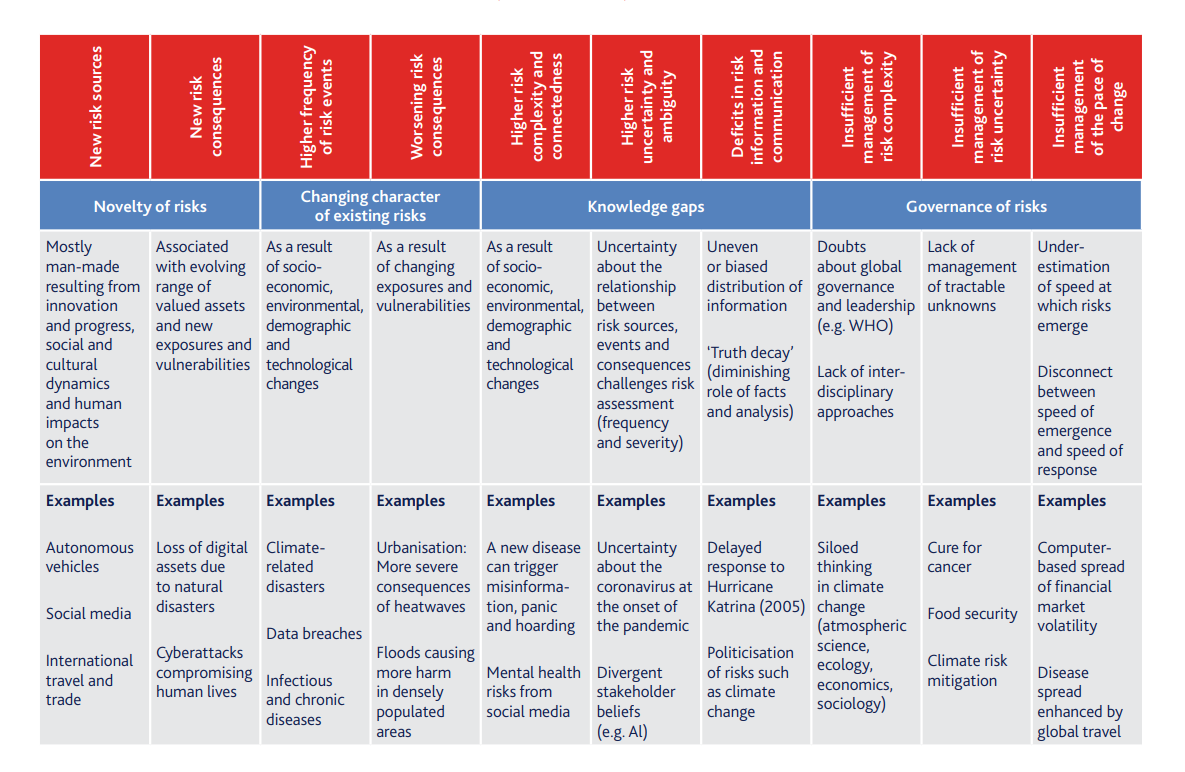
In conclusion, although it is impossible to predict the future, it is possible to monitor the factors that shape the current risk landscape and its insurable parts. For this purpose, we have introduced a novel framework for representing emerging risk as a dynamic, further development of the established view of risk as a combination of hazard, exposure and vulnerability. In this new framework, risk sources (hazards) trigger events which have consequences (as a result of both exposure and vulnerability). Another novel element is the consideration of dynamic risk drivers and their role in amplifying both risk sources and consequences. These risk drivers, therefore, can change hazards, exposures and vulnerabilities. Figure 3 summarises this novel representation of (emerging) risks.
FIGURE 3: A NOVEL REPRESENTATION OF (EMERGING) RISKS
Source: ETH Risk Center and The Geneva Association
Based on a connected and dynamic perspective on emerging risks, we can now explore specific tangible, intangible and systemic risks which have featured prominently in the academic, commercial and policy discourse on insurability over the past few years.33
For tangible risks, we chose, as examples, climate change, food and water shortages (existing risks with exacerbating features) and cyberattacks on physical assets such as infrastructure (a novel risk). For intangible risks, we consider wellknown risks such as loss of reputation, socio-political instability and common cyber risks such as data breaches. In Table 1, these risks are characterised not only by their sources, consequences, frequency and severity but also their systemic character and interconnectivity.34
TABLE 1: CHARACTERISTICS OF EMERGING RISKS35
| Tangible risks | Intangible risks | |||||
|---|---|---|---|---|---|---|
| Climate change | Food & water shortages | Cyberattacks on critical infrastructure | Loss of reputation | Socio-political instability | Common cyber risks | |
| Examples of consequences | Rising sea levels, extreme weather events, warming-induced loss of biodiversity | Economic volatility, socio-political instability | Attacks on energy grids, e.g. power plants | Reputational damage amplified by real-time digital news diffusion | Boycotts, sanctions | Data breaches, ransomware attacks, distributed denial of service attacks |
| Frequency | Low but increasing | Low but increasing | Rather low | Rather low | Low but increasing | High |
| Severity | Potentially extreme; economic losses estimated at up to 23% of worldwide GDP until the end of the century | Potentially high; funding gap estimated at around USD 265 billion per year to preserve food security | Potentially high; difficult to estimate, only scenario analyses exist; potentially in the billions | Potentially high; difficult to estimate; firm-level estimates range between a loss of 1-3% in firm value per incident | Potentially high; difficult to estimate as consequences are largely indirect | Low; average cost of a data beach and ransomware attack estimated at around USD 4.5 million |
| Systemic character | Yes. Implications on entire eco- and economic systems | Yes. Particularly for developing countries | Yes. Attack on critical infrastructure can have implications for society and economic systems | Rather not | At the national level, implications for economic systems | Generally not. Particular cases have systemic consequences, e.g. if widespread software solutions are targeted or national intelligence information is breached |
| Interconnectedness | Yes, e.g. extreme weather can result in damage to critical infrastructure and decreased economic competitiveness | Yes, e.g. crop failure can result in socio-political instability | Yes, e.g. power outages or cloud outages can result in loss of firm reputation and damage economic competitiveness | Rather not, but spillover effects to related firms are possible, e.g. in same industry | At the national level, e.g. reduced economic competitiveness and loss of reputation | Yes, e.g. loss of reputation and competitiveness at the firm level. For systemic events, far-reaching complications include political instability |
Source: Institute of Insurance Economics (University of St. Gallen) and The Geneva Association
2.2.1 Tangible risks
Climate change is arguably the biggest source and driver of risk of our time, with surging economic losses expected in the coming decades, including damages to property, infrastructure and crops as well as consequences for the life and health of millions of people around the globe.36 Inherent to climate change is its continuous exacerbation, beyond impacts which are already irreversible at this point, with increasing levels of greenhouse gases in the atmosphere that will lead to more frequent and severe extreme weather events.37 For 2022, Swiss Re estimated the global economic losses from natural catastrophes at around USD 270 billion, compared to insured losses of around USD 111 billion.38 The report highlights climate change as a particular driver of losses.39 In the longterm, the global economy could face a reduction of up to 23% in GDP by the end of the century due to temperature impacts alone.40 Climate change can also have secondorder effects such as increased income inequality due to disproportionate impacts on low-income populations, e.g. in the U.S.41 Climate change thus poses a systemic risk to entire ecosystems and economic systems.
Climate change also strongly affects food and water security. Increasing temperatures and dryness can lead to droughts and plagues of insects, which threaten crop harvesting. At the same time, intense agricultural methods can lead to reduced water tables and soil destruction.42 This is particularly severe for developing countries where the population relies on local production.43 The cost of preserving global food security at its current level is estimated at an enormous USD 265 billion per year, decomposed into USD 198 billion for investments in agriculture such as land development, machinery as well as plantation crops, and USD 67 billion for complementary social protection programmes, mainly in rural areas.44
Cyber risks to physical assets, in contrast to those such as data breaches and distributed denial-of-service (DDoS) attacks, are novel and tangible risks. The increasing interconnectedness of IT systems, including critical infrastructure such as electricity and cloud services, exposes physical installations to cyberattacks, with potentially significant consequences such as business interruption, cloud outages and, in an extreme event, blackouts. The latter can be considered systemic as they result in widespread harm to public safety, national security and economic systems. The increasing dependence of infrastructure systems on technology makes them ever more vulnerable to cyberattacks, with far-reaching impacts.45
2.2.2 Intangible risks
Loss of reputation is particularly difficult to estimate since it reflects events such as a breakdown of operations. Reputational risk is on the rise as ubiquitous digital connectivity leads to spread of word about negative corporate incidents in real time on a global scale, amplifying potential reputational losses.46 Such losses after operational risk events have been estimated at around 1–3% of firm value.47
Socio-political instability is also increasing, as reported by the Institute for Economics and Peace (IEP).48 The economic consequences are multi-faceted, ranging from boycotts and sanctions against specific companies, industries and countries to increased unemployment and severe recessions.
Common intangible cyber risks vary in type. They include data breaches, DDoS attacks and ransomware attacks. Differentiating between perils, IBM estimates the average cost of a data breach and ransomware attack at USD 4.3 million and USD 4.5 million, respectively.49 At the aggregate level, McAfee and the Center for Strategic and International Studies estimate the global cost of cybercrime at USD 1 trillion annually.50 This compares to estimated insured losses of as little as USD 7 billion.51 Despite their enormous loss potential, these high-frequency, low-severity types of cyber risks are, in most cases, not systemic. Their severity can range from minor to catastrophic, depending on the nature of the cyber event and the type of information that is lost. However, the interconnectedness of technology, increasing reliance on data and information systems and global dependence on very few IT service providers (e.g. AWS, Azure, SAP) create the potential for systemic risk, e.g. if software vulnerabilities across industries and countries are exploited.52
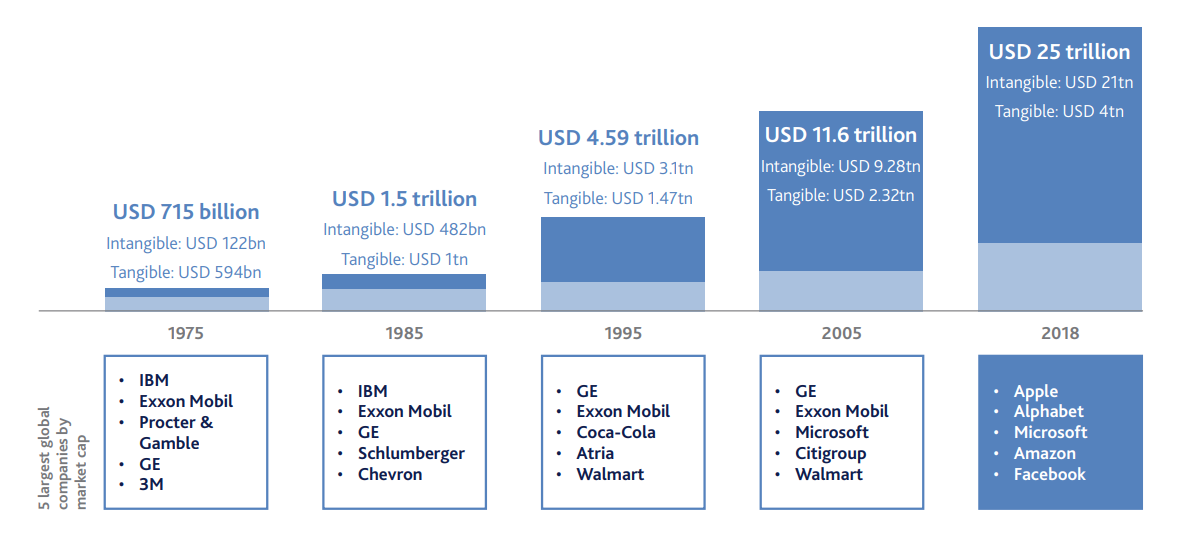
As an illustration of the rapidly changing intangible risk landscape, Figure 4 specifies the growing relevance of intangible assets, such as patents, brand value and customer data, using the S&P 500 as an example. Since the mid-1970s, the share of intangible assets in total S&P assets has increased from less than 20% to more than 80%.53
FIGURE 4: TANGIBLE VERSUS INTANGIBLE ASSETS FOR S&P 500 COMPANIES 1975–2018
Source: Aon54
2.2.3 The notion of systemic risk
Another major shift in risk characteristics that affects insurance and insurability is the increasing prevalence of systemic risk, both tangible and intangible.55 We define systemic risks as those that have the potential to cause economic and societal losses that are sufficiently significant to result in the breakdown of an entire (economic) system. As opposed to diversifiable catastrophic risks (e.g. earthquakes and windstorms), systemic risks simultaneously impact such a large proportion of society, across multiple geographies and industries, that traditional risk transfer mechanisms through insurance typically break down.56
The world experienced systemic risk in 2020 when the COVID-19 pandemic impacted virtually all households and businesses simultaneously, over an extended period of time. The fundamental mechanism of risk pooling and redistribution – spreading the losses of the few among the many unaffected by disaster – no longer worked. This was true for business interruption insurance in particular, when the destabilising effects of the pandemic rippled through the entire economy. The simultaneous ‘losses of the many’ could no longer be diversified and mutualised across risk pools.57
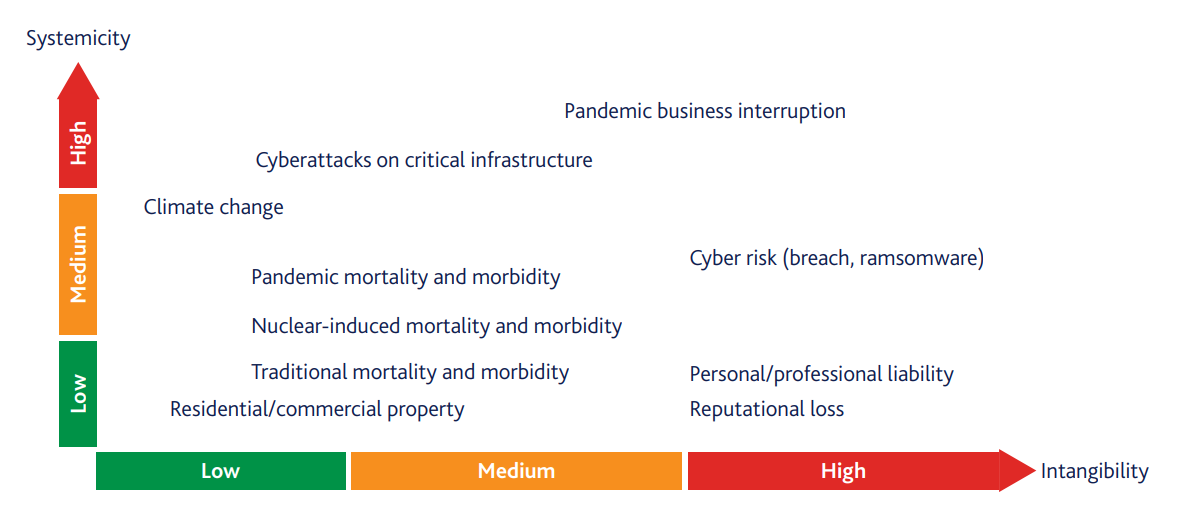
Figure 5 groups a number of insurable risks along the two dimensions of systemicity and intangibility. The lower left-hand area exhibits ‘traditional’ risks, which are tangible and well diversifiable. The other areas give examples of risks which are more challenging to insure, especially for property and casualty insurers.
FIGURE 5: THE INCREASING PREVALENCE OF SYSTEMIC AND INTANGIBLE RISKS
Source: The Geneva Association
On the basis of the novel, overarching representation of emerging risk introduced in section 2.1 of this report and an analysis of evolving risk characteristics discussed in section 2.2, we can now investigate the traditional core of the insurance industry’s customer and societal value – the insurability of risks.
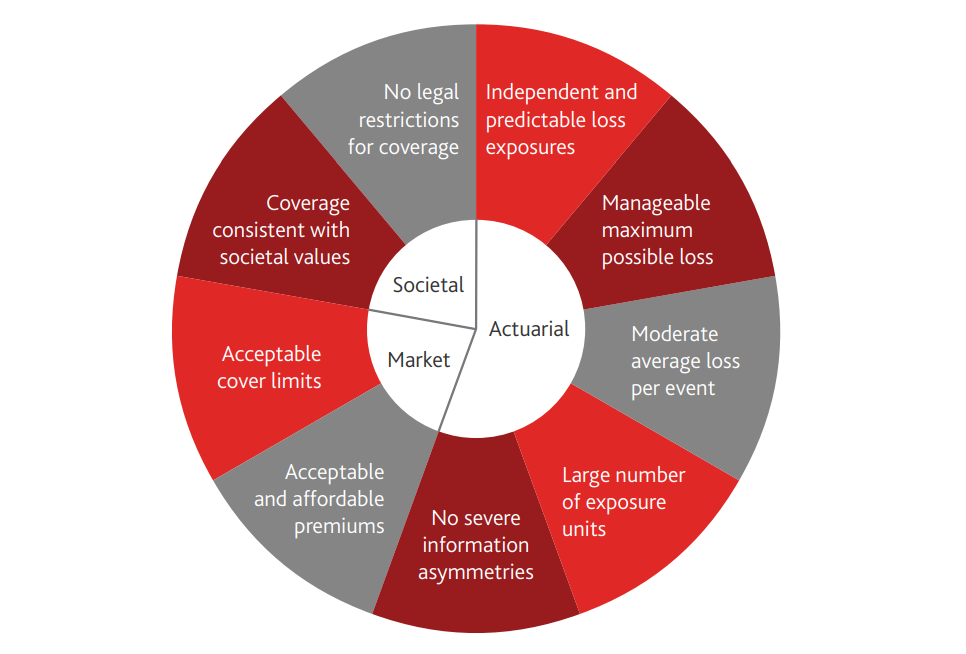
The academic literature offers different sets of criteria for the insurability of risks. A widely used framework is that of Berliner,58 who provides a compact set of nine criteria with actuarial, market and societal dimensions (see Figure 6 and Table 2). These criteria have already been applied to a wide range of insurance domains such as climate risk, cyber risk and pandemic risk.59 Risks that fulfil all nine criteria are considered perfectly insurable in the commercial market.
FIGURE 6: THE FUNDAMENTAL CRITERIA OF INSURABILITY
Source: The Geneva Association, based on Berliner60
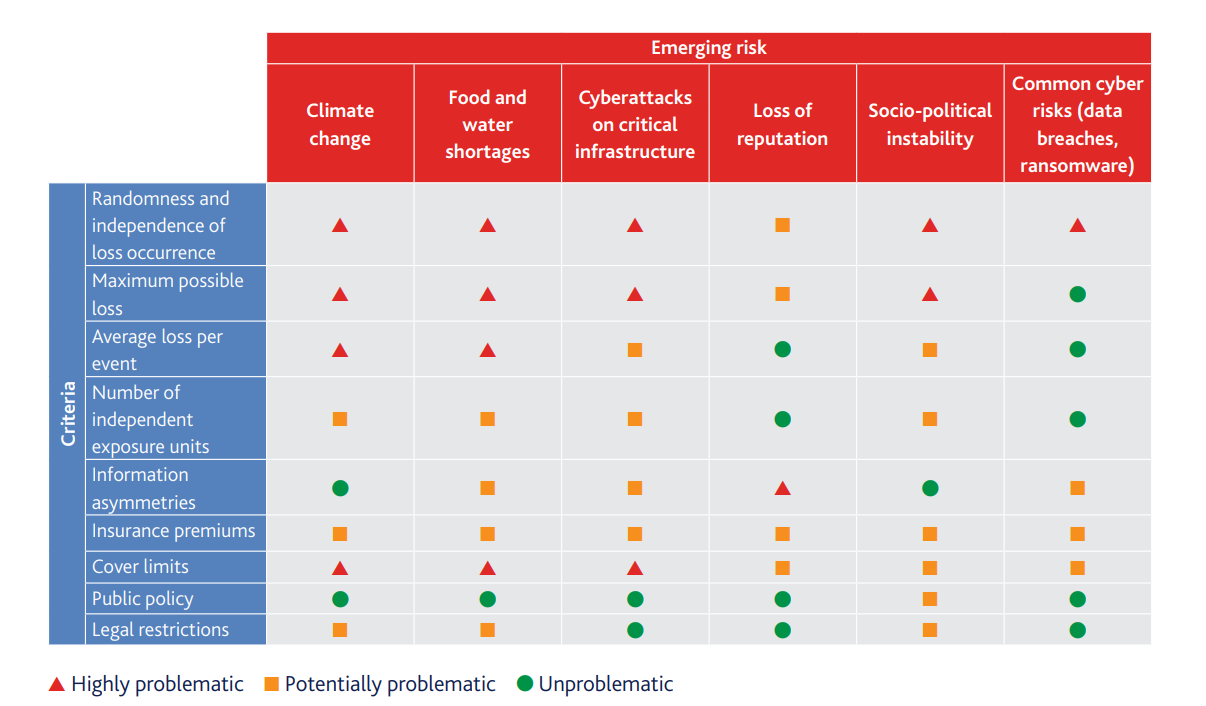
Table 2 summarises the assessed insurability of select emerging risks, based on actuarial, market and societal considerations. We subsequently highlight the main limitations to insurability for each of the categories (described in Table 1).
TABLE 2: INSURABILITY OF EMERGING RISKS
Source: Institute of Insurance Economics (University of St. Gallen) and The Geneva Association
The literature on climate change acknowledges insurability challenges, particularly due to huge and increasing losses (both single and accumulated), limits to diversification due to geographical correlation, the need for policy limits and deductibles, and potentially prohibitive insurance pricing.63 These challenges can also extend to crop insurance, with implications for food and water security.64 Insurability requires that loss potentials can be quantified, which is possible for risks such as crop failure and damage to physical assets, but very difficult for others (e.g. loss of biodiversity). In addition, increasing loss frequency and severity can lead to premiums which are no longer affordable.65 This might prompt government intervention, potentially leaving insurers with the choice of offering coverage at predefined conditions or exiting the market for property catastrophe insurance altogether, as recently witnessed in the state of California.66 Alternatively, governments can engage in partnerships with insurers, aimed at preserving insurability and promoting risk prevention and mitigation.67
The biggest obstacle to the insurability of cyber risk is the stochastic dependence of the losses, which challenges diversification through risk pooling.68 Catastrophic cyberattacks on critical infrastructure could be associated with maximum possible losses that go far beyond the risk-bearing capacity of the global insurance industry.69
In addition, cyber risk typically suffers from a lack of data for reliable risk quantification. It is also a dynamic, man-made risk that changes with the behaviour of cyber criminals and the cyber risk competencies of attacked firms. Other obstacles to insurability include moral hazard and adverse selection, i.e. reduced incentives for cyber risk prevention once coverage is in place, and a stronger demand for insurance among firms with a high exposure to cyber risk. These issues can be partially mitigated through deductibles and risk assessments but are exacerbated by the fast-evolving nature of cyber risk. Difficulties also arise when defining exclusions which require a clear differentiation between state-sponsored attacks and terrorist attacks.70 In combination, these factors impose high uncertainty on potential cyber risk policies, hindering insurability, driving up premiums and slowing cyber insurance market growth.71
For reputational risk, testing the insurability criteria is particularly difficult. This type of risk is a direct consequence of a variety of primary events, raising questions about the independence of the loss occurrences. For example, a major data breach in a company may not only result in a financial loss but also damage its reputation. Another concern is spillover effects on the reputation of firms in the same industry or on those with similar business models. The biggest obstacles to the insurability of reputational risks, however, are:
Similar issues arise for socio-political instability, a phenomenon which is typically neither random nor independent and can be associated with huge maximum possible losses due to its correlation characteristics. It can be partially addressed through political risk insurance, which can be broadly grouped into instruments for the protection of foreign direct investments and for international trade.75
The previous section highlighted growing obstacles to insurability and suggests a strong need for insurers to think beyond financial risk absorption.76 This section outlines a number of innovative approaches that could be used to enhance traditional risk transfer mechanisms.
3.2.1 Technological advancements
Technological advancements, such as richer datasets and sophisticated modelling, may improve the insurability of risks.77 Internet of Things (IoT) sensors, for example, can provide real-time data on the health and performance of industrial and homeowners equipment, allowing for more accurate pricing of insurance.78 Machine learning algorithms can analyse vast amounts of data to identify potential cyber threats, and help underwriters price cyber insurance policies.79 Furthermore, new technology-enhanced risk transfer instruments, such as parametric insurance, can provide additional insurance capacity for natural catastrophes; in these cases, the payout is determined based on physical parameter values, such as wind speed, rainfall levels or number of days above a certain temperature, rather than an insured loss.80
3.2.2 Alternative capital
The capital markets are often described as the natural bearer of large-scale risks. For the past 25 years or so they have provided insurance capacity, primarily in the form of insurance-linked securities (ILS). If traditional re/insurance capital is at the capacity limit, such alternative capital can increase insurability. ILS provide an additional risk transfer channel for the insurance industry, allowing insurers to take on more risk and provide more insurance coverage to households and businesses. This is particularly important for complex and large-scale risks, such as those posed by climate change, which can be difficult to insure through traditional means.81 At the end of 2022, alternative investments contributed to global re/insurance capacity in the amount of USD 96 billion, mainly for property catastrophe risks.82 This compares with uninsured natural catastrophe losses in the same year of about USD 150 billion.83 More recently, the market has been expanding to cyber risk, albeit at a small scale.84
Despite the potential of alternative capital to narrow protection gaps, there are challenges. A lack of reliable risk models is a persistent issue, especially for risks that depend on dynamic human behaviour, such as cyber or liability. In addition, investors prefer risks that are uncorrelated to other asset classes. Hence, alternative capital will likely not be able to address the largest and most systemic events such as large-scale cyberattacks.85
An increasing number of insurers have been launching customer propositions that go beyond their traditional role of absorbing financial risk. A changing risk landscape and mounting challenges to insurability, as discussed in the previous sections, are among the main reasons. This strategic shift reflects the need to contain the cost of risk and, as such, contribute to maintaining insurability.86 In addition, new propositions are needed to meet changing customer expectations and enhance the overall customer experience and engagement.87
The following section discusses three specific avenues for insurers to maintain or even expand their customer and societal relevance in a changing risk environment.
4.1.1 Risk assessment
Risk assessment is at the core of insurers’ ability to absorb financial risk. It is employed to appraise and analyse the hazards, exposures and vulnerabilities linked with insurance policies. As discussed in the previous section, risk assessment is particularly important and challenging in the context of intangible and systemic risks.
In the contemporary risk landscape, the role of data is set to be pivotal. A prominent example is climate change, an issue that will require a concerted effort between insurers, insureds, non-industry experts and policymakers to be effectively addressed.88 Insurers will be expected to complement their traditional value proposition of risk transfer with risk assessment services that support disaster resilience,89 such as informing corporate customers’ decision-making with scenario analysis tools that capture both physical and transition risk and build on a combination of qualitative and quantitative risk assessment approaches.90
Similarly, when it comes to cyber risk, the significance of risk assessment services cannot be overstated. For insurers, these services are a key driver of product value, allowing for the evaluation of customers’ cybersecurity preparedness and posture and the development of customised risk management strategies to protect digital assets and privacy.91
Business interruption risk is a further example. Through improved risk assessment, insurers can help companies quantify exposures and set up sensible safety margins, build continuity plans and create a culture of risk awareness.92 Risk assessment tools are also finding increasing application in the area of innovative dyamic products, which are designed to continually adapt to the ever-evolving circumstances and needs of customers.93 In this context, proactive risk assessment procedures take centre stage to provide customers with adaptive products, for example in health insurance, which reflect changes in lifestyle and behaviour.94 This data-driven and dynamic risk assessment approach will not only be the prerequisite for offering innovative risk transfer products but may also provide the basis for standalone services provided to insurance customers.95
4.1.2 Risk prediction
Based on ever more sophisticated risk assessment procedures, risk prediction services, frequently outsourced to specialised vendors, play an increasingly important role in the insurance industry. These services encompass a range of modelling and computational procedures that aim to estimate the likelihood of a risk materialising and its potential impact in a specific location. Once again, data forms the backbone of this process, with historical data, patterns and trends scrutinised to construct robust models and predictive analytics.
Based on informed predictions, insurers can make more precise decisions concerning pricing, underwriting and risk management strategies than with traditional lengthy processes that rely on complex actuarial formulae.96 More important in the context of this report, customers can benefit directly from risk prediction services, for example through improved personal safety97 or healthcare usage as well as predictive services which help foresee worsening health conditions.98
4.1.3 Risk prevention
Risk prevention is a service that derives from both risk assessment and prediction. While risk prediction is almost purely theoretical and based on modelling, prevention entails all activities (in collaboration with the customer) that effectively reduce the likelihood of a risk materialising.
Insurers can play a meaningful role for their customers in this respect, e.g. by promoting healthier lifestyles and safer behaviours through wellness initiatives that have been found to be effective in preventing chronic diseases.99 This role, however, is dependent on a conducive legal framework, for example for ‘pay-as-you-live’ pricing in health insurance.
One of the standout innovations in risk prevention is telematics-based insurance. For instance, ‘pay-how-youdrive’ policies have resulted in a 50% reduction in fatal accident risk.100 Health outreach programmes targeting at-risk clients, which have led to a 20% decrease in doctor and emergency room visits, provide another example.101
With access to real-time data and a direct connection to policyholders, the insurance industry can assume a prominent role in developing risk prevention tools and strategies, foster safer practices, minimise damages and ultimately enhance their value proposition both at the customer and societal levels. Additionally, insurers have a vested interest in helping their customers avoid risks through prevention services, which lower the cost of claims.102 By actively engaging with customers and providers (e.g. car manufacturers and hospitals) and promoting measures that prevent risks, insurers contribute to a safer and more secure environment for society at large, generating a positive externality.103, 104
4.1.4 Risk mitigation
Risk mitigation encompasses various approaches designed to reduce or minimise the potential negative impacts of a risk on individuals, households and organisations.
While insurance coverage remains the most relevant form of risk mitigation, insurers, based on their risk expertise, can offer a wide spectrum of additional mitigation services, for example supporting customers in designing and implementing emergency response and disaster recovery plans involving build-back-better policies to increase resilience,105 or business continuity plans adapted to the specific needs of a company, including regular data backups and auditing sessions.106
Although the underlying risks remain, thanks to these services policyholders are in a better position to minimise losses and bounce back more quickly.107 Combined with risk assessment and prevention services, insurers can offer interested customers a comprehensive risk management proposition.108
4.1.5 Risk assistance
Insurers have long offered a variety of risk assistance services to support policyholders following a covered loss event. The spectrum ranges from round-the-clock claims reporting and support services, emergency response coordination (e.g. arranging for immediate repairs), incident-related travel assistance to support in recovering from identity theft incidents, supply chain assistance through support in finding alternative suppliers or continuous support during natural disasters.109, 110
The benefits for customers are obvious and include timely support and access to experts and resources, resulting in less stress and enhanced peace of mind during challenging times.111
For insurers as well, offering post-event assistance services makes much sense. Such services can foster customer loyalty and satisfaction, help establish a unique selling proposition in competitive markets based on tangible and practical support beyond claims payments as well as reduce claims costs by pointing customers to trusted providers (e.g. repair shops).112
4.1.6 Risk education
Financial literacy has been identified as a crucial driving factor of risk awareness113 and insurance penetration.114 However, while financial literacy is essential, it may not inherently imply an understanding or clear explanations of insurance concepts. To address this, insurers can offer educational services that increase people’s awareness of general and specific risks and provide guidance on policy interpretation. Through those initiatives, insurers can enable customers to apply risk knowledge to insurance decision-making.115
In addition, by promoting and facilitating the dissemination of knowledge, insurers contribute to reducing costs and risks for both themselves and their customers.116, 117
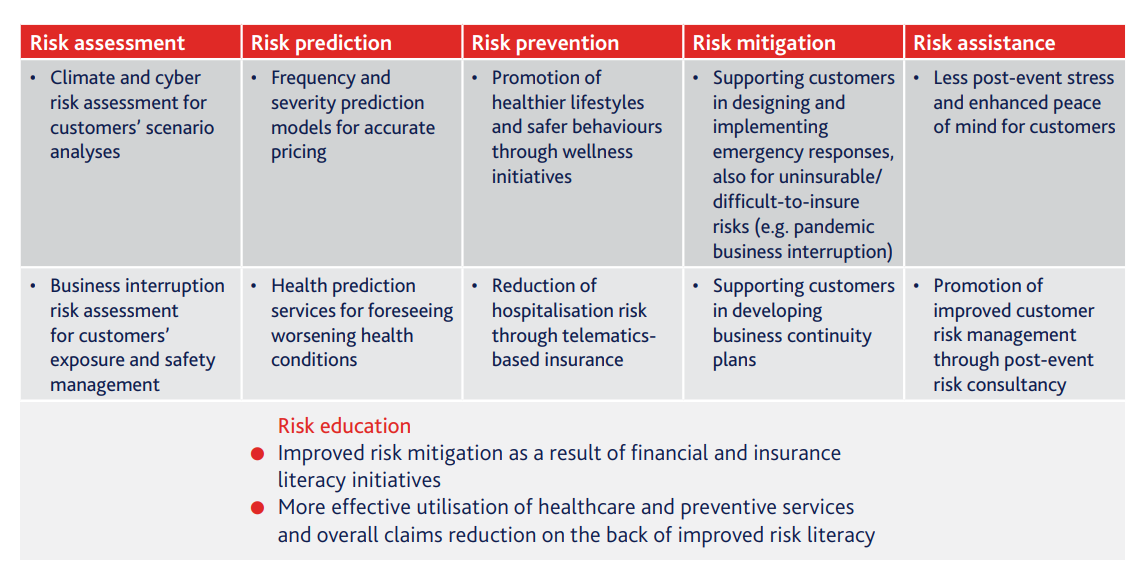
Figure 7 summarises the spectrum of risk services discussed in this section and offers specific examples.
FIGURE 7: RISK SERVICES BEYOND RISK TRANSFER
Source: The Geneva Association
In conclusion, while the foundational service provided by the insurance industry is, and is likely to remain, that of risk absorption, the fast-changing risk landscape requires strategic and operational agility and flexibility from insurers. These capabilities are needed to contain the rising cost of risk, push the limits of insurability and meet evolving customer needs.118
Another important source of additional or new customer and societal value for insurers is to specifically promote sustainable development through dedicated risk and investment solutions. Given their risk management expertise, strong relationships with insureds and investees as well as long-term risk and investment perspectives, insurers are in a unique position to promote sustainability and build socio-economic resilience for individuals, households, businesses and even governments.
Sustainable insurance can therefore be understood as ‘improving resilience through sustaining and enhancing access, affordability and insurability, reducing risks and exposures through risk management, innovation, prevention, as well as investing in green and robust assets’.119
Adopting a value chain perspective, this section will explore this additional source of customer and societal value with a clear focus on insurers’ distinct capabilities as risk takers, risk experts and long-term investors.
The discussion on insurers’ sustainable investment products and activities is relatively advanced, not least as a result of a robust regulatory environment. The EU’s Sustainable Finance Disclosure Regulation (SFDR), for example, offers a framework for such products and aims to improve transparency about their sustainability features. More specifically, the SFDR distinguishes between ‘Article 8/ light green’ investment products, which promote generic sustainability characteristics, and ‘Article 9/dark green’ products, which pursue specific and measurable sustainable investment objectives.120
While offering such products exposes insurers to the risk of greenwashing and associated reputational damage, not being able to provide them to customers could make insurers’ investment propositions unattractive.121, 122
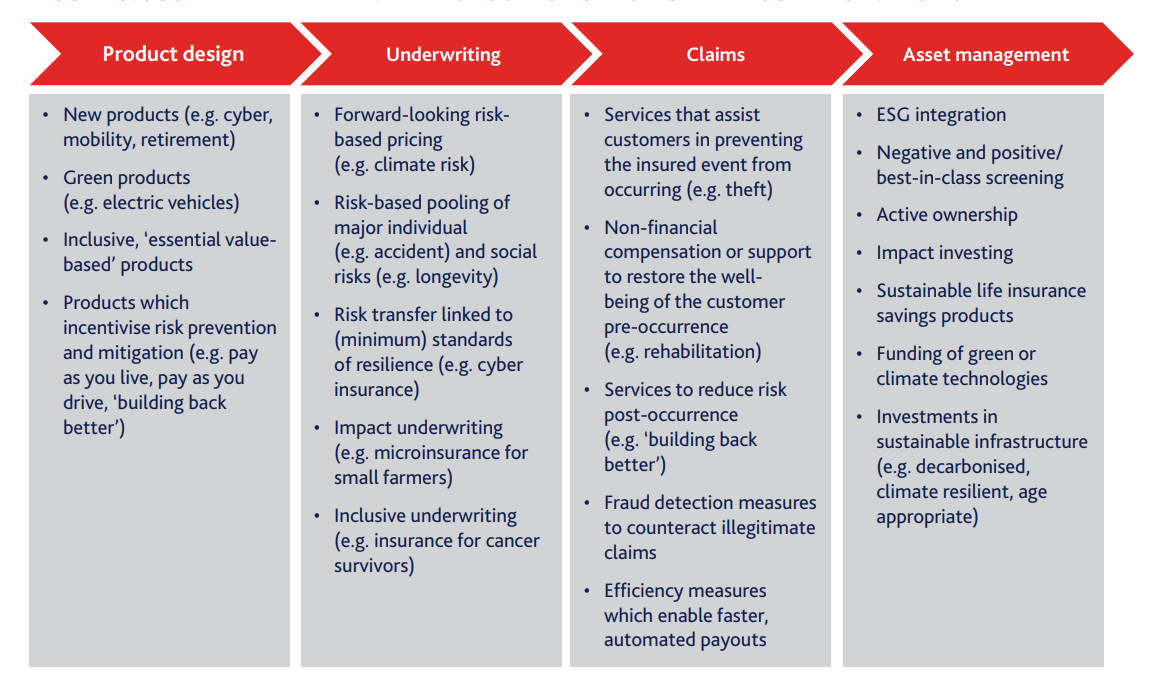
The most common approaches used by insurers to embed sustainability in their proprietary and third-party asset management operations include (see also Figure 8):
For risk products, specific regulations and reporting taxonomies are still in preparation. In the meantime, the United Nations Environment Programme Finance
Initiative (UNEP FI) Principles for Sustainable Insurance (PSI) can serve as a global framework for sustainable product strategies in insurance. The PSI stipulate that sustainable insurance products should go beyond financial risk absorption and also incentivise policyholders to take risk-mitigating measures, thus helping to reduce risk and preserve long-term insurability.129
Figure 8 outlines the most common current sustainability-driven propositions along the insurance value chain. Approaches in product design and development include:
The most common sustainability-driven practices in underwriting135 can be summarised as follows:
How insurers handle claims is key to customers’ perception of the value of insurance.141 Embedding sustainable practices in this part of the value chain is, therefore, particularly important. Examples include:
FIGURE 8: SUSTAINABILITY-DRIVEN PROPOSITIONS ALONG THE INSURANCE VALUE CHAIN
Source: The Geneva Association
In summary, by consciously integrating sustainability into their value chain, insurers can promote resilience and reduce risks beyond ‘business as usual’, for themselves, their customers and society at large.
A third avenue for insurers to preserve their value in a changing risk landscape is to engage in public-private partnerships (PPPs) which address the largest and most complex risks modern societies are facing and go beyond existing structures that address natural catastrophe and terrorism risks.
Most existing PPPs involving insurance leverage government intervention to improve the insurability of catastrophe risks. ‘Risks that can be insured need not be legislated; uninsurable risks, however, have to be dealt with by nation states’.147 If a risk is not insurable on the insurance or extended financial market, typical PPPs cover different layers of the potential loss. The first layer is ‘owned’ by primary insurers, which receive premiums from the risk pool of insureds. This exposure is reinsured in the second layer up to a certain coverage limit. The third layer comprises government absorption of the excess losses.148 Worldwide, there are more than 450 government-funded pool solutions in place.149 They combine insurance sector capacity with sovereign funds. Most PPPs in insurance pursue a similar conceptual objective, which is ‘to transform uninsured risk into insurance-based products’150, based on a combination of insurance, reinsurance and finite government backstopping through premiums, levies or taxes.151
This section, however, adopts a different perspective. Instead of viewing PPPs primarily as a means to facilitate financial risk absorption by insurers, we focus on structures that address large-scale and systemic risks which preclude or defy insurability, such as economic losses from pandemics, climate change or large-scale attacks on critical infrastructure.152
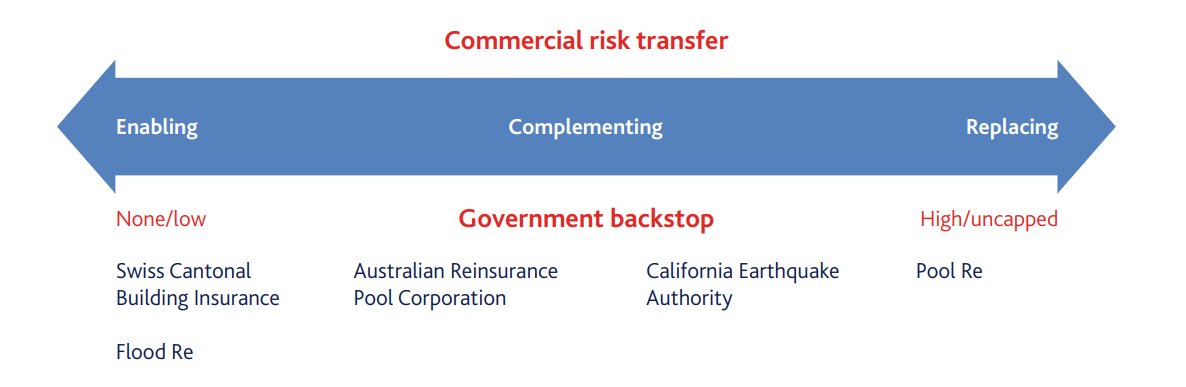
FIGURE 9: RISK TRANSFER UNDER PUBLIC-PRIVATE PARTNERSHIPS – APPROACHES AND EXAMPLES
Source: The Geneva Association
In order to address systemic risks in a meaningful way, PPPs need to involve significant government funds. For some risks such as terrorism and natural disasters, a limited government backstop may be sufficient. For systemic risks, however, an uncapped (or very high) government backstop is critical if the PPP’s objective is to harness the specific capabilities of the insurance industry. Governments need to get involved as ‘insurers of last resort’ and could draw on insurers’ potential and limited risk-bearing capacity but, and more important in the context of this report, also mobilise insurers’ vital, non-risk-bearing contributions to risk preparedness and resilience building (e.g. through risk assessment, risk mitigation and claims management as discussed in sections 4.1 and 4.2).153
PPPs operate across the continuum illustrated in Figure 9, which ranges from enabling commercial risk transfer through redistributing risk among policyholders to replacing commercial risk transfer by removing extreme and volatile risk from the insurance market.
Enabling risk transfer refers to taking the risk of loss of a relatively small group of highly exposed policyholders and sharing it across the wider pool of variably exposed policyholders through a levy.154 Low-risk policyholders pay a slightly higher premium than their actual risk in order to subsidise an affordable premium for those who are highly exposed to risk. Thus, the premiums of the many, widely distributed across possible exposures, can continue to cover the extreme losses of the few. However, they can only do so with some government legislation that enables a levy on lower-risk policyholders to subsidise higher-risk ones, as with Flood Re in the U.K., or through a non-profit government monopoly in which insurance is mandatory and offered at a fixed price, as with Cantonal Building Insurance in Switzerland.155
Complementing risk transfer constitutes some middle ground between enablement and replacement, for example by removing some elements of risk from the market while redistributing others, as with the Australian Reinsurance Pool Corporation.
Replacing risk transfer implies the removal of risk from the commercial insurance market onto the ‘balance sheet’ of the public sector. This approach is particularly suitable for risk that is seen as too volatile or extreme for the market to assume. In this scenario, insurance companies may accept premiums from insureds and issue and service their policies. However, they do not absorb any financial risk but pass the entire premium associated with the risk to a special vehicle which can then provide the cover because it has access to some limited or unlimited government guarantee to pay for losses, as with Pool Re in the U.K.156
In summary, PPPs play a valuable societal role besides financial risk absorption. Insurers can act as professional distributors and claims managers as well as experts in risk assessment and pricing (sending out important signals to society). By doing so, insurers contribute to societal risk mitigation and preparedness even in the face of (uninsurable) systemic risk.157
In light of the momentous changes affecting the global risk landscape, understanding the perceptions and expectations of customers becomes pivotal for insurers to maintain and further extend their relevance.
The insurance industry has long been exclusively associated with the absorption of financial risk. However, as risks escalate in complexity, ranging from cyber threats to climate change, customers are increasingly looking for more than just a safety net. The global insurance industry has started to respond to what might become a paradigm shift, with customers seeking comprehensive coverage that not only transfers and mitigates risks but also encompasses services that lower risk in the first place.
Against this backdrop, The Geneva Association commissioned an online customer survey, capturing perspectives from the world’s six largest insurance markets: the U.S., China, the U.K., Japan, France and Germany.158 In each market, a sample of about 1,000 economically, regionally and demographically representative insurance policyholders were polled, approximately 900 retail customers and 100 commercial customers in total, representing companies with up to 250 employees. The survey was conducted in the second quarter of 2023.
By examining customers’ current attitudes towards risk and insurance, their appetite for services beyond financial risk absorption and their future expectations towards the insurance industry, we hope to assist insurers in aligning their corporate strategies and business models with emerging risk trends and evolving customer preferences.
This section offers a comprehensive overview of the most relevant survey results. In a nutshell:
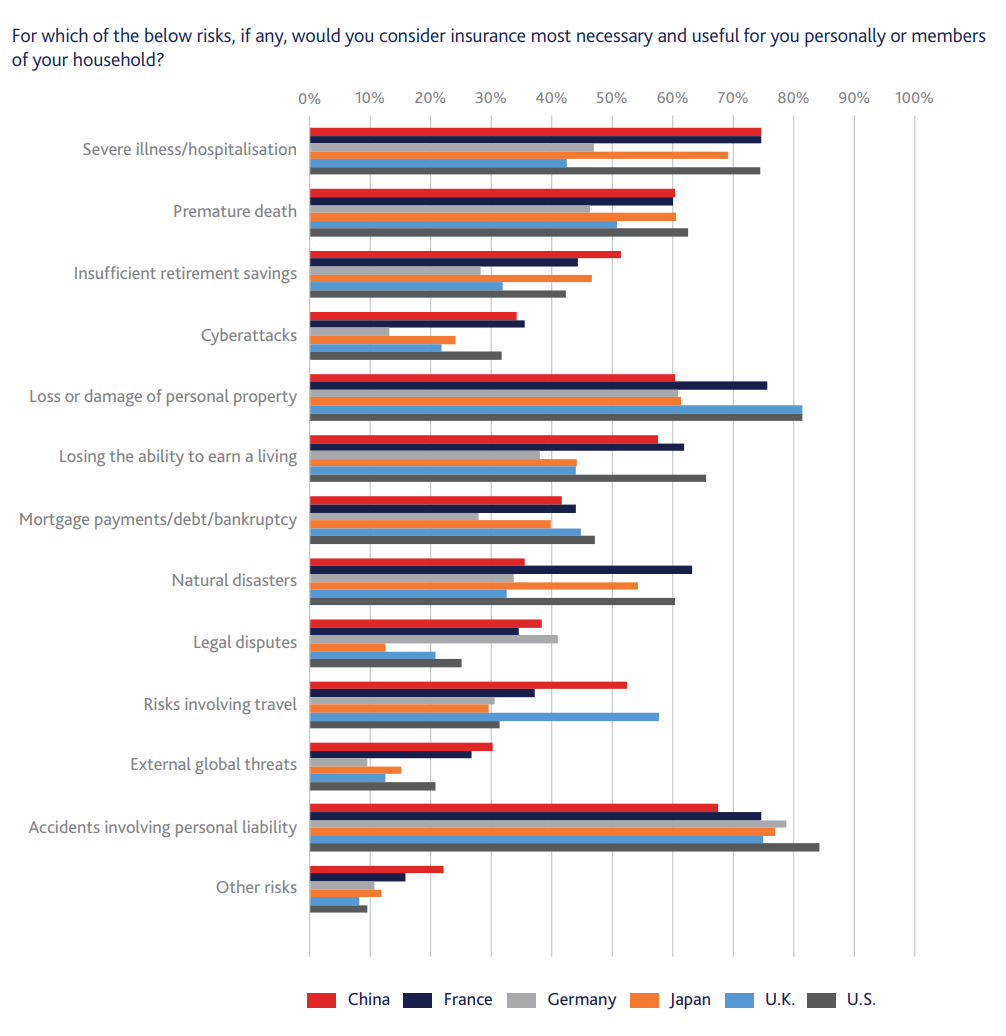
Figure 10 shows how approximately 5,400 global retail customers view the relevance of insurance in the context of specific risks (irrespective of their current insurance policies in place). Accidents involving personal liability (e.g. car accidents) are generally considered a risk for which insurance is deemed most useful by respondents (around 70–80%). In France, the U.K. and the U.S., property damage risk is also viewed as an area where insurance has an important role to play (more than 75% of respondents). The third most frequently mentioned risk is severe illness and hospitalisation, except for Germany and the U.K., where public healthcare is dominant. Insurance is deemed least relevant for external global threats.
FIGURE 10: THE RELEVANCE OF INSURANCE FOR SPECIFIC RISKS (RETAIL CUSTOMER PERSPECTIVE)
Source: The Geneva Association Global Customer Survey, powered by Dynata
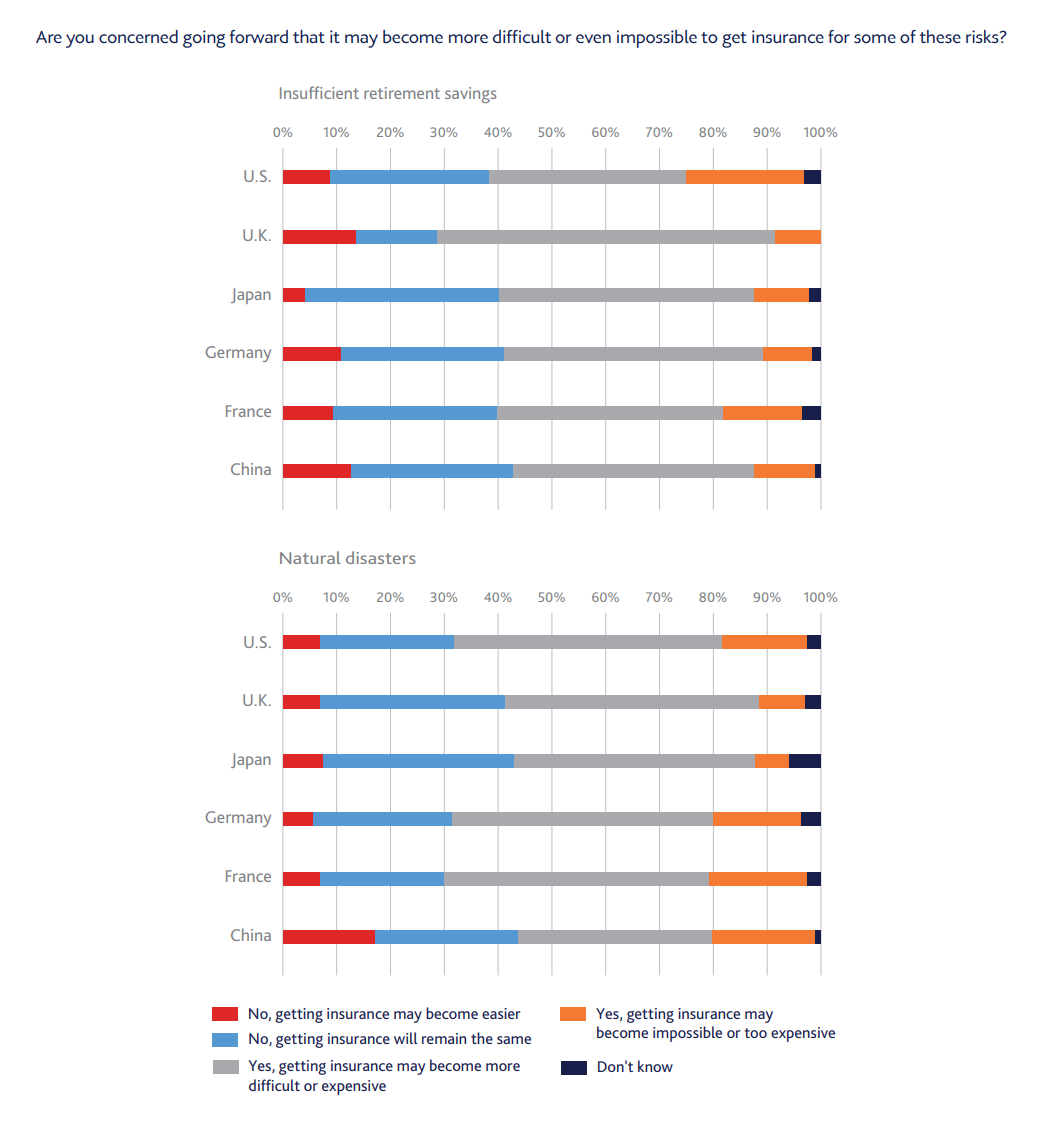
The insurability of risks is a growing concern among retail respondents. Insufficient retirement savings and natural disasters rank highest, with more than 50% of respondents expressing concerns in all surveyed countries. In the U.K., about 70% of survey participants worry that longevity pension insurance may become more difficult (or even impossible) and expensive to obtain. In Germany, France and the U.S., a similar share of survey participants voices concerns about coverage for natural disasters (Figure 11).
FIGURE 11: CONCERNS ABOUT THE FUTURE INSURABILITY OF RISKS (RETAIL CUSTOMERS)
Source: The Geneva Association Global Customer Survey, powered by Dynata
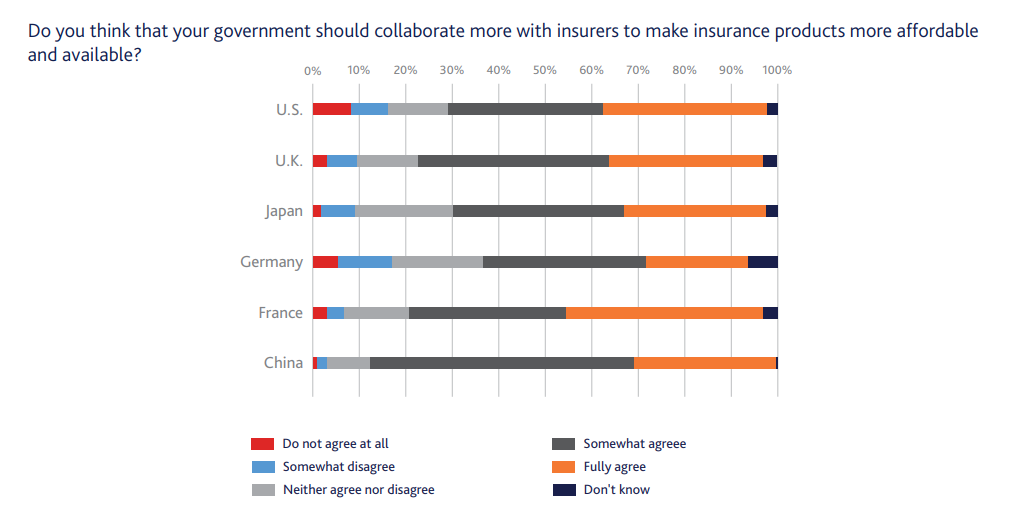
The vast majority of retail insurance customers canvassed agree that their governments should collaborate more with insurers to make insurance products more affordable and available. Levels of agreement are highest in China, France and the U.K. (Figure 12).
FIGURE 12: IMPROVING INSURANCE AFFORDABILITY AND AVAILABILITY THROUGH GOVERNMENT-INSURER COLLABORATION (RETAIL CUSTOMER PERSPECTIVE)
Source: The Geneva Association Global Customer Survey, powered by Dynata
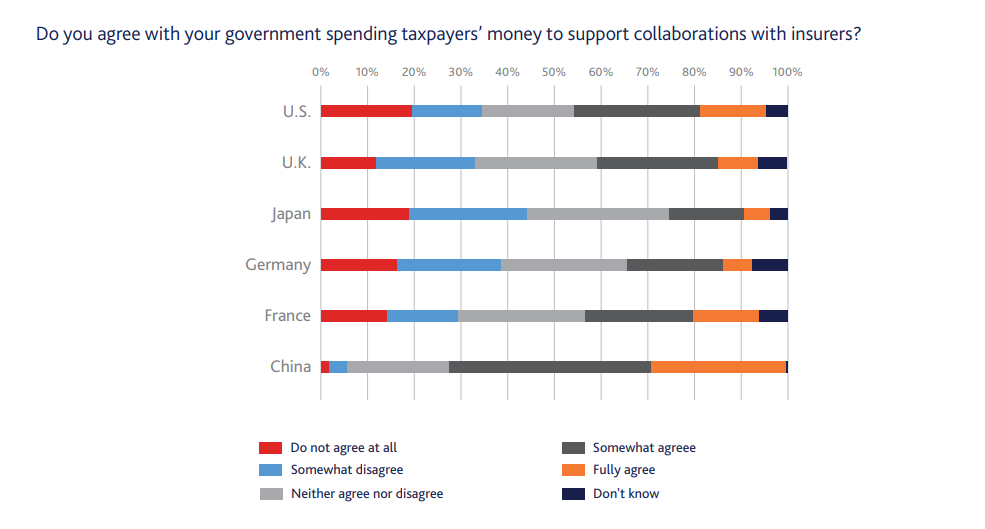
When asked whether it would be appropriate for their governments to spend taxpayers’ money to support such collaborations, a different picture emerges. China is the only country where the majority of respondents were in favour. Resistance is most pronounced in Japan, Germany and the U.S. (Figure 13).
FIGURE 13: USE OF TAXPAYERS’ MONEY FOR GOVERNMENT-INSURER COLLABORATION (RETAIL CUSTOMER PERSPECTIVE)
Source: The Geneva Association Global Customer Survey, powered by Dynata
In light of a changing risk landscape and growing challenges to insurability, one of the survey’s main objectives was to explore customers’ awareness of and appetite for insurance services that go beyond traditional risk transfer and financial loss absorption.
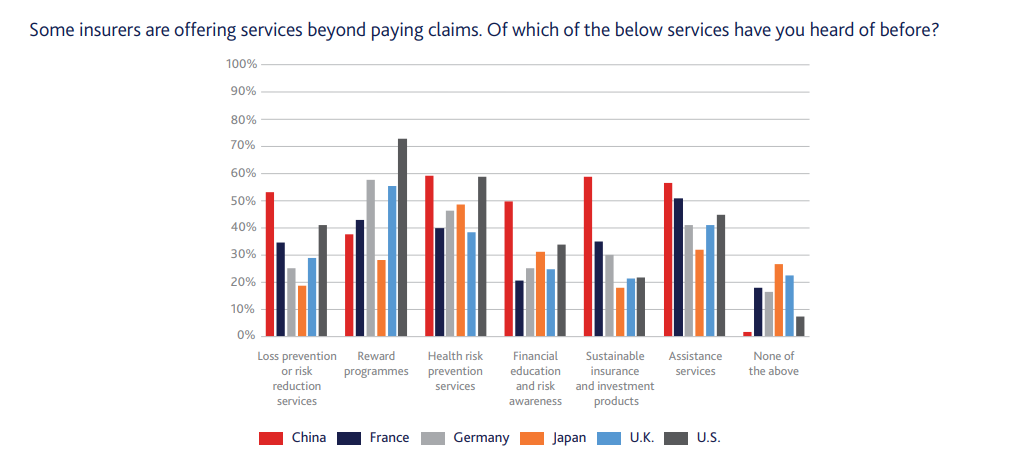
Reward programmes (e.g. safe driving rewards and wellness incentives), health risk prevention services (e.g. regular check-ups and screenings) and post-occurrence assistance services are best known to retail customers in most markets. The U.S. and China generally stand out. The lowest levels of awareness are recorded for specific sustainability-driven propositions as well as property loss prevention and financial education services (Figure 14).
FIGURE 14: AWARENESS OF INSURANCE SERVICES THAT GO BEYOND RISK TRANSFER (RETAIL CUSTOMERS)
Source: The Geneva Association Global Customer Survey, powered by Dynata
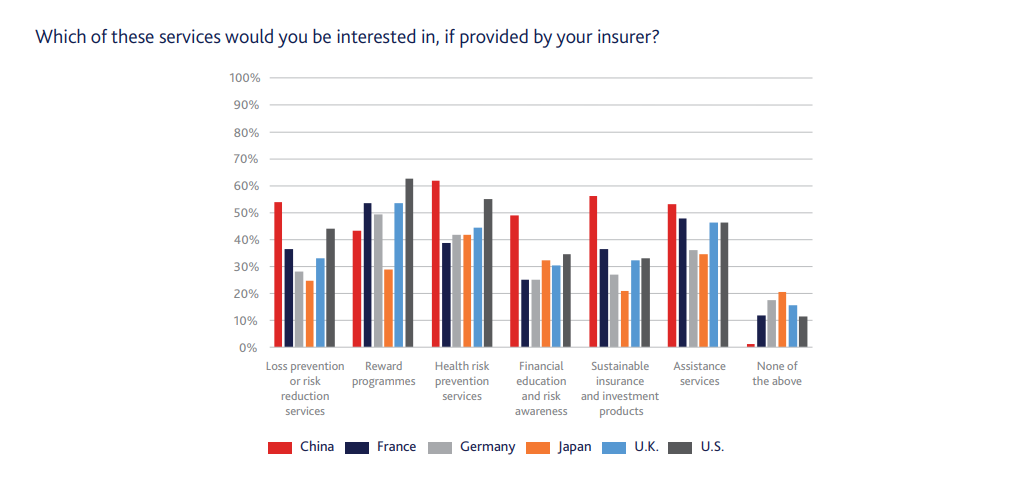
Retail customers are most interested in health risk prevention services and assistance services, especially in China, with respondent shares of 50% or more. Reward programmes are of particular interest to U.S. respondents. In Japan and Germany, interest is lowest across most services. Figure 15 also reveals that there is relatively little appetite for financial education and sustainability-related services. Encouragingly, less than 20% (except for Japan) express no interest in any such services.
FIGURE 15: INTEREST IN INSURANCE SERVICES THAT GO BEYOND RISK TRANSFER (RETAIL CUSTOMERS)
Source: The Geneva Association Global Customer Survey, powered by Dynata
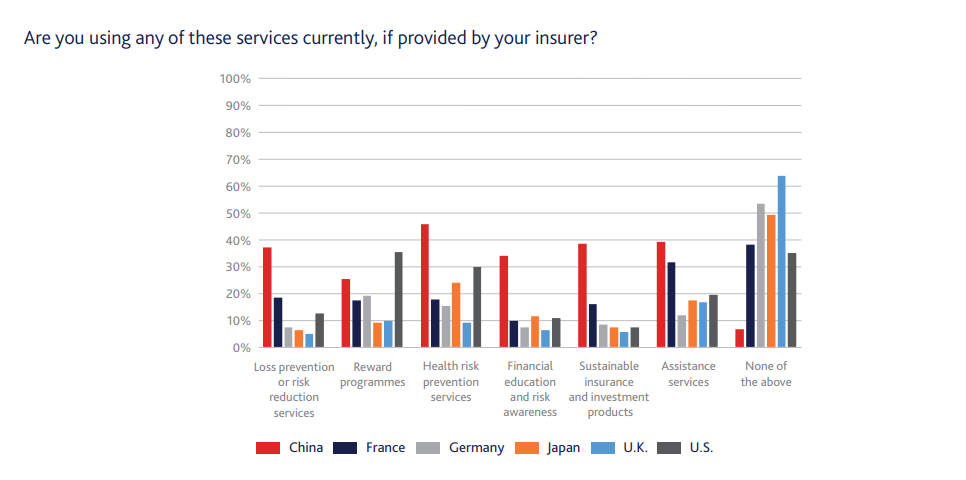
As far as actual usage of risk services is concerned, a heterogeneous picture emerges (Figure 16). China leads the pack with usage levels ranging from about 30–45%, with a particularly strong appetite for health risk prevention services. In the U.S., reward programmes and health risk prevention services are relatively common, at usage levels of about 30–35%. In Germany, the U.K. and Japan, less than 20% of retail customers make use of such services. On average, reward programmes, and health risk prevention and assistance services are most frequently used; (property) loss prevention, financial education and sustainability services least so.
China aside, non-usage levels vary from around 35–65%. In light of relatively low levels (around 10–20%) of non-interest (see Figure 15), a certain potential for risk services seems to exist.
FIGURE 16: USAGE OF INSURANCE SERVICES THAT GO BEYOND RISK TRANSFER (RETAIL CUSTOMERS)
Source: The Geneva Association Global Customer Survey, powered by Dynata
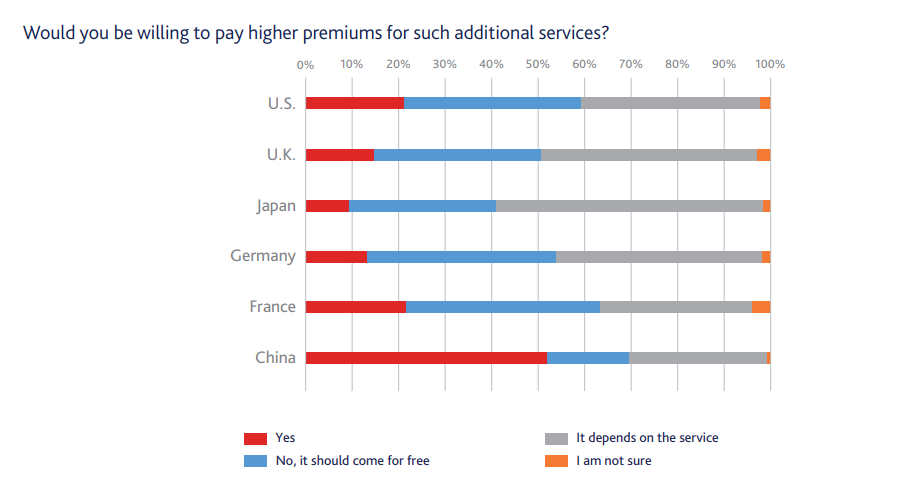
More than 50% of Chinese respondents are willing to pay extra for additional risk services. In other markets, willingness ranges from about 10–20% only. In France, Germany and the U.S., about 40% of surveyed customers expect such services to come for free (Figure 17).
FIGURE 17: WILLINGNESS TO PAY FOR INSURANCE SERVICES THAT GO BEYOND RISK TRANSFER (RETAIL CUSTOMERS)
Source: The Geneva Association Global Customer Survey, powered by Dynata
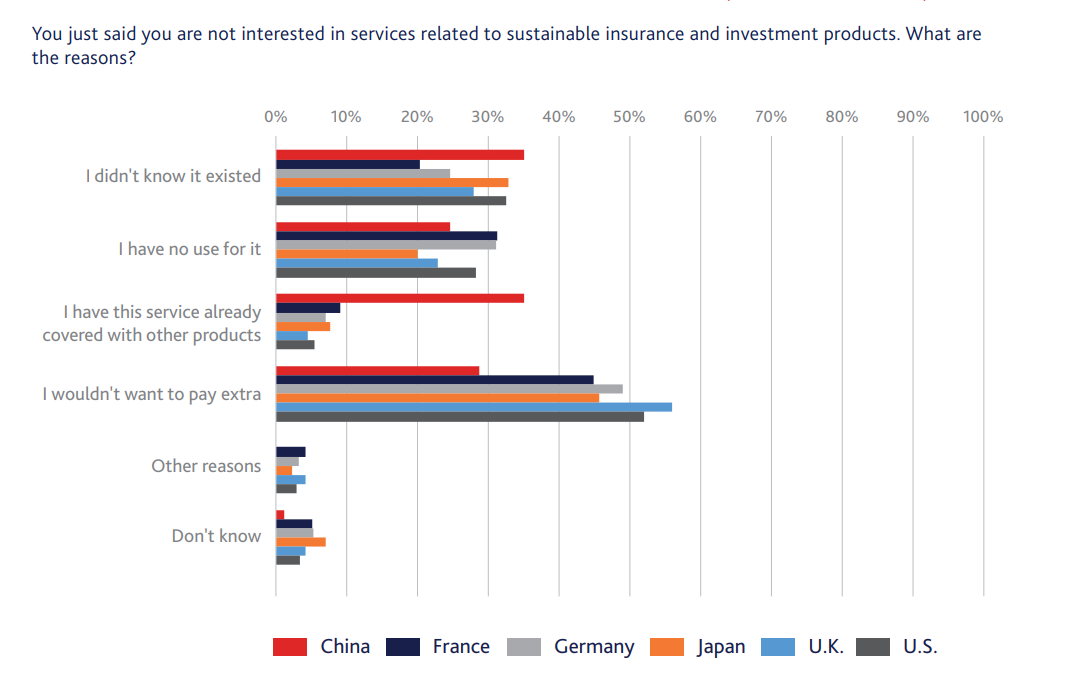
When asked about the reasons for their non-interest in specific risk services, unwillingness to pay extra, lack of awareness and a perceived lack of need are most frequently mentioned (see Figure 18, using sustainable risk and investment services as an example).
FIGURE 18: REASONS FOR LACK OF INTEREST IN ADDITIONAL SERVICES (RETAIL CUSTOMERS)
Source: The Geneva Association Global Customer Survey, powered by Dynata
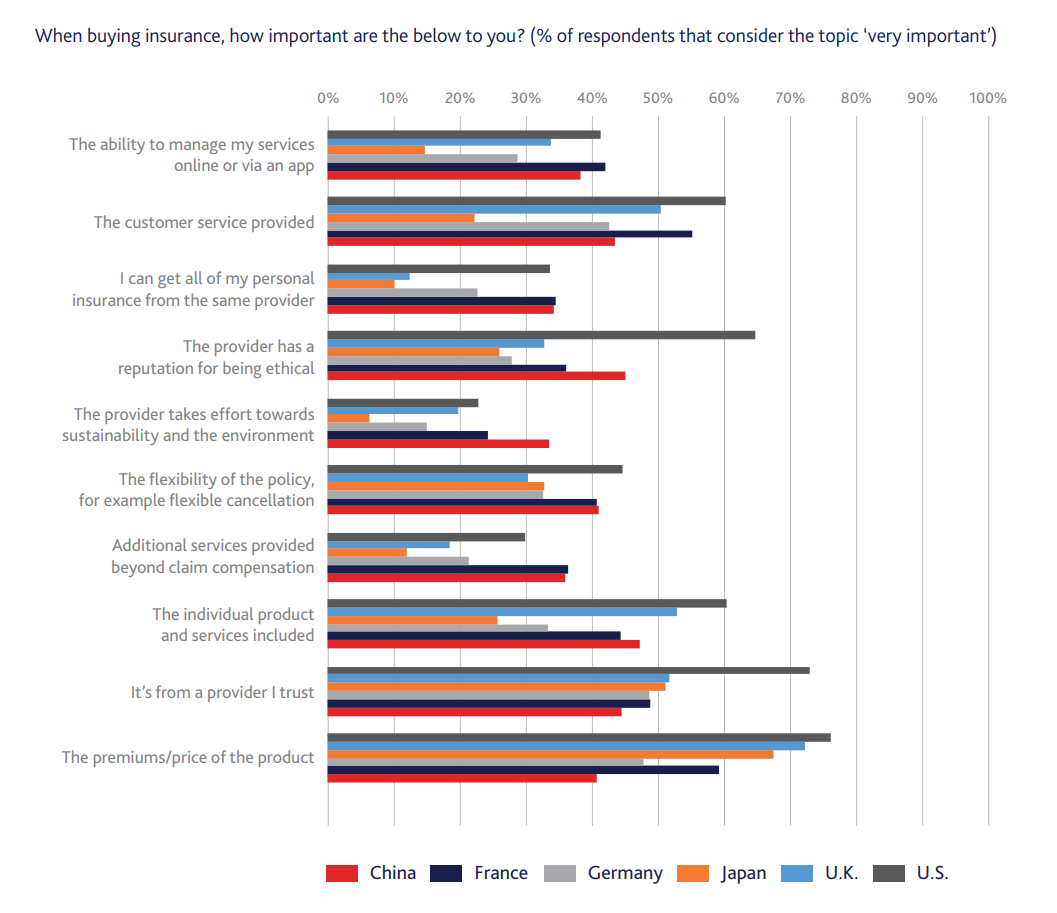
Figure 19 sheds light on the determinants of customers’ buying decisions. Strikingly, the provider’s ability to offer services beyond claims payments does not rank particularly highly, especially in the U.K., Japan and Germany. The insurer’s efforts towards sustainability are least relevant (especially in Germany and Japan).
On average, price (especially in the U.S., U.K. and Japan), trust (in the U.S. in particular) and customer service (which includes claims settlement) matter most to retail customers when it comes to making buying decisions.
FIGURE 19: CURRENT DETERMINANTS OF INSURANCE BUYING DECISIONS (RETAIL CUSTOMERS)
Source: The Geneva Association Global Customer Survey, powered by Dynata
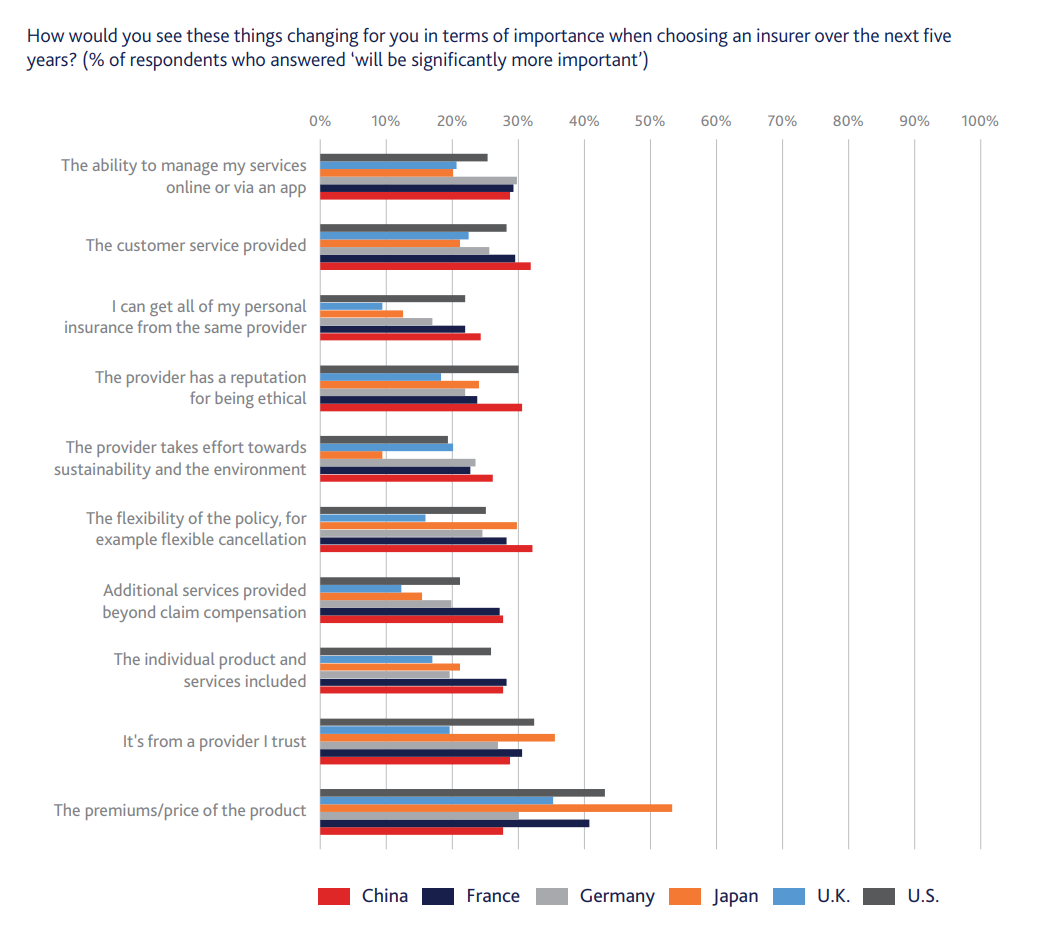
Over the next five years, price will become an even more important factor, especially in Japan, the U.S. and France (for about 40–50% of surveyed retail customers). More than 20% of respondents state that sustainability will significantly gain in relevance for their insurance buying decisions. In five years’ time, additional services beyond claims compensation are not expected to be particularly more significant than today, especially in Japan and the U.K. (Figure 20).
FIGURE 20: FUTURE DETERMINANTS OF INSURANCE BUYING DECISIONS (RETAIL CUSTOMERS)
Source: The Geneva Association Global Customer Survey, powered by Dynata
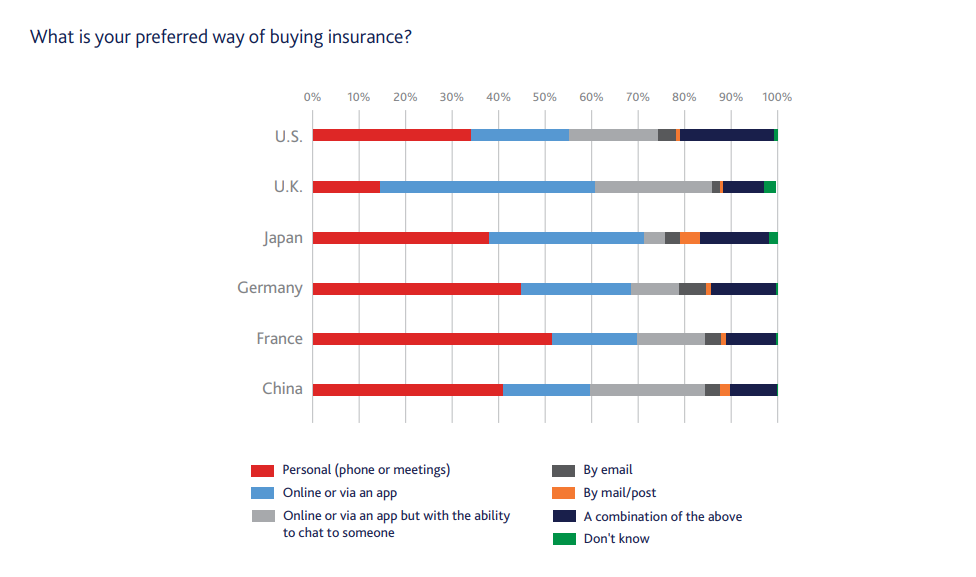
Figure 21 displays retail customers’ distribution preferences (which can be considered a proxy for their preferred way of interacting with insurers). Except for the U.K., personal channels remain more popular than digital. There is also a strong appetite for hybrid forms of interaction (up to about 40% in the U.S.). These findings suggest that retail customers continue to expect insurers to deliver their value proposition through a personal interface.
FIGURE 21: PREFERRED WAY OF BUYING INSURANCE (RETAIL CUSTOMERS)
Source: The Geneva Association Global Customer Survey, powered by Dynata
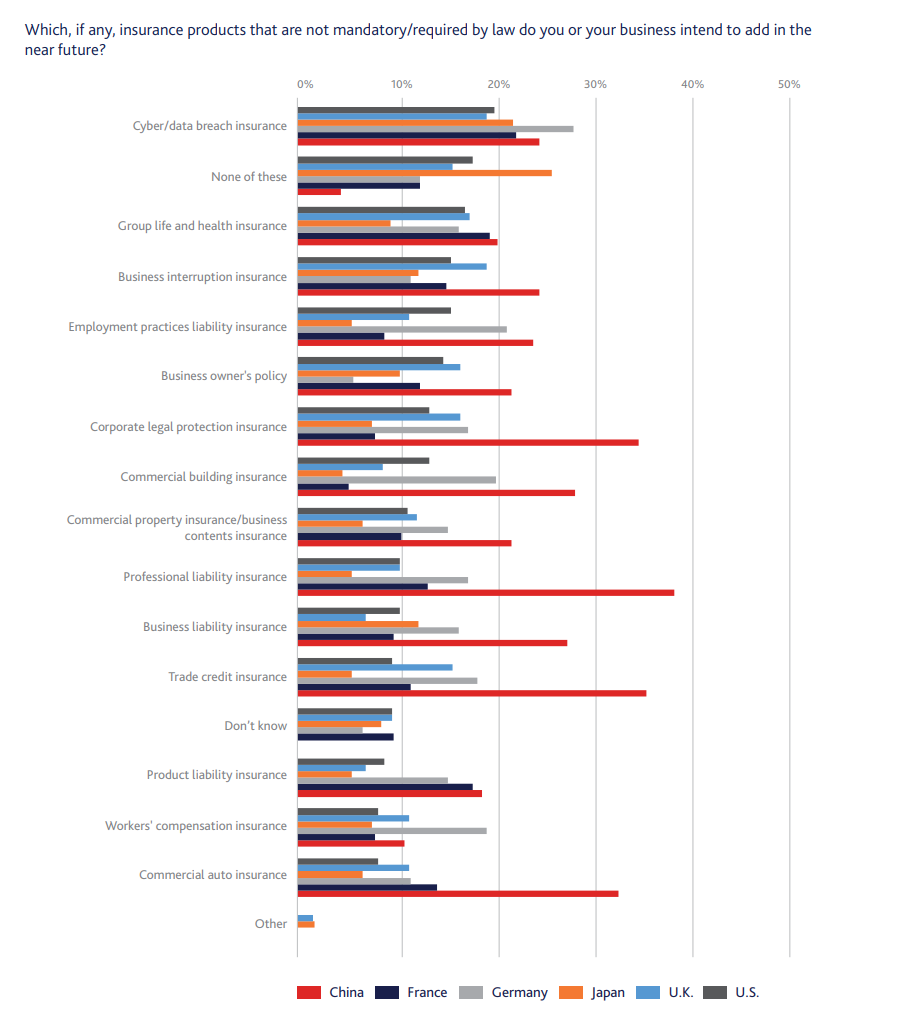
Figure 22 shows insurance products which our sample of about 600 SME commercial customers intend to add in the near future.
Chinese businesses stand out for their willingness to buy more insurance, especially professional liability, trade credit and legal protection insurance, with about 30–40% of companies stating this intention. German businesses also display a robust appetite for additional coverage. There is significant interest for additional cyber insurance in particular, from Germany (close to 30%), China, France and Japan (more than 20%).
FIGURE 22: INTEREST IN ADDITIONAL INSURANCE PRODUCTS (COMMERCIAL CUSTOMERS)
Source: The Geneva Association Global Customer Survey, powered by Dynata
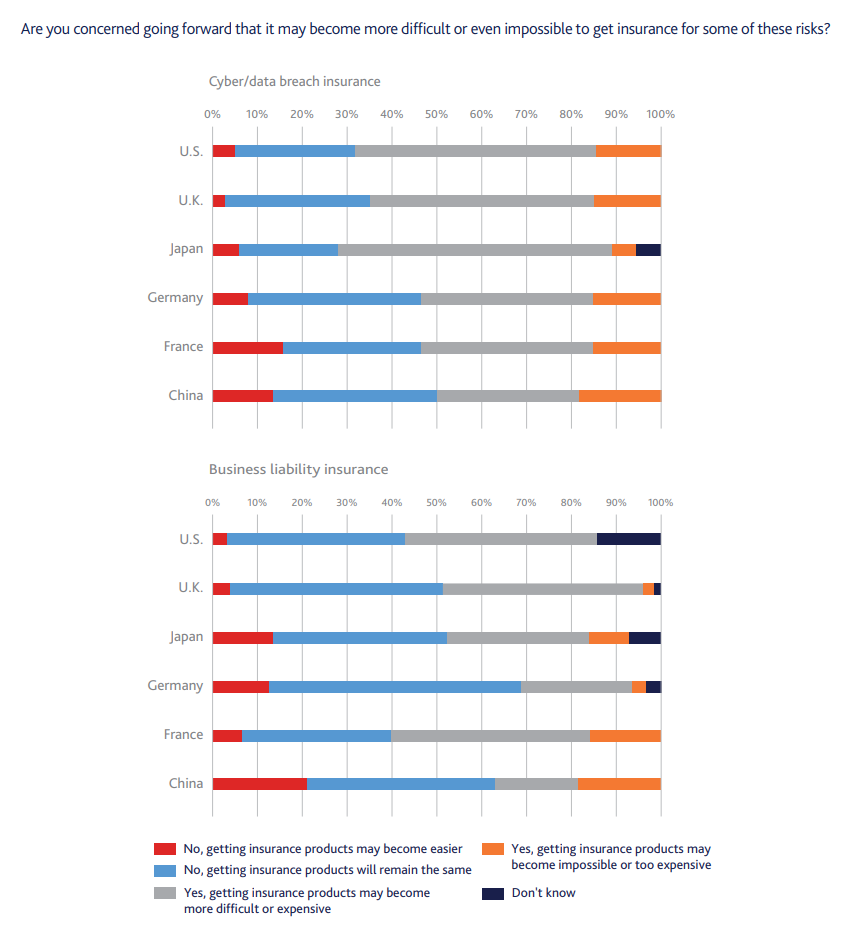
In terms of future availability and affordability of cover, respondents are most concerned about the prospects for cyber and business liability insurance. On cyber, more than 70% of Japanese businesses express concerns, in the U.S. and the U.K. about 65%. On business liability, almost 60% of U.S. and French respondents are worried; German businesses are less concerned (Figure 23).
FIGURE 23: CONCERNS ABOUT THE FUTURE INSURABILITY OF RISKS (COMMERCIAL CUSTOMERS)
Source: The Geneva Association Global Customer Survey, powered by Dynata
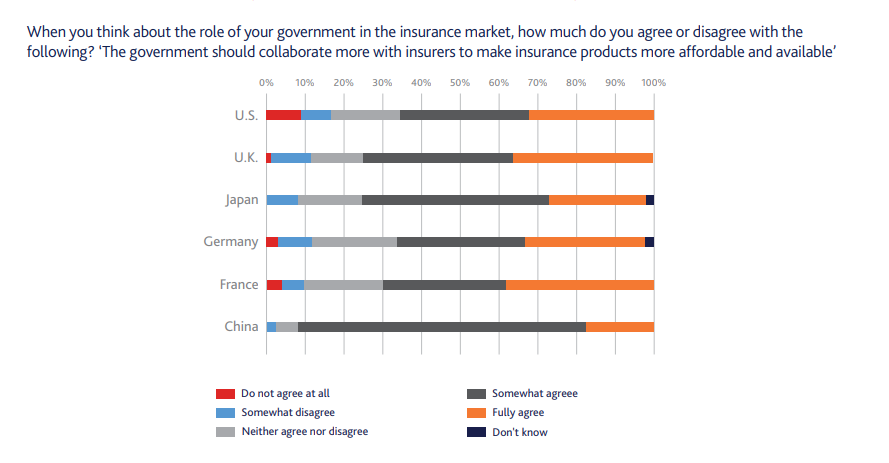
Across all countries, at least two thirds of canvassed firms believe that their governments should collaborate more with insurers to ease product affordability and availability issues (Figure 24). This opinion is strongest in China (more than 90% of respondents).
FIGURE 24: IMPROVING INSURANCE AFFORDABILITY AND AVAILABILITY THROUGH GOVERNMENT-INSURER COLLABORATION (COMMERCIAL CUSTOMER PERSPECTIVE)
Source: The Geneva Association Global Customer Survey, powered by Dynata
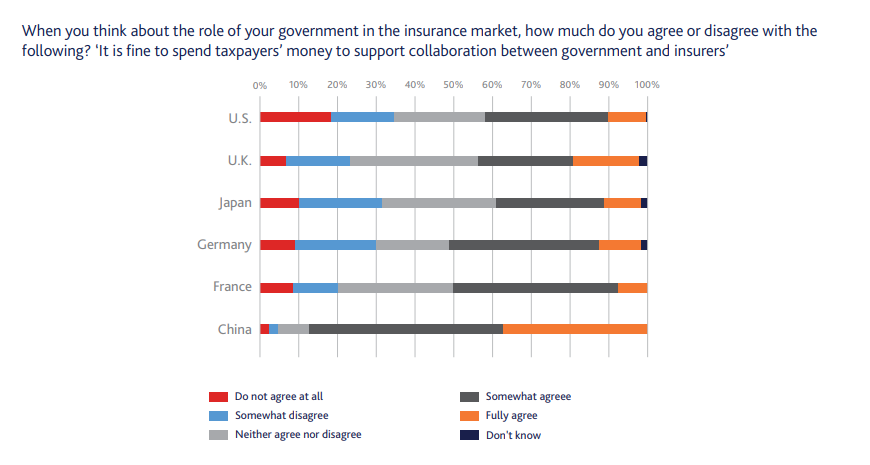
Almost 90% of Chinese companies think that it is worth spending taxpayers’ money on such collaborations. In all other countries, only about 40–50% of respondents share this opinion (Figure 25).
FIGURE 25: USE OF TAXPAYERS’ MONEY FOR GOVERNMENT-INSURER COLLABORATION (COMMERCIAL CUSTOMER PERSPECTIVE)
Source: The Geneva Association Global Customer Survey, powered by Dynata
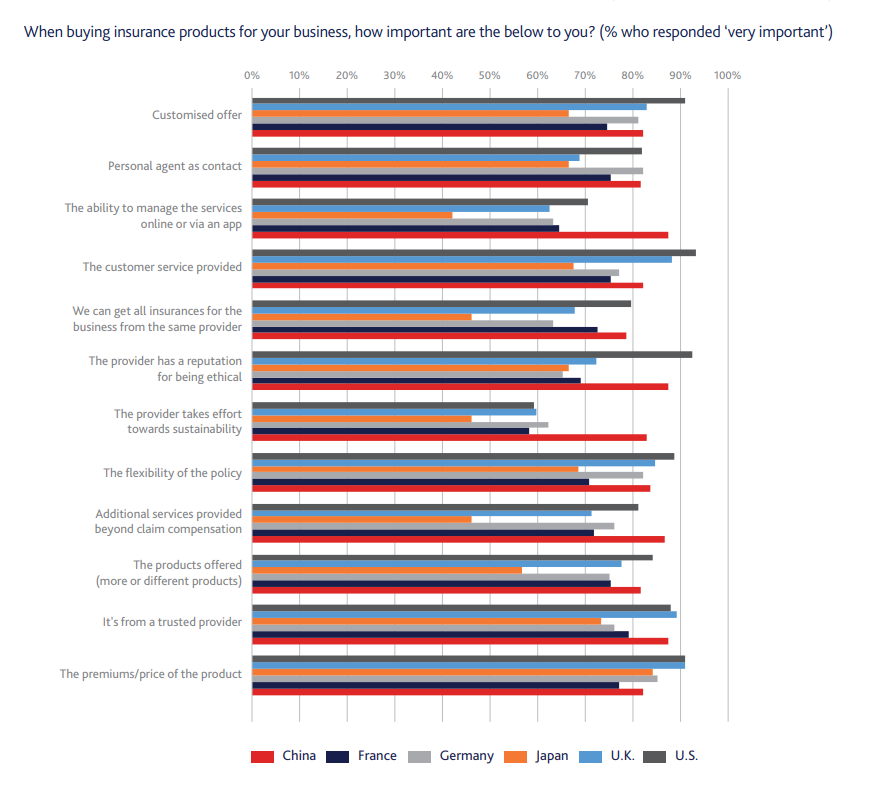
Figure 26 sheds light on the determinants of commercial customers’ buying decisions. Price and trustworthiness of the provider rank highest, especially in the U.S. (about 80–90% of respondents). Customer service and flexibility of the policy follow, again, most notably in the U.S.
Similar to the retail survey results, additional services beyond claims payments do not rank prominently. Dedicated efforts towards sustainability are ranked lowest.
FIGURE 26: CURRENT DETERMINANTS OF INSURANCE BUYING DECISIONS (COMMERCIAL CUSTOMERS)
Source: The Geneva Association Global Customer Survey, powered by Dynata
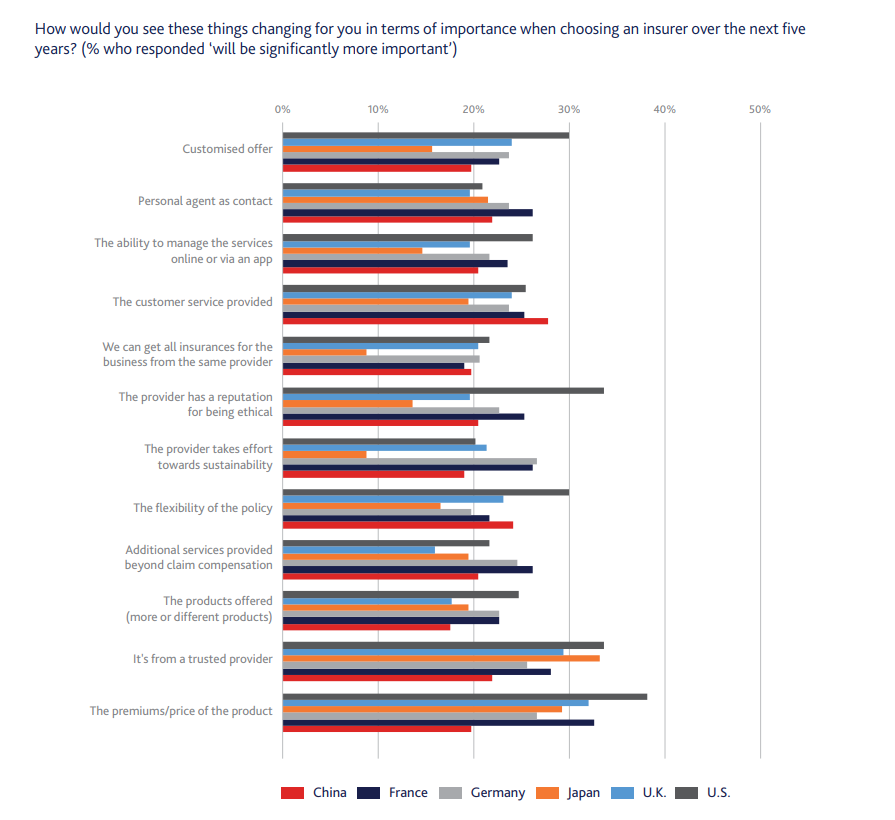
Over the next five years, price is the criterion that is expected to gain most in importance, particularly in the U.S., France and the U.K. The ethical reputation and trustworthiness of the provider is also expected to increase in importance in the U.S. Sustainability initiatives will increasingly determine buying decisions, specifically of German and French businesses (Figure 27).
FIGURE 27: FUTURE DETERMINANTS OF INSURANCE BUYING DECISIONS (COMMERCIAL CUSTOMERS)
Source: The Geneva Association Global Customer Survey, powered by Dynata
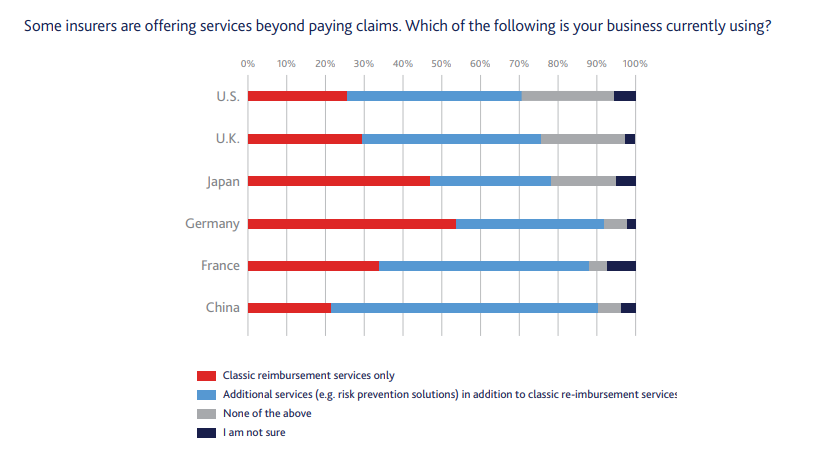
Figure 28 offers insights about customers’ general appetite for additional services beyond paying claims. More than 70% of all corporate respondents are using such services in addition to traditional risk transfer, with China leading the pack (about 90%). German and Japanese businesses are most reliant on classic reimbursement services only (about 50%).
FIGURE 28: USAGE OF INSURANCE SERVICES THAT GO BEYOND PAYING CLAIMS (COMMERCIAL CUSTOMERS)
Source: The Geneva Association Global Customer Survey, powered by Dynata
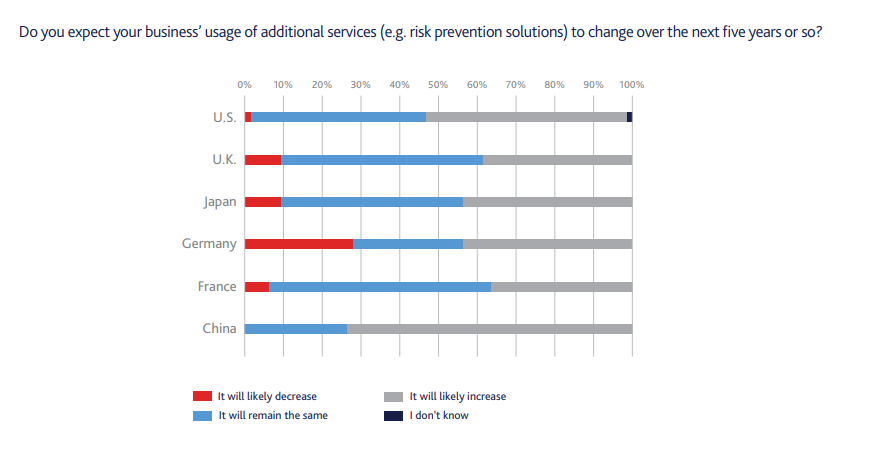
Going forward, the majority of commercial customers in China and the U.S. expect an increased usage of additional services (Figure 29).
FIGURE 29: FUTURE USAGE OF ADDITIONAL INSURANCE SERVICES (COMMERCIAL CUSTOMERS)
Source: The Geneva Association Global Customer Survey, powered by Dynata
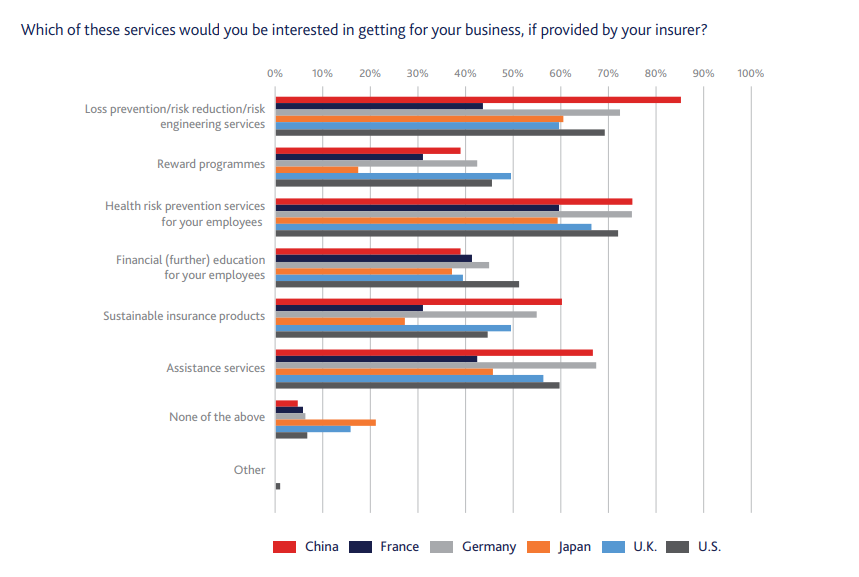
Figure 30 gives an indication of businesses’ interest in specific additional services. In general, there is a strong interest in property loss prevention, employee health risk prevention and post-event assistance services (35% and more), most notably in China (especially for loss prevention, almost 70% of respondents) and Germany (especially for employee health risk prevention, close to 60% of respondents). In these two countries, there is also a solid interest in sustainable products (about 45–50%), but considerably less so in Japan and France.
FIGURE 30: INTEREST IN ADDITIONAL INSURANCE SERVICES (COMMERCIAL CUSTOMERS)
Source: The Geneva Association Global Customer Survey, powered by Dynata
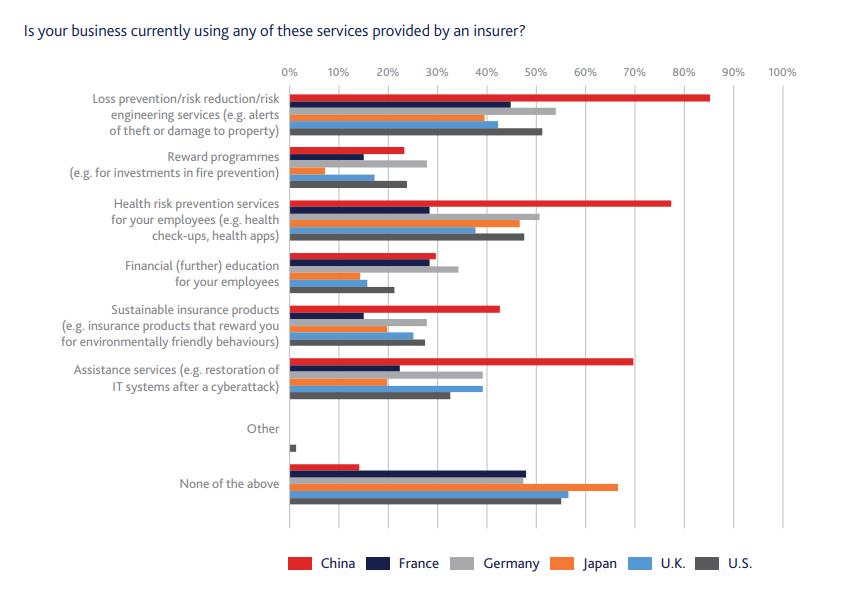
In terms of actual usage, Chinese businesses stand out, with more than 40–50% of respondents using property loss prevention, employee health risk prevention and assistance services. Usage by German and U.S. companies is solid, too (about 25–35%). Take-up in Japan is lowest for most services, with more than 40% not using any such services (Figure 31).
Relatively high levels of non-usage and strong levels of interest (Figure 30) suggest significant potential for such services. This is also true for sustainability-related services, in particular in Germany, the U.K. and the U.S.
FIGURE 31: CURRENT USAGE OF ADDITIONAL INSURANCE SERVICES (COMMERCIAL CUSTOMERS)
Source: The Geneva Association Global Customer Survey, powered by Dynata
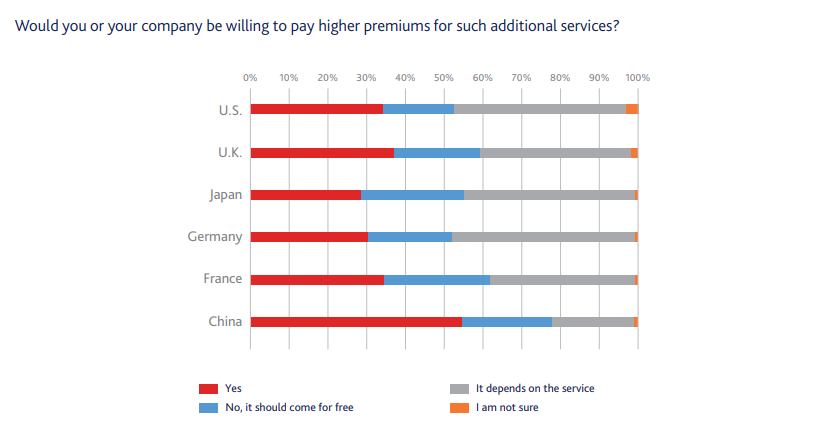
Figure 32 indicates businesses’ willingness to pay extra for additional services. Rates are highest in China and lowest in Japan and Germany.
FIGURE 32: WILLINGNESS TO PAY FOR ADDITIONAL INSURANCE SERVICES (COMMERCIAL CUSTOMERS)
Source: The Geneva Association Global Customer Survey, powered by Dynata
Figure 33 exhibits commercial buyers’ distribution preferences, again as a proxy for their preferred way of interacting Source: The Geneva Association Global Customer Survey, powered by Dynata with insurers.
For businesses in all markets, except for China and the U.K., personal channels are most preferred (around 40–50%). In the U.K., Japan and China, about 20–25% opt for online-only interaction, in the other markets even less. Hybrid approaches are popular in all markets, but least so in Japan. The personal element in value creation by commercial insurance therefore seems to be here to stay.
FIGURE 33: PREFERRED WAY OF BUYING INSURANCE (COMMERCIAL CUSTOMERS)
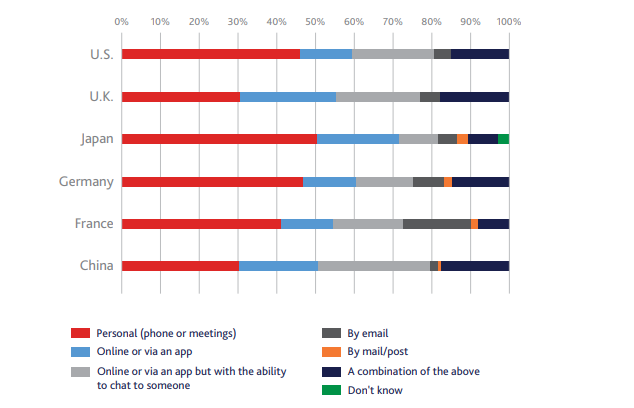
Source: The Geneva Association Global Customer Survey, powered by Dynata
The future promises elevated complexity, uncertainty and vulnerability due to geopolitical power shifts, rapid technological transformation, increasing interconnectivity and consequential dissemination of risk. Arising systemic risks, both tangible and intangible, cannot be diversified using traditional risk transfer mechanisms. The world was made aware of these limits to insurability during the COVID-19 pandemic. Even if not systemic in nature, intangible risks, which are growing rapidly in the digital economy, also pose fundamental insurability challenges, primarily due to the asymmetric distribution of information between insurers and insureds as well as fundamental difficulties in loss prediction and loss measurement.
These challenges necessitate some creative thinking about the insurance industry’s non-risk-bearing contributions to customers and society at large. We have shone the spotlight on additional risk services, product innovation in the context of sustainability and engagement with the public sector. Having said this, a stronger focus on risk prevention, advanced technologies and alternative sources of capital may enable insurers to maintain insurability even in the face of larger and less familiar risks. The robust development of global non-life insurance penetration (premiums as a share of GDP) over the past 10 years bodes well for the prospects of risk transfer.
The voice of the customer corroborates the main conclusions of this report: people and businesses are concerned about the future availability and affordability of certain types of insurance. They also want their insurers to collaborate more with governments to mitigate emerging insurability issues.
However, the survey results also suggest a sober and realistic perspective on additional risk services offered by insurers. On the one hand, levels of customer interest are significantly higher than levels of actual usage, indicating a certain potential for such services. On the other hand, the results suggest that that the current and future role of additional risk services as a determinant of insurance purchasing decisions should not be overestimated.
Risk transfer is expected to remain at the core of insurers’ customer and societal value. Having said this, insurers should respond to the increasing challenges to insurability by providing a broader spectrum of risk services in order to contain the cost of risk and respond to evolving customer needs. The determination and creativity with which they do so will allow insurers to convince customers of the value of these propositions and to monetise them.
Alex Research 2017.
Berliner 1982.
Brand Finance 2020.
Evans 2023.
Fell et al. 2022.
Frees 2014.
Gardener 2008.
McKinsey 2021.
OECD 2020.
PRI Association 2018.
RAND Corporation (n.d.).
Swiss Re 2017.
Swiss Re 2020.
Swiss Re 2023.
Sølvsten 2022.
Van Hulle 2020.