






  The Geneva Association
  • About us
    • Who We Are
    • Team
    • Board
    • History
    • Careers
    • Contact
  • Research topics
    • Macro & Geoeconomic Shifts
    • Climate Change & Environment
    • Population Health Trends
    • Demographic Transition
    • Digital & AI Transformation
    • Financial Inclusion
    • Public Policy & Regulation
    • Cyber
    • Evolving Liability
  • Publications
    • Research reports
    • The Geneva Papers
    • Articles
    • Annual reports
  • Events
    • Upcoming events
    • Summaries & Recordings
  • Awards
    • Women in Insurance Award
    • Ernst Meyer Prize
  • News & Media
Search
Subscribe
My Account Logout Subscribe
LinkedIn YouTube Instagram
Popular searches
Gen AI
Reports
Events
Financial Inclusion Conference
Women in Insurance Award
Geneva Papers
Webinar

Breadcrumb

  1. Home
  2. Events
  3. Financial Inclusion Conference 2026
Financial Inclusion Conference 2026

Financial Inclusion Conference 2026

Event | Mar 25, 2026 - Mar 26, 2026
  • Twitter
  • Linkedin
  • Email
  • Facebook

2026 年普惠金融大会 

Inclusive Insurance for a Resilient Future: Turning protection gaps into opportunities


Beijing, China, kindly hosted by PICC


Most internet browsers now support translation. In Explorer and Chrome, click the three dots in the upper-right corner and choose your translation preference.


Summary

The 2026 Financial Inclusion Conference of the Geneva Association, generously hosted by PICC in Beijing, brought together global, regional and national insurance leaders, policymakers, regulators and academics to address a central question: how can inclusive insurance scale to narrow today’s protection gaps?

Discussions converged on three priorities: learning from China’s rapid progress, understanding the macroeconomic benefits of insurance inclusion, and building commercially viable models. Speakers stressed that inclusive insurance must deliver on accessibility, affordability and sustainability while creating tangible value for both customers and providers.

China’s experience stood out. Strong public-private coordination and advanced digital infrastructure and ecosystems have enabled insurance to reach underserved populations at scale. Yet gaps remain widespread across regions and income levels, including in advanced economies. The overarching takeaway: Despite continued challenges, there is accelerating momentum, with inclusive insurance moving from the margins to the mainstream, developing into a core component of modern financial systems and a critical lever for resilience. 

 

Opening remarks – Jad ARISS

Jad ARISS, Managing Director, Geneva Association

Jad ARISS, Managing Director of the Geneva Association, opened the conference by framing financial inclusion as a rising priority for global insurers – and far more than a catchphrase. Access to affordable financial products and services underpins human dignity, poverty reduction, economic stability, and entrepreneurship and innovation. 

Around 1.3 billion adults worldwide still lack access to formal financial services, limiting their ability to manage risk, access credit, and build financial security. In this context, insurance has a vital role to play: helping households and businesses withstand shocks, recover faster, and participate more fully in economic life.

The barriers that continue to hold progress back include low financial literacy, lack of trust, regulatory constraints, and infrastructure gaps. Overcoming them will require coordinated action across the insurance industry, the broader financial sector,  policymakers and regulators. 


Keynote address – DING Xiangqun

DING Xiangqun, Chairperson & Executive Director, PICC

DING Xiangqun, Chairperson & Executive Director of PICC, reinforced inclusive insurance as a strategic pillar of economic resilience and social stability. She traced PICC’s history from 1949 to its current scale: 1.68 billion person-instances of inclusive coverage served annually and over CNY 170 billion in claims paid in 2025 alone. 

She identified four priority areas - agriculture, health and pensions, SMEs and disaster-risk management - and stressed that success requires balance: inclusive insurance must deliver social value while remaining commercially sustainable. For example: PICC’s agricultural insurance covers 45.78 million farm households a year; its Hao Yi Bao-style health products reach 86 million people, providing up to CNY 1 million in coverage for premiums of a few dozen to a few hundred renminbi per month. Innovation in product design and pricing is what makes both objectives achievable simultaneously.


Setting the stage – Kai-Uwe SCHANZ

Kai-Uwe SCHANZ, Director Financial Inclusion, Geneva Association

Kai-Uwe SCHANZ set the analytical foundation for the conference. Drawing on recent Geneva Association research, he showed that insurance reshapes risk management by reducing reliance on precautionary savings and debt and enabling faster recovery from shocks.  

Geneva Association survey data from major emerging economies identified healthcare costs as the primary household financial concern. Digitalisation is a powerful enabler but not a silver bullet: trusted, hybrid distribution, supportive public policy and regulatory frameworks are equally essential. Narrowing protection gaps requires an integrated approach, not isolated solutions.


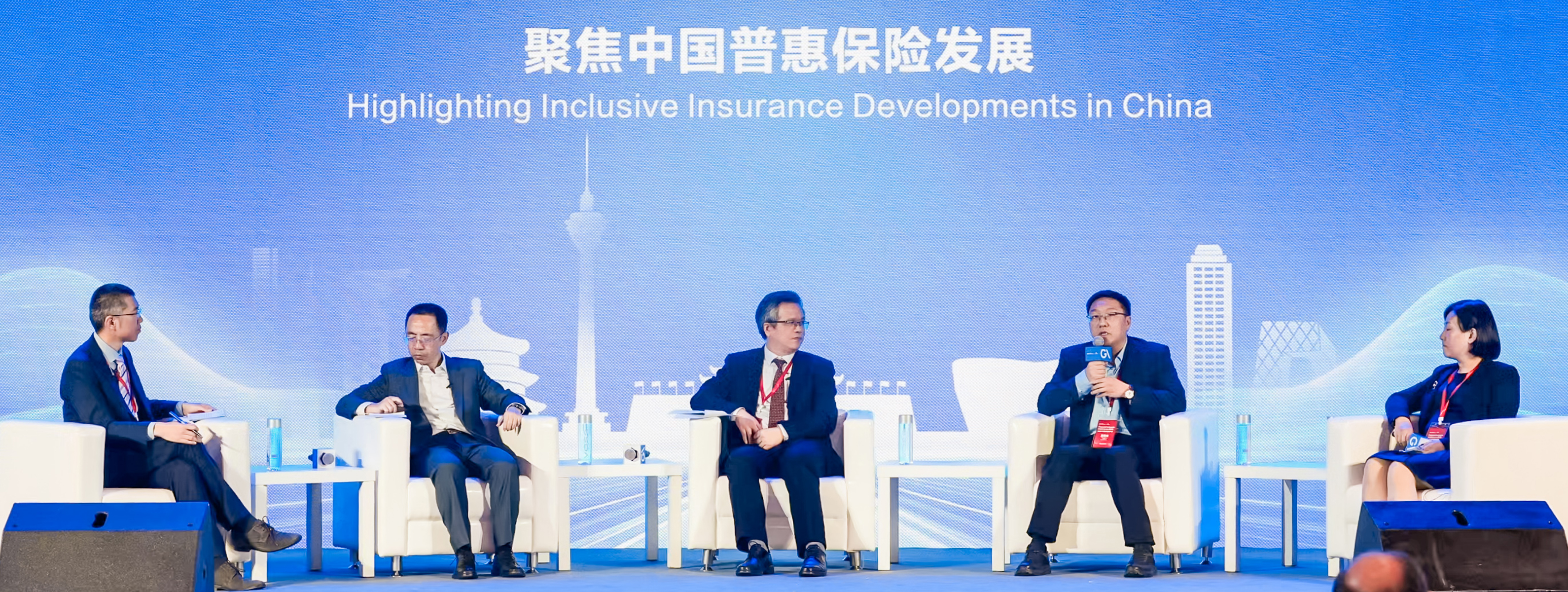
Panel 1 – Highlighting Inclusive Insurance Developments in China

JIA Ruo (Alex), Representative for China, Geneva Association (Moderator); ZHAO Yulong, President, Insurance Association of China; GONG Xinyu, Chief Business Officer and General Manager, Strategy & Training Department, PICC; PAN Gaofeng, Deputy General Manager & CTO, China Post Life; XING Li, Former Research Fellow, Renmin University and Former Head, Insurance Market Analysis, Swiss Re

The first panel explored how China has translated ambition into execution, identifying three structural strengths: nationwide distribution reach, effective state-market coordination and deep digital integration.

Scale functions as a risk management tool, not just a revenue driver. One insurer covers 400 million mu of farmland, roughly the size of the United Kingdom, across 46 million farm households, achieving a commercially viable combined ratio through geographic diversification, a 130,000-point rural service network and GIS-enabled underwriting. A postal insurer embedded products into 54,000 post offices and 450,000 rural stations, acquiring over ten million policyholders at near-zero cost. Critically, digital tools amplify but do not replace human service: a tiered model covering app self-service, video-assisted claims and dedicated telephone lines for over-60s ensures no segment is excluded.

The lesson: inclusive insurance scales when policy, market incentives and technology move together.  


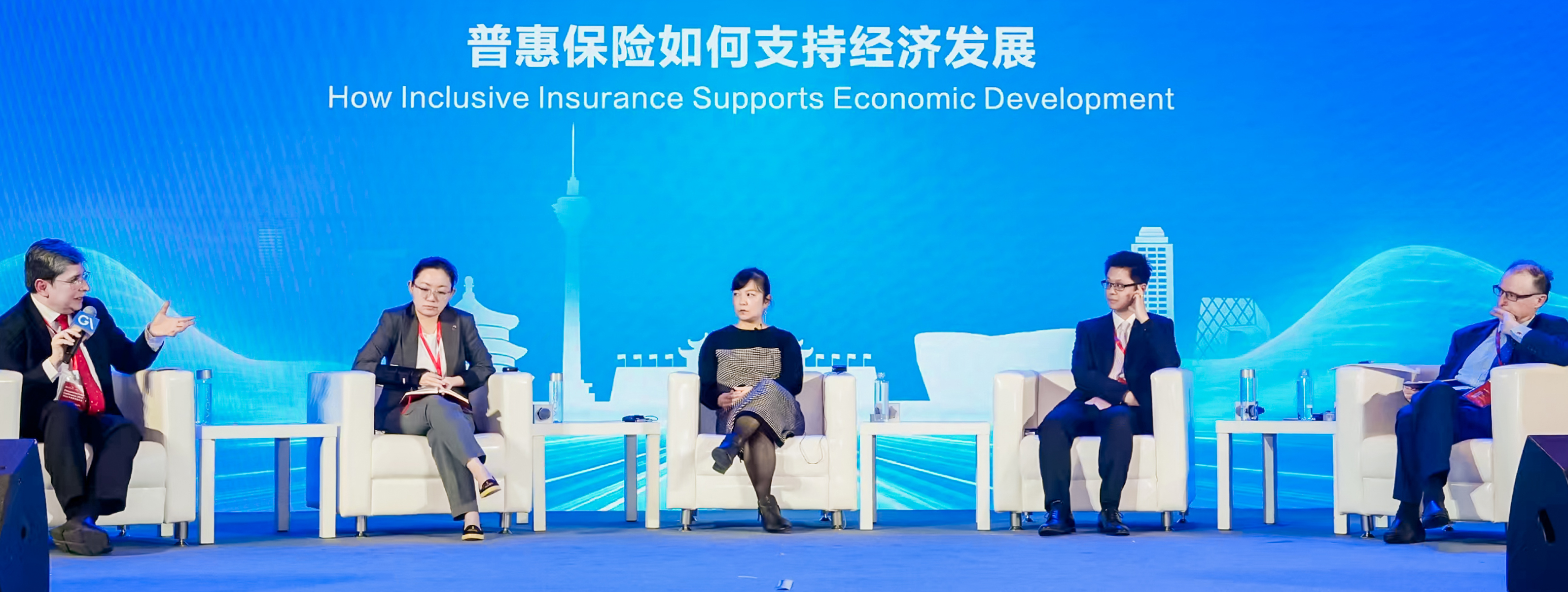
Panel 2 – How Inclusive Insurance Supports Economic Development

Arup CHATTERJEE, Unit Head, Capital Markets & Insurance Practice Team, Asian Development Bank; CHENG Min Hung, CEO, Global Asia Insurance Partnership; Uta SAOSHIRO, Director, Social Sustainability, Prudential plc; ZHU John, Chief Economist Asia-Pacific, Swiss Re; Darren PAIN, Director of Research, Geneva Association (Moderator)

The second panel made the macroeconomic case for inclusive insurance. Cross-country evidence showed that higher insurance penetration accelerates GDP recovery after major shocks: insured households restore consumption without depleting savings or taking on high-cost debt, insured collateral preserves credit availability and government fiscal capacity remains intact. Low insurance penetration, by contrast, creates a double shock: the loss event followed by fiscal drag.

Beyond stabilisation, insurance unlocks productive investment by improving the creditworthiness of SMEs, smallholder farmers and micro-entrepreneurs who would otherwise face prohibitive credit terms. Climate change is a structural demand driver; parametric insurance, i.e., automatic trigger-based payment without individual loss assessment, is particularly promising for agricultural and disaster contexts where traditional claims processing is too costly and slow.


Panel 3 – Making Inclusive Insurance Commercially Viable

 Amita CHAUDHURY, Group Head of Sustainability, AIA Group and Chair, UNEP FI PSI; JIANG Caishi, Executive Director & Vice President, PICC P&C; Pierre MARTELLY, Chief Insurance Officer, Asia, Generali; Michal MATUL, Head of Digital Health, Consumer Insights & Training, AXA EssentiALL; Kai-Uwe SCHANZ, Director Financial Inclusion, Geneva Association (Moderator)
 

The third panel addressed commercial viability from an international perspective. Panellists agreed that inclusive insurance can generate real returns, but only with sustained senior leadership commitment, a dedicated P&L structure and the patience to work through a three-to-five-year horizon before segment economics stabilise.

Three product principles that work: simplified standardised terms, distribution embedded in existing transactions and fast rule-based claims payment. One programme committing to five-day hospitalisation payouts found that reliable claims payment changed policyholder behaviour, reducing treatment delays and lowering average claim severity. Common failure modes, on the other hand, include underpricing without adequate data, designing products without understanding customer financial behaviour and treating inclusive insurance as marketing rather than a standalone P&L. 


Fireside Chat – Delphine TRAORÉ

Delphine TRAORÉ, CEO, General Insurance at SanlamAllianz

Delphine TRAORÉ, CEO of General Insurance at SanlamAllianz – the largest pan-African insurer across 26 countries – grounded the discussion in concrete African experience. She elaborated on parametric coverage for cocoa farmers in Côte d’Ivoire, distributed via a telecom’s mobile money service and paying out automatically against rainfall indices without farm visits. In Nigeria, a 60-second motor claims commitment, based on a photo via mobile, with up to USD 500 settled instantly, showed that payment speed is the most effective trust-building tool available.

Africa’s mobile money system, used by 700 million people without bank accounts, is a globally transferable distribution model for markets with high mobile penetration and limited traditional financial infrastructure.  

Government premium subsidies for agricultural insurance, already standard in China and India, represent the single most impactful untapped policy lever for Africa.  

African innovations – parametric design, telecom-enabled distribution and trust-through-speed – hold direct lessons for inclusive insurance worldwide.

Related Content

Cyber Conference 2026

Cyber Conference 2026

Nov 17, 2026
Conferences
Climate Change & Environment Conference 2026

Climate Change & Environment Conference 2026

Oct 27, 2026
Conferences
Health & Demography Conference 2026

Health & Demography Conference 2026

Sep 16, 2026
Conferences
Programme on Regulation and Supervision (PROGRES) 2026

Programme on Regulation and Supervision (PROGRES) 2026

Sep 02, 2026
Conferences
Financial Inclusion Conference 2026

Financial Inclusion Conference 2026

Mar 25, 2026
Conferences
Climate Change & Environment Conference 2025

Climate Change & Environment Conference 2025

Oct 29, 2025
Conferences

Related Content

Cyber Conference 2026

Cyber Conference 2026

Nov 17, 2026
Conferences
Climate Change & Environment Conference 2026

Climate Change & Environment Conference 2026

Oct 27, 2026
Conferences
Health & Demography Conference 2026

Health & Demography Conference 2026

Sep 16, 2026
Conferences
Programme on Regulation and Supervision (PROGRES) 2026

Programme on Regulation and Supervision (PROGRES) 2026

Sep 02, 2026
Conferences
Financial Inclusion Conference 2026

Financial Inclusion Conference 2026

Mar 25, 2026
Conferences
Climate Change & Environment Conference 2025

Climate Change & Environment Conference 2025

Oct 29, 2025
Conferences
The Geneva Association

Subscribe to our updates

About us

Research topics

Publications

Events

Awards

News & Media

Contact us

Terms & Conditions

Follow us on social media

LinkedIn Instagram YouTube

© Geneva Association

Admin

INSURANCE FOR A BETTER WORLD