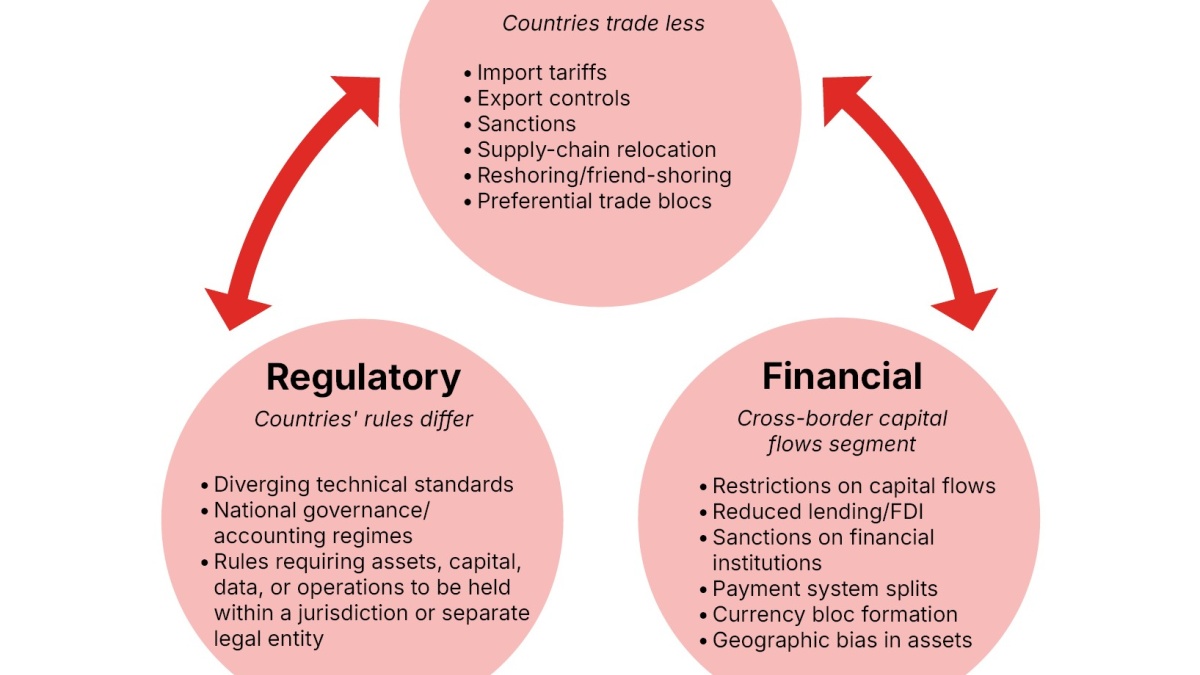


Macro & Geoeconomic Shifts

Dhar, S. and Pain, D. September 2026. Global Financial Fragmentation: Implications for the insurance and reinsurance industries. Geneva Association.
Geopolitical tensions are increasingly shaping international financial flows, regulatory frameworks, payment systems, and capital allocation, contributing to a gradual fragmentation of the global financial system and weakening cross-border financial integration.
Quantitative modelling of three scenarios shows financial fragmentation could affect re/insurers through reduced diversification benefits, less efficient cross-border risk transfer, more constrained investment opportunities, and greater liquidity and balance-sheet pressures.
The impact of financial fragmentation on re/insurers depends on its scale and form. Gradual and targeted fragmentation under the ‘Segmentation’ and ‘Reallocation’ scenarios may have manageable effects, while broader fragmentation combined with financial market stress in the ‘Amplification’ scenario could intensify losses, liquidity strains, and solvency pressures.
Re/insurers can strengthen resilience by adapting capital, liquidity, and reinsurance strategies. This could include updating investment and risk-transfer strategies, and pre-positioning capital within key markets.
Policymakers should prioritise maintaining international supervisory cooperation and preserving the infrastructure that supports cross-border risk sharing and financial stability.
This report examines how growing financial fragmentation, driven by geopolitical tensions and shifting economic relationships, could affect the global re/insurance industry. It explores how changes in capital flows, regulatory frameworks, payment systems, and investment patterns may influence insurers' ability to diversify risk, transfer exposures internationally, and manage their balance sheets. The report finds that financial fragmentation is unlikely to threaten the viability of international insurance markets, but it could reduce efficiency, increase regionalisation, and make the sector more vulnerable to periods of financial stress, particularly when fragmentation coincides with broader market shocks.
Insurance and reinsurance rely heavily on cross-border diversification, global capital markets, and international risk transfer networks. Financial fragmentation can reduce the ability of insurers to deploy capital efficiently, access reinsurance capacity, and diversify investment portfolios across jurisdictions. As a result, insurers may face higher costs, reduced flexibility, and increased exposure to local market shocks.
The report identifies several transmission channels through which fragmentation could affect insurers. On the liability side, weaker reinsurance links and reduced cross-border diversification may increase retained risk and claims volatility. On the asset side, greater investment home bias, reduced market liquidity, and higher funding and hedging costs could limit diversification opportunities and make balance-sheet management more challenging. These effects may become particularly significant during periods of financial market stress.
The report finds that different degrees of fragmentation have different consequences. Under the ‘Segmentation’ scenario, targeted fragmentation leads to localised increases in reinsurance prices and weaker recoverability without systemic disruption. Broader fragmentation in the ‘Reallocation’ scenario causes the more pervasive weakening of balance-sheet efficiency. However, broader fragmentation combined with a market shock in the ‘Amplification’ scenario could amplify existing vulnerabilities by restricting the movement of capital, collateral, and reinsurance capacity when they are needed most. Liquidity pressures and solvency concerns could become more pronounced across parts of the insurance sector under these circumstances.
The report suggests that insurers may need to adapt by strengthening liquidity management, diversifying reinsurance relationships, reassessing investment strategies, and pre-positioning capital within key markets. Reinsurers may also need to redesign operating models to function effectively in a more regionalised financial system. For policymakers, maintaining supervisory cooperation, supporting cross-border payment and settlement infrastructure, and preserving international risk-sharing mechanisms will be important to ensure resilience without losing the benefits of global financial integration.
Shamik Dhar, Director Economist, Deer Run Advisory
Darren Pain, Director of Research, Geneva Association
Geoeconomic fragmentation – the growing influence of geopolitical considerations on economic relations – is reshaping the global economy. As earlier Geneva Association analysis noted, this fragmentation to date has been most visible in more restrictive trade in goods and shifts in foreign direct investment as supply chains are reconfigured.1 The fallout on re/insurers has so far been modest, but the dynamic is now slowly extending further into finance. Regulatory divergence, the wider use of sanctions, changes to payment infrastructure, and shifts in capital allocation are all weakening cross-border integration in capital markets and financial intermediation.
For re/insurers – whose business models rely on international diversification, cross-border risk transfer, integrated investment markets, and dependable liquidity channels – these developments make financial fragmentation strategically significant. Payment systems, reserve allocation, reinsurance relationships, and capital flows may continue to reconfigure only gradually; however, a transition to a more financially fragmented system could prove especially challenging given increased financial leverage and the growing complexity of modern capital markets.
Official data show that the rapid expansion in crossborder financial positions during the ‘hyper-globalisation’ of the mid-1990s to the 2008 Global Financial Crisis has largely stalled (Figure 1). Since 2008, the ratio of global external assets and liabilities to world GDP has broadly plateaued, with some modest retrenchment recently. At this level of aggregation, clear signs of fragmentation along geopolitical lines are hard to detect.2 But investors are allocating less capital to countries with greater foreign-policy differences, and greenfield FDI between western countries has risen since 2016 while flows between the eastern and western blocs have declined.3
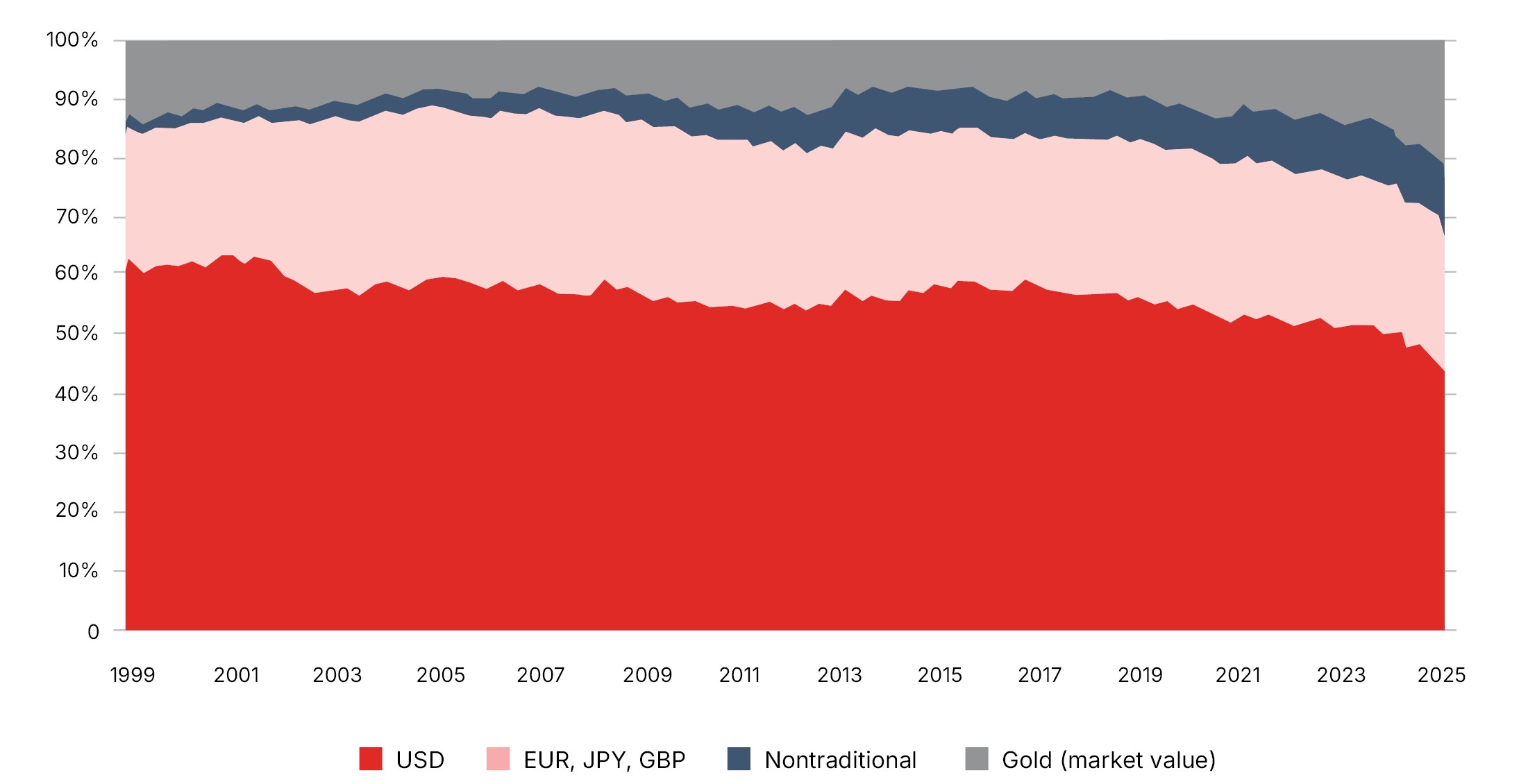
While the US dollar still dominates debt contracts and trade invoicing, its share of official reserves has declined as gold and non-traditional currencies have grown. Geopolitically distant countries are also increasingly invoicing trade in other currencies. The international monetary and financial system is ultimately underpinned by trust, and the world is, arguably witnessing the largest challenge to that trustbased system since World War II.
Financial plumbing once seen as neutral is increasingly used as a source of leverage: China and Russia are advancing their own payment systems, over 90% of Russia-China trade now settles in rubles and yuan, and stablecoins reduce dependence on the US banking system.4 Regulation is diverging again through localisation and ring-fencing rules and protracted country-level implementation of international frameworks such as Basel III and the Insurance Capital Standard. When capital movement requires political approval rather than responding to market forces, global integration loses efficiency by design.
Investors cutting exposure to politically distant countries would likely raise sovereign risk premia, especially for borrowers whose debt is already elevated. The aggregate global ratio of general government gross debt to GDP approached 94% in 2025 and is set to exceed 102%, driven by significant increased indebtedness among advanced economies, especially the US.5 While domestic investors (including central banks) are typically the largest holders of their countries' sovereign bonds, international and foreign creditors are highly influential in setting pricing and yields because they often absorb the marginal issuance.6
FIGURE 1: INTERNATIONAL FINANCIAL INTEGRATION BY GEOPOLITICAL ALIGNMENT (% OF WORLD GDP)
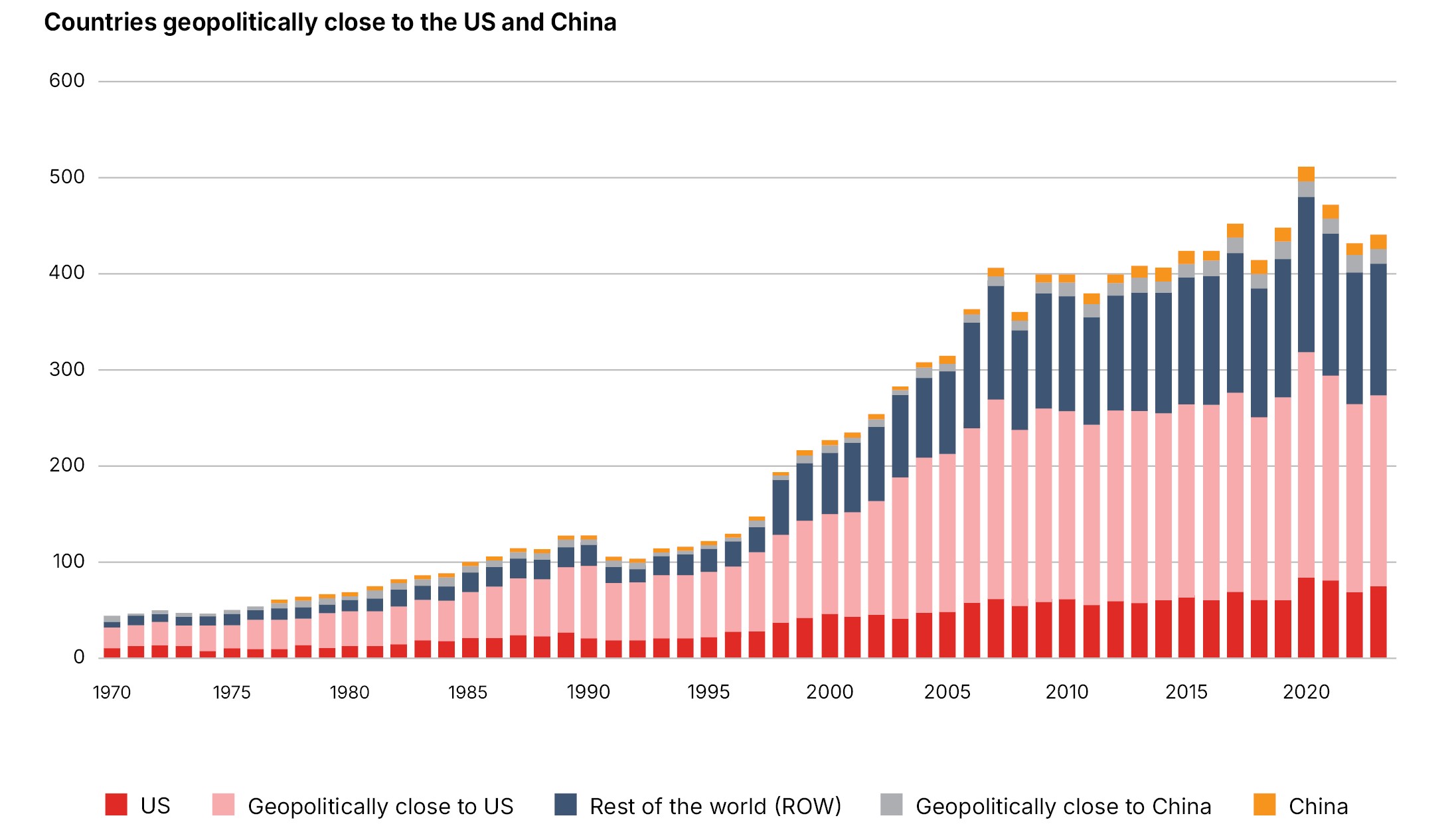
Notes: The chart plots the sum of the stock of total gross external financial assets and liabilities relative to world GDP. Latest observation: 2023. US Geopolitically close to US Rest of the world (ROW) Geopolitically close to China China Geopolitical alignment based on UN voting patterns.
Source: CEPR7
Fragmentation can affect both sides of re/insurers’ balance sheets and the networks through which risk is pooled and transferred. We identify four transmission channels (Figure 2).
FIGURE 2: FRAGMENTATION TRANSMISSION CHANNELS
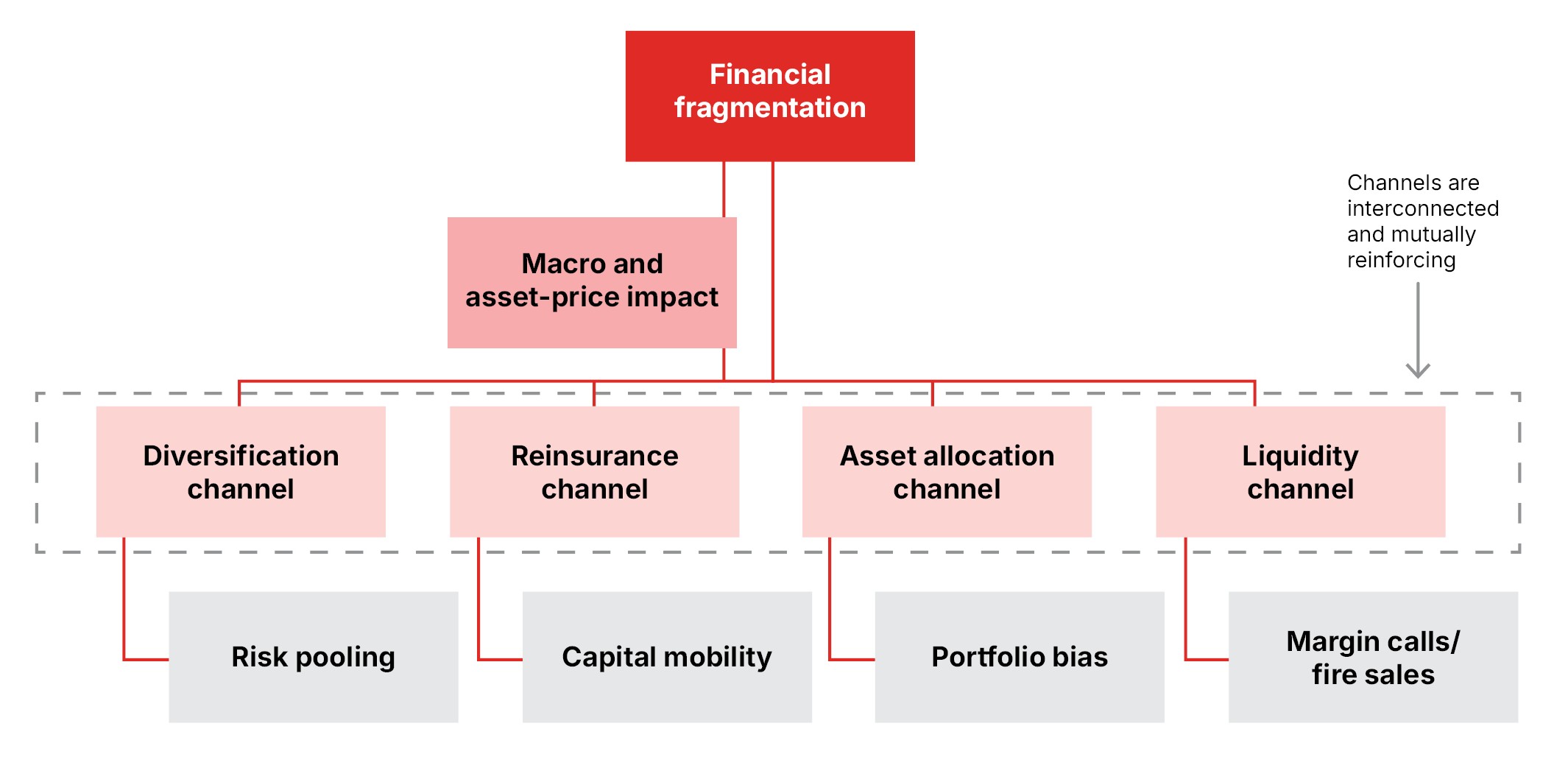
Source: Geneva Association
TABLE 1: SUMMARY OF THE SCENARIOS
| Scneario | Read-world interpretation | Main model mechanism | Intended insights |
|---|---|---|---|
| Segmentation Targeted rival-bloc fragmentation | Geopolitical/regulatory restrictions on rival-bloc re/insurance | Rival-specific geopolitical capital, and settlement wedges | Fragmentation can localise capacity and pricing effects without system-wide stress |
| Reallocation Broad-based fragmentation | Gradual reorientation of capital, portfolios, and reinsurance relationships across blocs | Wedges across all blocs plus binding global reinsurance capacity | Fragmentation reallocates risk-bearing capacity and reduces efficiency of global risk pooling |
| Amplification Disorderly fragmentation | Structural fragmentation as in Scenario 2 plus sudden market stress event | Broad wedges plus rate/ spread shock, stress dynamics, and market depth effects | Fragmentation can amplify balance sheet stress when liquidity and capital buffers are strained |
Source: Geneva Association
Liquidity, duration, and balance-sheet dynamics: Segmented financial markets make it harder to access foreign currency funding, mobilise cross-border collateral, and deploy derivatives margining. When rates rise, surrender incentives increase and liability duration shortens; in a fragmented environment, the asset-side adjustment is slower and more constrained, linking duration gaps to liquidity pressure, fire-sales, and falling asset prices. Hidden leverage and valuation uncertainty in alternative assets add to potential illiquidity-induced solvency strains.
We develop a small analytical model with three regions – Home, Partner, and Rival – and three modules: reinsurance capacity and cross-border risk transfer; primary insurer balance sheets and liquidity; and macro-financial asset pricing and market liquidity. Financial fragmentation enters through frictional ‘wedges’ – e.g. prudential divergence, capital localisation, settlement frictions, FX funding fragmentation, and geopolitical risk premia. The model does not forecast; it runs stylised experiments across three progressively stronger scenarios (Table 1).
Scenario 1 – Segmentation: Fragmentation is concentrated on the Rival bloc, which has a small footprint in cross-border re/insurance. Rival reinsurance capacity declines by around 35% and prices rise by around 8% – against an average annual change of 1–4% globally over the past 30 years. Home and Partner blocs remain stable, and balancesheet effects are contained: capacity becomes more segmented rather than reallocated. Pricing and capacity are affected without market-wide instability.
Scenario 2 – Reallocation: All country blocs face frictions, and a binding global reinsurance constraint forces active reallocation of risk-absorbing capacity. Rival reinsurance business falls by around 30%, much of it relocating to Home, where capacity rises by over 15%. Prices rise around 7% in Rival but fall 3% in Home and 0.5% in Partner, showing regional divergence rather than a uniform increase in the cost of protection. Capital buffers erode modestly by -1.5 to -2.5%, and duration gaps widen everywhere.
Scenario 3 – Amplification: Broad-based fragmentation coincides with a shock to interest rates and credit spreads. Liquidity pressures rise sharply as surrenders and collateral demands increase; forced sales depress asset prices in shallower markets; capital deteriorates, further raising surrenders; and rapid recapitalisation follows. Insurance capital in the Rival bloc falls by up to 90% initially, implying emergency capital injection, group support, or regulatory intervention. Global balance sheets can no longer efficiently absorb local shocks.
In a fragmented system, global diversification, flexible capital allocation, and access to deep international markets must be balanced against reduced capital fungibility, impaired cross-border risk transfer, and greater liquidity and settlement risk. Strategic responses by re/insurers need to move from a model of global efficiency toward resilient regional optimisation. These potentially include:
Policymakers face a trade-off between domestic resilience and international risk sharing. Capital localisation and restrictions on cross-border activity may strengthen local stability but reduce diversification, increase the cost of insurance, and widen protection gaps, with the biggest consequences for those with limited financial buffers. Specific priorities include maintaining supervisory cooperation (equivalence, mutual recognition, information-sharing on crossborder groups); safeguarding interoperable payment and settlement infrastructure on which premiums, claims, and recoveries depend; and coordinating more closely between industry and policymakers on capital and liquidity frameworks and cross-border crisis management.
The path to global economic integration is not linear. It evolves in response to changing political priorities, shifting patterns of power, and unexpected crises. Today, geopolitical considerations are increasingly reshaping economic and financial relationships and challenging the international economic order that has prevailed since World War II.
The world is not retreating from global finance overnight. Rather, there are growing signs of financial fragmentation. The share of central bank foreign-exchange reserves held in US dollars is declining. Foreign direct investment is shifting towards geopolitically aligned countries. The direction is clear: investment and financial flows are becoming increasingly influenced by geopolitical considerations.
Our 2025 report on geoeconomic fragmentation examined how shifts in global trade and supply chains are impacting the insurance industry. This study builds on that foundation by exploring the implications of financial fragmentation for insurers. Financial fragmentation makes it more difficult and more expensive to transfer risks and to move capital across geographies. It reduces access to cross-border reinsurance, makes international risk-sharing less efficient, and reduces flexibility in insurers’ balance sheets. And these effects could become more significant under a scenario of wide financial-market stress.
In this context, preparation is more important than prediction. Insurers and reinsurers need to reconfigure risk-transfer approaches, adapt capital structures, reposition investment strategies, and strengthen liquidity and balance-sheet resilience. For policymakers and regulators, it is essential to maintain cross-border supervisory cooperation, safeguard payment and settlement infrastructure, and strengthen dialogue more broadly with the industry. This will enable the insurance industry to continue helping economies withstand shocks in an increasingly uncertain world.
Jad Ariss
Managing Director
Geoeconomic fragmentation – the growing influence of geopolitical considerations on economic relations – is reshaping the global economy. As earlier Geneva Association analysis noted, this has so far been most visible in more restrictive trade in both intermediate and final goods, as well as shifts in foreign direct investment as supply chains are reconfigured. The dynamic is now extending further into finance, albeit slowly. Regulatory divergence, the wider use of sanctions, changes to payment and settlement infrastructure, and shifts in capital allocation are all contributing to financial fragmentation, which weakens cross-border integration in capital markets and financial intermediation.
Although the US dollar remains the dominant international currency, geopolitical considerations are playing a larger role in reserve allocation, trade invoicing, and regulatory alignment. Financial orders have shifted before, but a transition to a more fragmented system could prove especially challenging given two other prevailing trends: increased financial leverage, including on sovereign balance sheets, and the growing complexity of modern capital markets. In particular, the expansion of market-based finance, greater use of alternative assets, and increasing reliance on collateralised and derivative-based transactions have created new channels through which market stress can propagate across balance sheets. For re/insurers – whose business models rely on international diversification, cross-border risk transfer, integrated investment markets, and dependable liquidity channels – these developments make financial fragmentation strategically significant.
Building on the 2025 Geneva Association report Insurance in a Fragmented World Economy, this study develops a quantitative framework to examine the implications of financial fragmentation for the insurance sector. The framework links three core elements of the insurance system: reinsurance capacity allocation across jurisdictions, primary insurers’ balance-sheet management, and the behaviour of asset prices, interest rates, and market liquidity. In this setting, financial fragmentation enters as a series of frictions affecting capital mobility, the cost and availability of reinsurance, and asset portfolio allocation.
This approach makes it possible to trace and quantify how changes in the geometry of financial fragmentation impact re/insurers’ balance sheets. On the liability side, weaker cross-border diversification and less effective reinsurance increase retained risk, raise net claims volatility, and reduce the efficiency of global risk transfer. On the asset side, greater home bias in investments, higher hedging costs, lower market liquidity, and more constrained portfolio adjustment reduce diversification benefits and increase exposure to local interest-rate and credit-spread movements. The modelling framework is especially valuable in showing how these channels interact rather than operate in isolation.
The analysis of three selected scenarios shows how the impact of financial fragmentation depends significantly on its breadth and whether it is accompanied by market stress. Under a targeted fragmentation scenario (‘Segmentation’), the principal effect is a selective withdrawal of reinsurance capacity from geopolitically distant markets. The immediate consequences are localised increases in reinsurance prices, weaker recoverability, and somewhat higher retained risk in affected jurisdictions, while the broader system remains largely intact. Balance sheet effects are therefore concentrated rather than systemic: underwriting becomes less efficient where capacity is withdrawn, but capital and liquidity pressures elsewhere remain limited.
Under a broader fragmentation scenario (‘Reallocation’), geopolitical rivalry has far-reaching effects on the configuration of financial intermediation. The key issue is no longer only the loss of risk-absorbing capacity in one part of the system but the reorganisation of global capacity across country blocs. Reinsurance and investment flows shift towards politically aligned markets, cross-border diversification becomes less effective, and insurers’ capital becomes less fungible at the group level. The result is a more pervasive weakening of balance-sheet efficiency: retained exposures rise more broadly, reinsurance recoverables become a less reliable stabiliser, asset portfolios become more concentrated, and the mismatch between the location of liabilities and the availability of capital becomes more pronounced. However, even broad-based splintering in capital flows and the resulting decline in the global integration of financial markets and systems would have manageable, if undesirable, consequences for re/insurers.
More severe outcomes arise in a disorderly fragmentation scenario (‘Amplification’), where structural segmentation coincides with a broader financial market shock. In this case, fragmentation acts less as a standalone source of loss than as an amplifier of stress. Higher interest rates and wider credit spreads reduce asset values as policy surrender incentives, margin calls, collateral demands, and funding needs increase. If liquidity buffers prove insufficient, insurers may be forced to liquidate assets in shallower markets, further weakening valuations and potentially straining their solvency positions. The impairment of cross-border adjustment mechanisms is central: capital, collateral, and reinsurance capacity become less mobile precisely when they are most needed.
The future path for financial fragmentation is highly uncertain. Increasingly, the evidence points to a structural change in the financial architecture rather than a temporary disturbance that will eventually unwind. As a result, international re/insurers must adapt by reconsidering reinsurance and capital structures, investment strategies, liquidity management, and governance arrangements. This includes pre-positioning capital within certain jurisdictions and reconfiguring their international operations. More generally, re/insurers should stress test their balance sheets beyond financial variables to include sanctions regimes, reinsurance enforceability, and diversification failure under fragmentation scenarios.
Policymakers, for their part, face the task of strengthening domestic resilience without unduly weakening the cross-border risk-sharing, supervisory cooperation, and financial infrastructure on which the efficiency of international insurance markets depends. International insurance markets are likely to remain viable in a more fragmented world, but they may become less efficient, more regionalised, and more vulnerable to episodes of financial strain unless firms and authorities adjust to preserve resilience while safeguarding the core benefits of international integration.
An earlier Geneva Association report outlined the potential impact of deglobalisation on the insurance industry.1 It argued that global events and geopolitical upheavals, from the COVID-19 pandemic to the US-China trade conflict and the Russia-Ukraine war, have prompted a shift away from free trade and globally integrated supply chains in favour of greater national security and localisation. The formation of a new US government in 2025 and the subsequent escalation in trade barriers have reinforced the backlash against globalisation and international economic integration.2
So far, the implications for the world economy have been relatively modest. GDP growth has remained robust, belying concern that the sharp increase in tariffs on the trade of goods between selected countries would disrupt production and hit real incomes. However, the latest conflict in the Middle East could yet interrupt energy and supply chains and seriously weaken global economic prospects. Even if geopolitical tensions do not escalate further, concerns persist that the world is on the cusp of a major reconfiguration in trade and finance – especially if restrictions are broadened to include services, and associated capital/investment flows lead to a more regionalised international financial system.
Conceptually, geoeconomic fragmentation refers to the process whereby economic relations become increasingly shaped by geopolitical considerations.3 Trade, financial, and regulatory fragmentation can be understood as separate but potentially interconnected forms of this broader geoeconomic fragmentation. While analytically distinct, they often reinforce one another through sanctions, trade restrictions, investment screening, standards divergence, and other policy measures (Figure 1.1).
An escalation in tariffs and other measures affecting trade disrupts cross-border commerce and may encourage firms and governments to reconfigure supply chains. As trade barriers rise, regulatory fragmentation may intensify through export controls, sanctions, investment screening, subsidies, and divergent standards. These measures may, in turn, contribute to financial fragmentation by limiting capital and investment flows, weakening the incentives for cross-border finance, and making trade harder to fund and settle. The result is a cycle that potentially reinforces itself in which geopolitical tensions and policy divergence split trade, capital, and production networks into discrete country blocs.4
FIGURE 1.1: FORMS OF GEOECONOMIC FRAGMENTATION
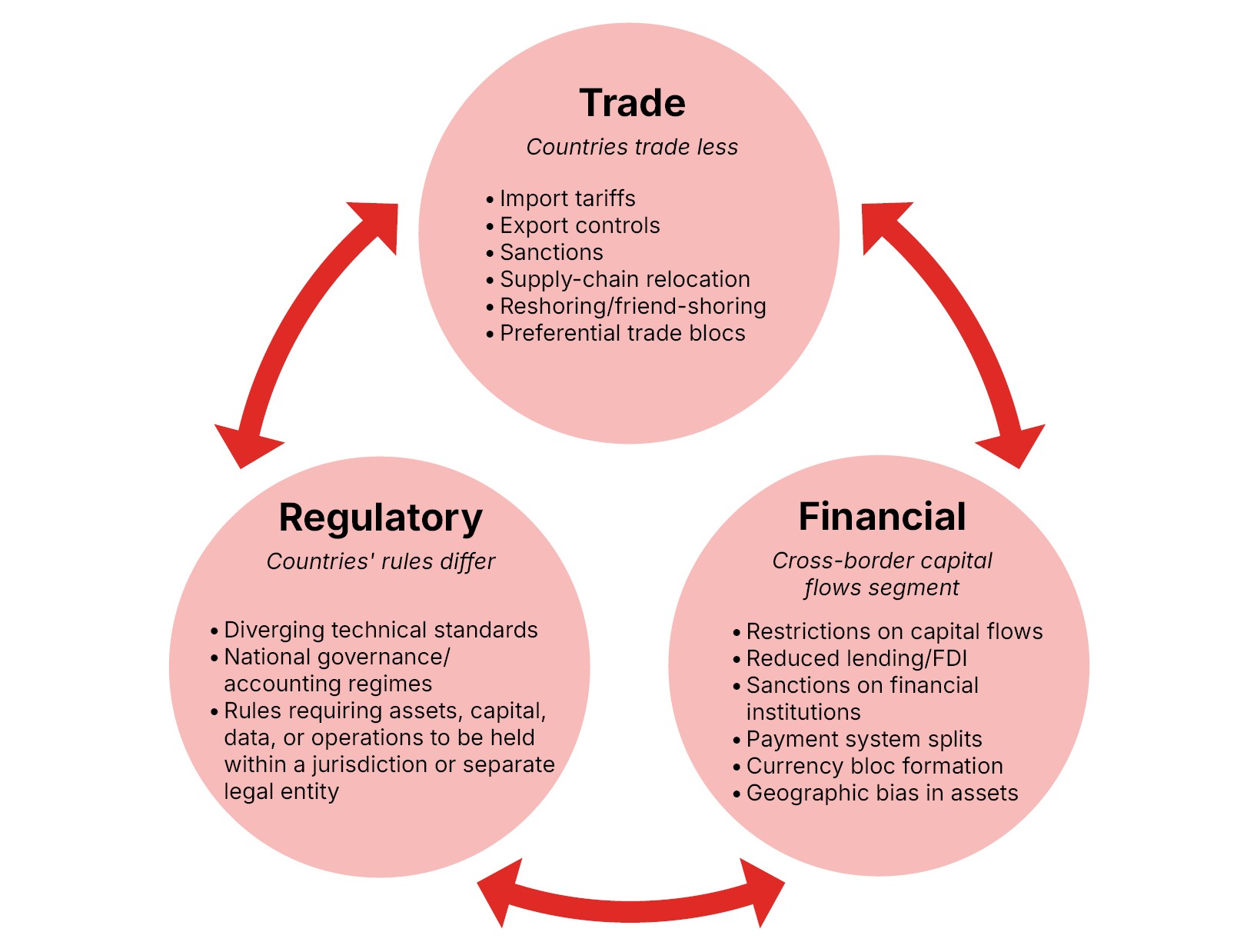
Source: Geneva Association
Financial fragmentation concerns the weakening of cross-border integration in capital markets and financial intermediation in response to geopolitical shifts. More broadly, it translates into a departure from the benchmark model of fully integrated international capital markets. In that highly stylised world, capital flows freely across borders in search of the highest risk-adjusted return. One global risk-free interest rate anchors asset pricing, and cross-country differences in returns reflect only systematic (i.e. non-diversifiable) risk premia.
Of course, in practice, financial markets do not operate seamlessly; they are segmented by regulation, institutional design, information frictions, political constraints, and dominant currency regimes. Over recent decades, the global economy moved closer to the integrated benchmark. The question now is whether that process has stalled or even started to reverse.
Financial fragmentation is not a single policy or market outcome. In practice, it can emerge through several overlapping mechanisms that affect the movement of capital, risk, collateral, payments, and financial services across jurisdictions. These mechanisms differ in both form and intensity, and isolating their effects is challenging.5 Some are explicitly policy-driven, including regulatory restrictions on cross-border financial activity, sanctions, capital controls, or localisation requirements. Others arise indirectly through the development of jurisdictions’ financial systems, changes in market behaviour – such as shifts in investor preferences away from politically distant jurisdictions – reduced willingness to rely on foreign counterparties, or concerns about the resilience of international payment and settlement infrastructure.
Increased financial fragmentation also need not imply the collapse of global finance. The future pathways are myriad, depending on the underlying drivers and the fungibility of existing international financial architecture. For example, financial flows could become increasingly influenced by political alignment, sanctions regimes, security considerations, and regulatory compatibility without a major rupture. Likewise, payment systems, reserve allocation, reinsurance relationships, and capital flows may evolve toward partially distinct blocs rather than a single, fully integrated system.
Geoeconomic fragmentation has so far largely manifested as more restrictive trade in goods (both final and intermediate) and associated shifts in foreign direct investment as supply chains have been reconfigured. The financial fallout on the re/insurance sector has been relatively modest, partly because the macroeconomic effects of trade fragmentation have so far also been limited. Protectionist policies have led more to the rerouting of supply chains than to the absolute decoupling of trade, limiting the impact on the frequency and severity of insurance claims.6
Indeed, trade fragmentation opens business opportunities for some insurers. Most obviously, political risk and cyber insurance may see increased demand as multinational companies move from treating geopolitical exposure as episodic to embedding it permanently within risk-management frameworks.7 Geopolitical realignment could also catalyse new insurable risk categories. For example, the push for energy independence could spur demand for specialised engineering insurance, while industrial policy initiatives, including the US CHIPS and Science Act, European sovereignty investment programs, and rising defence spending, are generating substantial new property and infrastructure exposures.8
However, if trade barriers were extended to include financial services, and cross-border capital flows became more constrained, the implications for re/insurers would be considerably greater. A more regionalised international financial system, characterised by segmented capital markets, payment systems, and reserve assets, would interact with two other prevailing trends: increased financial leverage, including on sovereign balance sheets, and the growing complexity of modern capital markets. In particular, the expansion of market-based finance, the increasing use of alternative assets, and the greater reliance on collateralised and derivative-based transactions have created new channels through which financial market stress can propagate. For re/insurers, whose business models depend on long-term investment portfolios, cross-border risk transfer, and effective liquidity management, these developments increase the potential for financial fragmentation to amplify balance sheet pressures.
While most insurance policies are typically not written across borders, insurance is inherently a global business. International carriers – especially reinsurers – rely on their ability to diversify risks across policyholders from different countries, deploy capital flexibly across jurisdictions, and manage exposures through globally diverse financial markets. Even domestically focused insurers count on internationally integrated capital markets to invest policyholder funds, manage asset duration and credit exposures, and access reinsurance capacity to lay off unwanted risks. They may also rely on international investors to source their own debt and equity capital to support their balance sheets beyond the technical reserves they build up to pay future claims.
This is not just a theoretical concern. Besides the Geneva Association, several insurers have identified geopolitical shifts as a first-order strategic issue for the sector. For example, a recent report by Allianz highlighted how moves towards a more fragmented global economy are making risk environments more complex, challenging cross-border business models, and weakening traditional diversification benefits.9 Insurance supervisors also perceive the potential impact of geoeconomic fragmentation on financial markets to be in the medium-to-high range, albeit most individual risks are viewed as having a medium-to-low impact (Figure 1.2).10
FIGURE 1.2: SUPERVISORY PERCEPTIONS OF THE RISKS ASSOCIATED WITH GEOECONOMIC FRAGMENTATION (% OF SURVEY RESPONDENTS)
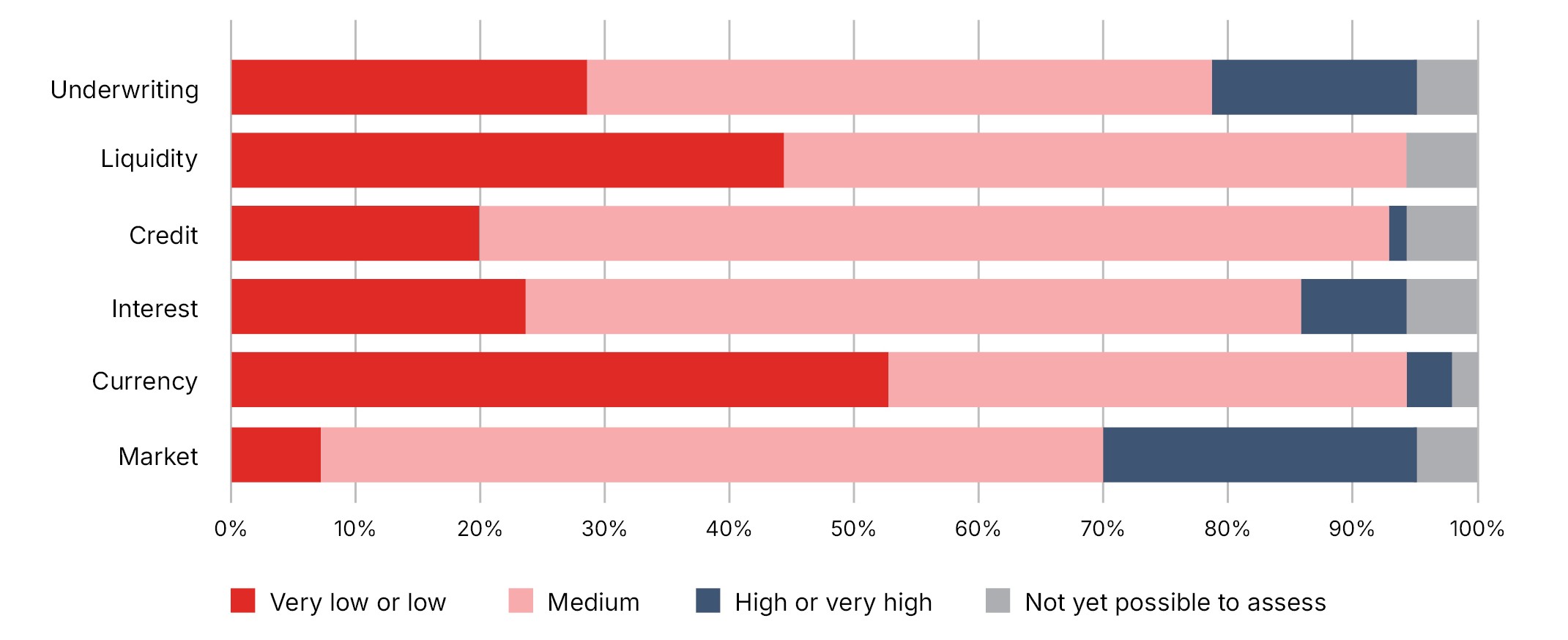
Note: Based on a sample of 35 national insurance supervisors. Survey responses are weighted by insurance market size.
Source: IAIS11
This report builds on the Geneva Association's earlier work on geoeconomic fragmentation, particularly in the use of scenario analysis. That earlier paper mapped three pathways of rising severity: gradual regionalisation, escalating fragmentation, and full bifurcation of the global economy into antagonistic blocs. Like that analysis, this study treats fragmentation as a continuum, not a binary shift from globalisation to autarky.
The present analysis narrows the lens to financial and re/insurance markets. Trade and financial fragmentation are connected, but they need not evolve at the same pace. Trade flows can be redirected more readily than the underlying financial infrastructure underpinning global payments, settlement, reserve management, and risk transfer. Because modern finance remains deeply embedded in US-led institutions and contractual networks, a sudden breakdown of the existing international financial architecture is less plausible than a gradual increase in financial frictions.
The scenarios in this study therefore adapt the earlier geoeconomic framework to investigate increasing degrees of financial fragmentation, from targeted restrictions to the broader regionalisation of financial markets and disorderly fragmentation with market stress. They deliberately exclude complete financial autarky or a collapse of the international monetary system. Such outcomes are not impossible, but they sit in the extreme tail of the distribution of potential outcomes and are outside the study‘s focus.
This report first examines the macro-financial drivers of financial fragmentation, including changes in crossborder capital flows and payment systems. It then asks how a less integrated international financial system could affect re/insurers’ balance sheets, liquidity, and investment allocation. Specifically, it develops a small analytical model and uses scenario analysis to assess three related questions: which transmission channels matter most for the re/insurance sector; how large the potential effects could be under plausible fragmentation pathways; and under what conditions financial fragmentation could materially impair efficient risk transfer. On that basis, the report discusses the associated strategic, policy, and regulatory issues facing the insurance sector should financial fragmentation pressures intensify, before offering some concluding remarks.
Once characterised by deepening integration, expanding cross-border capital flows, and increasingly interconnected financial markets, the global financial system is now showing signs of increased fragmentation shaped by strategic rivalry.12 Rising geopolitical tensions, economic security concerns, and the strategic use of financial networks have prompted states to reassess their participation in global finance.13 Viewed through a geoeconomic lens, this shift highlights how governments are increasingly leveraging financial institutions and infrastructures, as well as market access, as instruments of power and statecraft.
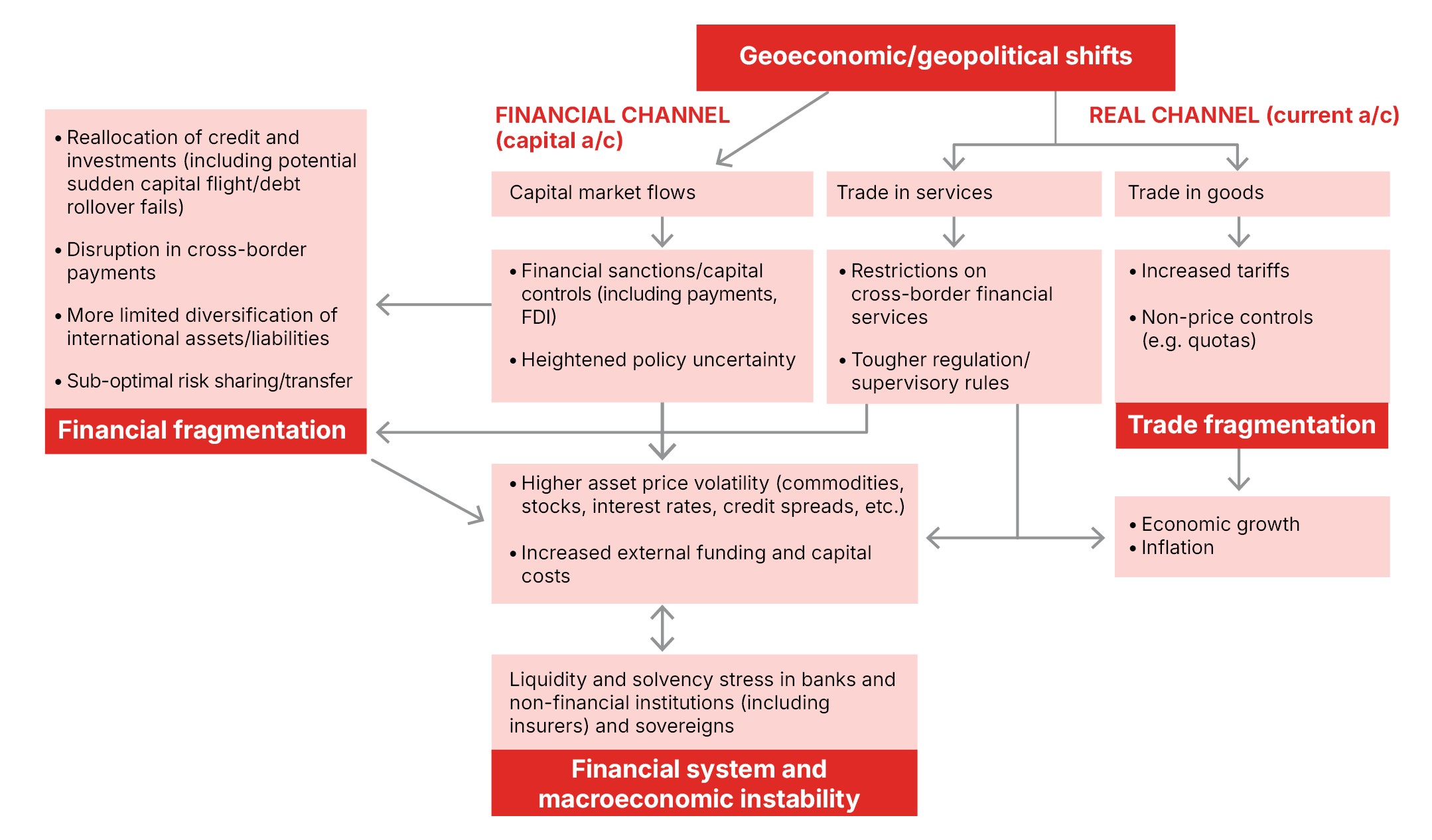
FIGURE 2.1: GEOECONOMIC FRAGMENTATION AND MACROECONOMIC STABILITY
Source: Adapted from IMF 2023
Global trade and financial markets are deeply connected. Any import or export of goods and services implies a currency (capital flow) transaction in the opposite direction.14 However, international trade patterns can be associated with different configurations of associated finance depending on institutional, geopolitical, and market conditions.
Although trade and financial markets are closely connected, fragmentation in one does not automatically imply fragmentation in the other. Tariffs and other trade barriers may increase while international capital continues to flow relatively freely. Financial fragmentation becomes more economically significant when geopolitical tensions begin to impede cross-border capital allocation, financial intermediation, and payment systems. In those circumstances, international risk-sharing becomes less effective, financing costs increase, and capital is allocated less efficiently across countries.
Most obviously, additional restrictions on trade in financial services (including re/insurance) trap capital and liquidity within local markets, raising the costs of cross-border transactions while potentially exacerbating inflation and reducing economic efficiency. More generally, a move away from a unipolar, US dollar-centric system towards a multipolar, regionalised, or bloc-based structure could translate into increased asset market volatility with knock-on implications for macroeconomic stability (Figure 2.1).
2.2.1 Gross capital flows matter but are difficult to track
As discussed in Box 1, accurately measuring financial fragmentation is challenging. While gross trade flows – imports and exports of goods and services – are relatively direct (albeit, often mediated through complex supply chains), gross capital flows are large, complex, and frequently difficult to track, at least in the aggregate statistics. This is especially so if they involve multiple intermediaries (e.g. correspondent banks, offshore financial hubs, etc.).
A further complication is that the structure of financial intermediation often breaks the assumed alignment between geography, currency, and risk-bearing capacity. Some researchers argue that focusing solely on net capital flows can obscure the role of gross cross-border flows intermediated by global financial institutions.15 Prior to the Global Financial Crisis (GFC) in 2008–2009, for example, European banks intermediated large volumes of US dollar funding into US securitised credit markets – flows that were largely invisible in net current account balance of payment positions but critical in shaping overall credit conditions.
This distinction between net and gross flows is particularly relevant in assessing financial fragmentation. Even if net capital flows remain stable, fragmentation may still occur if gross flows become increasingly concentrated within geopolitical blocs or if cross-border intermediation relies on fewer global balance sheets.
Box 1: Measuring financial fragmentation
Measuring financial fragmentation is not straightforward, especially considering the complex nature of modern international finance. Most obviously, official data on countries’ external assets and liabilities and associated financial flows (for example, those used to construct balance of payments and international investment position statistics) are typically compiled on a residency basis. This means they record transactions between residents of a country (or economic area) and non-residents (the rest of the world) during a given period.
However, such an approach fails to capture the underlying economic ownership or control of the assets/liabilities, which is crucial in mapping external risks and financial dependencies.16 Multinational firms and financial institutions often operate across jurisdictions, and debt contracts are frequently denominated in international currencies that extend well beyond national borders.17 As a result, net capital flows may conceal large gross flows that materially affect leverage, liquidity, and financial vulnerability.18
For the insurance sector, this distinction is particularly relevant. Re/insurers frequently operate through offshore subsidiaries and deploy intra-group reinsurance vehicles as well as cross-border collateral arrangements. Moreover, onshore and offshore insurance centres play an outsized role in sourcing risk-absorbing capacity (i.e. technical reserves and capital) from around the globe to support crossborder re/insurance programmes. For example, close to half of premiums written in the London company market relate to risk exposures outside of the UK and Ireland (Figure B.1). This adds to the empirical challenges in measuring the effects of financial fragmentation on the re/insurance sector.
FIGURE B.1: LONDON COMPANY MARKET OVERALL PREMIUM IN 2024, BY TERRITORY (GBP BN)
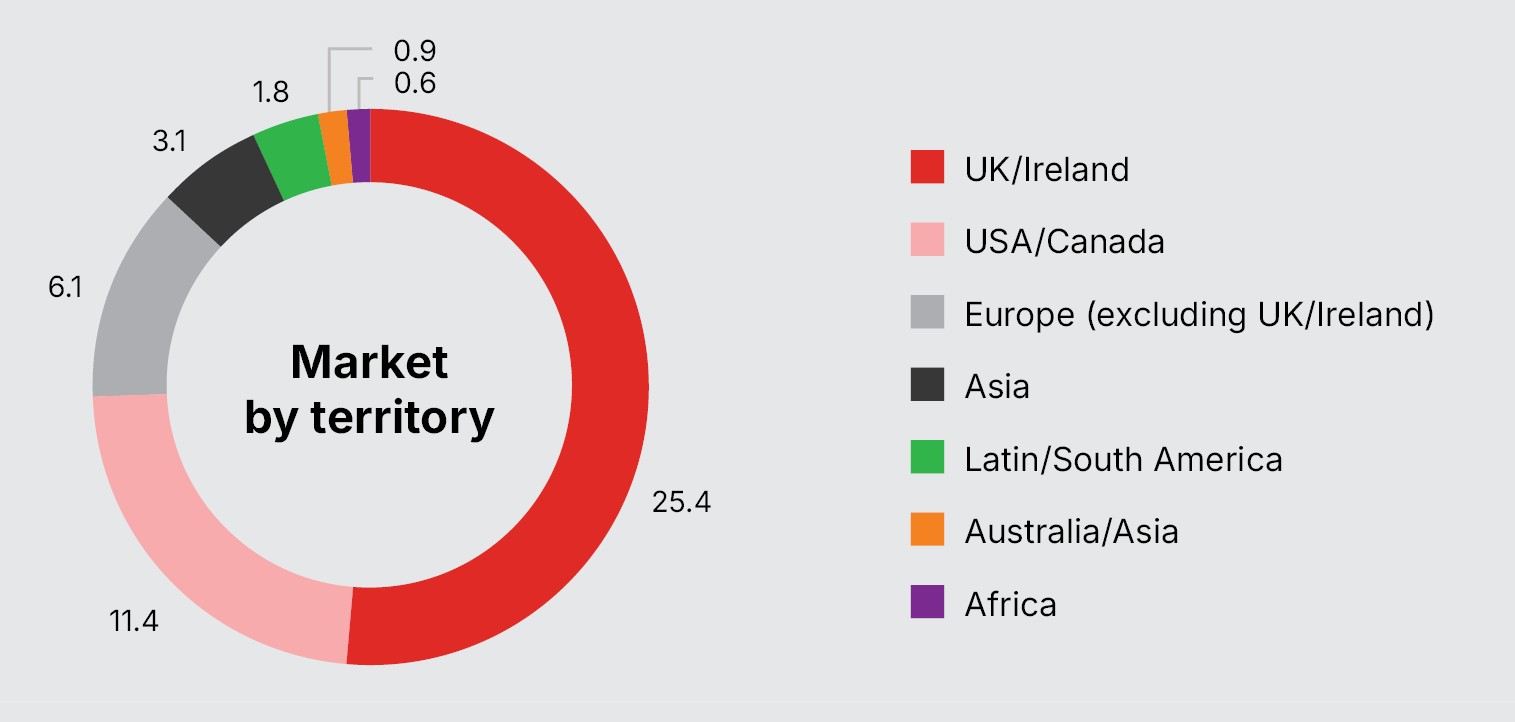
Based on companies in London providing international and wholesale re/insurance coverage (excluding managing agencies operating in the Lloyd’s market). The data refer to both business written in London and ‘controlled premium’, which is written in other locations but overseen and managed by London operations.
Source: International Underwriting Association
Source: Geneva Association
2.2.2 The official data can still be informative
Official data on external assets and liabilities provide useful evidence on the evolution of international financial integration. Figure 2.2 shows that the rapid expansion in cross-border financial positions observed during the period of 'hyper-globalisation' from the mid-1990s until the Global Financial Crisis has largely stalled. Since 2008, the ratio of global external assets and liabilities to world GDP has broadly plateaued, with some evidence of modest retrenchment in recent years. This pattern closely mirrors the slowdown in international trade integration over the same period.
FIGURE 2.2: INTERNATIONAL FINANCIAL INTEGRATION BY GEOPOLITICAL ALIGNMENT (% OF WORLD GDP)
Notes: The chart plots the sum of the stock of total gross external financial assets and liabilities relative to world GDP. Latest observation: 2023. Geopolitical alignment based on UN voting patterns.
Source: CEPR19
Looking at data at this broad level of aggregation, it is hard to detect clear signs of global financial fragmentation along geopolitical lines. However, more direct evidence of financial fragmentation emerges when one examines the direction of cross-border financial flows rather than aggregate external positions. Investors generally allocate a smaller share of capital to recipient countries that have greater differences in foreign policy compared to their country of origin (Figure 2.3, left panel). Likewise, greenfield FDI flows – foreign investments made by companies to build new or extend existing production capacity – between western countries have been on the rise since 2016, while flows between the eastern and western blocs have declined (Figure 2.3, right panel).
FIGURE 2.3: EFFECTS OF FINANCIAL FRAGMENTATION ON CROSS-BORDER INVESTMENTS
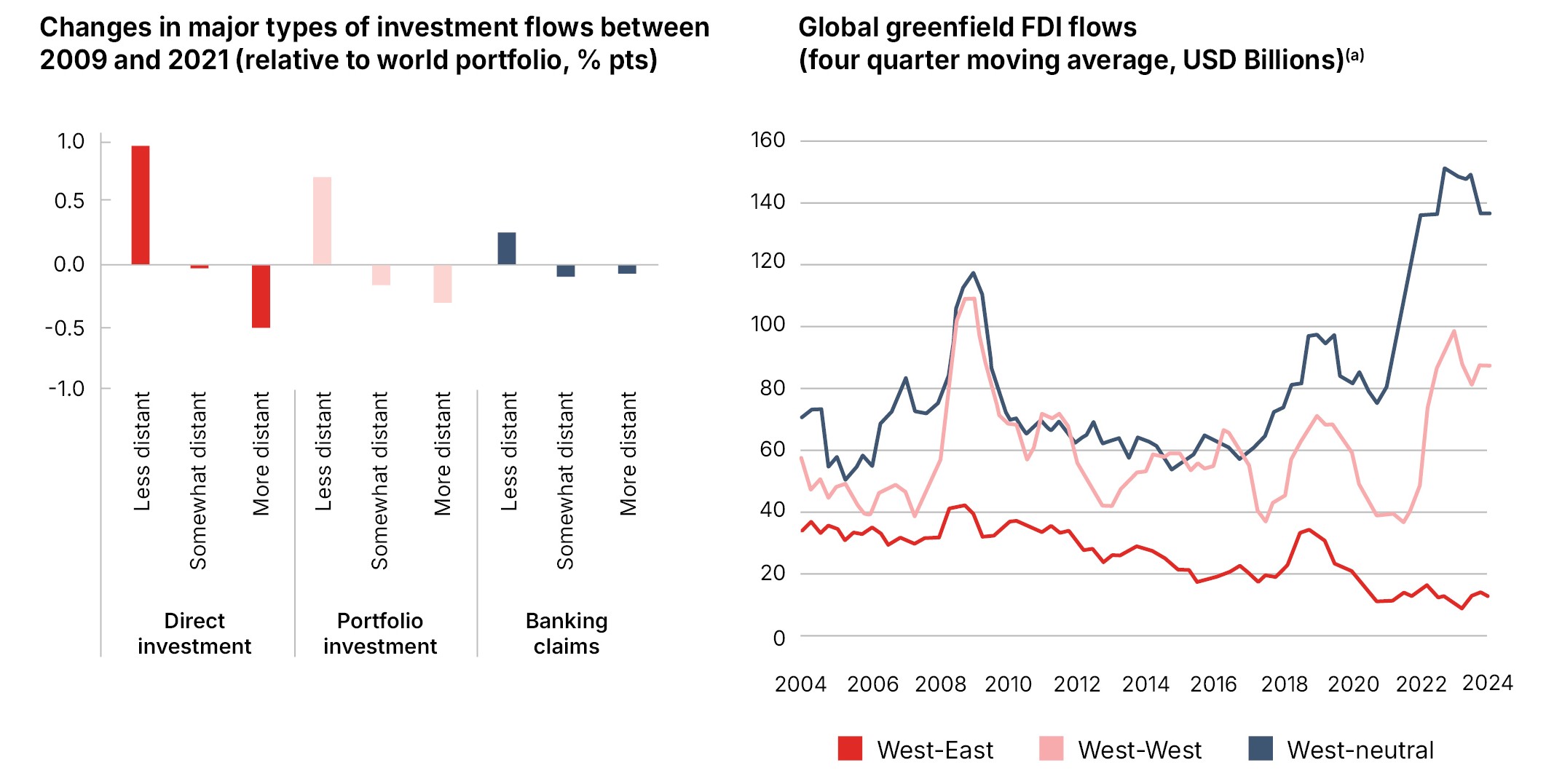
(a) The three distinct blocs – a 'western' (US-centric) bloc, an 'eastern' (China-centric) bloc, and a 'neutral' bloc comprising non-aligned countries – is based on the ECB’s geopolitical index. Details of the index are outlined in Besten et al. 2023.
Source: IMF and ECB20
2.2.3 A source of geopolitical risk premia
Deteriorating international relations could encourage investors to reduce exposure to politically distant countries.21 In a more fragmented financial system, such portfolio shifts would raise volatility in government bond markets and increase sovereign risk premia, especially where public debt levels are already elevated. In 2025, the global ratio of general government gross debt to GDP approached 94% and is set to climb further to over 102%, driven by significant increased indebtedness among advanced economies, especially the US.22
Across major advanced economies, yield curves have steepened over recent years, accompanied by widening interest rate swap spreads, broadly capturing rising credit risk and funding pressures in the financial system. According to the IMF, fiscal considerations have increasingly driven such moves, with swap spreads exhibiting strong co-movement with projected average budget balances.23
While domestic investors (including central banks) are typically the largest holders of their countries' sovereign bonds, international and foreign creditors are highly influential in setting pricing and yields because they often absorb the marginal issuance.24,25 For example, since 2010, foreign investors absorbed a large and rising amount of US government debt, about USD 7 trillion or around a quarter of the cumulative increase.26 This shifting composition of buyers, combined with the shortening maturity structure of public debt – most notably in the US, where the share of government debt maturing in less than two years rose to over 30% in 2025, up from less than 20% a decade earlier – is adding new layers of fiscal vulnerability and driving up associated risk compensation.27
It is important not to overstate the degree of financial fragmentation that has taken place so far. Western institutions, which created the rules under which international trade in assets takes place, still exert significant influence over global finance.28 A substantial share of global debt contracts – including those between non-US borrowers and non-US lenders – are denominated in US dollars. Similarly, the US dollar continues to dominate global trade invoicing, despite rising geopolitical tensions.29 However, signs are emerging of important changes in the global financial architecture.
The US dollar continues to dominate global currency reserves, trade invoicing, and payments, but signs are emerging of important changes in the global financial architecture.
2.3.1 The changing role of the US dollar
The share of the US dollar in official foreign exchange reserves has declined in recent years, while gold holdings and select non-traditional currencies have gained importance (Figure 2.4). Some studies also show that as countries have moved away geopolitically from the US (or the euro area), they have increasingly substituted the US dollar (and the euro) with the renminbi, their own currencies, or third-country currencies in trade invoicing.30
2.3.2 The waning post-WWII economic and financial order
Ultimately, the current configuration of the international monetary and financial system (IMFS) is underpinned by trust: trust that the US will continue to provide key global public goods, such as highly liquid and deep markets for the global safe asset (US treasuries); trust that domestic policies will be geared towards keeping that asset safe; and trust that, in extreme circumstances, it will continue to play the role of global lender of last resort, providing dollar liquidity (at a penal rate) to solvent financial institutions that need it outside its borders.
FIGURE 2.4: COMPOSITION OF GLOBAL CURRENCY RESERVES (FX RESERVES PLUS GOLD), 1999–2025 (% OF TOTAL)
Source: IMF Currency Composition of Official Foreign Exchange Reserves; IMF International Financial Statistics
Box 2: Historical precedents of financial fragmentation
The US dollar has long been the global reserve and transaction currency, while US infrastructure remains dominant in cross-border payment and settlement networks. Recent developments, however, especially heightened geopolitical rivalry, mean this equilibrium is under mounting pressure that could presage a reconfiguration in international trade and finance. Such shifts are not unprecedented – history suggests that even centuries-long monetary systems can ultimately unravel if the conditions that once sustained the prevailing financial order no longer hold (Table B.2).
TABLE B.2: HISTORICAL SHIFTS IN INTERNATIONAL MONETARY REGIMES
| Regime | Peak period | Central currency | Backed by | Source of dominance | Trigger for regime shift |
|---|---|---|---|---|---|
| Roman Empire | 1st to 2nd century AD | Denarius | Silver, gold |
|
|
| Tang and Song dynasties (China) | 7 to 13 century | Coins, early paper money | Silver, copper |
|
|
| Spanish Empire | 16t century | Peso | Gold, silver |
|
|
| Dutch Republic | 17 century | Dutch guilder | Gold |
|
|
| British Empire | 19" to early-20 century | Pound sterling | Gold |
|
|
Source: Hiscox
Past episodes show that, depending on latent economic vulnerabilities, financial fragmentation may or may not trigger sharp, disruptive reversals of capital flows and sudden regime shifts. For example, in the interwar years of the 20th century, competitive devaluations and the rise of protectionism triggered the collapse of the gold standard. Capital markets became segmented and exchange rates more volatile, deepening the economic fallout from the Great Depression. By contrast, the Cold War era represented a gradual, policy-driven decoupling between Western and Eastern-led blocs rather than a sudden crash. The US dollar and Bretton Woods institutions anchored the Western bloc – even after convertibility into gold was suspended in 1971 – while the Soviet Union and its allies operated through non-convertible currencies and bilateral clearing arrangements under the Council for Mutual Economic Assistance (CMEA).31
Source: Geneva Association
That trust in the IMFS has rested on the assumption of neutrality and continuity. Once confidence in the system is lost, highly mobile capital is likely to relocate within national borders, or to like-minded and closely allied countries. Any significant move towards national or regional financial autarky will undermine the key functions of international financial markets, namely the smooth financing of current account deficits and risk-sharing across national borders. Both of these lessen exposure to domestic shocks, improve allocative efficiency, and reduce the cost of capital.32
Arguably, the world is currently witnessing the largest challenge to the trust-based system since the end of World War II. That threat may prove temporary, but a permanent change would likely trigger a major reconfiguration of trade and capital/financial flows. Shifts in the IMFS have happened before, and historical episodes suggest this can occur gradually or abruptly (Box 2).
International capital flows rely on underlying financial infrastructures that provide the channels through which payments, settlement, and data flow across borders. These infrastructures, through interoperability and standardisation, help lower costs and reinforce integration.33 For example, the SWIFT system (Society for Worldwide Interbank Financial Telecommunication) – overseen by the G10 central banks, including the US Federal Reserve, the Bank of England, and the European Central Bank – is used to process an overwhelming majority of cross-border financial transactions, most of which happen in US dollars.34
However, over recent years, alternative international payment networks have developed, partly in response to increased geopolitical rivalry.35 What had long been perceived as neutral financial plumbing is increasingly seen as source of leverage. China has expanded its Cross-Border Interbank Payment System (CIPS); Russia promotes the System for Transfer of Financial Messages (SPFS); and several regions are piloting instant-payment platforms. Today, over 90% of Russia-China trade is settled in rubles and yuan using SPFS and/or CIPS.36
Technological innovation is also challenging US dollar-centric payments. The China-led Project mBridge combines digital currency with distributed ledger technology (i.e. blockchains) to support direct, real-time settlement. Similarly, stablecoins – privately issued digital tokens that circulate on public, permissionless blockchains – reduce the operational dependency of international finance on the US banking system.
Most stablecoins still reference US assets (e.g. US treasuries).37 But non-dollar stablecoins are expanding, albeit from a small base, especially euro-backed tokens, with additional issuance emerging in Asia and the Americas (Figure 2.5). This is prompting payment infrastructure providers like Visa to support blockchain-based settlement beyond the US dollar, potentially reinforcing regionalised commerce and monetary ecosystems.38
FIGURE 2.5: SELECTED STABLECOIN CAPITALISATION FIGURE 2.5: SELECTED STABLECOIN CAPITALISATION (USD BILLIONS)
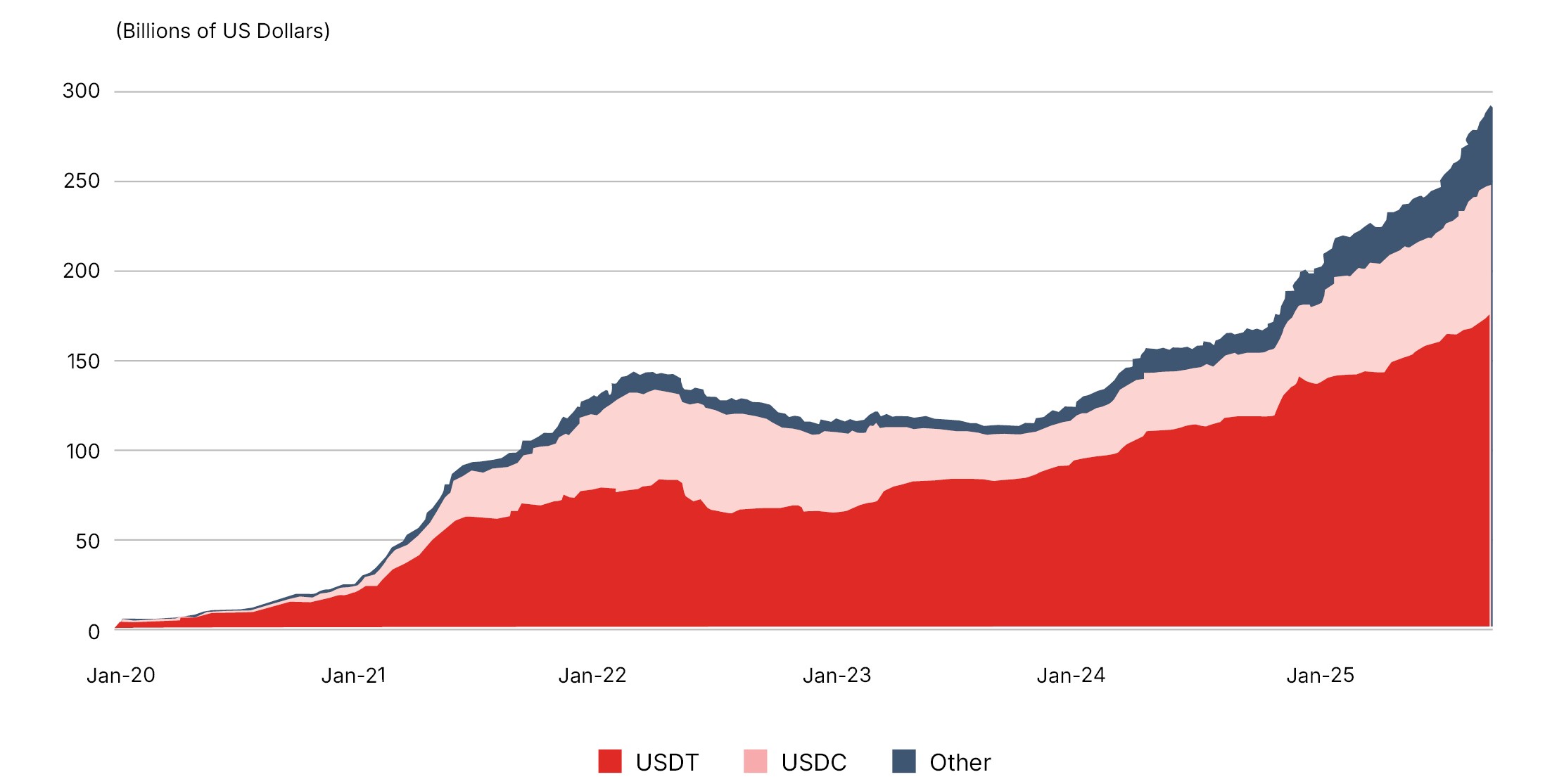
Note: USDT and USDC are the among the largest US dollar-pegged stablecoins and refer to tokens issued by Tether and Circle respectively
Source: CoinGecko and IMF39
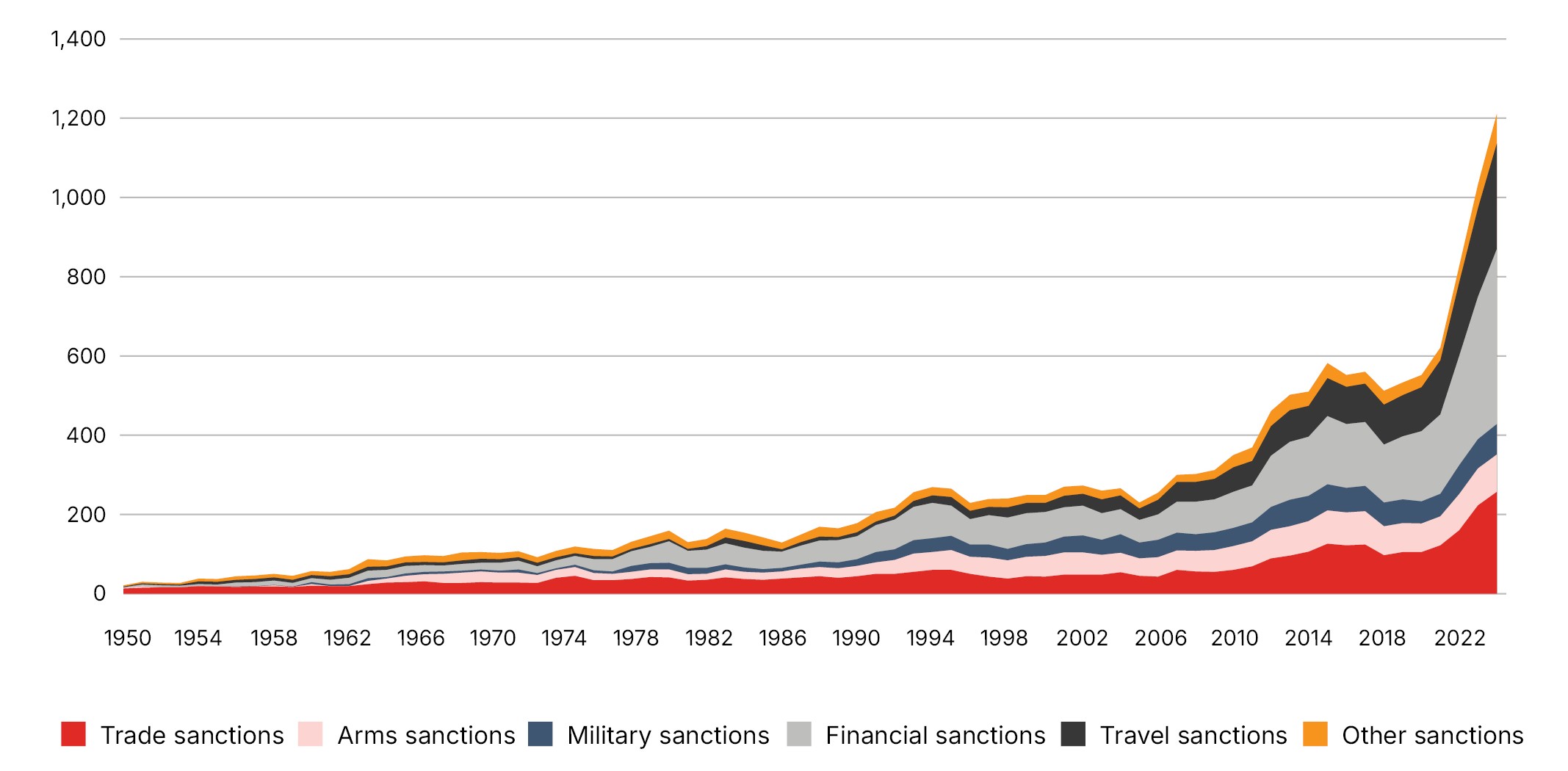
In the wake of the Global Financial Crisis, enhanced international cooperation and coordinated action by financial authorities sought to address the fault lines exposed by the crisis.40 In recent years, however, regulatory approaches have begun to diverge again. Examples include increased focus on financial sovereignty, an expansion in trade, and financial sanctions (Figure 2.6).41 Tougher localisation and ring-fencing rules, which require assets, capital, data, or operations to be held within a jurisdiction or that certain assets, activities, or legal entities be segregated from the rest of a financial group, have also started to appear as national regulators rewrite rules to match domestic growth and competitiveness goals.42 A common manifestation of the latter is delays in country-level implementation of agreed global standards such as the Basel III framework for banks and the risk-based global Insurance Capital Standard (ICS) for insurers.43
FIGURE 2.6: NUMBER OF INTERNATIONAL SANCTIONS, BY TYPE
Source: Global Sanctions Data Base44
Some forms of localisation or ring-fencing may be protective, especially in periods of stress. But these policies may give rise to extraterritorial effects, restrict crossborder flows and market access, and create incompatible or duplicative home and host regulatory requirements.45 When the movement of capital increasingly requires political approval rather than responds to market forces, global integration loses efficiency by design.46
The effects of some regulatory policy changes might be ameliorated by transitional mitigation strategies. A good example is Brexit, where the alignment of prudential capital requirements between the UK and the EU prevented immediate operational or compliance challenges for financial institutions.47 Divergent regulatory frameworks across jurisdictions, nevertheless, create opportunities for regulatory arbitrage, where institutions shift activities to jurisdictions with less stringent rules. This undermines the effectiveness of regulation, creates an uneven playing field, and can lead to a build-up of latent risks to financial system stability.48 More generally, regulatory fragmentation can impede financial integration, with macroeconomic costs for global growth and diminished opportunities for risk sharing.49
Because re/insurers operate as long-term financial intermediaries embedded in global capital markets, financial fragmentation can influence both sides of their balance sheets as well as the networks through which risks are pooled and transferred internationally. This section therefore describes four main transmission channels through which financial fragmentation would likely affect the insurance sector:
These channels are analytically distinct but mutually reinforcing (Figure 3.1). In combination, they shape how fragmentation alters the efficiency of global risk pooling, the allocation of capital within the insurance sector, and the potential for amplification effects during periods of financial stress.50
FIGURE 3.1: FRAGMENTATION TRANSMISSION CHANNELS
Source: Geneva Association
Importantly, the effects of financial fragmentation are not uniquely felt by re/insurers. Many of the same underlying mechanisms – including liquidity pressures, collateral dynamics, reduced market depth, and asset-price amplification – also affect banks, asset managers, and other non-bank financial intermediaries. For instance, IMF analysis shows that an increase in geopolitical distance between an investing and recipient country could reduce bilateral cross-border portfolio and banking allocation by around 15%.51 The focus here is instead on how fragmentation interacts with the specific structural features of insurance-sector balance sheets, including long-duration liabilities, reliance on reinsurance, and exposure to market-based assets.
The effects of financial fragmentation are not uniquely felt by re/insurers but also banks, asset managers, and other non-bank financial intermediaries.
Insurers take in known cashflows (premiums) in exchange for a promise to indemnify policyholders should a defined event occur or as a vehicle in which individuals can save. By pooling policies across
insureds, insurers can diversify risk, holding technical reserves on the liability side of their balance sheet that cover the expected present value of future claims and/or benefit payouts. Companies will also hold capital (‘shareholder funds’ or equity capital) to cover unexpectedly large losses. Holding capital, though, is expensive and must be optimised to cover the underlying economic risks while considering minimum regulatory requirements as well as credit rating agency thresholds.52
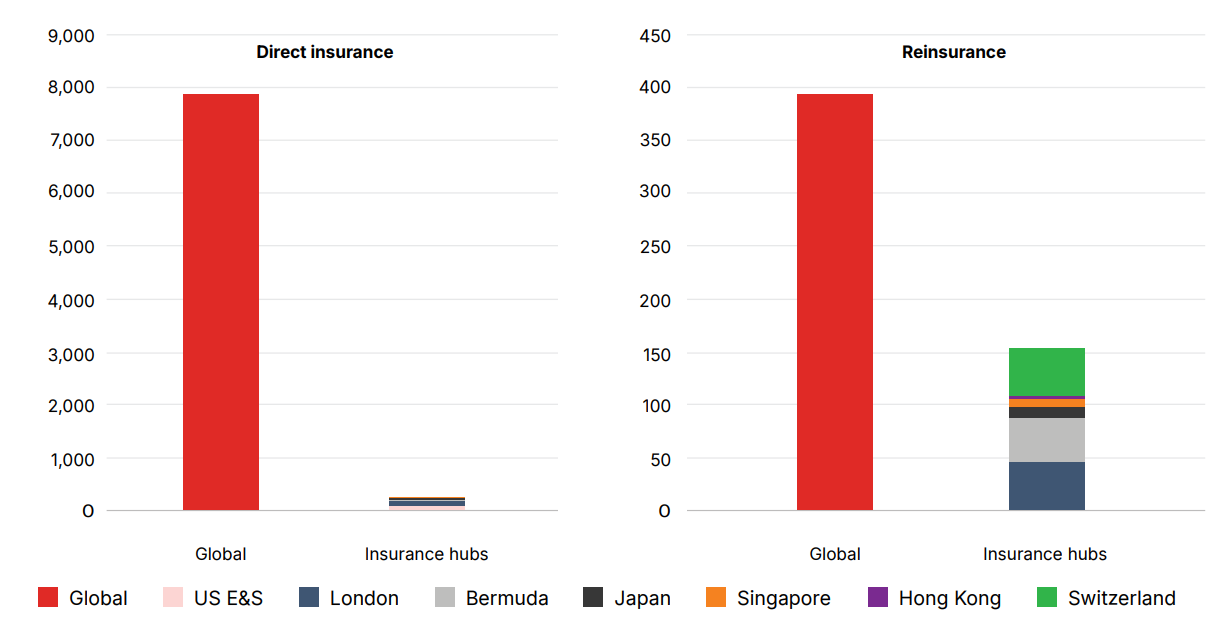
As discussed in Box 3, regulation is the primary determinant of whether insurers can write business cross-border, creating significant trade barriers. Genuinely cross-border business is largely restricted to international corporate risks in sectors such as marine, aviation, and transport and is often routed through international financial centres. Even then, business written through insurance hubs represents less than 4% of global direct insurance premiums (Figure 3.2). Instead, major insurance groups that underwrite risks in different countries do so almost entirely through locally incorporated entities or branches and/or deploy specific organisational workarounds (e.g. fronting arrangements whereby a locally licenced insurer issues a policy on behalf of an overseas insurer).
FIGURE 3.2: INSURANCE VIA INTERNATIONAL HUBS (GROSS PREMIUMS 2024 IN USD BILLIONS)
Source: Based on data from the London Market Group, Swiss Re, and Atlas.
To the extent geopolitical tensions spark new or more restrictive rules on international insurance business, geographical diversification gains may fall, causing risk concentration, expected losses, and associated technical reserves to rise.53 It would also increase compliance costs and operational risks facing insurers with additional implications for their overall costs of capital.
Box 3: Cross-border re/insurance and barriers to trade
Cross-border insurance transactions are subject to complex regulations designed to protect policyholders and ensure financial stability. Most jurisdictions require international insurers to be licensed locally to operate within their territory. These so-called admitted insurers may be set up as separate legal entities (i.e. subsidiaries) that are subject to full host-country supervision. Alternatively, they may be an overseas branch of the insurer, with supervisory oversight remaining with the homecountry regulator. Although foreign branches need not hold independent capital, host supervisors often require them to maintain ring-fenced assets within the jurisdiction equivalent to their local liabilities.54
Non-admitted insurance and fronting
Some insurance may be written internationally without meeting local licencing and regulatory requirements. Such non-admitted insurance typically covers specialised commercial risks including professional liability (e.g. D&O, E&O), excess/umbrella liability, and niche sectors like marine, aviation, and transport.
However, the rules relating to non-admitted insurance differ across jurisdictions. For example, non-admitted insurance is generally not permitted in China and India, while some countries, like Brazil and Mexico, expressly permit non-admitted insurance only where comparable coverage is not available in the local market. Compared with P&C insurance, non-admitted coverage for life insurance is rare and limited to unique or high-value risks, and, in some jurisdictions, is not permitted at all.
Even where non-admitted coverage is allowed, there may be restrictions on whether certain insurance-related activities are permitted. As a result, international insurers often use ‘fronting’ arrangements to comply. A locally licenced ‘fronting’ carrier initially issues the policy, then immediately transfers most or all the risk to a non-admitted captive insurer or reinsurer via a reinsurance agreement.
Offshore reinsurance
Reinsurance plays a key role in spreading risks geographically. Even if a policy is technically written locally, the risk is frequently passed back to an offshore entity through reinsurance and retrocession. Non-admitted reinsurers typically operate through specialty markets such as Lloyd’s of London or Bermuda, meaning capital flows are frequently directed toward and concentrated in these insurance hubs.
To ensure adequate security to underpin the risk transfer, a foreign reinsurer may have to post collateral with the cedant (e.g. a letter of credit with a local bank). These regulatory requirements differ across countries depending on inter-regulator agreements (Figure B.3). For example, in the US, reciprocal jurisdictions allow non-US reinsurers to post zero collateral, whereas qualified jurisdictions require certified reinsurers to post reduced collateral based on their external credit ratings.55 In some jurisdictions, such as China and Canada, local regulators may impose additional capital requirements on ceding insurers who use offshore reinsurance.
FIGURE B.3: CROSS-BORDER REINSURANCE OPENNESS INDEX
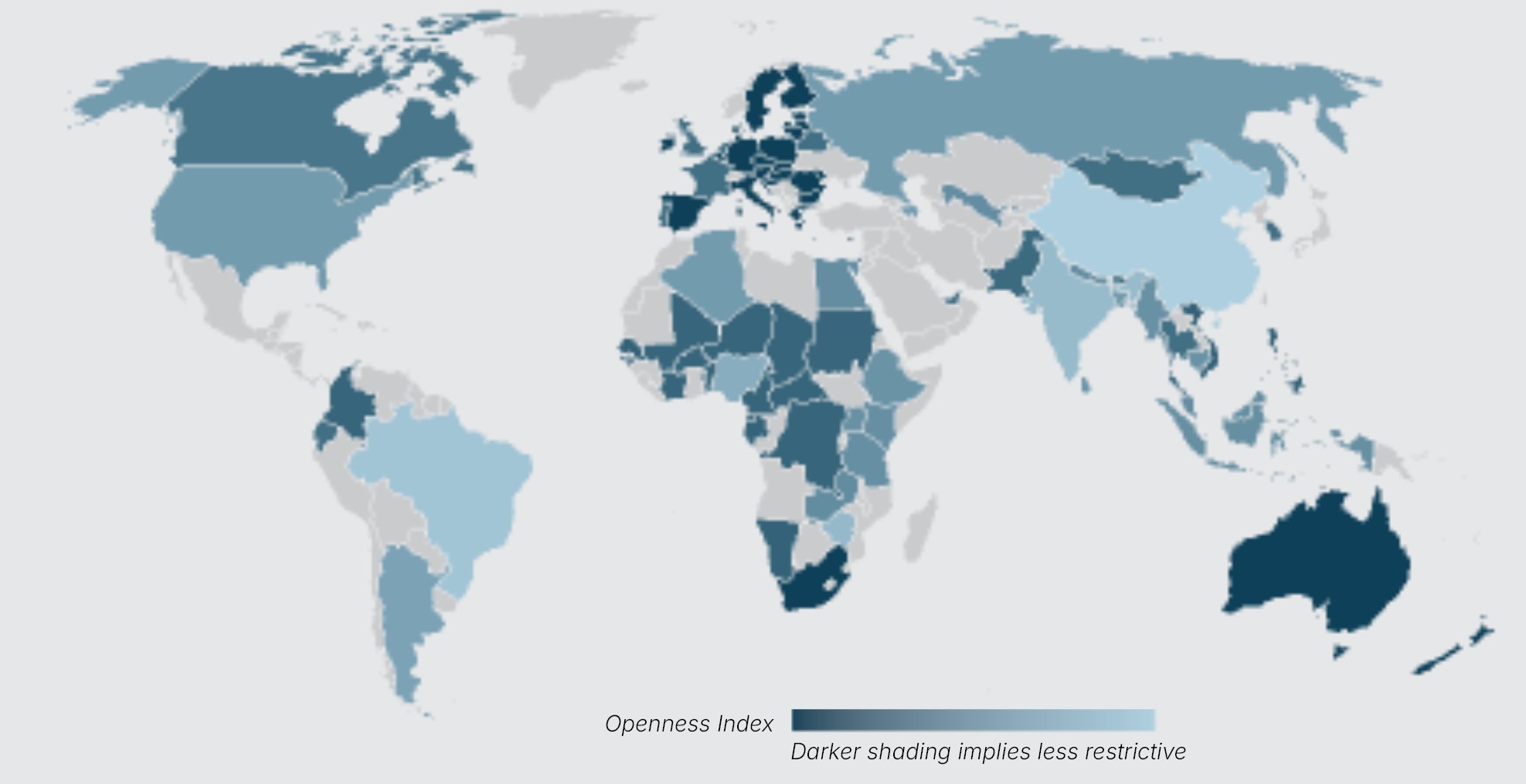
Note: The index is a weighted average score of country-level indicators measuring the ease of using cross-border reinsurance to cede risks. These include whether cross-border reinsurance is permitted, whether offshore reinsurers must post collateral and/or security, and whether some reinsurance must be placed with a local reinsurer.
Source: Calculations by the Geneva Association based on the Reinsurance Trade Barriers and Market Access information published by the Global Reinsurance Forum (GRF).56
Source: Geneva Association
Whereas Channel 1 concerns the relatively limited amount of insurance business written directly across borders, this second channel focuses on international risk transfer through reinsurance – the principal mechanism through which insurance markets share risk internationally. Even when insurance policies are written domestically, risk transfer through reinsurance markets is often crucial. While reinsurance recoverables are treated as an asset on an insurance company’s balance sheet, economically they function to reduce the net liability (claims payable) to policyholders, reflecting the shared financial burden. As a result, they can be an important part of the optimal management of insurers’ capital.
Reinsurance is inherently international. Global reinsurers diversify ceded risks across geographies, lines of business, and regulatory regimes. They rely heavily on globally integrated capital markets to source appropriate assets to back their liabilities. Fragmentation may impair this mechanism through:
Global reinsurance markets exhibit hub-and-spoke characteristics, with major reinsurers in specific financial centres acting as central nodes. Collectively, the major insurance hubs account for close to 40% of the global reinsurance market (Figure 3.2). To the extent that financial fragmentation reduces network density – where reinsurers are less interconnected and interact less frequently – this could also increase the transmission of shocks within blocs while decreasing global diversification benefits.
From an analytical perspective, reinsurance markets can be viewed as mechanisms for allocating global riskbearing capacity across jurisdictions. Large reinsurers operate as internationally diversified intermediaries that deploy capital where risk-adjusted returns are most attractive. Financial fragmentation may alter this allocation mechanism by introducing frictions in cross-border capital mobility, reinsurance receivables settlement, and the regulatory treatment of liabilities. In extreme cases, fragmentation may lead to regionalisation of reinsurance markets, increasing concentration risk within country blocs.
Besides reduced geographical risk diversification opportunities, financial fragmentation could lead regulatory authorities in host countries to require foreign reinsurers to maintain higher levels of capital locally, preventing capital from moving freely across borders. This reduced fungibility lowers overall capital efficiency and pushes up the cost of reinsurance. In turn, this may increase the levels of own capital primary insurers need to hold to meet commitments to policyholders, the cost of which will be reflected in the prices they charge for their policies.
Financial fragmentation could pose particular challenges to asset-intensive reinsurance strategies if they straddle jurisdictions that become less aligned. These structured transactions, which have become common recently in some life and annuity sectors, involve the reinsurer assuming both the chances of higher-than-expected claims and potential underperformance of the transferred assets associated with the portfolio of policies. They depend crucially on global capital mobility and cross-border risk transfer to manage the long-term asset and liability risks, so increased fragmentation can reduce any capital and operational efficiency gains.
While the first two channels operate primarily through the liability side of insurers’ balance sheets, financial fragmentation also affects how insurers invest policyholder funds as well as their own capital. It constrains the choice of assets to back their liabilities, which makes the investment process more challenging with important repercussions for managing legacy risks such as guaranteed annuities. Figure 3.3 shows the average allocation across broad asset types for different types of insurers, based on data from the OECD. Regardless of their domicile, insurers exhibit a strong home bias in their investments (i.e. a tendency to favour domestic over foreign assets). For example, according to ECB analysis, traditional life insurers hold 40–50% of total bond portfolios in domestic securities.57
FIGURE 3.3: AVERAGE ASSET ALLOCATION OF DOMESTIC LIFE, NON-LIFE, AND COMPOSITE INSURERS AMONG REPORTING JURISDICTIONS AT THE END OF 2024 (% OF TOTAL INVESTMENT)
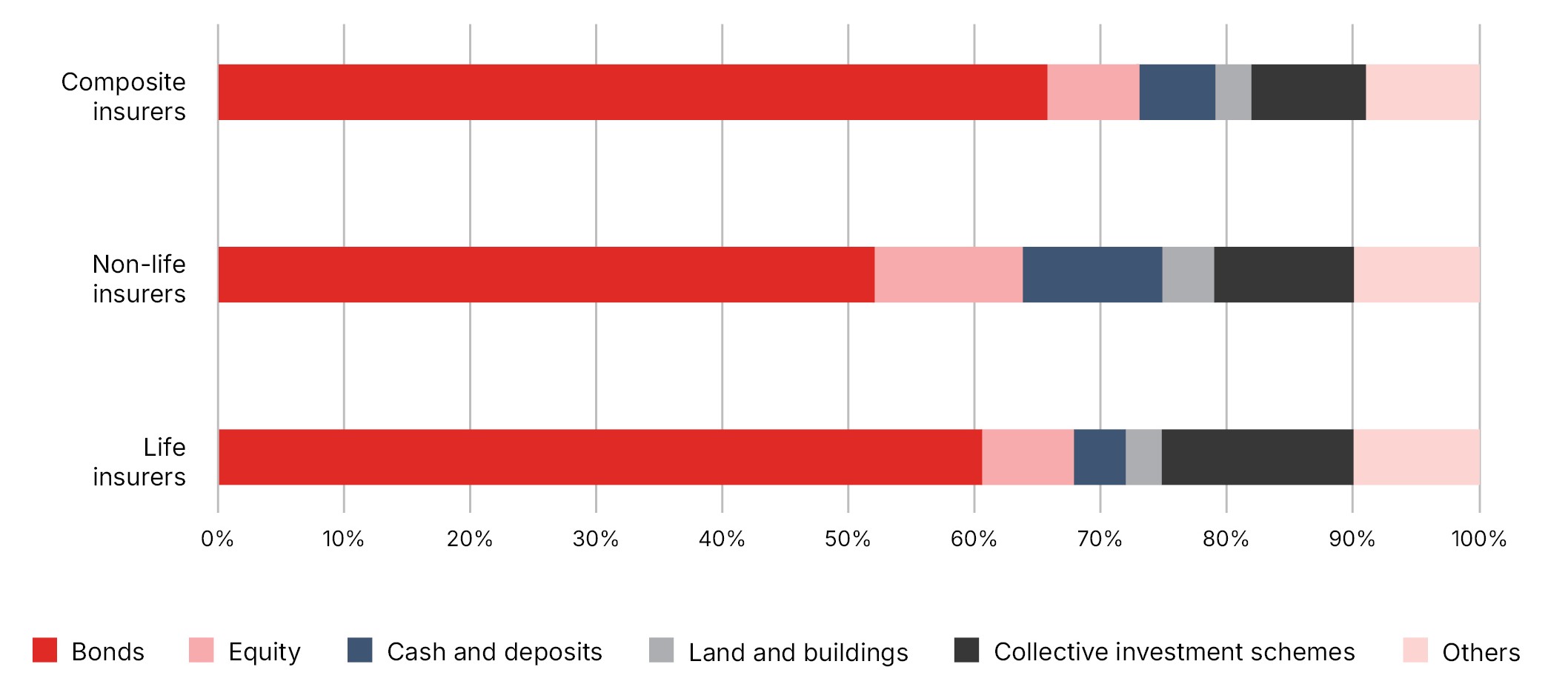
The data exclude assets related to unit-linked products where risk is fully borne by policyholders. The 'Others' category includes investments in loans, private equity funds, hedge funds, structured products, and other investments. Negative values in some categories for some jurisdictions were excluded.
Source: OECD58
Financial fragmentation typically manifests itself through reduced cross-border capital flows, heightened geopolitical risk premia, regulatory divergence, sanctions regimes, and restrictions on capital mobility. For both domestic and international insurers, such developments alter both the opportunity set and the relative pricing of assets. But for globally active re/insurers, which invest in international sovereign and corporate securities to back international insurance liabilities, financial fragmentation poses additional challenges.
Fragmentation can induce or accentuate:
This reallocation may reflect both market forces (reactions to changing risk premia, currency volatility, liquidity conditions) and supervisory or political pressures. Over time, the global diversification benefits that historically characterised insurers’ asset portfolios may erode.
Unlike banks that fund themselves through (short-term) deposits, insurers‘ funding comes in the form of upfront policyholder premiums. These are not typically repayable on demand (or at least over short periods) and are held to pay claims that typically occur much later. Consequently, insurers do not face the risk of a ‘run’ in the same way as banks.
Instead, insurers must manage potential illiquidity arising from:
The heightened need for funds to meet insurers’ short-term obligations can often arise during periods of macroeconomic stress, such as when interest rates rise sharply and unexpectedly. Should funding strains coincide with financial market fragmentation, the potential for these stresses to intensify increases.
3.4.1 Fragmentation, liquidity segmentation, and duration
The further segmentation of funding markets along geopolitical or jurisdictional lines would make it more difficult for re/insurers to:
As a result, liquidity that was once globally fungible may become regionally constrained.
This has important implications for how insurers (especially life insurers) manage duration risk – i.e. how their assets and liabilities change as market interest rates change. When interest rates rise, surrender incentives typically increase and the effective duration of liabilities shortens.59 This mechanical shortening reflects the embedded option value of surrender rights: higher market yields make guaranteed contracts relatively less attractive, increasing lapse and surrender activity. The liability side of the balance sheet therefore becomes more sensitive to interest rates in a rising interest rate environment.
In an integrated financial system, insurers can respond by adjusting the duration of their assets through portfolio rebalancing, derivatives, or cross-border asset sales to maintain asset-liability alignment. However, in a fragmented environment, this adjustment may become slower, more costly, or more constrained. Reduced cross-border market access, segmented funding markets, lower secondary market liquidity, or regulatory frictions can limit the insurer’s ability to shorten asset duration in line with liabilities.60
The result is not simply a static duration mismatch, but an increase in the elasticity of the duration gap, or how closely the timing of asset cash inflows and liability cash outflows respond to interest-rate movements.61 Fragmentation impairs the asset side’s capacity to adjust in response to duration gaps. Under stress, this rigidity can necessitate asset sales to restore alignment, thereby linking changes in duration directly to liquidity pressure, potential fire-sales, and downward pressure on asset prices (including bonds).62
3.4.2 Hidden leverage and balance sheet opacity
Alternative assets such as private credit, infrastructure debt, structured securities, and private equity can provide yield and duration matching benefits. This is especially important for life insurers that sell savings products with guaranteed returns and can commit funds without needing to quickly liquidate. However, alternative assets may involve heightened valuation and illiquidity uncertainty as well as structural complexity. Such features may be exacerbated by financial fragmentation, given the increased potential for information asymmetries to distort price discovery in asset markets.
In a fragmented environment, cross-border comparability of regulatory treatment and transparency may decline, increasing the challenges in assessing the fundamental value of financial assets.63 Leverage is often embedded in asset structures rather than traditional borrowing. The extent of this synthetic leverage may also be underappreciated and only become evident, for instance, when a derivative position’s value moves strongly, potentially creating a large profit or loss.64 In combination, hidden leverage and valuation uncertainty increase insurers’ susceptibility to illiquidity-induced solvency strains.
In summary, there are four main ways through which financial fragmentation may affect the re/insurance sectors: access to diversifying risks pools, availability and cost of reinsurance, selection of optimal investments to back their liabilities, and potential added complexities in managing capital and liquidity. Although conceptually distinct, these channels are tightly interconnected because re/insurers operate as integrated financial intermediaries whose balance sheets link underwriting risk, investment portfolios, and capital allocation decisions. Financial fragmentation alters how risks and capital move across borders, how insurers adjust their portfolios, and how shocks propagate through financial markets.
To analyse these mechanisms systematically, it is useful to translate the conceptual channels described above into a quantitative framework that captures the interaction between underwriting decisions, balancesheet management, and macro-financial conditions. The challenges in measuring financial fragmentation – especially the lack of publicly available data on non-bank gross capital flows on an ultimate owner basis – make a traditional statistical approach impractical. Instead, this report develops a small analytical model to assess empirically the impact of financial fragmentation on re/insurers. By carefully calibrating the model against sector-wide features of the aggregate re/insurance balance sheet as well as plausible estimates of potential shocks to financial market variables, the framework provides a way to articulate and quantify the potential impact of financial fragmentation. This is explored further in the next section.
The quantitative framework combines elements of insurance economics, network modelling, and macro-financial analysis. Since the direct insurance market is already globally fragmented – international insurers typically operate through locally incorporated subsidiaries with ring-fenced assets – the setup focuses on how increased financial fragmentation affects insurers’ balance sheets through available reinsurance capacity and the resulting asset market dynamics. The model is not intended to replicate the full complexity of the global insurance system. Instead, it provides a tractable representation of the core mechanisms through which financial fragmentation can influence the behaviour of re/insurers. The model is calibrated using stylised balance-sheet features representative of the life insurance and reinsurance sectors.65
4.1.1 Core structure
The insurance system can be viewed as a set of interacting balance sheets and networks embedded within a macro-financial environment. Specifically, the model incorporates three geographic regions – Home, Partner, and Rival constituencies – reflecting that financial fragmentation is often shaped by geopolitical alignment. Within this environment, there are three key behavioural modules:
The interaction between these three modules determines how shocks propagate through the economy and re/insurance sector and ultimately affect systemic resilience.
The stylised three-country-bloc and three-behavioural-module framework is not intended to imply symmetry in the real-world financial system. Current global financial architecture remains heavily concentrated around US dollar funding markets and Western-centred reinsurance hubs. The model illustrates transmission mechanisms rather than attempting to replicate the existing distribution of market power. Depending on the nature of any escalation in geopolitical rivalry, the model helps evaluate how the geometry of global finance may change and the likely ramifications for re/insurers.
4.1.2 Financial fragmentation effects
Financial fragmentation can arise through different mechanisms: policy restrictions on cross-border financial activity; prudential or regulatory divergence; sanctions and geopolitical alignment constraints; settlement and payment frictions; and a shift in investor preferences away from assets issued in politically distant jurisdictions (Table 4.1). These mechanisms are distinct in practice, but they operate in the model through a common set of frictional ‘wedges’ that affect cross-border capital mobility, payment systems, and portfolio investment.
These wedges alter the optimal behaviour of re/insurers and generate feedback between their underwriting, investment, and liquidity management decisions. As a result, the wedges influence the allocation of reinsurance capacity (Module 1), insurers’ balance-sheet dynamics (Module 2), and asset market conditions (Module 3). Box 4 provides an overview of the key model features. Additional technical details are available in a companion online document.66
4.1.3 Shifts versus shocks
It is useful to distinguish between structural shifts and disruptive shocks. Some forms of fragmentation are gradual: regulatory requirements tighten, capital becomes trapped locally, cross-border reinsurance becomes costlier, and portfolios slowly tilt towards domestic or politically aligned markets. Other forms may crystallise suddenly if a geopolitical or financial event causes a sharp reassessment of trust in the international financial infrastructure. The model does not attempt to forecast either path. Instead, it provides stylised experiments showing how different degrees and forms of fragmentation could affect reinsurance capacity, insurer balance sheets, and asset market conditions.
The model is silent on the precise structural drivers of financial fragmentation – the underlying forces that influence whether the financial system becomes more (or less) integrated. Instead, it captures the overall effect of increased financial fragmentation via exogenously imposed frictions that affect how easily (and at what cost) capital and funding flow across borders. By varying the degree of persistence of these frictions, the model can mimic slow-moving or more rapid, and potentially more disruptive, forms of financial fragmentation.
TABLE 4.1: OPERATIONAL FORMS OF FINANCIAL FRAGMENTATION
| Operational mechanism | Practical example | Insurance-sector effect |
| Prudential divergence | Higher capital charges on foreign reinsurance recoverables | Raises cost of cross-border reinsurance |
| Capital localisation | Ring-fencing of capital/liquidity within subsidiaries | Reduces fungibility of global capital |
| Settlement/payment frictions | Delayed cross-border claims payments or collateral transfer | Reduces recoverability and increases liquidity needs |
| FX funding fragmentation | Higher hedging or dollar funding costs | Raises collateral and liquidity pressure |
| Portfolio/geopolitical home bias | Investors shift away from rival-bloc assets | Raises spreads and reduces diversification |
Source: Geneva Association
Box 4: How the model works
FIGURE B.4: MODEL ARCHITECTURE
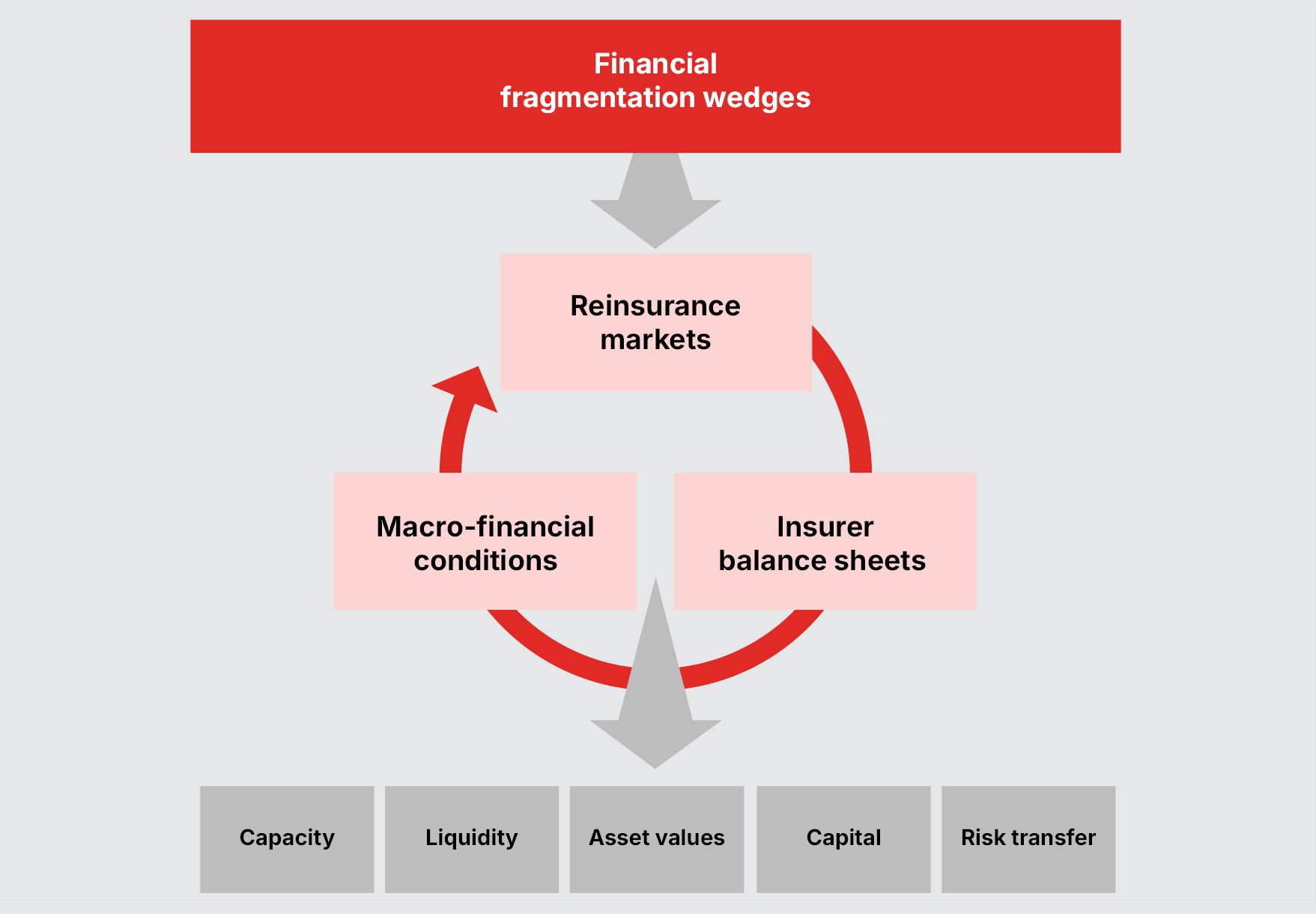
Source: Geneva Association
Figure B.4 summarises the core relationships and transmission channels captured in the model. Because of the key role reinsurance plays in facilitating cross-border risk transfer, the model assumes increased financial fragmentation initially impairs reinsurance (Channel 2) – downplaying the effects on cross-border direct insurance (Channel 1), which are modest for most insurance lines – before propagating further through the system. Specifically, cross-border capital mobility constraints limit the ability to deploy reinsurance across jurisdictions; regulatory divergence alters capital requirements across regions; settlement and payment frictions affect the reliability of reinsurance recoveries; and geopolitical risk premia increase the cost of providing coverage in certain jurisdictions.
All these frictions reduce the fungibility of global reinsurance capital leading to regionalisation of reinsurance markets. That distorts the allocation of global risk-bearing capacity, affecting both the quantity of reinsurance supplied and its cost, which in turn will spill over into the terms and conditions that households and firms face for insurance.
Constraining which international financial instruments investors (including insurers) can hold alters the demand for foreign assets, reduces market depth, and triggers repricing for those assets, including required risk premia. In fragmented markets, liquidity is not easily transferable. Constraints could therefore expose underappreciated liquidity mismatches and counterparty risks for insurers, especially if such market moves reveal hidden leverage, all of which have implications for their ability to manage their balance sheets.
The model captures these effects through a simplified representation of insurers’ balance sheets, linking surrender behaviour, liquidity needs, and portfolio adjustments. When liquidity pressures exceed available buffers, insurers may be forced to sell assets to meet contractual commitments. Reduced market depth means that large asset sales can generate significant price impacts, creating feedback between insurers’ balance sheets and asset market volatility.
Source: Geneva Association
The future evolution of the international financial system remains highly uncertain. The modelled scenarios aim to translate plausible geoeconomic drivers into tractable model experiments to explore potential outcomes. Rather than attempt to capture every conceivable future, the scenarios are intended to reflect the main ways in which financial fragmentation could unfold under realistic geoeconomic conditions. The scenarios therefore assume that, despite growing fragmentation and a greater regional focus in some areas of finance, the international financial system continues to be centred on Western markets and the US dollar.
The scenario structure builds directly on the Geneva Association's earlier work on geoeconomic fragmentation. Whereas the previous report classified scenarios largely according to the geopolitical evolution of trade fragmentation, the present study focuses on the corresponding evolution of financial market fragmentation. The emphasis therefore shifts from the effects of a reconfiguration in geopolitical trading blocs on re/ insurance to the resilience of re/insurers in the face of greater financial market frictions.
Table 4.2 summarises the chosen three scenarios that represent progressively stronger forms of financial fragmentation.
TABLE 4.2: SUMMARY OF THE SCENARIOS
| Scenario | Real-world interpretation | Main model mechanism | Intended insight |
|---|---|---|---|
| Segmentation Targeted rival-bloc fragmentation | Geopolitical/regulatory restrictions on rival-bloc re/insurance | Rival-specific geopolitical, capital, and settlement wedges | Fragmentation can localise capacity and pricing effects without system-wide stress |
| Reallocation Broad-based fragmentation | Gradual reorientation of capital, portfolios, and reinsurance relationships across blocs | Wedges across all blocs plus binding global reinsurance capacity | Fragmentation reallocates risk-bearing capacity and reduces efficiency of global risk pooling |
| Amplification Disorderly fragmentation | Structural fragmentation as in Scenario 2 plus sudden market stress event | Broad wedges plus rate/ spread shock, stress dynamics, and market depth effects | Fragmentation can amplify balance sheet stress when liquidity and capital buffers are strained |
Source: Geneva Association
4.3.1 Scenario 1: Segmentation – targeted fragmentation of Rival-bloc insurance and reinsurance
In the first scenario, fragmentation is gradual and concentrated on the Rival bloc, which has a small footprint in cross-border re/insurance markets. The practical interpretation is a further tightening of restrictions on crossborder re/insurance activity between geopolitically distant jurisdictions. This could take the form of higher regulatory charges on business ceded to Rival-bloc reinsurers, additional collateral requirements, restrictions on non-admitted insurance, or higher operational costs associated with legal, compliance, and settlement risk.
This scenario is closest to a continuation of existing patterns of geopolitical and regulatory divergence. It assumes that the Rival bloc is most affected, while Home and Partner – which account for the bulk of re/insurance capacity – remain broadly integrated. It is therefore best interpreted as a targeted fragmentation scenario: the system becomes more segmented but not systemically stressed given limited spillover effects on the rest of re/insurance sector.
FIGURE 4.1: SMOOTH TRANSITION WITH RIVAL-FOCUSED FRAGMENTATION
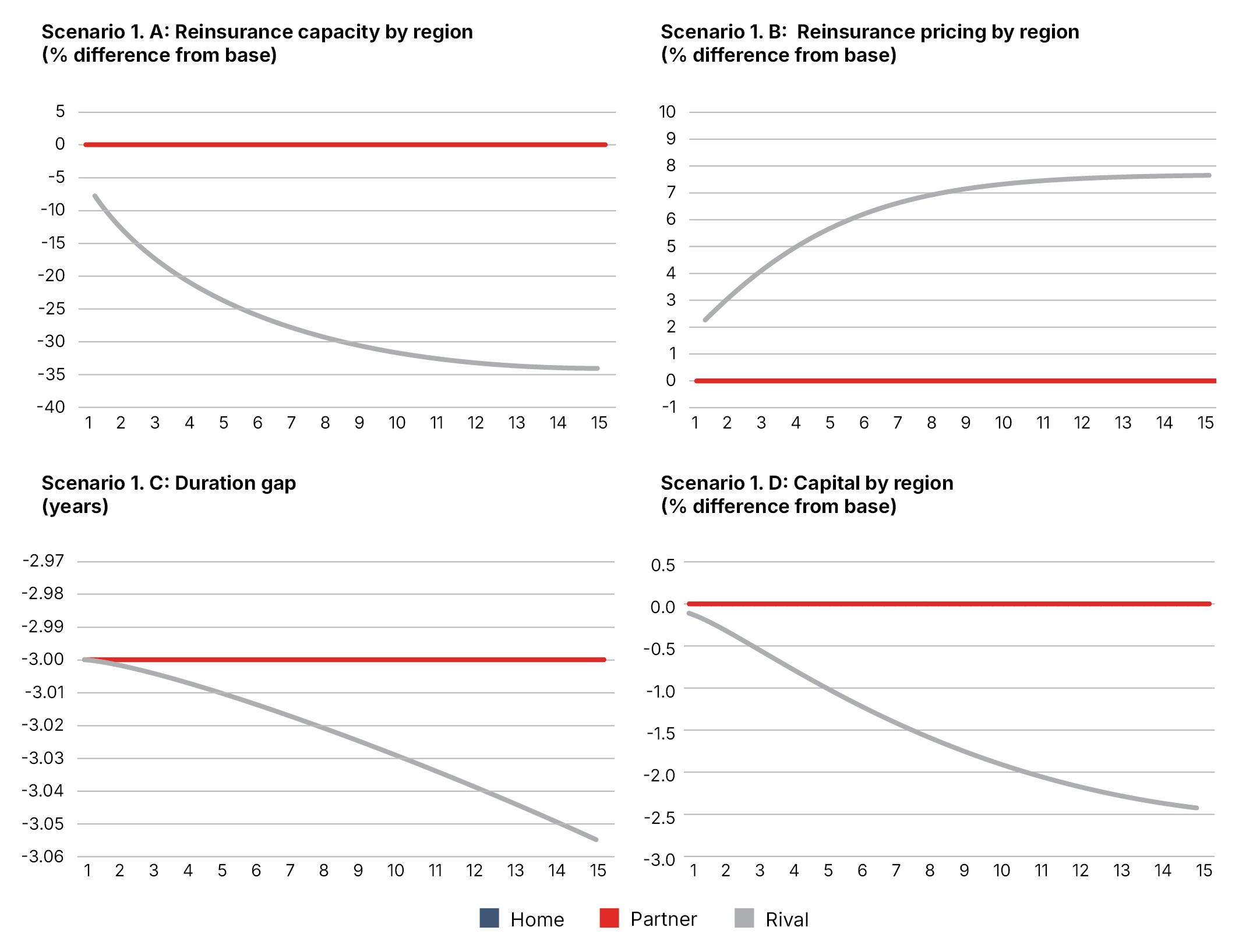
Note: Author calculations from calibrated model. The charts show percentage differences from base levels for reinsurance capacity, reinsurance prices, and capital in Home, Partner, and Rival regions. The duration gap is measured in years (base level = 3, assets = 7, liabilities = 10). The horizontal axes measure time periods. Home and Partner blocs are identically impacted in the scenario, hence the blue and orange lines overlap.
Source: Geneva Association
The scenario illustrates the implications of asymmetric regionalisation of insurance impacts, as shown in Figure 4.1.
A key implication is that financial fragmentation can meaningfully affect pricing and capacity without triggering market-wide instability, particularly when changes are gradual and feedback loops remain muted. The relatively small spillover effects of localised fragmentation are well illustrated by the recent exclusion of Russian re/insurers from global insurance markets following the outbreak of war with Ukraine in 2022.68
4.3.2 Scenario 2: Reallocation – broad-based fragmentation and reallocation across blocs
The second scenario broadens the fragmentation process. Rather than increased frictions affecting only the Rival bloc, this scenario assumes a more widespread dislocation in cross-border financial activity. In practice, this would correspond to a gradual consolidation of financial claims, investment portfolios, and reinsurance relationships within geopolitically aligned blocs. This could reflect tighter regulatory treatment of overseas reinsurance, reciprocal increases in collateral requirements, higher hedging costs, or shifts in investor preference away from politically distant assets.
Such a scenario could encompass redrawing the pattern of international risk sharing between established and emerging powers, or even a more fundamental shift arising from fragmentation within the prevailing Western alliance. This scenario does not, however, assume a full-scale breakdown of the IMFS. It can occur without wholesale de-dollarisation or the collapse of existing payment infrastructure. Instead, it represents a slow process of financial reorientation: portfolios become more home-biased, reinsurance capacity becomes more regionally allocated, and settlement frictions reduce the effectiveness of cross-border risk transfer.
In model terms, all three country blocs face additional fragmentation frictions, with the largest effects still in the Rival bloc and smaller effects in the Partner bloc. A binding global reinsurance constraint is imposed so that reductions in one region prompt a reallocation elsewhere rather than simply a marginal reduction in total risk-absorbing capacity. Settlement frictions also enter more directly into reinsurance pricing and effective capacity. While there are stronger interlinkages across model modules than in the first scenario, any resulting turbulence in global financial markets remains limited. The scenario therefore captures a broader but still orderly adjustment in the geography of riskbearing capacity.
In this case, fragmentation leads not only to market segmentation but to active reallocation of risk-bearing capacity (Figure 4.2).
The key implication is that fragmentation reduces the efficiency of global risk pooling/transfer, even in the absence of crisis dynamics.
FIGURE 4.2: SMOOTH TRANSITION WITH BROAD-BASED FRAGMENTATION
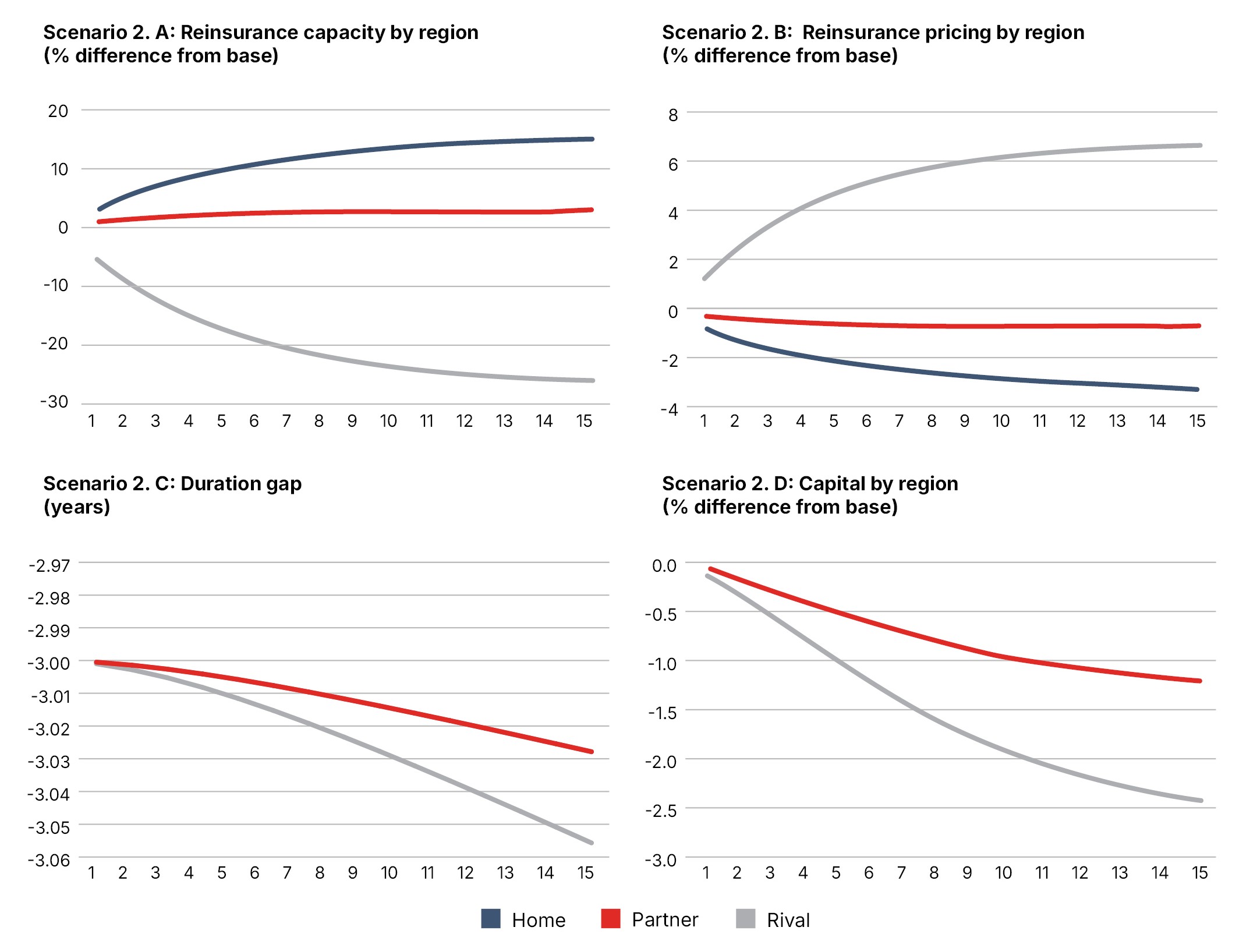
Note: Author calculations from calibrated model. The charts show percentage differences from base levels for reinsurance capacity, reinsurance prices, and capital in Home, Partner, and Rival regions. The duration gap is measured in years (base level = 3, assets = 7, liabilities = 10). The horizontal axes measure time periods. Results for duration gap and capital for Home and Partner are identical and the lines therefore overlap.
Source: Geneva Association
4.3.3 Scenario 3: Amplification – disorderly fragmentation with market stress
The third scenario considers a disorderly transition in which ongoing fragmentation coincides with a sudden financial market event or macro-financial shock.69 The latter originates in broader financial markets and affects insurers directly through their balance sheets, liquidity needs, and reinsurance relationships. Examples of potential triggers include a major sanctions escalation, reserve freeze, payment-system disruption, or new geopolitical conflict. Alternatively, the disruption may not be related to a policy intervention at all but rather a major market disturbance, such as a credit event (e.g. sovereign or corporate default or failed debt roll-over) or a sharp change in investors’ risk appetite.
Heightened worries about the fiscal sustainability of some countries could mean creditors demand higher compensation against future inflation (i.e. inflation risk premia) and for holding long-term government debt instead of rolling over shorter-term bonds (i.e. term premia). Such moves would likely roil financial markets, reduce market depth, and increase the cost of liquidity. In a fragmented system, these effects may be harder to absorb because cross-border capital, collateral, and liquidity are less fungible.
From a modelling perspective, Scenario 3 combines the broad-based wedges in Scenario 2 with an exogenous shock to market interest rates and corporate credit spreads as well as activation of the model’s stress dynamics. Specifically, the scenario allows for a period of turbulence involving higher rates and spreads reduce asset values; higher surrender and collateral needs increase liquidity pressures; reduced market depth raises the impact of asset sales; and impaired reinsurance recoveries increase retained losses. Unlike Scenarios 1 and 2, this third scenario models a disruptive ‘shock’ rather than gradual ‘shift’. It shows how financial fragmentation can worsen the balance-sheet consequences of a major capital market shock.
In this scenario, the system adjusts non-linearly, including through amplification effects that operate across re/insurance balance sheets (Figure 4.3).
FIGURE 4.3: DISORDERLY TRANSITION WITH BROAD-BASED FRAGMENTATION FIGURE
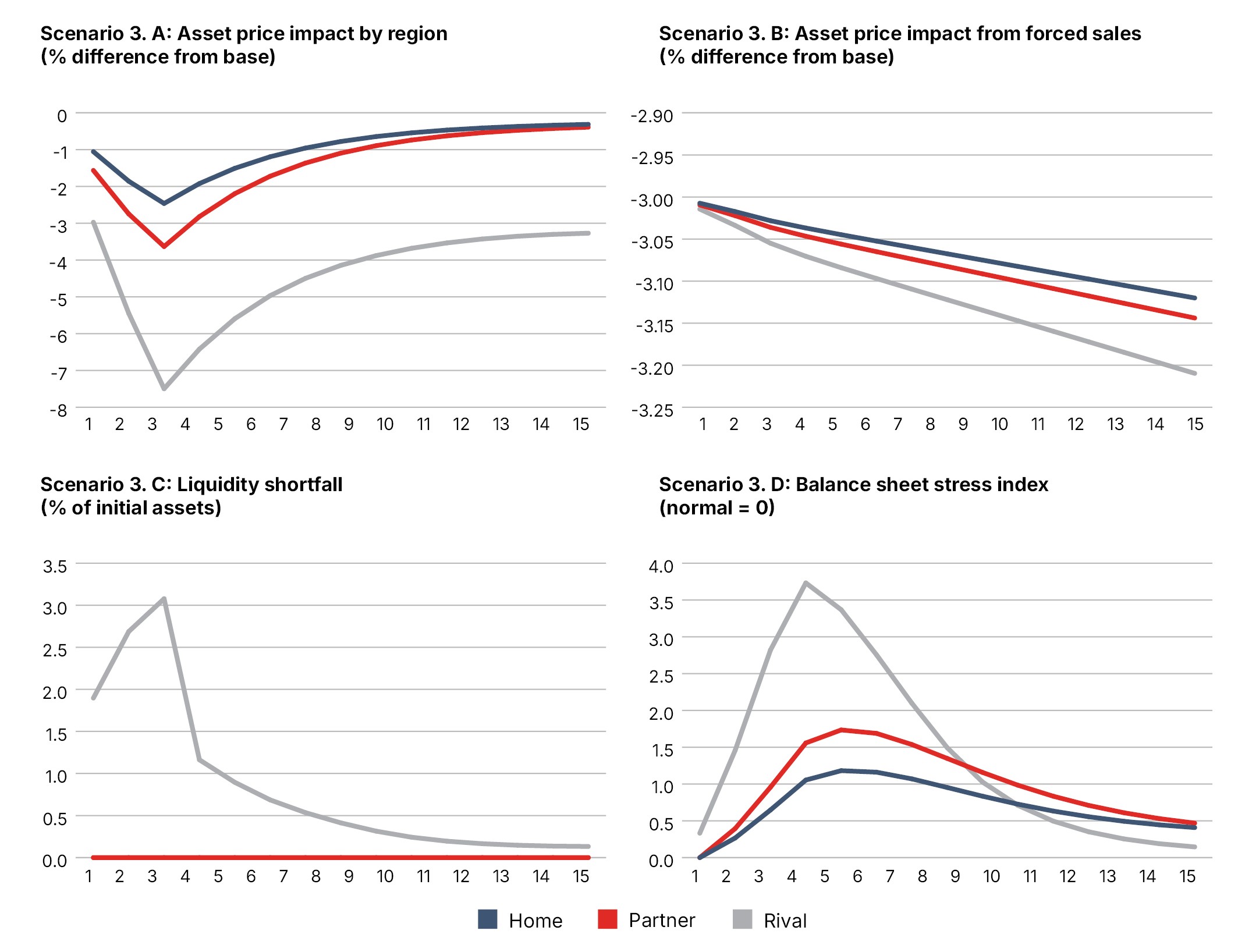
Note: Author calculations from calibrated model. The charts show percentage differences from base levels for asset price impact and forced sales price impact in Home, Partner, and Rival regions. Liquidity shortfall is measured by liquidity need minus liquid assets net of haircuts and is expressed as a percentage of initial assets (100). Balance sheet stress is a dimensionless index with a normal value of zero. The horizontal axes measure time periods. The liquidity impact on Home and Partner blocs is the same and hence the lines overlap.
Source: Geneva Association
FIGURE 4.3: DISORDERLY TRANSITION WITH BROAD-BASED FRAGMENTATION
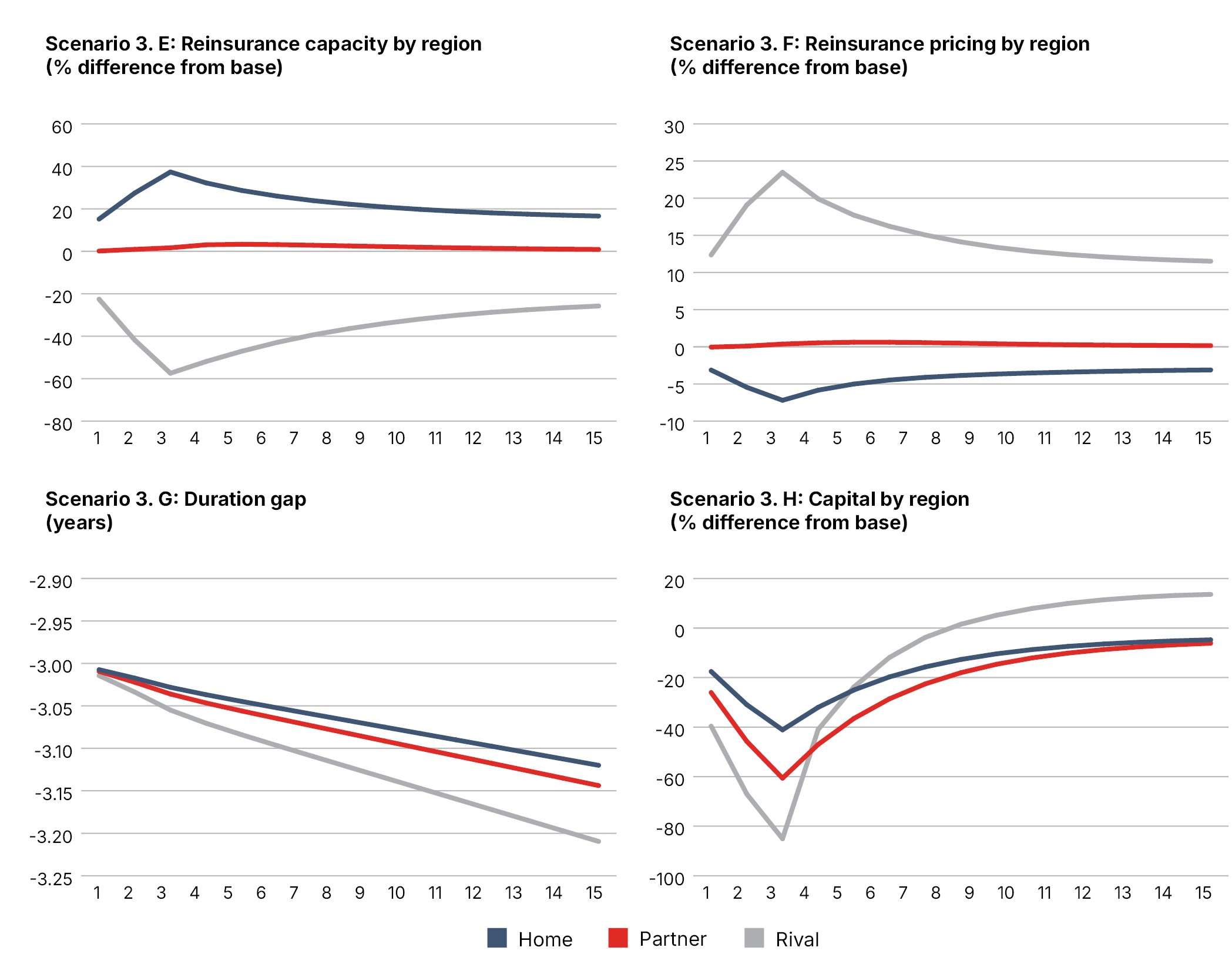
Note: Author calculations from calibrated model. The charts show percentage differences from base levels for asset price impact and forced sales price impact in Home, Partner, and Rival regions. Liquidity shortfall is measured by liquidity need minus liquid assets net of haircuts and is expressed as a percentage of initial assets (100). The horizontal axes measure time periods.
Source: Geneva Association
This fourth effect deserves further explanation. Recapitalisation happens in Scenarios 1 and 2, but the capital impact is relatively small (between 1 and 2.5%) and gradual. In practice, insurance firms can often stabilise capital at levels consistent with solvency capital requirements through a combination of gradually cutting new business, retaining earnings, reducing dividends, shrinking liabilities, or issuing new equity.
In Scenario 3, the combination of financial stress and liquidity shortfalls threatens to make some firms insolvent, notably in the Rival bloc where capital falls by up to 90% initially. Firms would respond to that impact rapidly, not gradually. The recapitalisation process is accelerated in this simulation, and an imposed solvency floor prevents capital from falling below 1% of liabilities. Economically, this can be interpreted as an emergency capital injection, group support, liability restructuring, or regulatory intervention.
The results illustrate how financial fragmentation could amplify the consequences of an otherwise conventional market shock. Although the initial increases in interest rates and wider credit spreads affect all regions, the interaction between liquidity pressures, asset sales, and capital constraints generates important non-linear effects. Fragmentation reduces the ability of re/insurers to move capital, collateral, and risk-bearing capacity across borders. As a result, global balance sheets can no longer efficiently absorb local shocks.
Importantly, direct market mechanisms – such as duration-gap effects and the price impact of forced asset sales – are relatively similar across regions. The larger losses observed in the Rival region arise not because the underlying asset market shock is fundamentally different, but because the same shock is applied to institutions that possess less capacity to absorb it. Fragmentation therefore acts primarily as an amplifier rather than an independent source of losses. Small differences in liquidity needs or capital adequacy generate disproportionately large differences in outcomes once feedback effects become active.71
4.3.4 Cross-scenario insights
Taken together, the scenarios illustrate that the impact of financial fragmentation depends on the nature of any shift and the state of the financial system when it occurs. On its own, a gradual but sustained increase in financial fragmentation would not present a material threat to re/insurers. This is most obvious if the degree of market segmentation was concentrated among smaller rival countries, limiting the scope for spillovers on the broader financial system. Even a broad-based splintering in capital flows leading to less globally integrated financial markets and systems would have manageable, if undesirable, consequences for re/insurers. Indeed, the separation could bring benefits for some if the recycling of capital led to lower reinsurance costs in some regions of the world.
Financial fragmentation would pose different challenges across the insurance sector. Life insurers are particularly vulnerable to unexpected duration and liquidity mismatches because of the long-term nature of their liabilities and the assets available to back them. Non-life insurers may be relatively more exposed to fragmentation through cross-border re/insurance markets, catastrophe risk transfer, claims inflation, and disruptions to international capital provision. Barriers to cross-border activities stop reinsurers from spreading insurance risks globally, potentially turning localised or regional spikes into severe concentrations that strain capital and lower risk-absorbing capacity.
Insurance is already heavily segmented among countries by rules and regulation. Thus, cross-border spillovers from increased financial fragmentation would probably be largely contained, especially if regulatory changes were implemented slowly. Moreover, the sector has built up specific institutional architecture – notably important international insurance hubs – designed to recycle capital and funding across countries that could be re-configured to reflect changes in geopolitical alignment.
The implication is that material fragmentation effects on the insurance sector would require a much larger geopolitical shock. This could arise in the form of financial fragmentation itself – for example, a sudden escalation in financial sanctions against foreign powers that upended existing payments and settlements systems. Given how crucial Western finance is, particularly the preeminent role of the US dollar, such a major rupture seems unlikely, at least in the near term. Instead, the source of the disturbance could be less direct, with investors reacting to rising geopolitical tensions by retreating from certain asset classes, including government and corporate securities of rival countries. Such a sudden change in investor risk appetite – perhaps linked to a particular financial market event like a technical default or failed auction – would translate into a sharp repricing in financial assets.
As the third scenario highlights, the combination of significantly higher interest rates, wider credit spreads, and more segmented capital markets would be much more disruptive for the re/insurance sector. In those circumstances, some insurers’ balance sheets could come under stress as liquidity pressures intensify, potentially weakening their solvency buffers. Fragmentation need not be widespread to have global consequences: shocks can be geographically concentrated but financially contagious.
The preceding analysis suggests that global financial fragmentation is unlikely to manifest as a single discrete event. Rather, it is better understood as a continuum of structural change, ranging from gradual regionalisation of financial markets to more abrupt and disorderly episodes of market stress.
Moderate-to-severe scenarios are decision-useful because they help identify vulnerabilities, stress points, and strategic options. By contrast, planning around highly costly and unlikely tail outcomes could encourage responses that erode efficiency and weaken the diversification benefits central to re/insurers’ business models. This section therefore focuses on strategic responses that remain useful across plausible fragmentation pathways. The aim is not to optimise for an extreme end-state, but to identify measures that strengthen resilience, preserve the benefits of international diversification where possible, and allow re/insurers to remain globally active under more segmented financial conditions.
Further fragmentation would make the operating environment harder to predict and navigate. For re/insurers, this implies a shift in their underlying optimisation strategy. In a highly integrated system, insurance carriers maximise value by:
In a fragmented system, these objectives must be balanced against a new set of constraints:
Strategic responses therefore need to move from a model of global efficiency toward one of resilient regional optimisation, in which re/insurers remain globally active but are structured to operate under more segmented financial conditions. That is entirely sensible in order to safeguard re/insurers’ solvency and best enable them to make good on their promises to policyholders. But the macroeconomic consequence could be a weakening of one of the international insurance sector’s core stabilising functions: the efficient transfer of risk across borders.
5.1.1 Reconfiguring reinsurance and risk transfer strategies
Fragmentation directly affects the availability, pricing, and reliability of reinsurance. Primary insurers may need to adapt by:
In practice, this may lead to a gradual shift toward more redundant and layered reinsurance structures, trading off cost efficiency for robustness.
5.1.2 Adapting capital structures
A central consequence of financial fragmentation is reduced international capital mobility. Re/insurers may therefore need to shift away from highly centralised capital models toward more regionally self-sufficient structures.
This could involve:
While such changes may reduce capital efficiency, they can materially improve insurers’ financial resilience in scenarios where cross-border transfers become constrained, especially in the face of financial market volatility.
5.1.3 Repositioning investment strategies
Fragmentation alters both the opportunity set and the risk characteristics of insurers’ asset portfolios. Strategic responses may include:
For life insurers in particular, fragmentation raises important challenges for asset–liability management, including the ability to maintain duration matching under more volatile and segmented market conditions.
5.1.4 Strengthening liquidity and balance-sheet resilience
As discussed in Section 3 and the model simulations, fragmentation can amplify liquidity pressures through the interaction of:
Post-GFC regulatory reforms and sector-wide practices have materially strengthened capital, liquidity, and risk-management practices across much of the global insurance industry.72 However, the potential amplification effects of financial fragmentation on insurers’ balance sheets may not have been expressly considered. Firms may therefore need to:
In addition, insurers should carefully assess exposures to hidden or synthetic leverage, including through derivatives and structured assets, which may become more difficult to manage in fragmented markets.
5.1.5 Revising operational and governance processes
Fragmentation is not only a balance sheet phenomenon but an operational one. Firms may need to strengthen:
At the board level, this requires a more explicit consideration of geopolitical risk as a core business variable rather than an external backdrop.
Policymakers face a fundamental trade-off between enhancing domestic financial resilience and preserving the benefits of international risk sharing and capital mobility.
Measures such as capital localisation, collateral requirements, and restrictions on cross-border activity may strengthen local stability but can also:
The upshot is that insurance could become less available and affordable in the markets and segments most affected by withdrawn capacity or higher reinsurance costs, widening already significant protection gaps for some perils. The impact would not be uniform: it would fall hardest on households, firms, and communities with limited financial buffers, leaving them more exposed to catastrophic losses they are least able to absorb.
Policymakers must avoid excessive financial fragmentation, which may undermine the resilience they seek to promote. Even in a world of weaponised interdependence, institutional measures can still mitigate the potential for widespread instability.74 Countries remain deeply interconnected through global capital markets, production networks, payment systems, commodity markets, and cross-border investment. This continued interdependence sustains several mutual incentives for cooperation, even if those are likely to rest less on broad-based multilateralism than on pragmatic, issue-specific coordination aimed at managing common risks.
5.2.1 Maintaining cross-border supervisory cooperation
Given the global nature of re/insurance markets, supervisory cooperation remains crucial. Priorities include:
Fragmentation of supervisory frameworks could otherwise compound financial fragmentation and increase systemic risk.
5.2.2 Safeguarding payment and settlement infrastructure
As discussed in Section 2, fragmentation of payment systems and financial infrastructure could be a key transmission channel. Policymakers should seek to:
Given the importance of timely claims payments and reinsurance recoveries, disruptions in this area could have outsized effects on the insurance sector.
5.2.3 Industry–policy coordination
Fragmentation risks arise at the intersection of private sector behaviour and public policy. Effective responses will therefore require close coordination between industry and policymakers, including:
Industry bodies, such as the Geneva Association, can play an important role in facilitating this dialogue and developing shared analytical frameworks.
Building on the Geneva Association's earlier report on geoeconomic fragmentation, this report provides a complementary perspective on the implications of increasingly regionalised capital markets. The earlier work examined how geopolitical forces may reshape trade in goods and industrial organisation. This study examines how similar forces may affect international financial markets and the impacts on re/insurance.
Global financial fragmentation does not imply the end of international insurance markets. However, it does signal a transition toward a more complex and less predictable operating environment. To illustrate the implications of global financial fragmentation for the re/insurance sectors, this report considered three stylised scenarios. These are not intended as forecasts, but as structured thought experiments designed to isolate the key transmission channels through which fragmentation would affect the re/insurance sector.
Collectively, the scenarios suggest financial fragmentation is best understood as a change in the underlying conditions governing cross-border risk transfer rather than resulting from a single disturbance. Its effects vary according to the scale and breadth of the fragmentation, the channels through which it is transmitted, and whether it unfolds gradually or under more disruptive conditions. The main implication is that fragmentation may remain manageable in a stable financial environment but becomes more consequential when it impairs the system’s capacity to absorb and redistribute risk.
Insurers possess several structural features that may mitigate fragmentation-related stress relative to other financial institutions. These include generally stable liability structures, lower reliance on short-term wholesale funding, substantial regulatory capital buffers, and the long-term nature of many investment liabilities. In many jurisdictions, post-GFC reforms have also strengthened liquidity management and enterprise risk-management practices. The significance of fragmentation therefore lies less in creating entirely new vulnerabilities than in altering the interaction between existing balance-sheet structures and market conditions and the implications for optimal risk sharing.
For re/insurers, the central challenge is to remain globally active while becoming structurally resilient to:
For policymakers, the challenge is to strike a balance between national resilience and the preservation of global risk-sharing mechanisms.
The interaction between these two sets of responses will ultimately determine whether fragmentation leads to a more stable, regionally anchored system, or a less efficient and more volatile global re/insurance landscape.