


Macro & Geoeconomic Shifts

Geneva Association. 2025.
Insurance in a Fragmented World Economy.
Author: Kai-Uwe Schanz. January.
Kai-Uwe Schanz, Director Macro and Geoeconomic Shifts, Geneva Association
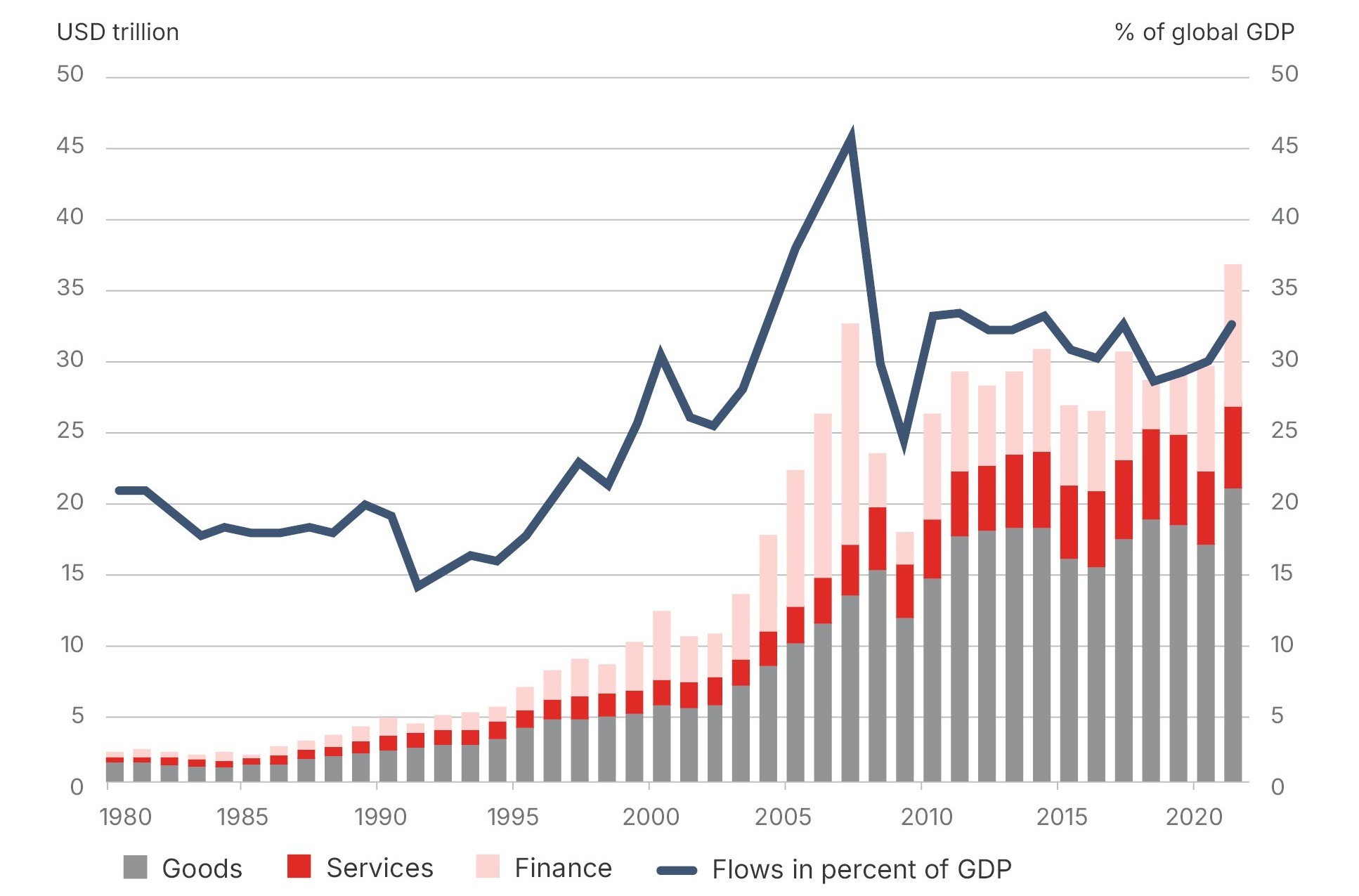
The 2008 Financial Crisis marked a significant turning point in global economic liberalisation. It prompted the rise of anti-globalisation and populist movements and significantly slowed down the steady growth of cross-border trade and foreign direct investment flows that had gained momentum since the 1980s. The world has since entered an era of ‘slowbalisation’, characterised by stagnation in global integration (see Figure 1).
Recent geopolitical upheavals – including the US-China trade conflict, the COVID-19 pandemic, and the RussiaUkraine war – have further fragmented trade and supply chains, steering the global economy towards ‘geoeconomic fragmentation’. This reflects nations’ increasing prioritisation of security and resilience over efficiency – as exemplified by free trade and globally integrated supply chains – though the global economy remains deeply interconnected, making large-scale ‘deglobalisation’ unlikely.
FIGURE 1: GLOBAL TRADE FLOWS (IN USD TRILLION AND PERCENT OF GLOBAL GDP)
Source: International Monetary Fund (IMF)1
Current trends towards protectionism have reversed some of the gains from trade liberalisation made in the post-war era, which fostered global economic growth and brought down inflation. Foreign direct investment, vital for growth and technology transfer, has also suffered; since the Financial Crisis, foreign direct investment flows have declined as a share of global GDP, worsened by geopolitical tensions. Capital increasingly gravitates within geopolitical blocs, prompting a restructuring of global supply chains via reshoring or ‘friendshoring’. While these strategies may reduce geopolitical risks, they come at the cost of efficiency, ultimately raising production costs and consumer prices.
Technology diffusion has been impeded by geoeconomic fragmentation as countries enforce export restrictions to safeguard national interests. This deceleration in innovation and productivity could lead to significant long-term GDP losses, particularly in technology-driven economies like the US and China. Estimates suggest that the trend toward technological decoupling in itself could slash certain countries’ GDP by as much as 5%, compared to the 10-year forecast.
Combined with restrictions on cross-border flows of goods, services, and capital, geoeconomic fragmentation could lower GDP growth in some countries by up to 12%. Declines in cross-border trade and investment, compounded by technological decoupling, risk creating a stagflation environment characterised by higher inflation and lower economic growth.
Geoeconomic fragmentation presents notable challenges and potential opportunities for insurers (see Table 1). It complicates global risk management, hampering international cooperation on pressing issues such as climate change, pandemic preparedness, and cybersecurity that require coordinated action. Insurers may also face increased risk exposure and insurability challenges related to these threats.
TABLE 1: GEOECONOMIC FRAGMENTATION AND INSURANCE
| Mitigation of global risks | International risk diversification | Global footprint | Specialty insurance | Mainstream insurance | Financial markets |
|---|---|---|---|---|---|
|
|
| Demand for:
|
| Volatility due to:
|
Source: Geneva Association
Geographical risk spreading, a hallmark of effective insurance, is increasingly constrained by barriers to cross-border activities. This heightens the volatility of claims and investment returns, potentially necessitating higher premiums for policyholders. Fragmentation also increases operational complexity for international insurers, as diverging or even discriminatory legal and regulatory frameworks impose significant compliance costs, particularly in geopolitically distant regions. This may compel some insurers to refocus on home and geopolitically closer markets, potentially spurring consolidation within the insurance industry.
The commercial and specialty insurance sectors face immediate and direct issues. Unlike retail insurance, which is affected indirectly by changes in economic growth and inflation, these sectors grapple with heightened risks tied to political instability and supply chain interruptions, for example. However, opportunities also arise from increased government investment in essential infrastructure, for example in semiconductor production and clean energy.
Recent industrial policies, such as the US CHIPS and Science Act, have positively influenced the outlook for commercial property insurance, which protects assets against risks like fire and natural disasters. New investments and construction projects necessitate comprehensive property coverage, particularly as the emphasis on strengthening critical supply chains and technological infrastructure elevates the risk profile of high-value assets.
Engineering insurance, which addresses risks associated with the construction, installation, and operational activities of projects, is also poised for growth in a geopolitically influenced industrial policy environment. The push for energy independence is likely to spur investments in renewable energy and localised manufacturing, increasing demand for specialised engineering insurance products for complex machinery and renewable installations like wind turbines and solar farms.
Marine insurance, crucial for covering losses related to ships, cargo, and infrastructure, faces challenges from geoeconomic fragmentation. A shift from global toward localised supply chains is expected, which will affect established shipping routes. This could, in the short term, lead to an uptick in insurance claims due to rerouting, ultimately heightening marine insurers’ risk exposure.
Geoeconomic fragmentation also introduces complexities for trade credit insurance, which protects businesses against non-payment risks arising from trading partners’ insolvencies or defaults. Increased trade barriers could strain firms reliant on international commerce, raising the likelihood of insolvencies, particularly among small and medium-sized enterprises.
Political risk insurance, which offers coverage against losses from political events such as expropriation, has gained prominence. The tense geopolitical climate amplifies demand for this coverage, particularly among multinational companies which are now more vulnerable to actions jeopardising their foreign assets.
Cyber insurance, which primarily addresses losses stemming from cyberattacks and data breaches, is increasingly vital in today’s geopolitical environment. State-sponsored cyber threats may escalate due to geopolitical tensions, exacerbating risks for businesses and adding to attribution challenges in the context of insurability.
Corporate executives and non-executives use directors & officers (D&O) insurance to protect against claims stemming from their decisions. Geoeconomic fragmentation increases the potential for arbitrary regulatory investigations, which amplifies claims exposure for D&O insurers. Reputational risks tied to political controversies further underscore the importance of D&O coverage.
Insurers must proactively adapt to geoeconomic fragmentation to maintain resilience and relevance as a stabilising force in a rapidly changing world economy. Effective scenario planning is key. This methodology equips insurers to anticipate various potential futures and assess both immediate and long-term impacts on operations. Each scenario must consider implications for critical areas such as claims frequency, severity, and investment returns, as well as impact assessments encompassing growth, profitability, and solvency (see Table 2).
TABLE 2: STRATEGIC INSURANCE INDUSTRY RESPONSES TO GEOECONOMIC FRAGMENTATION
| Gradual and controlled intensification of geoeconomic fragmentation with no reversal of globalisation | Gradual and controlled intensification of geoeconomic fragmentation with no reversal of globalisation | Bifurcation into two antagonistic blocs |
|---|---|---|
|
|
|
Source: Geneva Association
We put forward three geoeconomic fragmentation scenarios and possible responses from insurers. Scenario 1 envisions a gradual and controlled intensification of geoeconomic fragmentation, marked by regionalisation of trade, a further geopolitically inspired increase in tariffs and government subsidies for specific domestic sectors, and selective decoupling, but not a full-scale reversal of globalisation. In this environment, insurers must develop products that address specific, new risks emerging from more fragmented global markets. Political risk insurance should deal with shifting trade policies, and supply chain insurance will need to adapt to more regionalised supply chains. A more granular approach to underwriting will be essential, incorporating real-time geopolitical intelligence to assess region-specific risks. Capital management must be highly flexible, adjusting to varying geopolitical risks across regions. Insurers will also need to diversify asset portfolios across countries and sectors benefiting from this scenario, such as nonaligned countries and renewable energy and advanced technology companies.
Scenario 2 foresees an exacerbation of geoeconomic fragmentation due to trade-war-like tit-for-tat measures, where escalating protectionism leads to more volatile global cross-border flows and supply chains. Insurers will need to address heightened risks related to trade disruptions, with increased demand for products covering trade conflicts and retaliatory measures. Underwriting must adapt to the unpredictable nature of escalating trade barriers, requiring dynamic risk assessments and stress tests. Capital management will emphasise liquidity and flexibility, enabling quick redeployment of funds to less exposed regions. In asset management, defensive strategies will dominate, with increased allocation toward markets insulated from geopolitical conflicts, such as non-aligned nations.
Scenario 3 is the most extreme outcome: a bifurcation into two antagonistic blocs, prompted by a major geopolitical conflict and large-scale economic sanctions. This radical fragmentation forces insurers to align with one bloc, severely limiting global diversification opportunities. Insurers will need to focus on bloc-specific products, particularly in sectors like infrastructure and manufacturing, driven by government policy. Underwriting as well as capital and asset management will have to address heightened concentration risks within each bloc.
Scenario 2 is considered the most likely outcome, given the results of the 2024 US presidential election. Scenario 1 also has significant likelihood, as key trading partners may adopt a transactional approach to avoid an outright global trade war. Scenario 3 is expected to remain a remote possibility.
The tides of globalisation are shifting. Nations are increasingly prioritising security over efficiency, a trend that has given rise to ‘geoeconomic fragmentation’. This phenomenon, marked by reduced global economic integration as a result of new barriers to cross-border trade and capital flows, has profound implications for economies and industries worldwide. Models project that in its most severe form, geoeconomic fragmentation could slash global GDP growth by as much as 7%, compared to 10-year baseline forecasts.
Our report examines the implications of this evolving landscape for re/insurers and how they may need to adapt to continue thriving. One significant challenge posed by geoeconomic fragmentation is that it undermines international cooperation on global risks, such as climate change and cybersecurity, increasing insurers’ exposure to threats that are harder to mitigate and insure. In addition, geoeconomic fragmentation restricts diversification in both underwriting and investment portfolios, amplifying the volatility of claims and returns. This volatility could result in higher premiums for policyholders, underscoring the financial ripple effects of fragmentation.
Yet, geoeconomic fragmentation is not solely a source of risk – it also creates new business opportunities. The shift towards energy independence will likely spur demand for specialised insurance products to cover renewable energy projects, including wind turbines and solar farms. Similarly, the heightened vulnerability of multinational companies to geopolitical events will drive growth in political risk insurance.
To navigate the uncertainties of geoeconomic fragmentation, insurers must embrace agile risk management and innovative strategies. Our report outlines three scenarios – mild, accelerated, and extreme fragmentation – and provides actionable recommendations for insurers to adapt to each one. By tailoring products, leveraging real-time geopolitical data, and rebalancing portfolios, insurers can remain resilient and seize opportunities in a less integrated world. Considering these scenarios is essential for insurers to chart a sustainable path forward amid geoeconomic fragmentation.
Jad Ariss
Managing Director
The 2008 Financial Crisis marked a significant turning point in global economic liberalisation. It prompted the rise of anti-globalisation and populist movements and significantly slowed down the steady growth of crossborder trade and foreign direct investment flows that had gained momentum since the 1980s. The world has since entered an era of ‘slowbalisation’, characterised by stagnation in global integration.
Recent geopolitical upheavals – including the US-China trade conflict, the COVID-19 pandemic and the RussiaUkraine war – have further fragmented trade and supply chains, steering the global economy towards ‘geoeconomic fragmentation’. This reflects nations’ increasing prioritisation of economic and national security and resilience over efficiency – as exemplified by free trade and globally integrated supply chains – though the global economy remains deeply interconnected, making largescale ‘deglobalisation’ unlikely.
Current trends towards protectionism have reversed some of the gains from trade liberalisation made in the post-war era, which fostered global economic growth and brought down inflation. Foreign direct investment, vital for growth and technology transfer, has also suffered. Since the Global Financial Crisis, foreign direct investment flows have declined as a share of global GDP, worsened by geopolitical tensions. Capital increasingly gravitates within geopolitical blocs, prompting a restructuring of global supply chains via reshoring or ‘friend-shoring’. While these strategies may reduce geopolitical risks, they come at the cost of efficiency, ultimately raising production costs and consumer prices.
Technology diffusion has been impeded by geoeconomic fragmentation as countries enforce export restrictions to safeguard national interests. This deceleration in innovation and productivity could lead to significant long-term GDP losses, particularly in technology-driven economies like the US and China. Estimates suggest that the trend toward technological decoupling in itself could slash certain countries’ GDP by as much as 5%, compared to the 10-year forecast.
Combined with restrictions on cross-border flows of goods, services, and capital, geoeconomic fragmentation could lower GDP growth in some countries by up to 12%. Declines in cross-border trade and investment, compounded by technological decoupling, risk creating a stagflation environment characterised by higher inflation and lower economic growth.
Geoeconomic fragmentation presents notable challenges and potential opportunities for insurers. It complicates global risk management, hampering international cooperation on pressing issues such as climate change, pandemic preparedness, and cybersecurity that require coordinated action. Insurers may also face increased risk exposure and insurability challenges related to these threats.
The geographical spread of risk, a hallmark of effective insurance, is increasingly constrained by barriers to cross-border activities. This heightens the volatility of claims and investment returns, potentially necessitating higher premiums for policyholders. Fragmentation also increases operational complexity for international insurers, as diverging or even discriminatory legal and regulatory frameworks impose significant compliance costs, particularly in geopolitically distant regions. This may compel some insurers to refocus on home and geopolitically closer markets, potentially spurring consolidation within the insurance industry.
The commercial and specialty insurance sectors face immediate and direct issues. Unlike retail insurance, which is affected indirectly by changes in economic growth and inflation, these sectors grapple with heightened risks tied to political instability and supply chain interruptions, for example. However, opportunities also arise from increased government investment in essential infrastructure, for example in semiconductor production and clean energy.
Recent industrial policies, such as the US CHIPS and Science Act, have positively influenced the outlook for commercial property insurance, which protects assets against risks like fire and natural disasters. New investments and construction projects necessitate comprehensive property coverage, particularly as the emphasis on strengthening critical supply chains and technological infrastructure elevates the risk profile of high-value assets.
Engineering insurance, which addresses risks associated with the construction, installation, and operational activities of projects, is also poised for growth in a geopolitically influenced industrial policy environment. The push for energy independence is likely to spur investments in renewable energy and localised manufacturing, increasing demand for specialised engineering insurance products for complex machinery and renewable installations like wind turbines and solar farms.
Marine insurance, crucial for covering losses related to ships, cargo, and infrastructure, faces challenges from geoeconomic fragmentation. A shift from global toward localised supply chains is expected, which will affect established shipping routes. This could, in the short term, lead to an uptick in insurance claims due to rerouting, ultimately heightening marine insurers’ risk exposure.
Geoeconomic fragmentation also introduces complexities for trade credit insurance, which protects businesses against non-payment risks arising from trading partners’ insolvencies or defaults. Increased trade barriers could strain firms that are reliant on international commerce, raising the likelihood of insolvencies – particularly among small and medium-sized enterprises.
Political risk insurance, which offers coverage against losses from political events such as expropriation, has gained prominence. The tense geopolitical climate amplifies demand for this coverage, particularly among multinational companies which are now more vulnerable to actions jeopardising their foreign assets.
Cyber insurance, which primarily addresses losses stemming from cyberattacks and data breaches, is increasingly vital in today’s geopolitical environment. State-sponsored cyber threats may escalate due to geopolitical tensions, exacerbating risks for businesses and adding to attribution challenges in the context of insurability.
Corporate executives and non-executives use directors’ & officers’ (D&O) insurance to protect against claims stemming from their decisions. Geoeconomic fragmentation increases the potential for arbitrary regulatory investigations, which amplifies claims exposure for D&O insurers. Reputational risks tied to political controversies further underscore the importance of D&O coverage.
Insurers must proactively adapt to geoeconomic fragmentation to maintain resilience and relevance as a stabilising force in a rapidly changing world economy. Effective scenario planning is key. This methodology equips insurers to anticipate various potential futures and assess both immediate and long-term impacts on operations. Each scenario must consider implications for critical areas such as claims frequency, severity, and investment returns, as well as impact assessments encompassing growth, profitability, and solvency.
This report introduces and investigates three specific geoeconomic fragmentation scenarios and possible responses from insurers. Scenario 1 envisions a gradual and controlled intensification of geoeconomic fragmentation, marked by regionalisation of trade, a further geopolitically inspired increase in government subsidies for specific domestic sectors, and selective decoupling, but not a full-scale reversal of globalisation. In this environment, insurers must develop products that address specific, new risks emerging from more fragmented global markets. Political risk insurance should tackle shifting trade policies, and supply chain insurance will need to adapt to more regionalised supply chains. A more granular approach to underwriting will be essential, incorporating real-time geopolitical intelligence to assess region-specific risks. Capital management must be highly flexible, adjusting to varying geopolitical risks across regions. Insurers will also need to diversify asset portfolios across countries and sectors benefiting from this scenario, such as non-aligned countries and renewable energy and advanced technology companies.
Scenario 2 foresees an exacerbation of geoeconomic fragmentation due to tit-for-tat measures, where escalating protectionism leads to more volatile global crossborder flows and supply chains. Insurers will need to address heightened risks related to trade disruptions, with increased demand for products covering trade conflicts and retaliatory measures. Underwriting must adapt to the unpredictable nature of escalating trade barriers, requiring dynamic risk assessments and stress tests. Capital management will emphasise liquidity and flexibility, enabling quick redeployment of funds to less exposed regions. In asset management, defensive strategies will dominate, with increased allocation toward markets insulated from geopolitical conflicts, such as non-aligned nations.
Scenario 3 is the most extreme outcome: a bifurcation into two antagonistic blocs, prompted by a major geopolitical conflict and large-scale economic sanctions. This radical fragmentation forces insurers to align with one bloc, severely limiting global diversification opportunities. Insurers will need to focus on bloc-specific products, particularly in sectors like infrastructure and manufacturing, driven by government policy. Underwriting as well as capital and asset management will have to address heightened concentration risks within each bloc.
Scenario 2 is considered the most likely outcome, given the results of the 2024 US presidential election. Scenario 1 also has significant likelihood, as key trading partners may adopt a transactional approach to avoid an outright global trade war. Scenario 3 is expected to remain a remote possibility.
The 2008 Global Financial Crisis was a pivotal moment for the international economic liberalisation era that started in the 1980s and is characterised by the rise of free trade and cross-border capital flows. The economic opening of China, the political and economic integration of the former Soviet bloc, and the stipulation of multilateral trade agreements were all steps towards an increasingly globalised world. This trend never fully resumed after the Financial Crisis and the world entered a new phase known as ‘slowbalisation’ – a prolonged slowdown and stagnation in the pace of global economic integration. Figure 1 illustrates the surge in cross-border flows of goods, services, and capital since the 1980s and their marked slowing after the Global Financial Crisis, the US-China trade dispute, the breakdown of global supply chains in the wake of the COVID-19 pandemic, and the war in Ukraine and Russia’s subsequent exit from the Western economic system in 2022.1 In terms of their share of global GDP, cross-border flows now hover around the levels seen in the late 1990s and early 2000s.2
FIGURE 1: GLOBAL TRADE FLOWS (IN USD TRILLION AND PERCENT OF GLOBAL GDP)
Source: International Monetary Fund (IMF)3
Against this backdrop, many countries have reconfigured their priorities – national and economic security and resilience have taken precedence over free trade and economic efficiency. This is referred to as geoeconomic fragmentation, defined as ‘a policy-driven reversal of global economic integration often guided by strategic considerations’.4
Multinational corporations are very concerned about geoeconomic fragmentation and its underlying geopolitical reasons. According to a recent survey, 69% of respondents experienced supply chain disruption due to geopolitical events. Concern about political risk in Asia and North America was reported by 64%.5
Despite recent trends toward economic nationalism and shifts in trade policies, the global economy remains profoundly interconnected (see Figure 1). Large-scale ‘deglobalisation’ appears improbable as major economies are still heavily invested in the benefits of cross-border trade and foreign investment. Multinational supply chains and access to foreign markets, for example, remain foundational to many economies, and dismantling these ties would likely bring more costs than benefits.
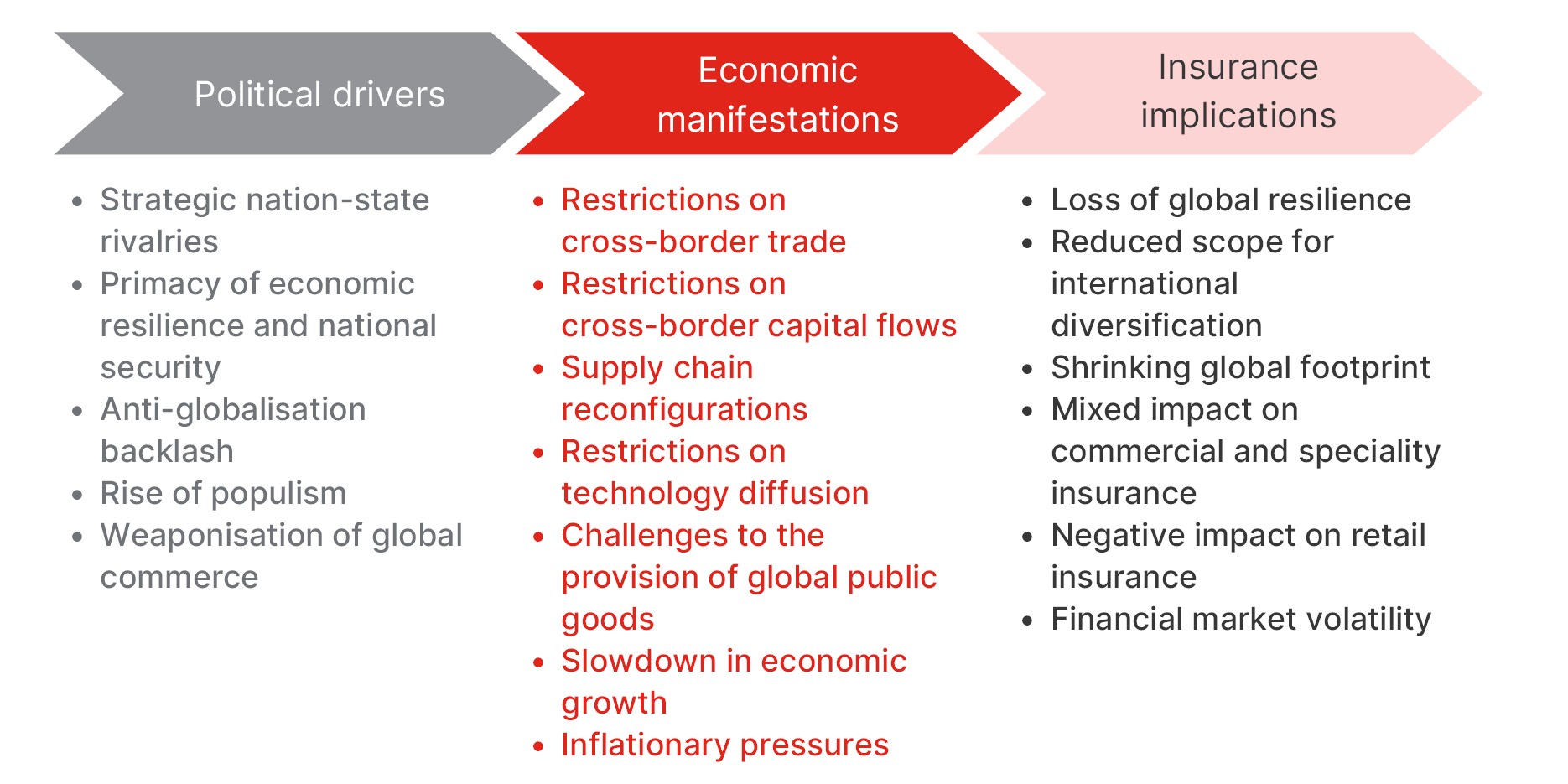
Against that backdrop, this report utilises a holistic framework (see Figure 2) to analyse the implications of geoeconomic fragmentation for the insurable risk landscape and the insurance industry. The starting point is to explore the political drivers of geoeconomic fragmentation:
FIGURE 2: A HOLISTIC RISK AND INSURANCE APPROACH TO GEOECONOMIC FRAGMENTATION
Source: Geneva Association
Public support for globalisation has eroded over time, particularly as the benefits of trade became increasingly unevenly distributed. Initially, post-war trade negotiations led by the US fostered global economic integration, establishing a relatively successful multilateral framework. However, the failure to adequately compensate those negatively affected by globalisation led to growing discontent. The inclusion of China in the WTO in 2001, based on the assumption that free markets would further enhance reform, further intensified concerns as the anticipated benefits did not materialise. This disillusionment has fuelled scepticism toward globalisation, particularly in the US.
Robert Kahn, Eurasia Group
The economic manifestations of geoeconomic fragmentation are momentous and wide-ranging:
These political and economic developments could have a significant impact on the insurance industry:
Against this backdrop, section 2 of this report delves deeper into the economic manifestations and consequences of geoeconomic fragmentation. Section 3 provides a comprehensive analysis of how geoeconomic fragmentation reshapes the insurable risk landscape and its impact on specific classes of insurance. Section 4 discusses potential strategic responses from the insurance industry, considering three distinct scenarios for the future trajectory of geoeconomic fragmentation.
Box 1: The journey of insurance through globalisation and fragmentation
The industrialisation era of the 19th century brought more than just automation and capitalism – it was a catalyst for globalisation, first in the Western hemisphere and later worldwide. This period, which ended in 1914, saw significant changes due to industrialisation, such as urbanisation (leading to the concentration of people and property) and a rapid increase in global economic integration. Risks became more concentrated and complex, as demonstrated by catastrophic events like the great fire in Hamburg (1842), and the 1906 San Francisco earthquake. The insurance industry advanced significantly during this time, protecting both domestic and international interests. In the latter half of the 19th century, major reinsurers like Munich Re and Swiss Re emerged, expanding the international reinsurance network.
The World War era (1914–1945) brought rapid deglobalisation due to rising nationalism and severe economic depressions. Despite this, insurance continued to play a crucial role in protecting national and individual economic interests. The industry reduced insurance costs and preserved insurability by carving out war risks from standard policies and creating specific coverages for war-related risks, such as marine and aviation insurance. Similar adjustments were made for life and health insurance.
Globalisation resurged after the wars. The post-war era (1946–1980) was marked by infrastructure reconstruction, technological innovation, inflation, and growing economic affluence. Social security and insurance programmes expanded, and the insurance industry grew in both scope and revenue. However, in several countries, it became a target for nationalisation, as governments sought to tap into premium revenue and reserves for various purposes, such as post-war reconstruction, economic development, political gain, and addressing market failures.20 This intervention hindered the true growth of the insurance industry and discouraged talent development. Privatisation and market liberalisation in many regions did not occur until the 1980s or later.
During the extended globalisation period (1980–2008), the insurance industry continued its expansion. New products such as investment-linked, foreign-currency-linked, and flexible life insurance and pension plans enabled individuals to better manage wealth and reduce exposure to longevity risk. Microinsurance also gained traction as technological advancements lowered transaction costs and enabled new distribution channels.
The 2007–2008 Global Financial Crisis, triggered by the accumulation of non-performing loans, predatory subprime mortgage practices, and excessive risk-taking by key financial institutions, disrupted global economic growth.
More recently, the COVID-19 pandemic, rising geopolitical tensions, increasing nationalism, and trade restrictions have further disrupted global economic growth, leading to what some describe as a period of ‘slowbalisation’.
While it remains uncertain whether we are truly entering an era of deglobalisation, it is clear that we are facing an age of extremism. Widening wealth disparities, growing social divisions, and displays of national or regional superiority pose significant challenges for future generations. These human-induced conflicts, alongside adverse climate change, increase costs for the insurance industry. Ultimately, these costs are borne by underwriters, policyholders, and, if necessary, taxpayers.
Insurance rarely causes uncertainty; instead, it manages the uncertainties created by others and by nature. The true value of insurance, particularly as a public good, can be realised only when we foster a more harmonious society.
Source: Contributed by W. Jean Kwon, St. John's University, New York
In a world where geopolitical issues are creating increased uncertainty and higher business risks, insurance companies play a crucial role in providing protection to both individuals and corporations. This dynamic environment presents both challenges and opportunities for insurers. For instance, with increasing economic volatility, life insurers may benefit from heightened demand to ensure financial stability despite economic disruptions and offer a layer of security in uncertain times. Moreover, growing political and economic uncertainty underscores the complexity and urgency of retirement planning, particularly in countries with unstable pension systems or high exposure to geoeconomic fragmentation. Non-life insurer may find opportunities in areas such as developing new and creative insurance solutions for reconfigured supply chains and longer, less familiar trade routes.
To navigate this changing landscape, it is imperative for insurance firms to enhance their strategic planning and preparedness. Strengthening market intelligence and risk management is essential in the face of increasing geoeconomic fragmentation. This involves staying informed about global political and economic shifts and developing scenarios to cope with uncertainty. We must also ensure we are aware of the facts, rather than being misled by impressions or rhetoric. For example, some say we are in an era of deglobalisation, but it may be too early to draw a conclusion as others say that globalisation is plateauing and being reconstructed. To analyse the situation correctly and make critical business decisions, we need to understand the facts.
By focusing on such points, insurance companies can turn potential threats into opportunities, ensuring they continue to provide essential protection and stability to their clients in an increasingly unpredictable world.
Hiroshi Shimizu, CEO, Nippon Life, and co-sponsor of the Geneva Association’s Macro & Geoecomic Shifts work stream
This section explores the economic manifestations and ramifications of today’s geopolitical realities (see Table 1). Much like the effects of economic integration, its stagnation or even reversal influences a wide spectrum of economic parameters such as cross-border trade and investments, supply chains, industrial policies, the diffusion of technology, and the provision of global public goods which benefit the world at large.
TABLE 1: ECONOMIC MANIFESTATIONS OF GEOECONOMIC FRAGMENTATION
| Cross-border trade | Cross-border capital flows and supply chains | Technology diffusion | Provision of global public goods | Economic growth | Inflation |
|---|---|---|---|---|---|
|
|
| Eroding multilateralism with negative effects on:
|
|
|
Source: Geneva Association
In the decades following the Second World War, international trade has been instrumental in reducing global poverty and promoting higher standards of living. On the back of multilateral and regional trade liberalisation efforts, countries were able to integrate into the world economy, amplifying their competitive edge and benefiting from significantly higher levels of productivity.21 For the world economy as a whole, trade integration has generated income growth22 and fostered innovation.23
Over the past three decades in particular, the emergence of global supply chains has brought significant benefits to developing countries, as evidenced in a significant and sustained reduction in poverty.24 In advanced economies, trade liberalisation has brought down prices on imported consumer goods, disproportionately benefiting low-income consumers.25
One of the key challenges associated with trade liberalisation has been the frequently unequal distribution of gains within domestic economies. The income share of labour in GDP has fallen in many economies whereas the share of capital owners and skilled workers has increased.26 As a result, political resistance, in the form of populist and anti-globalisation movements, against free trade and global economic integration has been on the rise, especially since the Global Financial Crisis.
The recent trend towards trade restrictions and other protectionist measures comes at a steep economic cost. For example, in 2018 and 2019, tariffs imposed by the US on imports from China were entirely passed on to US domestic consumers and importers of intermediate goods.27 Flaaen and Pierce suggest that those trade restrictions have lowered overall employment in the US manufacturing sector.28 Going forward, accelerated fragmentation in international trade could impair overall economic growth, especially in developing economies. Higher import prices, on top of other domestic inflationary pressures, could disproportionately hurt low-income consumers in advanced economies.29
Trade between geopolitically distant economies accounts for nearly 20% of global goods trade. This trade is especially vulnerable to geopolitical risks when it involves globally concentrated goods. For example, 40% of trade in products like laptops and iron ore – where a small number of countries dominates global exports – occurs between geopolitically distant economies.30
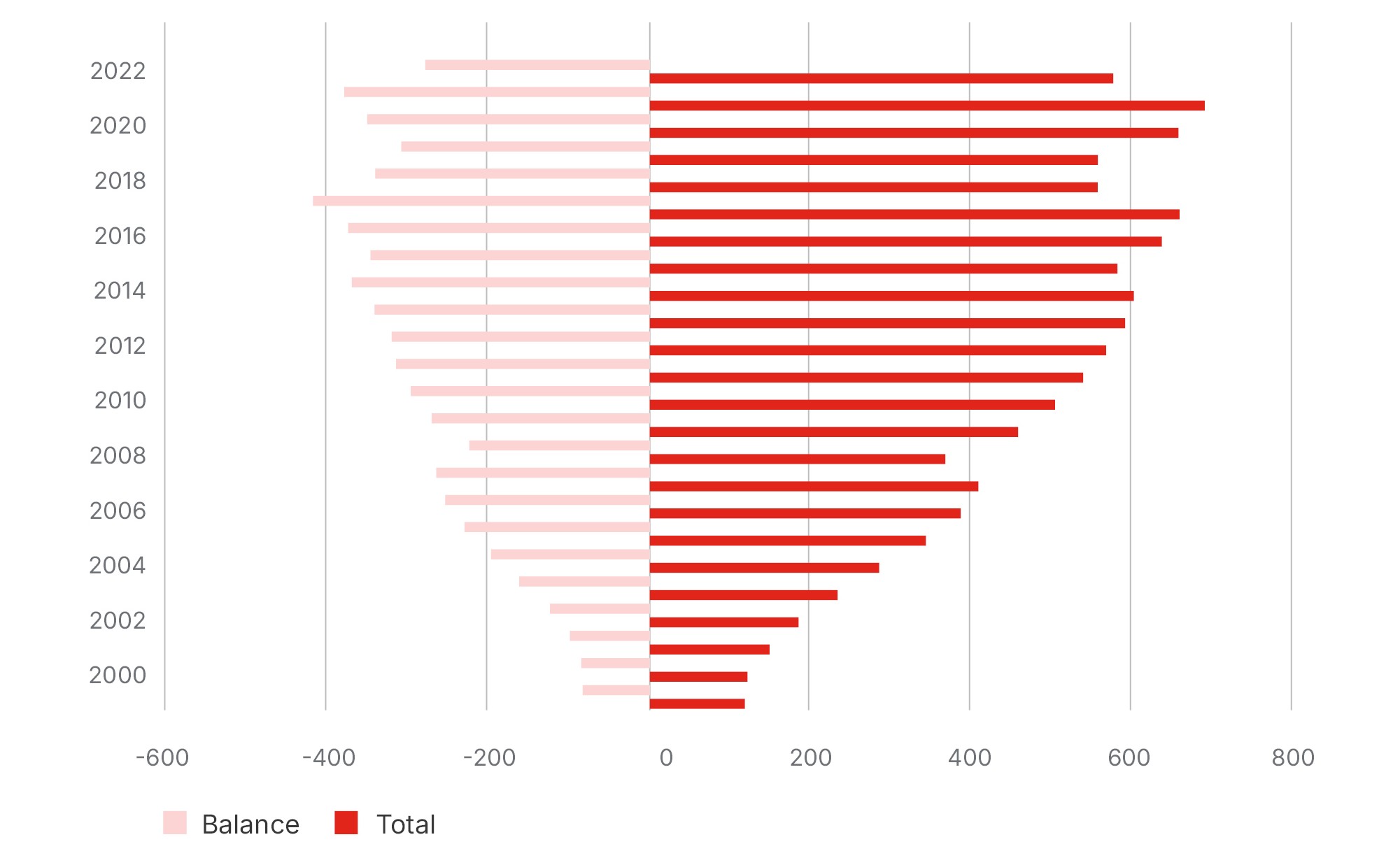
Figure 3 illustrates trade flows between the US and China since the year 2000. Both trade volumes and the US trade deficit increased steadily until 2014, with the exception of 2009, when the Global Financial Crisis impacted markets. After 2014, bilateral trade continued to grow, reaching an all-time high in 2022, but the pace of growth slowed and became more volatile. The sharp fall in trade volumes in 2019 and 2020 reflects the impact of US import tariffs, Chinese retaliatory measures, and the COVID-19 pandemic. That said, despite a decline of approximately 15%, which was followed by a rapid rebound in 2021, bilateral trade has demonstrated remarkable resilience.
FIGURE 3: TRADE BETWEEN THE US AND CHINA, 2000–2023 (USD BILLION)
Source: Data from the US Census
Growing tensions among nations and scepticism towards the advantages of global interconnectedness have also impacted foreign direct investment, which involves international investors acquiring significant influence over local businesses. The rise of geoeconomic fragmentation poses a risk to the flow of capital across borders, which is crucial for efficiently allocating resources, facilitating the transfer of skills and technology, and ultimately driving economic growth.31
After the Global Financial Crisis, annual foreign direct investment flows as a percentage of global GDP decreased from over 5% to less than 3%. The emergence of the US-China trade conflict in 2018 further diminished this ratio to below 1%, although it presently hovers around 2%. Foreign direct investment flows are now more concentrated among nations with aligned geopolitical interests. If geopolitical tensions escalate and nations drift further apart along geopolitical fault lines, foreign direct investment is poised to concentrate further within blocs of aligned nations.32 Given that foreign direct investment, on average, constitutes approximately 12% of domestic capital stocks, the ramifications for certain countries and regions could be substantial.33
A key manifestation of foreign direct investment fragmentation is the restructuring of global supply chains. Companies and policymakers are increasingly considering strategies to reshore or ‘friend-shore’ production – either bringing it back to domestic soil or relocating it to politically aligned countries to reduce vulnerability to geopolitical tensions. Notably, financial disclosure data from a substantial sample of multinational corporations shows a surge in interest in reshoring and friendshoring. This shift marks a significant departure from earlier offshoring practices, which were primarily driven by labour and input cost disparities.34
While shifting production mitigates local producers’ vulnerability to shocks like geopolitical conflicts and pandemics, it also undermines overall cost efficiency as global markets become increasingly fragmented. There is evidence that the restructuring of global supply chains drives up both domestic consumer and producer prices, particularly in trade-intensive manufacturing sectors.35 A further decline in foreign direct investment would also exert adverse effects on host countries, including diminished capital accumulation, knowledge transfer, technological advancement, and productivity growth. Model-based projections indicate that foreign direct investment fragmentation stemming from a sustained increase in barriers to capital flows between blocs could markedly curtail global output, potentially by around 2% over the long term.36
Recent large-scale policies by major economies to bolster domestic strategic manufacturing sectors have further accelerated the shift in cross-border capital flows. Notably, legislative measures enacted amid escalating strategic nation-state rivalries, such as the US CHIPS and Science Act, the Inflation Reduction Act, and the European Chips Act, have significantly influenced multinational corporations’ production and sourcing strategies. These initiatives further reinforce the push to restructure global supply chain networks.37
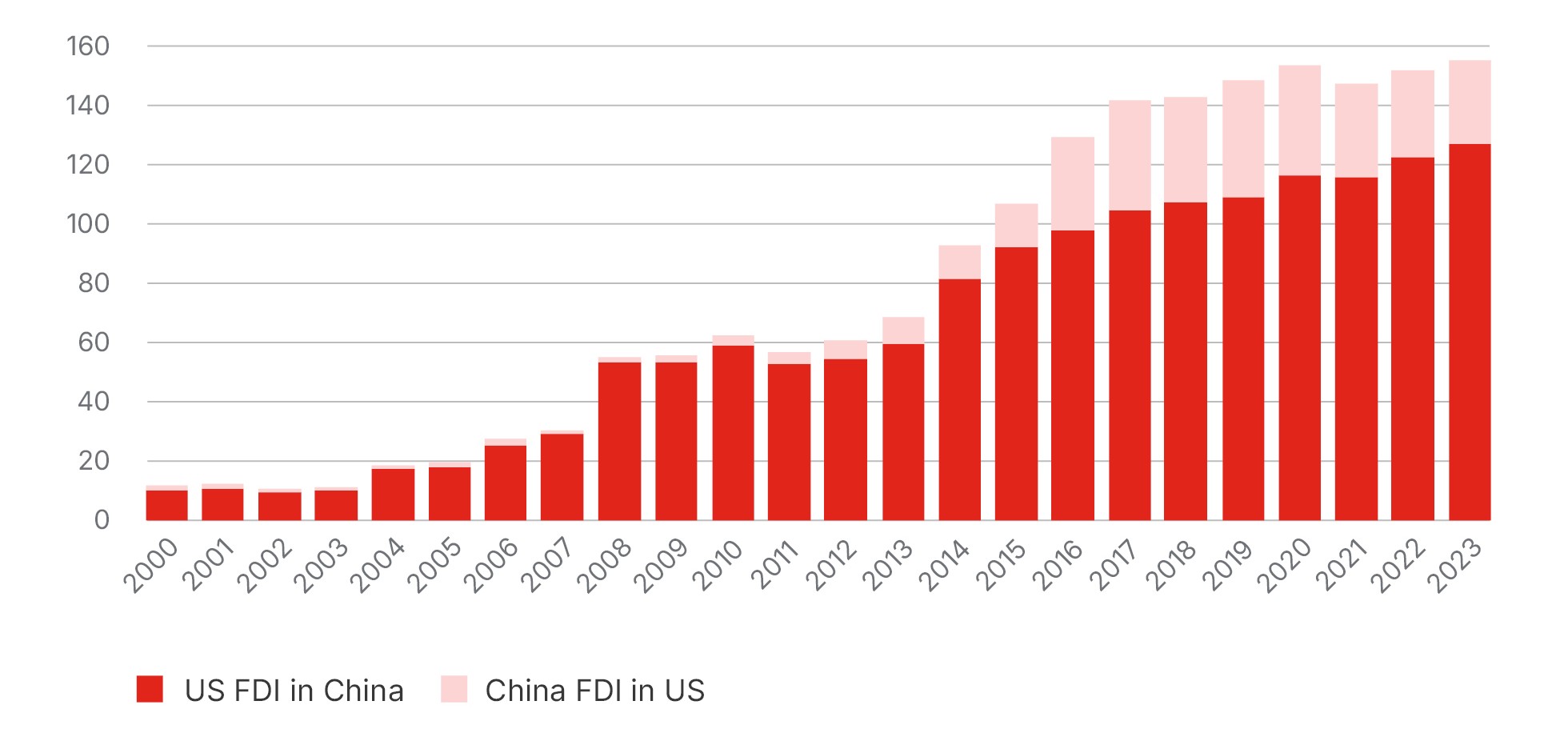
Figure 4 illustrates the deceleration in foreign direct investment flows between the US and China. Since 2018, US foreign direct investment stocks in China have experienced a notable slowdown in growth. Chinese foreign direct investment stocks in the US peaked in 2019 and have been on a steady decline since.
FIGURE 4: FOREIGN DIRECT INVESTMENT BETWEEN THE US AND CHINA, 2000–2023 (STOCKS IN USD BILLION) 180
Source: Statista
International technology diffusion refers to the spread of technological knowledge across national borders. It encompasses the transfer of ideas, innovations, and technical expertise from one country to another. This knowledge transfer can take various forms, such as patents, blueprints, and software code.38 Innovations can spill over to other countries through trading partners and foreign direct investment, including the establishment of production facilities and related knowledge transfer.39
International technology diffusion, enabled by openness to international trade and investment, has been crucial for economic growth and innovation, enhancing productivity and living standards.40 However, countries increasingly impose export restrictions on certain technologies to protect national security or economic interests, leading to more fragmented global markets and growing impediments to the free flow of technological knowledge. For instance, the US has put in place controls on semiconductor manufacturing equipment and advanced computing exports to limit China’s access.41 Related government subsidies to strategic technology industries can distort markets, reduce productivity, and result in excess capacity in some sectors.42
Technological fragmentation could result in GDP losses of up to 5%, compared to 10-year forecasts, for economies with large technology sectors (‘technology hubs’). The extent of losses increases with the level of fragmentation. A scenario where non-hub countries are limited to trading with just one technology hub has been found to be particularly damaging.43
Public goods are non-excludable, i.e. available to all. They are also non-rival, i.e. can be enjoyed over and over again by anyone without diminishing the benefits they deliver to others. Public goods can be ‘produced’ locally (e.g. public fireworks), nationally (e.g. national defence) and globally (e.g. the protection of the global environment).44 From an economic theory perspective, global public goods are no different from local or national public goods. However, their provision falls short of the latter. The main reason is the complexity of international cooperation and its organisation through multilateral institutions – a prerequisite for the supply of global public goods.45
Mitigating climate change is an example. The effectiveness of measures has benefited from policy coordination across borders. Meeting the goals of the Paris Agreement (or rather minimising the extent of missing them) will require continued international cooperation.46 The current trend towards geoeconomic fragmentation threatens to undermine the collaborative efforts necessary for fighting climate change by transitioning to clean energy and a net-zero future.47 Examples of other challenges that need a globally coordinated approach include pandemic preparedness, cybersecurity, and the prevention of humanitarian and financial crises.48
According to several recent academic studies, geoeconomic fragmentation can lead to long-term GDP losses. Given the recent and emerging nature of fragmentation, most attempts at quantification are based on modelling exercises. These studies focus primarily on trade restrictions and technological decoupling. They make different assumptions about the nature of fragmentation, the composition of geopolitical and/or trade blocs, the types of barriers imposed between blocs, and elasticities of substitution among suppliers.49
The costs increase as fragmentation deepens. The studies examine various scenarios, with those involving more barriers and fewer options for countries resulting in greater output losses. For instance, the losses are higher when trade barriers expand from specific sectors to all goods sectors. Similarly, losses increase when ‘non-aligned’ countries are forced to choose sides and trade solely with one dominant bloc rather than having the freedom to trade with multiple blocs.50
Reduced knowledge diffusion due to technological decoupling strongly amplifies the effects of trade fragmentation. This is because an economy’s productivity heavily depends on access to technology, knowledge, and processes.51
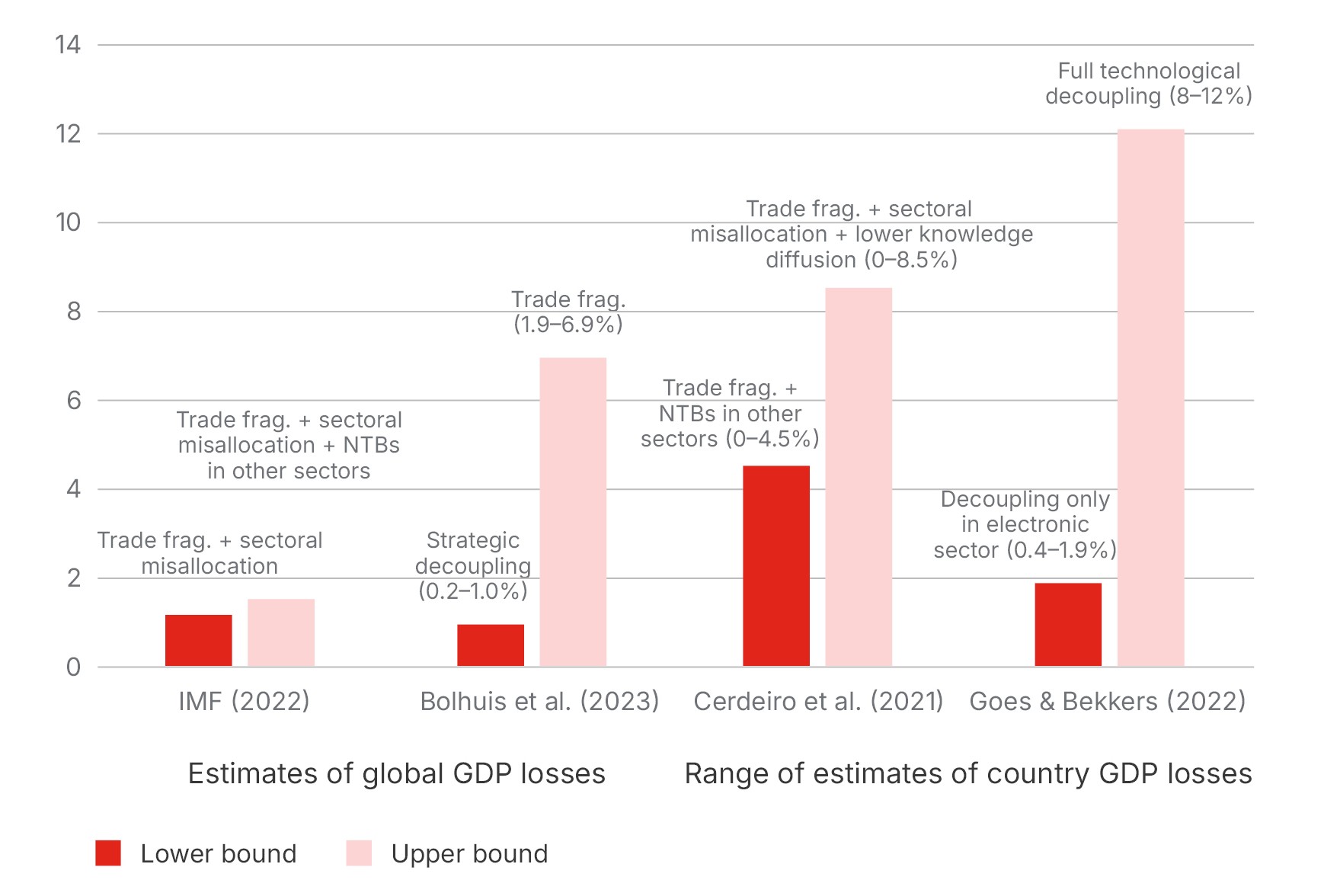
Depending on modelling assumptions, the cost to global output (measured as the deviation from 10-year baseline GDP forecasts) due to geoeconomic fragmentation could reach up to 7% of GDP in a severe trade fragmentation scenario, where the world splits into two blocs with no remaining trade or investment links. With the added impact of technological decoupling and its negative effects on productivity growth, the loss in output could rise to as much as 12% in some countries (see Figure 5).52
FIGURE 5: LONG-TERM LOSSES FROM TRADE AND TECHNOLOGY FRAGMENTATION (IN PERCENT OF GLOBAL GDP)
Source: Aiyar and Illyina53
More recent modelling exercises are based on specific potential future trade barriers imposed by the US. Since 2018 in particular, both Democratic and Republican administrations have imposed tariffs for various reasons, including supporting domestic industries and products, as well as addressing national security concerns. Therefore, the US is likely to maintain its recent protectionist stance based on a bipartisan consensus.
Considering this, EY, for example, modelled a scenario to evaluate the risks such tariffs could pose to both the US and global economies.54 The scenario assumes a 60% tariff on Chinese imports and a 10% universal tariff on imports from other nations, as suggested by Donald Trump in early 2024. It is also anticipated that many of the affected countries will retaliate with comparable tariffs on US exports.
The modelled economic impact on the US is significant, with reductions in consumer spending and business investment, along with a substantial decline in household disposable income.55 In this scenario, US real GDP would be about 2.5% (or about USD 800 billion) lower by the end of 2026 compared to the baseline (no further escalation of trade conflicts). US households in the top income quintile would see a 0.7% drop in disposable income, while those in the bottom quintile would face a loss more than twice as large, at 1.6%.
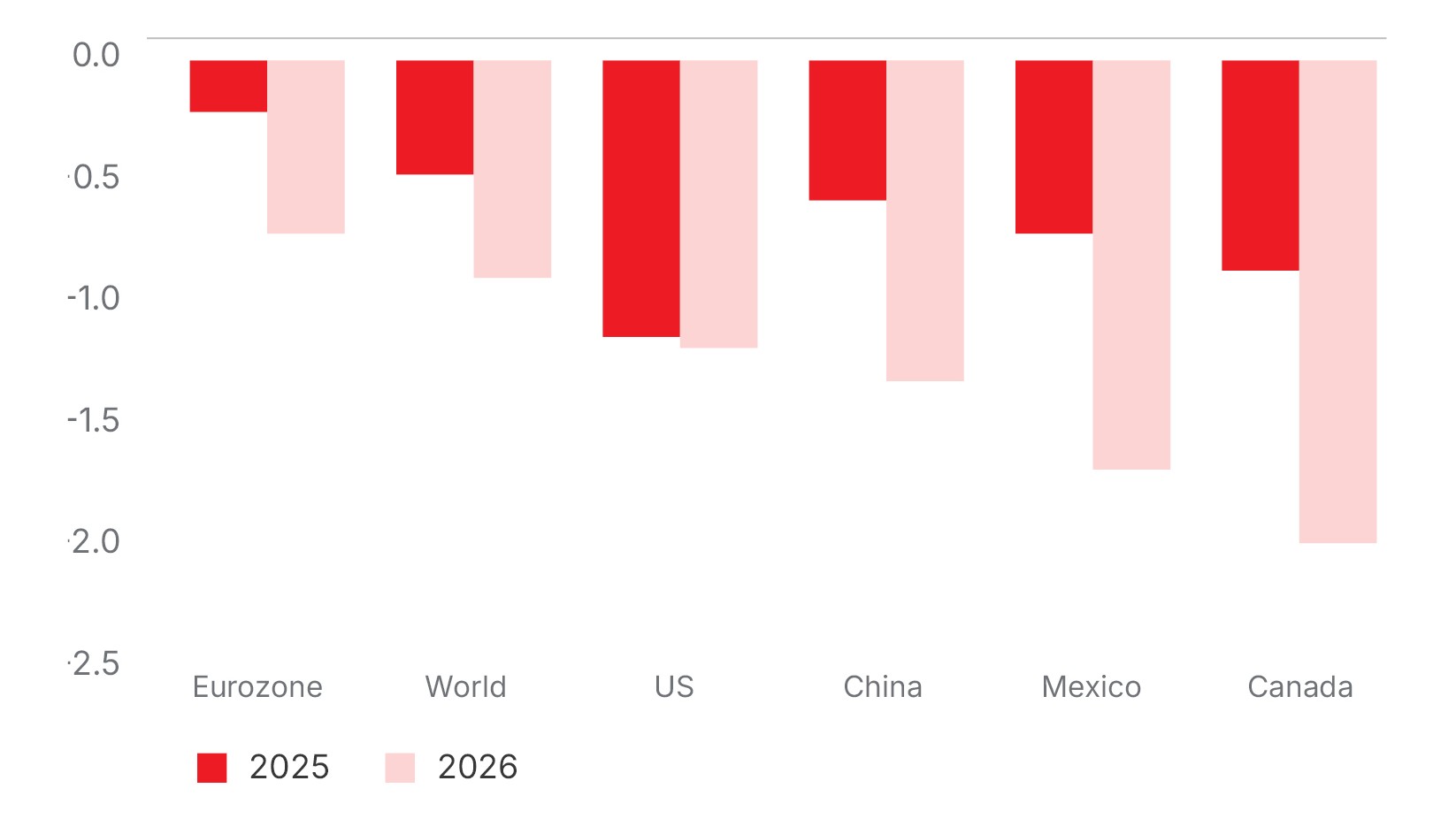
Globally, real GDP would decline by 0.5 percentage points in 2025 and 0.9 points in 2026 due to rising protectionism and slower US growth. Mexico and Canada, whose real GDP would suffer disproportionately from an economic slowdown in the US, are among the most affected economies (see Figure 6).56
FIGURE 6: IMPACT OF ADDITIONAL TARIFFS PROPOSED BY PRESIDENT TRUMP ON REAL GDP GROWTH (IN PERCENTAGE POINTS, RELATIVE TO BASELINE)
Source: EY57
Starting in the 1980s, an ever-accelerating pace of globalisation has aligned with a trend of decreasing inflation (disinflation), especially in developed countries. This decline occurred as cheaper imports supplanted more expensive domestically produced goods, enabled by a deeper and broader global division of labour, the strategic use of international supply chains to minimise production costs, and lower trade barriers. Notably, the global average tariff rate dropped from 8.6% in 1994 to 2.6% in 2017, which also helped curb inflation.58
The reversal of globalisation has been modelled as increasing inflation. Afrouzi et al. explore this by examining an economy with an initial 2% inflation rate.59 In their deglobalisation scenario, the country reduces its reliance on international trade, which weakens market competition and increases domestic firms’ pricing power. The inflationary impact varies with the extent of deglobalisation and the economy’s openness. The authors assume a scenario where the economy experiences a 10% reduction in the import share of GDP. Under these conditions, annual inflation rises from 2% to 3.4%.60
More concretely, the potential sharp rise in tariffs examined by EY would create a strong inflationary surge, pushing the overall consumer price inflation rate in the US up by a full percentage point by the fourth quarter of 2025.61 This, coupled with weakened GDP growth, heightens the risk of stagflation, i.e. a combination of economic stagnation and elevated inflation. The degree to which businesses pass these higher costs onto consumers will ultimately shape the impact of tariffs on inflation. The inflationary effect could be less severe if companies absorb part of the cost increase by reducing their profit margins or increasing productivity.62
With increasing geopolitical tensions, shifting trade policies, and emerging economic blocs, geoeconomic fragmentation presents major challenges but also opportunities for insurers. This section delves into the multifaceted implications for the insurance industry.63
Firstly, it examines how fragmentation exacerbates the difficulties of managing global risks, especially those which require international, government-level collaboration. It then explores how increasing barriers to cross-border economic activity limits insurers’ ability to spread risk geographically, impacting their underwriting and investment portfolios, and ultimately the cost of insurance. It then sheds light on how insurers may have to adjust their international market strategies and the consequences for the industry’s global footprint. This is followed by an analysis of how fragmentation directly or indirectly influences the demand for certain insurance products, by line of business. Finally, second-order effects arising from heightened financial market volatility are explored (see Table 2).
TABLE 2: GEOECONOMIC FRAGMENTATION AND INSURANCE
| Mitigation of global risks | International risk diversification | Global footprint | Specialty insurance | Mainstream insurance | Financial markets |
|---|---|---|---|---|---|
|
|
| Demand for:
|
| Volatility due to:
|
Source: Geneva Association
Geopolitical and geoeconomic fragmentation poses a significant risk to the insurance industry’s capacity to effectively diversify its risk portfolio. Fragmentation – manifested through trade disputes, regulatory divergence, or economic decoupling – constrains the geographic and sectoral reach of insurers. As regulatory landscapes become more localised and fragmented, barriers to capital fungibility and diversification emerge. The increasingly localised regulatory focus with less consideration of group context hinders global capital flows and the global pooling of risks, undermining insurers’ abilities to achieve the economies of scale and capital efficiency that are essential for competitive pricing and comprehensive coverage.
Moreover, fragmentation disrupts the syndication of risk – the practice of distributing large risks across multiple insurers globally. This fragmentation drives up operational costs for insurers and potentially leads to higher premiums for policyholders.
Capital fungibility and diversification are also a cornerstone of financial resilience, especially in life insurance, pensions, and long-term savings. These products require insurers to make long-term investments, often across multiple global markets. A well-diversified investment portfolio enables insurers to reflect the illiquid nature of long-term liabilities and navigate the risks associated with these liabilities, such as interest rate fluctuations, inflation, and market volatility.
Ultimately, diversification allows the insurance industry to function as an economic ‘shock absorber’. By spreading risks globally, insurers can mitigate the impact of economic downturns or crises, thereby playing a critical role in maintaining financial stability for individuals, businesses, and governments.
Lard Friese, CEO, Aegon, and co-sponsor of the Geneva Association’s Macro & Geoeconomic Shifts work stream
The global geopolitical landscape is growing increasingly complex, influencing various aspects of business operations, from regulatory shifts to market access and technology and data requirements. However, long-term economic trends remain positive, driven by factors like population growth and rising consumption. In this evolving environment, insurance plays a crucial role in stabilising established markets and supporting the development of new ones by managing both traditional and emerging risks, such as cyber threats and advanced technologies like generative AI. Despite facing numerous challenges, the outlook for the insurance industry remains optimistic.
Kweilin Ellingrud, McKinsey
Geopolitical tensions and reduced international government collaboration on critical issues such as climate risk mitigation, pandemic preparedness, and cybersecurity significantly affect the insurance industry, primarily through increased risk exposure and a further exacerbation of challenges to insurability.64
3.1.1 Climate risk mitigation
Climate change exemplifies an externality wherein costs or benefits extend beyond national boundaries and are not accounted for by market prices. Specifically, in the context of climate change, we can refer to a global negative externality or ‘public bad’ characterised by greenhouse gas emissions. These emissions not only elude the control of markets but also transcend the regulatory reach of national governments, thereby complicating mitigation efforts.65
Fifty years ago, businesses saw geopolitical and geoeconomic risks as isolated events. Today, their impacts are discussed regularly at the board level. Businesses are turning to their insurers to support with additional derisking strategies and to help them navigate an increasingly fragmented geoeconomic environment. While traditional insurance products meet the needs of many, our marketplace is innovating to close potential geopolitical protection gaps which may leave businesses highly exposed to supply chain disruption, regional instability, market access challenges, increased cyber risks, and more. By working collaboratively, we hope to foster an improved relationship between insurers and risk professionals and build greater resilience to these threats across global businesses operations.
Rebekah Clement, Lloyd’s
Mitigating climate risks is essential for preserving the insurability of climate-related weather events, as it reduces their frequency and severity. This helps ensure the continued viability and affordability of insurance coverage. In the absence of effective mitigation strategies, the escalating frequency and intensity of weather-related natural disasters, such as hurricanes, floods, and wildfires, would result in a significant increase in claims and further challenge insurers’ ability to maintain profitability while pricing policies at levels that remain affordable for consumers.66
3.1.2 Pandemic risk preparedness
In the same vein, global collaboration among governments on pandemic risk preparedness is essential for insurers due to the inherently transnational nature of pandemics, which can lead to widespread economic disruption and substantial financial losses. Cooperative efforts enable the sharing of critical information, best practices, and resources, thereby enhancing the capacity of nations to respond promptly and effectively to emerging health threats. Enhanced global surveillance and early warning systems, facilitated by collaboration among governments, enable quicker mobilisation of resources and more coordinated responses to health crises. This collective and concerted approach not only improves public health outcomes but could also stabilise the insurance market by mitigating the unpredictability and magnitude of pandemic-related claims in areas such as mortality, hospitalisation, and business interruption. Thus, global collaboration is important for sustaining the societal relevance of the insurance industry in the face of global health threats.67
3.1.3 Cybersecurity
Global cooperation on cybersecurity is paramount for insurers due to the interconnected nature of cyber threats, which, like greenhouse emissions or viruses, transcend geographical boundaries and pose significant financial risks. Collaborative efforts enable the sharing of intelligence, threat assessments, and best practices among nations and organisations, enhancing the collective ability to detect, prevent, and respond to cyberattacks effectively.68
Multilateral cooperation strengthens global cyber resilience, reducing the likelihood and severity of cyber incidents that could lead to substantial financial losses for insurers. Additionally, international collaboration facilitates the development of standardised cybersecurity frameworks and regulations, promoting consistency and clarity in risk management practices across jurisdictions. This would promote the global insurability of cyber risks.69
International risk diversification, through own operations and/or reinsurance, is essential for insurers to optimise the resilience of their assets and underwriting portfolios by distributing exposures across multiple geographies. This approach mitigates concentration risk, reduces volatility in investment and underwriting results, and enhances capital efficiency. By leveraging diversification, insurers can enhance their ability to manage correlated risks, such as catastrophic events or macroeconomic shocks.
Geoeconomic fragmentation constrains insurers’ scope for effective international risk diversification across both assets and liabilities. On the asset side, limited access to global markets reduces investment opportunities, increasing concentration risk and undermining portfolio diversification.70 On the liability side, fragmentation hampers crossborder risk pooling and syndication, leading to a higher correlation of risks within regional markets.
3.2.1 Implications for the cost of insurance
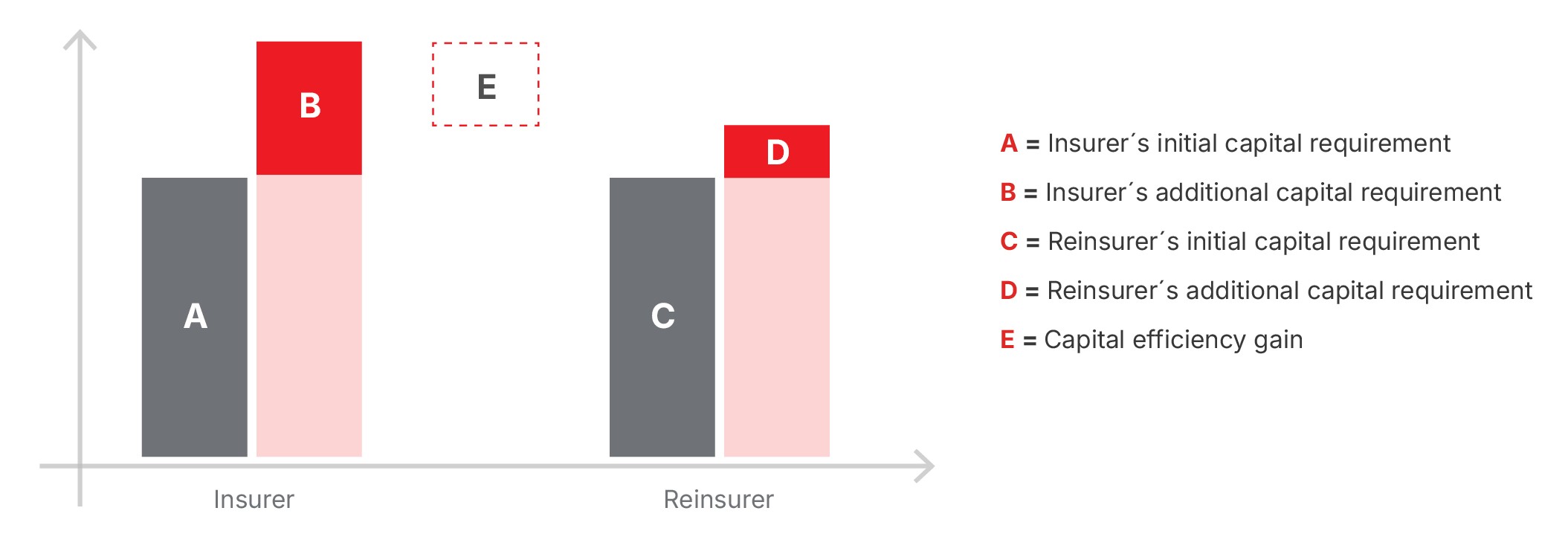
The reduced scope for international diversification pushes up the cost of ‘producing’ insurance. As markets fragment and risk pools shrink, the law of large numbers weakens, reducing the predictive accuracy of historical data and amplifying claims variability. Fragmentation restricts insurers’ access to a larger, diversified pool of insured risks across multiple countries and regions. Instead of covering risks in different geographic areas, insurers are limited to specific blocs or markets. This reduces the number of independent risks they can pool together, leading to increased correlation of risks within fragmented regions. Heightened claims volatility leads to greater uncertainty, requiring insurers to maintain higher capital reserves to mitigate potential risks and resulting in diminished capital efficiency (see Figure 7). Insurers are compelled to recalibrate their pricing models to reflect the heightened volatility, leading to premium increases.71
3.2.2 The role of reinsurance in mitigating fragmentation effects
Reinsurance is instrumental in mitigating the adverse effects of geoeconomic fragmentation on the insurance industry by providing a robust B2B mechanism for global risk sharing. Reinsurers, with their ability to diversify risks more effectively than mostly domestically operating primary insurers, play a crucial stabilising role, especially as cross-border trade in reinsurance tends to be less prone to restrictions than primary insurers operating abroad.72
The core value proposition of reinsurance is its ability to assume a specific unit of risk at lower capital charges compared to less well-diversified primary insurers. This capital efficiency, evident in the reduced requirements for a given block of business (section E in Figure 7), lowers overall risk costs and constitutes the added value of reinsurance. This cost efficiency is passed on to primary insurers and ultimately to policyholders, allowing insurance premiums for end customers to remain affordable, even amidst geoeconomic fragmentation.
FIGURE 7: THE VALUE PROPOSITION OF REINSURANCE
Source: Global Reinsurance Forum (GRF)73
Geoeconomic fragmentation can profoundly impact the economics of internationalisation strategies in insurance, particularly for foreign insurers who operate subsidiaries or branches in jurisdictions that become geopolitically more distant. This section explores several political, economic, legal, and regulatory factors that may affect the commercial case for a global footprint.
3.3.1 Divergence of legal and regulatory frameworks
Geoeconomic fragmentation can prompt or exacerbate legal and regulatory divergence across different economic blocs, presenting significant compliance challenges and increased operational costs for insurers operating internationally. This divergence requires insurers to implement diverse compliance and reporting protocols and systems. The resulting operational complexity can substantially impact the profitability of internationally operating insurers.74 In addition, different regulatory standards across fragmented geoeconomic blocs could necessitate that internationally operating insurers customise their products and organisational set-up to meet local regulations, further adding to their costs and heightening operational risks.75
3.3.2 Discriminatory laws and regulations
Rising nationalism and protectionism, due to growing geopolitical tensions, can lead to policies favouring domestic insurers over foreign subsidiaries, especially as multilateral frameworks such as the World Trade Organization (WTO) and the General Agreement on Trade in Services are losing relevance and some jurisdictions could backtrack from previous commitments under such agreements.76
Unilaterally implemented policies may include differential taxation and discriminatory regulations (e.g. foreign ownership limits, and discriminatory licencing, market conduct and product approval requirements).77 Geopolitical tensions could also elevate the risk of expropriation or nationalisation of foreign-owned insurance subsidiaries, deterring insurers from maintaining operations in geopolitically distant or even hostile jurisdictions. Additionally, deteriorating international relations can result in economic sanctions, which, by freezing assets and restricting financial transactions, may put an end to the ability of insurance companies to operate in certain markets.78
3.3.3 Reputational considerations
CEOs of multinational insurance companies must assess reputational risks when operating in geopolitically sensitive or hostile regions, even if legally permissible. These risks, including potential boycotts, loss of customer trust, and strained relationships with home-country governments, can have significant financial and operational impacts. Companies must weigh the long-term consequences of reputational damage against short-term profit.79
3.3.4 Market structure and attractiveness
Geoeconomic fragmentation can impact the structure of both host and home countries of multinational insurance companies. In host countries, a reduced footprint of international insurers could erode competitive pressures and hinder innovation, potentially driving up premiums and limiting product variety. As a result, customers may encounter fewer options and diminished value.80
Conversely, competitive pressures in domestic and geopolitically aligned markets may intensify as international insurers shift their focus closer to home. These markets could also experience increased consolidation and merger and acquisition activity.
In addition, geoeconomic fragmentation may influence the fundamental attractiveness of certain overseas markets. Fragmentation often has disproportionately negative economic effects on developing countries, typically leading to increased exchange rate volatility and higher inflation.81 These economic instabilities can erode the profitability of foreignowned insurance operations.82 Conversely, some markets may become more attractive due to the dynamics of reglobalisation, marked by increased trade and investment flows toward the Global South as the two major trading blocs, the US-EU and China, show signs of decoupling.
Due to geoeconomic, political, and regulatory fragmentation, we expect large insurance groups to refocus on their core regions to achieve scale and secure the top five positions in each market or opportunistically monetise their expertise in select new growth markets. This is likely to drive further consolidation, particularly in commercial lines, reinsurance, and P&C, as well as personal lines. While insurers face growing pressure to enhance efficiency through digitalisation, there are also significant challenges and opportunities in developing new solutions to address global warming, ageing, cyber, and political risks, while leveraging AI advancements. Overall, although the business models of the largest insurance players have proven resilient in the years following the pandemic, sustained fragmentation could reshape the industry – ironically strengthening key players in their respective markets.”
Nicolas Desombre, Citi
Geoeconomic fragmentation brings both challenges and opportunities for commercial and specialty insurance companies. As opposed to retail insurance, where implications are more indirect in nature, internationally operating commercial and specialty insurers are experiencing direct, first-order effects from geoeconomic fragmentation. On the one hand, they need to grapple with elevating risks from political instability, supply chain disruptions, and divergent regulations, for example. On the other hand, there are opportunities arising from a renewed focus on industrial policies and public investments in strategically important infrastructure, from semiconductors to clean energy, after decades of underinvestment in the West. In addition, insurers are set to benefit from higher demand for insurance in times of heightened volatility and uncertainty.
3.4.1 Property insurance
Industrial policies, such as the US CHIPS and Science Act, emerging in response to geopolitical tensions significantly enhance the prospects of domestic commercial property insurance, which typically covers completed, operational properties and assets like buildings, stock, or equipment against risks such as fire and natural disasters. The wave of new investment and construction activity stimulates demand for comprehensive property coverage. The overarching focus on bolstering critical supply chains and technological infrastructure elevates the need for property insurance solutions that address risks associated with these high-value assets.83
3.4.2 Engineering insurance
In a geopolitically driven industrial policy environment, engineering insurance, similar to property insurance, can greatly benefit from state-backed initiatives aimed at enhancing infrastructure resilience and technological advancement. Engineering insurance covers risks associated with the construction, erection, installation, and operational activities of engineering projects. It protects against losses or damages during the project life cycle, such as during construction and machinery installation.
For example, nations focused on energy independence may promote or even mandate investments in renewable energy projects or localised manufacturing, reducing dependency on foreign supply chains. This creates opportunities for specialised engineering insurance products, such as those covering complex machinery or renewable energy installations like wind turbines and solar farms.84
3.4.3 Marine insurance
Marine insurance provides coverage for the loss or damage of ships, cargo, terminals, and transportation infrastructure. As such it is intricately linked to global trade flows. Geoeconomic fragmentation, characterised by the disintegration of global markets, has several economic implications.
As nations endeavour to mitigate dependence on global supply chains, especially those connected to geopolitical adversaries, there is a shift towards more localised or regional supply chains.85 This transition could lead to the reconfiguration of established shipping routes, fluctuations in shipment volumes and frequencies, and greater logistical complexity. Consequently, the maritime sector might experience an uptick in insurance claims due to delays, rerouting, or the necessity for additional storage, all of which would elevate marine insurers’ risk exposure.86
In addition, the enforcement of trade sanctions or embargoes could have direct economic repercussions on marine insurance. For instance, ships transporting goods to or from sanctioned nations may become uninsurable or face elevated insurance premiums.87
While trade volumes might decrease under various fragmentation scenarios, the riskiness of remaining trade flows could increase. Companies’ awareness of their exposure to these risks is likely to rise as well. From an insurance perspective, P&C lines will be most affected as they are more directly linked to GDP growth and international trade. Marine and cargo insurance may see the biggest impact due to the restructuring of international supply chains. Credit insurers may also face challenges due to the decreased profitability of export enterprises and reduced transactions between counterparts from geopolitically distant economies. More generally, internationally operating re/insurers should expect increasing compliance costs for KYC and sanction risk procedures, for example.
Sheldon Yu, Taiping Reinsurance
3.4.4 Trade credit insurance
Trade credit insurance mitigates the risk of non-payment by buyers arising from insolvency, default, or political events. Geoeconomic fragmentation presents both challenges and opportunities for this segment of the insurance industry.
As trade barriers intensify and global markets become more fragmented, firms, particularly those reliant on international trade, may encounter financial strain due to diminished market access, elevated costs, and disrupted supply chains. This scenario is likely to elevate the incidence of insolvencies, especially among small and medium-sized enterprises with limited capacity to absorb such economic shocks. Consequently, insurers offering trade credit coverage may need to consider premium adjustments to reflect the heightened probability of businesses defaulting on their payments.
Despite elevated risks, geoeconomic fragmentation also opens avenues for expansion within the trade credit insurance market. As businesses seek to navigate the growing uncertainties in global trade, demand for trade credit insurance is expected to rise. This could spur the development of innovative products designed to address the unique risks associated with fragmented markets, such as coverage for non-payment due to political disruptions or cross-border supply chain interruptions.88
3.4.5 Political risk insurance
Political risk insurance offers indemnity against losses incurred due to political events such as expropriation, political violence, and breach of contract. The shift towards geoeconomic fragmentation has significant implications for the political risk insurance landscape. With escalating geopolitical tensions and the rise of protectionist policies, businesses operating across multiple jurisdictions are exposed to heightened political risks including expropriation, currency inconvertibility, and shifts in trade policy. This is particularly pronounced in geopolitically distant markets where governments may be more prone to radical actions such as ‘grey-zone aggression’, where hostile states indirectly target globally operating companies as extensions of their adversary’s governments.89 Consequently, demand for political risk insurance is poised to rise, especially among multinational enterprises and investors seeking to safeguard their foreign assets.90
3.4.6 Cyber insurance
Cyber insurance, which covers businesses against losses resulting from cyberattacks, data breaches, and other cyber-related incidents, is increasingly relevant in the context of geopolitical tensions. Growing cyber threats encompass a wide range of malicious activities and geopolitical tensions can significantly exacerbate such threats in the form of politically motivated cyberattacks, tolerated or even sponsored by states (e.g. on critical infrastructure, vital supply chains, and government institutions) and espionage and intellectual property theft (e.g. sensitive information and trade secrets).91 Even in the absence of fully fledged cyber warfare, cyber incidents have become one of the costliest threats to businesses, with an estimated USD 1 trillion in annual economic losses, or 1% of global GDP.92
Many countries are also implementing data localisation requirements, which mandate that data generated within a country be stored and processed locally. This can create significant compliance and cybersecurity challenges for multinational companies, particularly in terms of managing and securing data across different jurisdictions.93 Cyber insurers may need to offer more tailored coverage options that address those risks.
In times of uncertainty, especially amid geoeconomic fragmentation, insurance can demonstrate its value by providing stability and financial protection. As businesses and individuals navigate increasingly unpredictable political and economic landscapes, the role of our industry as a shock absorber is continually gaining in importance. By covering risks such as property damage, business interruptions, and liability claims, insurers help smooth economic growth. Additionally, tailored products like cyber, political risk and trade credit insurance with associated risk management solutions can effectively mitigate specific challenges arising from geopolitical shifts.
Brad Irick, Tokio Marine
3.4.7 Directors’ and officers’ liability insurance
Directors’ and officers’ (D&O) liability insurance serves as a protective mechanism for executives and board members, shielding them from legal claims arising from their managerial decisions. As enterprises navigate geoeconomic fragmentation, D&O insurance will likely encounter several significant challenges.
If governments impose more stringent controls on foreign entities and their leadership, the risk exposure for directors and officers heightens as they may become targets of regulatory investigations and enforcement actions, particularly in geopolitically distant jurisdictions. Consequently, D&O insurers may experience a surge in claims, as executives grapple with lawsuits or penalties related to alleged compliance breaches in multiple, increasingly fragmented jurisdictions.94
Geoeconomic fragmentation can also disrupt global supply chains, potentially exposing companies to operational risks and financial losses. Directors and officers may face increased liability if they fail to adequately prepare for or respond to such disruptions, necessitating more comprehensive D&O coverage.
Finally, in a geopolitically fragmented world, companies and their leadership are more susceptible to reputational harm arising from political controversies, sanctions, or affiliations with regimes deemed unfavourable by certain governments or the public. D&O insurers must increasingly account for the growing threat of reputational damage, which could trigger shareholder lawsuits or other legal actions against directors and officers.95
Geoeconomic fragmentation is poised to result in more volatile international relations across a wide range of areas, including, for example, multilateral agreements on climate risk mitigation, cross-border trade, and capital flows. This shift presents strategic, commercial, and operational challenges for re/ insurers. However, a more unstable world also offers opportunities for our industry, leveraging our unique capability to absorb and manage volatility both domestically and internationally. By providing risk management solutions for a fragmented world, re/insurers can reinforce their role as a stabilising force.
Michael Menhart, Munich Re
As discussed in sections 2.5 and 2.6, geoeconomic fragmentation can impair economic growth and fuel inflation. This section discusses the implications of these macroeconomic, second-order effects on life and non-life (property & casualty and health) insurance.
3.5.1 Income-sensitivity
Life insurance is often seen as a discretionary, non-essential expense. In periods of financial strain, customers may cancel policies, reduce coverage, or avoid purchasing new policies, depressing demand. Conversely, as income increases, individuals are more likely to purchase life insurance products, reflecting their improved ability to afford premiums and their desire to protect their higher standard of living. Depending on the level of per-capita income and based on data from 90 countries, a maximum income elasticity of almost 2 was found for life insurance, meaning that for a 1% change in income, life insurance demand changes by 2%.96
The income elasticity of non-life insurance consumption is much lower, including demand for health insurance, which changes little because of changes to income.97 The average long-run income elasticity of non-life insurance has been found to be not different from 1, characterising non-life insurance as a normal good.98
3.5.2 Inflation-sensitivity
Inflation can diminish the value of life insurance products with fixed future payments, leading to reduced new business and higher lapse rates. Moreover, as inflation reduces households’ real income, the resulting decrease in purchasing power negatively impacts demand.99 Conversely, a shift from a prolonged period of very low interest rates, as seen in recent years, to higher yields benefits the demand for savings-type and annuity products.100
The effect of inflation on non-life insurance demand is similarly complex. On one side, financial shocks, such as a surge in inflation, tend to heighten risk perception and increase risk awareness, creating favourable conditions for a rise in insurance demand.101 However, inflationary periods that coincide with slower economic growth and lower inflation-adjusted incomes are usually linked to a general decline in non-life insurance demand, particularly in sectors where customers view insurance as a discretionary expense.102
“A more fragmented world is likely to experience slower economic growth and higher inflation. This shift could negatively impact key areas of the insurance industry, particularly savings-oriented life insurance and property insurance. However, the effect on specialty lines is more mixed. For instance, marine insurance might see a boost in demand and higher rates due to shipping routes becoming longer, less familiar, and consequently riskier.”
Gerardo Di Filippo, Generali
Figure 8 illustrates how geopolitical tensions may undermine overall macrofinancial stability through two interconnected channels. First, there is the direct financial channel. Escalating tensions can lead to financial restrictions, heightened uncertainty, and cross-border credit and investment outflows which could drive up yields on government bonds in affected countries, reduce their valuation in insurers’ investment portfolios and add to their funding costs. In addition, financial fragmentation could increase the volatility of capital flows by limiting the scope for international diversification of asset portfolios.
The second channel is the real economy. Disruptions to supply chains and commodity markets caused by tariffs, for example, could hurt domestic economic growth and push up inflation. This, in turn, could cause market and credit losses for insurers, weakening their profitability and solvency. Insurers may respond by taking less risks, leading them to reduce underwriting capacity and further slowing economic growth.103
A case in point: in 2018, the global financial landscape was shaken by the first Trump Administration’s unexpected decision to impose tariffs on China and several US allies. This action significantly impacted the US equity market, causing a USD 1.7 trillion loss in market value at the height of US-China economic tensions in mid-2019.104
FIGURE 8: MACROFINANCIAL INSTABILITY UNDER GEOECONOMIC FRAGMENTATION
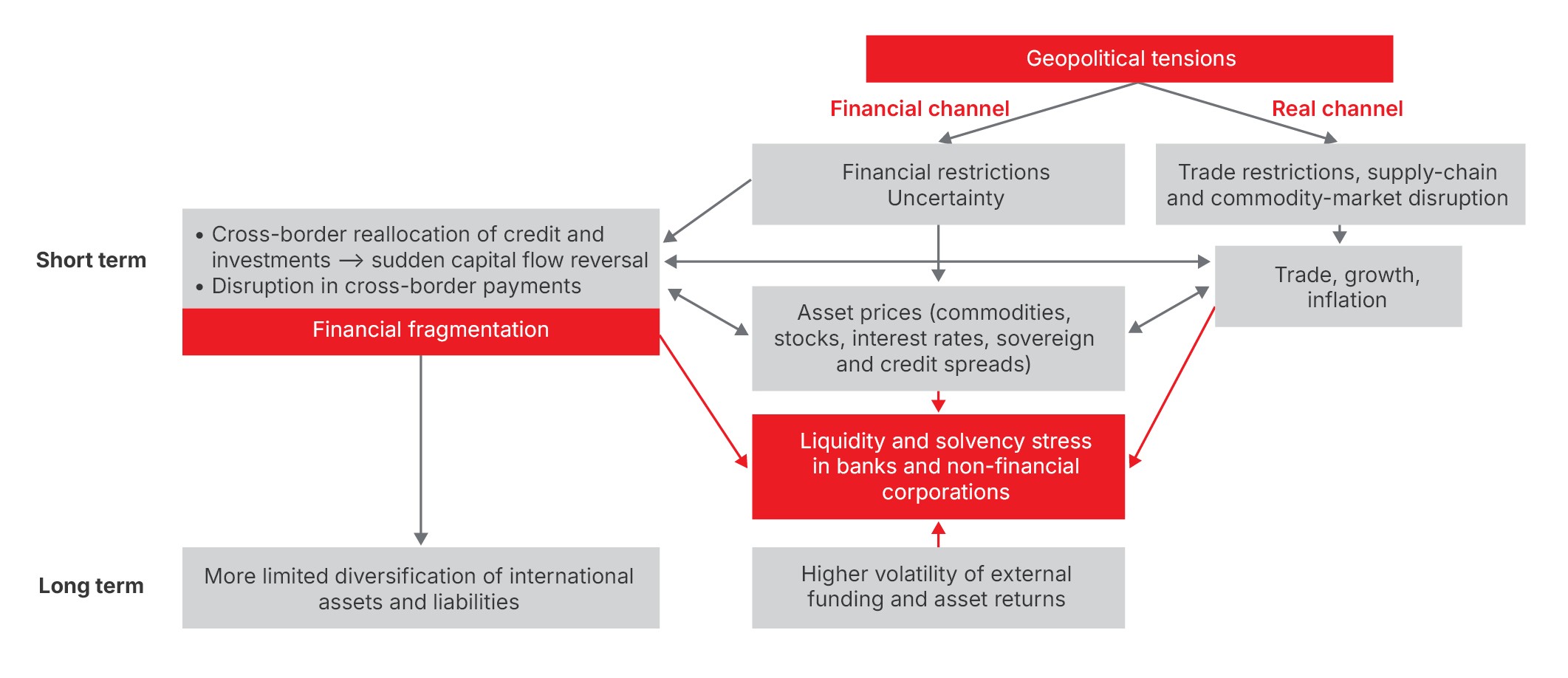
Source: Centre for Economic Policy Research105
Box 2: Geopolitical conflicts and insurance – Lessons from the Russia-Ukraine conflict
Insurance plays a critical role in facilitating international trade by offering economic security against catastrophes, facilitating credit, and boosting confidence among households and businesses. The growth of the insurance industry stimulates economic expansion, which in turn drives demand for broader coverage and innovative products.
Over the past four decades, insurers have supported globalisation. However, the complementary relationship between insurance and other industries has been disrupted by ongoing geopolitical and geoeconomic conflicts worldwide. In the face of violent conflicts in particular, the insurance industry has withdrawn from certain areas of coverage. In some instances, insurance has even been weaponised as a tool in conflict.
This overview explores the impacts of the Russia-Ukraine war on the insurance industry and the implications for international trade in Russia and Ukraine.
Aerospace
The UK, the EU, and other Western countries imposed sanctions on Russia, prohibiting the supply of aircraft and spare parts. In retaliation, Russia seized foreign-leased aircraft, leaving many planes stranded. This led to substantial losses in airplane hull insurance, causing aviation war coverage rates to spike by approximately 200%, prompting many insurers to reassess their coverage.106 Western governments also moved to exclude Russia’s aviation sector from their re/insurance markets.
Aviation and space sanctions resulted in the loss of international coverage for satellite launches, deployments of Russian-made satellites, and launch sites on Russian territory. Between 2017 and 2021, Russia accounted for about 16% of global satellite launches.107 As Russian aircraft carry a significant percentage of satellites manufactured outside Russia, the global capacity for satellite launches has declined, potentially delaying launches for years, with ripple effects on aerospace insurance beyond Russia.
Sea freight
Damage to ships’ hulls and cargo caused significant losses at Ukrainian ports. Cargo moving by land through Ukraine could no longer be insured.108 Global supply chains and commodity flows have also been disrupted. Sanctions and trade controls on Russia have intensified, affecting a wide range of goods entering and leaving the country. The EU, UK, and several other countries have banned the financing and insuring of affected imports and exports.
Divergent national sanctions policies have heightened the complexity and risks of conducting international business. Companies operating in global markets must not only understand the sanctions directly applicable to them but also consider the broader impact on their supply chains, including effects on business partners, banks, lenders, and insurers.
In recent years, US and UK regulators have also urged the marine insurance industry to enhance the monitoring of vessels and cargo they underwrite to identify potentially sanctioned shipowners or vessels involved in evading sanctions.
Energy and electricity
Sanctions on Russian oil, combined with the EU’s efforts to reduce its dependence on Russian energy, have directly impacted the premium income of the energy insurance market. As of December 2021, Russia accounted for nearly 10% of global oil production.109 Germany and other EU member states that previously purchased Russian gas and oil have sought alternative energy supplies. Meeting electricity demand has increased the need for upstream energy investments and infrastructure outside Russia.
A long-term consequence of the Russia-Ukraine conflict is the acceleration of the transition to renewable energy. Energy market analysts predict that mature economies are entering a ‘capex110 supercycle’ with substantial capital spending anticipated to support the shift to a low-carbon economy. This transition is likely to increase demand for insurance in these emerging sectors.
Credit and political risks
Claims under trade credit, political risk, and structured credit policies (covering complex financial transactions) issued before sanctions have emerged, particularly in Russia but also in Ukraine, especially for war-related losses, confiscation, and expropriation. Since late February 2022, few new political risk or credit insurance policies have been issued in Russia, Ukraine, or Belarus.
The Russia-Ukraine conflict has underscored the growing geopolitical volatility in recent years, complicating supply chain risk management and the assessment of risk costs. As a result, demand for trade credit, political risk, and structured credit insurance has grown to ensure liquidity and reduce capital costs in an increasingly risky environment.
Directors’ & officers’ liability
The war has altered business leaders’ attitudes, with over a thousand companies scaling back or ceasing operations in Russia. The mass exodus of Western companies from Russia suggests that public pressure can heighten the risks of corporate decisions, particularly concerning commitments to environmental, social, and corporate governance (ESG) objectives. For instance, deciding whether to continue doing business in a country accused of violating ESG principles or exit with financial losses can complicate liability risks for directors, officers, and senior management.
Conclusion
Geopolitical conflicts can have mixed effects on the insurance industry’s development. While they lead to property damage, business interruption, and liability claims, they also create opportunities for specialised insurance and niche products that provide stability in times of uncertainty. Insurers must remain adaptable to changing political and economic environments to stay competitive and relevant.
Source: Contributed by Runhuan Feng, Tsinghua University, Beijing
Geoeconomic fragmentation is a multi-faceted phenomenon. On the one hand, we have seen fairly moderate economic decoupling between the US and China. On the other, we are witnessing the emergence of new patterns of connectivity involving medium-sized economies, sometimes referred to as ‘reglobalisation’. For insurers, currently the first-order effects of fragmentation on business growth, underwriting profitability, customers, and employees seem to be manageable. Secondorder effects, e.g. arising from turbulence in financial markets, require strong attention as they might be far more material. In any case, insurers need a highly agile risk and resilience approach to navigating the current environment on the basis of well-prepared mitigation instruments for a wide spectrum of scenarios along the macro-risk continuum.
Thomas Seidl, Allianz
Insurers must respond to geoeconomic fragmentation to ensure their resilience and continued relevance in today’s world economy. Adaptability will allow them to manage new and increasingly complex exposures, which is a prerequisite for upholding their vital role as stabilisers during political and economic volatility. This section emphasises the importance of establishing scenarios and developing a set of strategic responses for each one, based on a value chain perspective.111
Given the profound uncertainty surrounding the future trajectory of global political and economic relations, the adoption of scenario planning to address geoeconomic fragmentation is a strategic imperative for insurers. Scenario planning allows insurers to anticipate a spectrum of potential futures, assess their direct and indirect impacts,112 and formulate strategic responses that enhance adaptability, resilience, and long-term financial stability. An insurance-specific approach to scenario planning may look as follows:113
Identification of key drivers and manifestations of change: Insurers should begin by identifying the primary drivers and manifestations of geoeconomic fragmentation within their specific business lines and geographic markets. As discussed in section 2, these factors include the reconfiguration of cross-border trade, investments, and supply chains; restrictions on technology diffusion; reduced multilateral efforts to address global risks; and heightened macroeconomic volatility affecting economic growth and inflation.
Scenario development: Once the key drivers and manifestations have been identified, insurers can construct a set of distinct yet plausible scenarios representing various potential futures. Each scenario should reflect varying degrees of geoeconomic fragmentation, with a view of its relevance for key insurance-specific areas such as claims frequency and severity, and investment returns.114
Impact assessment: For each scenario, insurers should conduct a comprehensive assessment of the potential impacts on growth, profitability, and solvency, for example. More specifically, this assessment would also consider the effects on regulatory environments, reinsurance markets, and the potential for increased exposure to new and systemic risks.
Strategic response development: Following the impact assessment, insurers should devise strategic responses along their value chain, tailored to each scenario (see section 4.2).
Monitoring and adaptation: Scenario planning is an iterative and ongoing process. Insurers must continuously monitor the external environment and update their scenarios and strategies as new information emerges. This requires sustained investment in geopolitical and geoeconomic risk intelligence, as well as the integration of advanced analytics and real-time data monitoring into risk management frameworks.
Geopolitical risk remains underpriced in financial and risk markets, from oil and spreads to equities. As global fragmentation is here to stay, it structurally pushes up the cost and volatility of doing business, yet risk awareness has not caught up with these shifts. Unlike sudden shocks such as the COVID-19 pandemic, ongoing uncertainty is more challenging to quantify and integrate into market valuations, but scenarios can help cope with uncertainty and allow for better strategic planning and decision-making and, ultimately, resilience.
Jerome Haegeli, Swiss Re
Figure 9 presents an overview of three specific geoeconomic fragmentation scenarios, organised by their impact on economic integration between geopolitically distant countries and the role of non-aligned countries in international trade, as well as their likelihood. The highest probability is assigned to the ‘exacerbation’ scenario, given the stated objectives of US President Donald Trump. The ‘regionalisation’ scenario also carries significant likelihood, as major trading partners may reach agreements to avoid an outright global trade war that would leave all parties worse off. ‘Bifurcation’ is considered a remote possibility.
FIGURE 9: THREE GEOECONOMIC FRAGMENTATION SCENARIOS
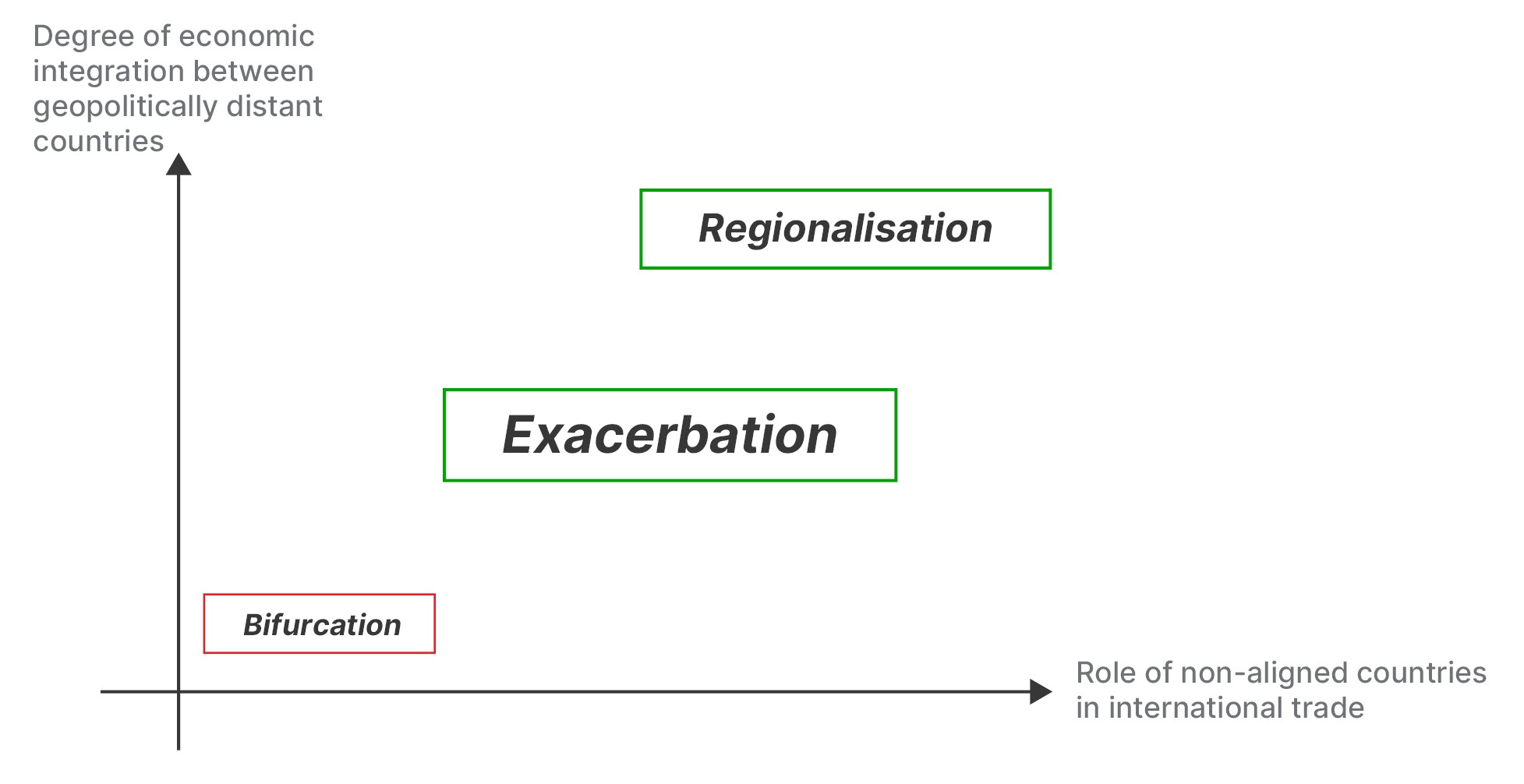
Note: The size of the boxes indicates the probability of each scenario.
Source: Geneva Association
4.2.1 Scenario 1: Regionalisation
In this scenario, extrapolating from the trends observed since 2018, as detailed in section 2 of this report, geoeconomic fragmentation manifests in heightened barriers to trade, investment, and technology diffusion, as well as vast government subsidies for strategically important manufacturing sectors. Strategic decoupling and derisking, characterised by selective disengagement between the US and Europe on one side and China on the other, are driven primarily by concerns over national security and economic sovereignty. While globalisation endures, it increasingly assumes a regionalised and fragmented character, prompting multinational corporations to reconfigure their operations to mitigate geopolitical and geoeconomic risks. The rise of economic nationalism and protectionism further undermines global governance structures, precipitating a decline in multilateral cooperation. Concurrently, trade links with and among geopolitically non-aligned nations (e.g. Brazil, Mexico, India, and Southeast Asia) continue to strengthen, a process referred to as ‘reglobalisation.’115
The insurance industry must recalibrate its strategies across the value chain to address emerging risks and opportunities in a global economy that is simultaneously fragmenting along geopolitical lines and reglobalising within new regional blocs.
Geopolitical tensions and geoeconomic fragmentation lead to increased volatility in financial and risk markets. Insurance companies must incorporate this dimension into asset management and insurance strategies. They must combine high-quality intelligence with advanced risk and scenario modelling to make organisations and their underlying business and operating models more agile and adaptive. This improves their ability to quickly react to sudden events and transform pricing, underwriting, risk management, claims handling, and supply chain management accordingly. Currently, geopolitical tensions are primarily used to explain past financial performance rather than to inform future strategies. By addressing this deficiency, insurance companies could better support the global economy while also gaining a competitive edge.
Miguel Abecasis, Fidelidade
4.2.2 Scenario 2: Exacerbation
In this scenario, geoeconomic fragmentation intensifies as nations increasingly engage in reciprocal trade measures, thereby amplifying economic nationalism and protectionism. Initial unilateral actions, such as the imposition of tariffs or the implementation of export controls, trigger retaliatory responses, resulting in a cycle of escalating trade and investment barriers. This tit-for-tat dynamic erodes global trade relationships, accelerating the fragmentation of supply chains and the weakening of multilateral cooperation. Nations prioritise domestic industries and economic sovereignty, undermining the foundations of globalisation. As trade conflicts escalate, the global economy becomes increasingly volatile, with regions turning inward and emphasising self-sufficiency. Nevertheless, geopolitically non-aligned countries, to some extent at least, retain their relevance in international trade, preventing the complete fragmentation of the global economy.116
Like scenario 1, scenario 2 requires distinct adjustments across the insurance value chain.
4.2.3 Scenario 3: Bifurcation
In this extreme scenario, the world divides into two antagonistic geopolitical blocs, with drastically diminishing economic ties between them. Such a scenario could be prompted by a major geopolitical conflict and subsequent large-scale economic sanctions.117 This bifurcation compels countries and companies to align with one bloc or the other, eliminating the presence of a non-aligned group insulated from geoeconomic fragmentation. Global supply chains, financial markets, and cross-border trade are severely disrupted, leading to profound economic instability. The collapse of cooperation results in a radically fragmented global economy, with each bloc potentially developing its own technological standards, financial systems, and trade networks. This division exacerbates geopolitical tensions as competition and conflicts over resources, influence, and technological supremacy intensify.
With most insurers restricted to operating within a single bloc and global diversification opportunities severely diminished, strategic focus shifts toward managing risks and opportunities within a much more concentrated environment.
In navigating the complexities of geoeconomic fragmentation, insurers must adopt agile, regionally focused strategies across product development, underwriting, risk management, capital management and asset management. Scenario 1, characterised by controlled geoeconomic fragmentation and selective reglobalisation, necessitates refined insurance offerings that address regional risks, enhanced geopolitical intelligence for underwriting, and flexible capital allocation. Scenario 2, marked by escalating trade conflicts, demands more stringent underwriting and defensive asset management. Scenario 3, featuring a bifurcated world, requires insurers to deeply understand bloc-specific risks and adopt highly focused underwriting, capital, and asset management strategies (see Figure 10).
FIGURE 10: STRATEGIC INSURANCE INDUSTRY RESPONSES TO GEOECONOMIC FRAGMENTATION SCENARIOS
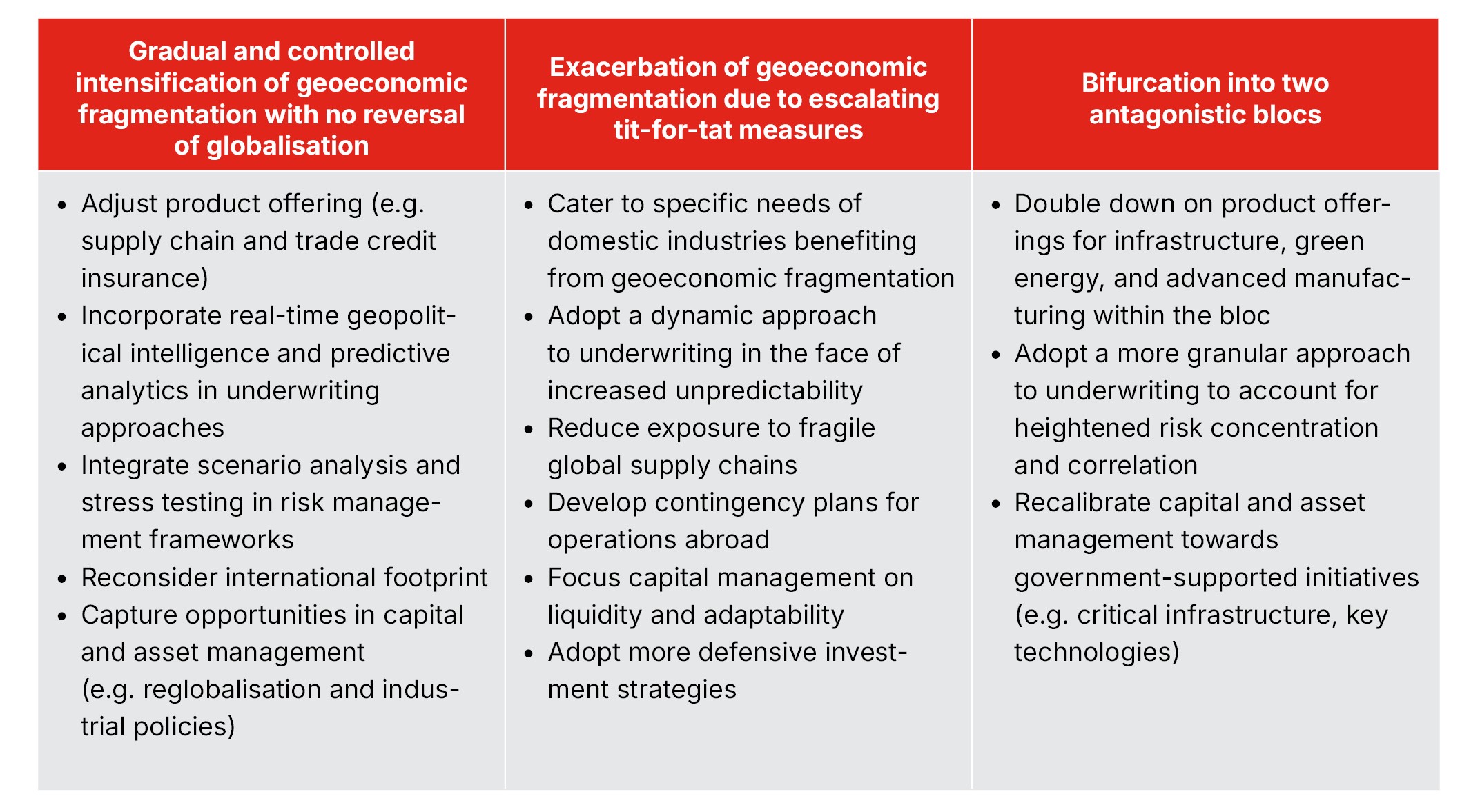
Source: Geneva Association
Analysis of geoeconomic fragmentation reveals a world moving away from the era of seamless global integration that characterised the late 20th and early 21st centuries. The Global Financial Crisis marked a significant turning point in global economic liberalisation, with cross-border trade and capital flows starting to stagnate as broad public support of globalisation began to evaporate. This trend has since been exacerbated by geopolitical developments, including trade tensions between the US and China, Russia’s invasion of Ukraine, and the COVID-19 pandemic. These events have collectively intensified the shift toward geoeconomic fragmentation, where nations prioritise national security and economic resilience over the efficiency afforded by globalisation.
The economic consequences of geoeconomic fragmentation are profound, ranging from stagnating international trade and foreign direct investment to the restructuring of global supply chains through reshoring or ‘friend-shoring’. As countries move toward regionalised supply chains to minimise geopolitical risks, they sacrifice the efficiencies of global trade, leading to increased production costs and consumer prices. Moreover, technological decoupling has emerged as a critical feature of geoeconomic fragmentation, with export restrictions and protectionist policies slowing the diffusion of innovation.
For the insurance industry, geoeconomic fragmentation presents both challenges and opportunities. The fragmentation of global markets makes risk management more complex as geographically diversifying risks becomes increasingly difficult. Insurers are required to adjust their operations to account for region-specific risks and the growing unpredictability of global trade policies. The rise of economic nationalism and protectionism has also elevated demand for insurance products covering political risks, trade disruptions, and supply chain interruptions. Insurers will need to enhance their use of geopolitical intelligence and scenario analysis to accurately assess these risks.
Geoeconomic fragmentation is rooted in fundamental and enduring geopolitical and economic rivalries, ensuring its persistence regardless of shifts in political leadership. Insurers must make addressing geoeconomic fragmentation a strategic priority, crafting long-term responses to navigate this evolving paradigm of global economic interconnectedness. Historically, the insurance industry has been adept at adapting to structural shifts in the risk landscape. By responding with agility across the value chain, insurers can maintain resilience and relevance in an increasingly fragmented global economy.
Lloyd’s 2024.
Swiss Re 2023b.
Swiss Re 2024a.