Adrita Bhattacharya-Craven, Director Health & Demography, Geneva Association
Axel Heitmueller, Managing Director, Imperial College Health Partners
Kai-Uwe Schanz, Director Financial Inclusion, Geneva Association

Geneva Association. 2025.
Insurance and the Longevity Economy: Navigating protection in the era of 100-year lives.
Authors: Adrita Bhattacharya-Craven, Axel Heitmueller & Kai-Uwe Schanz. February.
Adrita Bhattacharya-Craven, Director Health & Demography, Geneva Association
Axel Heitmueller, Managing Director, Imperial College Health Partners
Kai-Uwe Schanz, Director Financial Inclusion, Geneva Association
The global population has more than tripled since the 1950s, standing at over 8 billion in 2025. Whilst growth is slowing and fears of unfettered expansion have subsided, new challenges have emerged: declining birth rates and ageing populations. Fertility rates have more than halved from five children per woman in the 1950s to the present day, with the world approaching a replacement level of 2.1. Global life expectancy has soared over the same period from 46 to 74 years, surpassing 80 in many OECD countries. Our world is now grappling with a demographic shift where more people face longer lives – increased longevity – with fewer young people to support them. This creates new needs and vulnerabilities and challenges established societal norms and economic structures.
The term ‘longevity’ is often used interchangeably with ageing. But while the concepts are related, they represent two different phenomena. The former refers to the length of life, and the latter refers to the ‘progressive loss of physiological integrity leading to functional impairment’.1 Grasping longevity’s impact on individuals necessitates an examination of whole-life factors – biology, lifestyle, wealth, and environment – rather than fixating on a ‘number’, our chronological age. Assessing the economic implications of increased longevity requires scrutiny of production and consumption patterns arising from new age structures and behavioural shifts as people adapt to extended life spans.
Life and health insurance have historically been central to managing some of the pivotal outcomes of human lives. Originally, life insurance provided protection against untimely death, also known as mortality risk. Today, however, the majority share of life insurance business concentrates on longevity risk (i.e. protecting against the chances of outliving one’s savings) through annuities, private pension insurance, or saving investment plans as well those that come with long-term care or income protection solutions. But overall demand for many of these savings products has waned since the Global Financial Crisis as interest rates plummeted (with some arguing demographic change itself was a contributor),2 despite the fact that longevity risk increases with rising life expectancies. Health insurance that protects against morbidity risks also has to contend with significant medical cost inflation as demand for health services increases with higher prevalence of chronic and age-related conditions.
But if the relationship between chronological and biological age becomes more malleable, it could be argued that the factors contributing to longevity risks do too, with implications for both health and life insurance. For instance, rather than individuals curtailing their workforce participation beyond a certain chronological age and running down their accumulated assets, they may opt to continue saving for longer, according to their biological age (which can be bolstered through better health interventions), or return to work after a mid-life career break.
Longevity presents a multifaceted challenge, necessitating a fresh perspective from insurers to address not only the risk of outliving personal savings but also the risk of declining physical and mental faculties due to unhealthy ageing. This requires redefining the concepts of ‘working age’ and ‘old’, moving from ‘sickness’ to ‘health’, and shifting business models from getting people ‘to retirement’ to helping them navigate financial security over longer lives, including ‘through retirement’.
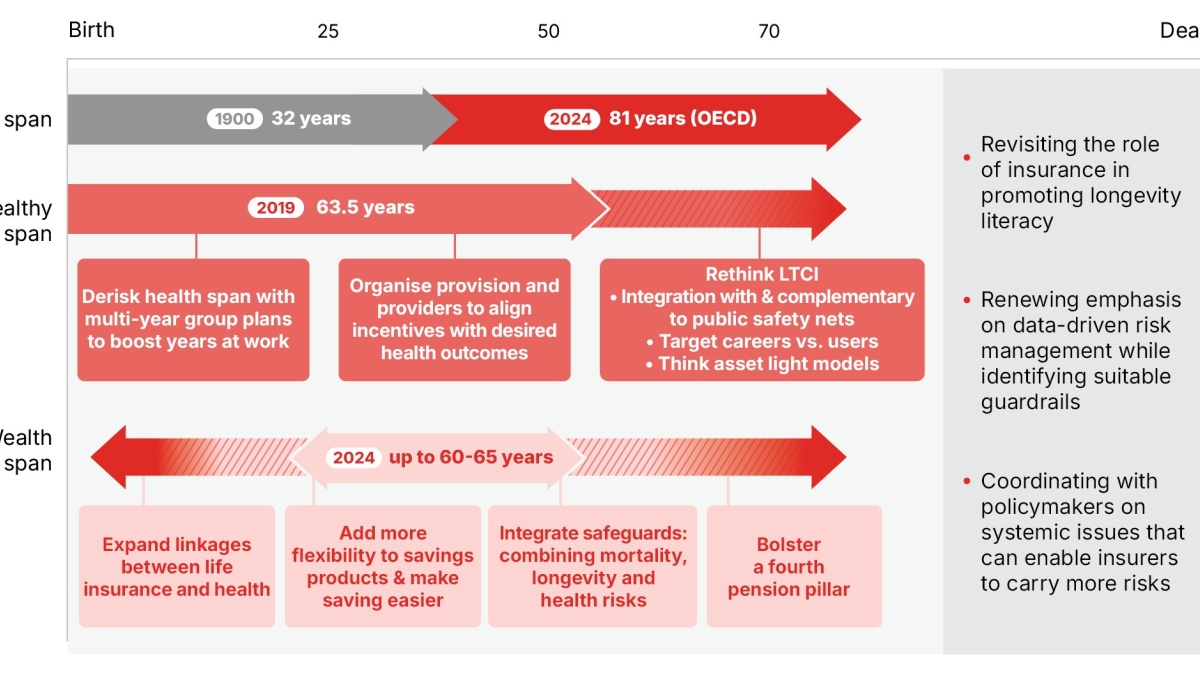
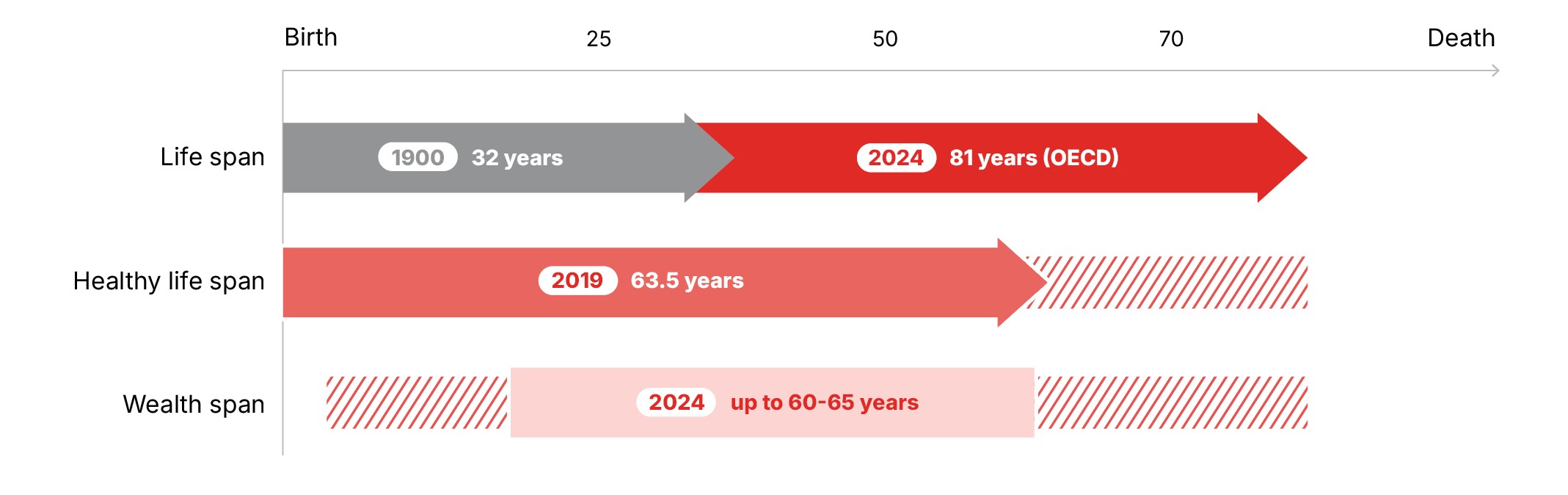
Achieving this means embracing a paradigm shift that recognises the intricate interplay between ‘health span’ (the duration of an individual’s life during which they remain in good health) and ‘wealth span’ (the period during which an individual maintains financial independence), which collectively shape the life span, determine quality of life, and thus the appropriate rate of accumulation and decumulation of personal assets. Figure 1 illustrates this concept, where intervention with the right tool (shaded in red) may provide an opportunity to better align health, wealth, and life spans.
FIGURE 1: THE MISALIGNMENT OF LIFE, HEALTH, AND WEALTH SPANS
Source: Geneva Association, based on data from WHO, Our World in Data, and WEF3
Doing so, specifically in the context of insurance, warrants four strategic considerations: 1) How the insurance customer base may evolve with demographic shifts and what that means for insurers’ conventional risk threshold; 2) How trends in consumer behaviour in response to longevity might influence insurance products; 3) The conditions for scalability in the altered state of risk, especially when some risks may be prone to market failures; and 4) What new market developments could influence how insurers deal with those risks.
The Geneva Association commissioned a survey to explore people’s general perceptions of longevity, their concerns, preparedness as they age, and the institutions they value for supporting their preparation for a longer life. A total of 15,000 respondents were surveyed across 12 countries.4 Four key messages emerge from the results:
People’s estimation of longevity differs between developed and developing countries. Individuals in developing countries generally overestimate their longevity, while those in developed countries tend to underestimate it (except in the UK and US, where estimates are largely accurate). Globally, concerns about rising longevity extend beyond financial considerations to include health and loneliness, underscoring a growing focus on quality of life in later years.
People worry about the challenges of living longer but also overestimate their preparedness. Over two thirds of respondents express concerns about access to healthcare, the adequacy of retirement savings, and the robustness of public safety nets. But self-reported preparedness in these areas is unexpectedly optimistic. This highlights the challenge of translating broad awareness of issues into individual action.
Insurance is identified as a key institution to support longevity. Insurance is ranked highly alongside family and government, but engaging young adults remains a challenge, indicating the need to simplify products to enhance their appeal.
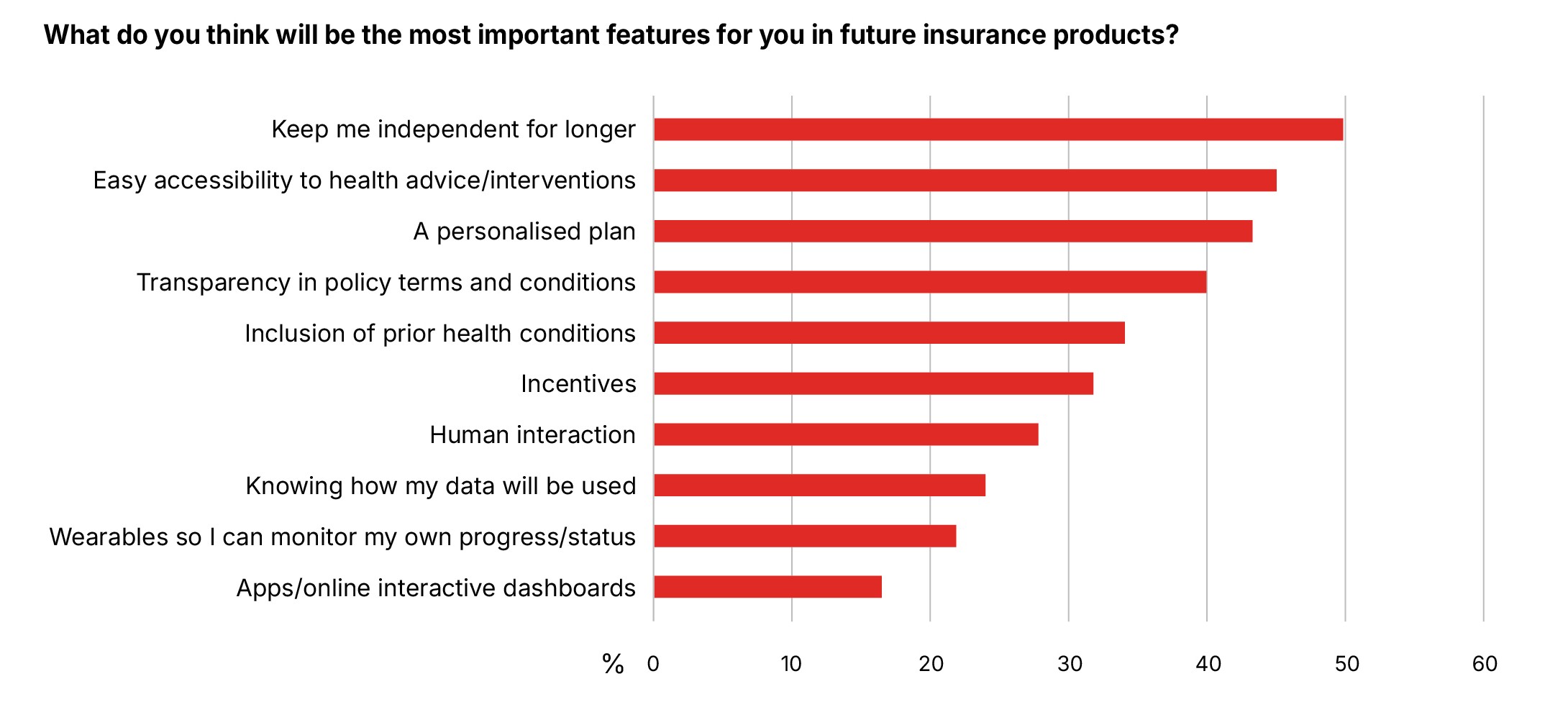
People want to remain independent as they age. There is an opportunity for insurers to create products and services centred on autonomy and innovative risk-reward models that complement traditional indemnity solutions (see Figure 2).
FIGURE 2: MOST IMPORTANT FEATURES OF FUTURE INSURANCE PRODUCTS
Source: Geneva Association
This evolving concept of longevity offers insurers fertile ground for experimentation with existing and new products. It also enables the industry to look beyond chronological age and associated parameters (i.e. pensionable age) and focus on health span as a potential driver of improved longevity outcomes, thereby creating wholly new templates for asset accumulation and decumulation. They can double down on emerging integrated health and wealth strategies and upscale them by combining protection, savings, and services and breaking down traditional distinctions between ‘health and life’ and ‘accumulation and decumulation’.
At the interface of accumulation, wealth, and health spans
At the interface of decumulation, wealth, and health spans
At the interface with public policy
The world is experiencing a profound demographic shift. In 1950, the global population was 2.5 billion; today, it exceeds 8 billion. While concerns about rapid population growth have diminished, new challenges have emerged. Global fertility rates are in significant decline, and life expectancy has surged from 46 years in 1950 to 74 years today, surpassing 80 in many OECD countries. People are living longer, but there are fewer young people to support them. Challenges to health systems and finances are growing.
This report examines public perceptions of longevity, its risks, and preparedness, based on a survey of 15,000 individuals across 12 countries. A central theme is the interplay between life span, ‘health span’ – the years spent in good health – and ‘wealth span’ – the duration of financial independence. Unfortunately, life, health, and wealth spans are significantly misaligned, opening opportunities for a holistic reassessment of financial and health security models as well as innovation.
Our findings reveal a longevity paradox: while people acknowledge the risks of longer lives, they often overestimate their preparedness. Concerns extend beyond finances to include healthcare access and long-term independence. In this context insurance is well-positioned to support longevity.
To address these shifts, insurers can develop hybrid solutions that integrate longevity, mortality, and health risks. Rethinking long-term care models and strengthening policy responses will be essential. With the global pension protection gap exceeding USD 1 trillion annually, regulatory frameworks must evolve to attract capital for savings, annuities, and health insurance solutions.
This report provides a roadmap for building a resilient longevity economy – one that empowers individuals, strengthens financial security, and redefines insurance for a world where people are living longer than ever before.
Jad Ariss
Managing Director
The global population has more than tripled since the 1950s, standing at over 8 billion in 2025. Whilst growth is slowing and fears of runaway expansion have subsided, new challenges have emerged: declining birth rates and ageing populations. Fertility rates have more than halved from five children per woman in the 1950s to the present day, with the world approaching a replacement level of 2.1. Global life expectancy has soared over the same period from 46 to 74 years, surpassing 80 in many OECD countries.
This ‘longevity revolution’ signifies remarkable progress. But it also strains health systems, which now grapple with chronic and age-related conditions. Financial security is also at risk as individuals’ savings must stretch over longer life spans. It is thus timely to reassess priorities, including reimagining health and life insurance for a reality where savings and protection needs have changed radically.
This report examines longevity and its socio-economic impact and provides a framework to understand its implications for insurers. It explores the interplay between life, health, and wealth spans, alongside public perceptions of these issues. The report also highlights opportunities for insurers to enhance existing solutions and innovate new ones, thereby fostering a resilient longevity economy.
‘Longevity’ in this context refers to extended life spans, emphasising the biological ageing that impacts health and the quality of extra years of life. A ‘longevity society’ is characterised by a rising proportion of people living longer, requiring a comprehensive approach to life shaped by biology, lifestyle, environment, and wealth. A longevity economy highlights the economic and social opportunities that emerge when these factors are effectively managed, equipping individuals to optimise both the asset accumulation and decumulation phases of their lives.
The population pyramid is morphing into a dome, with a growing over-40s cohort at the top and declining fertility rates tapering the base. This demographic shift will profoundly impact labour markets, savings, consumption patterns and population health. For life and health insurers, improving longevity risk management would mean embracing a paradigm shift that recognises the intricate interplay between ‘health span’ (the duration of an individual’s life during which they remain in good health) and ‘wealth span’ (the period during which an individual maintains financial independence), which collectively shape the life span, determine quality of life, and thus the appropriate rate of accumulation and decumulation of personal assets.
Against this backdrop, the Geneva Association commissioned a survey of 15,000 individuals across 12 countries. The results offer four key takeaways:
People’s estimation of longevity differs between developed and developing countries. Individuals in developing countries generally overestimate their longevity, while those in developed countries underestimate it – the UK and US are exceptions, where estimates are largely accurate. Globally, concerns about rising longevity extend beyond financial considerations to include health and loneliness, underscoring a growing focus on quality of life in later years.
People worry about the challenges of living longer but also overestimate their preparedness. Over two thirds of respondents express concerns about access to healthcare, the adequacy of retirement savings, and the robustness of public safety nets. But their self-reported preparedness in these areas is unexpectedly optimistic. This highlights the difficulty of translating broad awareness of issues into individual action.
Insurance is identified as a key institution to support longevity. Family, insurance, and government are ranked as the top three institutions to help prepare for increased longevity. However, boosting young adults’ engagement with insurance remains a challenge, indicating the need for simpler, more appealing products.
People want to remain independent as they grow older. This provides opportunities for insurers to create products and services centred on autonomy and innovative risk-reward models that complement traditional indemnity solutions.
The evolving concept of longevity offers insurers fertile ground for experimentation with existing and new products. The report outlines how, by advancing current integrated health and wealth strategies, insurers can combine protection, savings, and services, while dismantling traditional, bifurcated approaches of ‘health and life’ and ‘accumulation and decumulation’.
At the interface of accumulation, wealth, and health spans
At the interface of decumulation, wealth, and health spans
At the interface with public policy
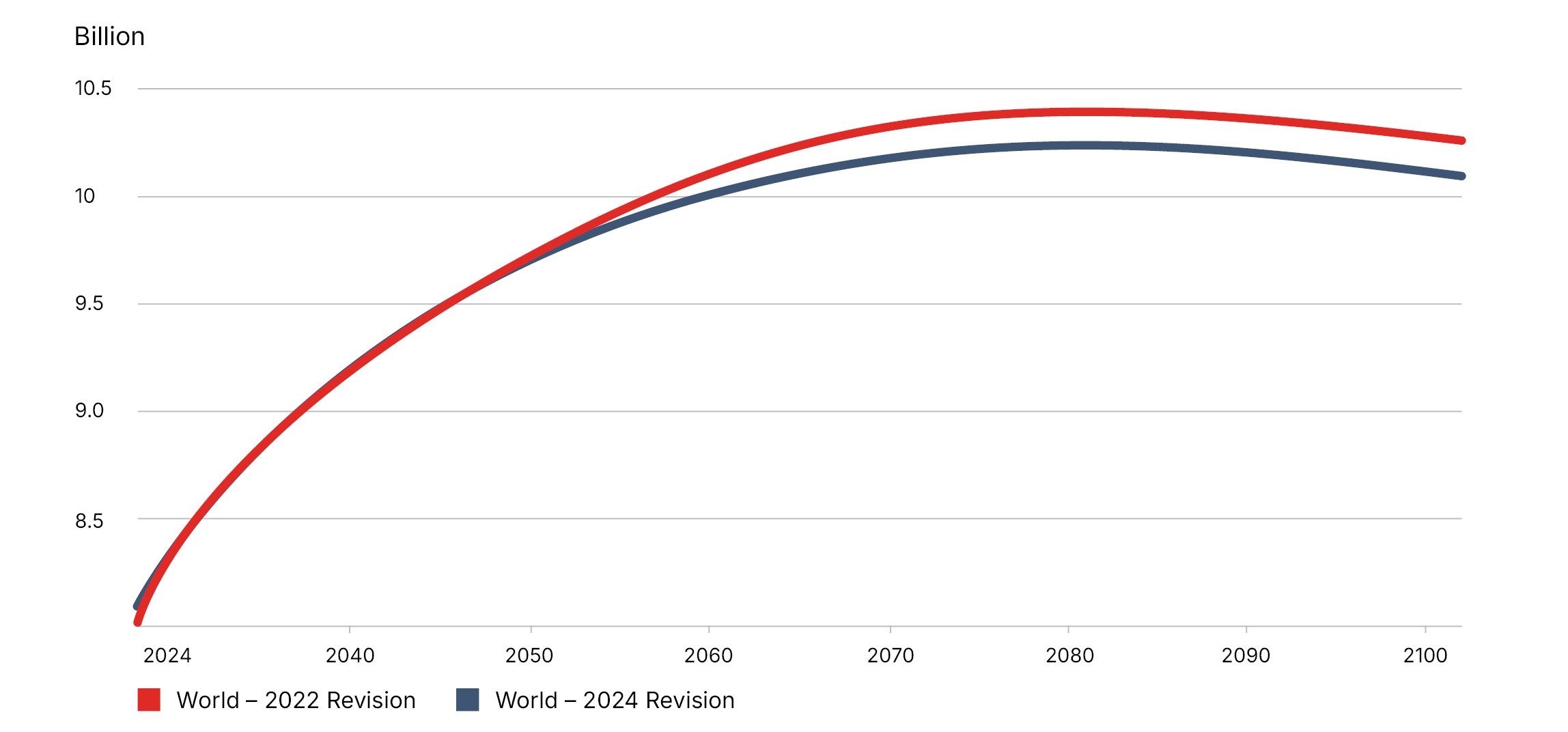
The global population has more than tripled since the 1950s, standing at 8.2 billion in 2024.1 According to United Nations projections (Figure 1), it will continue to grow but at a much slower pace, peaking at 10.3 billion around the 2080s before falling to around 10.2 billion by the end of the century. Worries about runaway population growth have therefore been largely abated, but new challenges have emerged: declining birth rates and an ageing population.
The global fertility rate is at the core of this phenomenon, which has more than halved from five children per woman in the 1950s to just over the replacement level of 2.1.2 During the same period, average global life expectancy has risen from 46 years to 74 years.3 In China it is 78 years, in Japan 84 years, and the average in OECD countries is just over 80 years.4 As such, the world is now grappling with a demographic shift where more people face longer lives – increased longevity – with fewer young people to support them. This creates new needs and vulnerabilities and challenges established societal norms and economic structures.
Increased longevity is undoubtedly a triumph of scientific and societal achievements, yet it exposes a disquieting reality – longer lives aren’t necessarily healthier or wealthier. Health services strain under mounting pressure of chronic and age-related illnesses, whilst individuals’ savings stretch perilously thin across extended years. Longevity itself is not the problem; the crucial question is, what kind of longevity is desirable for people and workable for harmonious societies and thriving economies?
This warrants an exploration of the socio-economic implications of longevity against the backdrop of existing policies and market developments. It requires taking the pulse of public perception of longer lives, especially with regards to health and wealth concerns. It also necessitates introspection from life and health insurers to help redefine their relevance in an unfolding risk landscape that is likely to be vastly different from that of the 20th century.
FIGURE 1: UNITED NATIONS REVISED POPULATION PROJECTIONS
Source: Our World in Data5
The term ‘longevity’ is often used interchangeably with ageing. While the concepts are related, they represent two different phenomena. The former refers to the length of life, and the latter refers to the ‘progressive loss of physiological integrity leading to functional impairment’.6
A longevity society is one where a significant portion of people are expected to sustain a longer life. The ageing process heavily influences the quality of longevity. Hence, grasping longevity’s impact on individuals necessitates examining whole-life factors: biology, lifestyle, wealth, and environment. Assessing the economic implications of increased longevity requires scrutiny of production and consumption patterns arising from new age structures and behavioural shifts as people adapt to extended life spans.
Experts argue that longevity, despite its recent fluctuations, is here to stay and that it is timely to flip the narrative around it from one of burden to opportunity. If managed well, longevity can bring about economic and societal benefits.7 Rather than older individuals curtailing their workforce participation beyond a certain chronological age and running down their accumulated assets, they may opt to continue saving for longer, according to their biological age, or return to work after a mid-life career break.
Longevity highlights the flexibility of ageing
When thinking of ageing, societies often rely on chronological age to define economic and social norms. Yet, through the lens of longevity and the importance of changing how we age, chronological age becomes secondary, shifting the focus to the quality of longer lives and making the connection between chronological and biological age more flexible and important.
This perspective places health at the forefront, driving innovative policies, products, and services to enhance outcomes. It also opens the door for individuals to make different life choices, creating entirely new possibilities for living. There is a lot health and life insurers can do here but it does mean reimagining traditional parameters like pensionable age.
Contributed by Andrew Scott,
Professor, London Business School
Life and health insurance have historically been central to managing some of the pivotal outcomes of human lives. Originally, life insurance provided protection against untimely death, also known as mortality risk. Today, however, the majority share of life insurance business concentrates on longevity risk (i.e. protecting against the chances of outliving one’s savings) through annuities, private pension insurance, or saving investment plans. Sometimes such products also come with long-term care benefits. Others include protection against loss of income due to accident or sickness. But overall demand for savings and annuities products in life insurance has waned since the Global Financial Crisis as interest rates plummeted (with some arguing demographic change itself was a contributor),8 despite the fact that longevity risk increases with rising life expectancies.
Health insurance protects against morbidity risks, or the risk of illness or disability, by covering treatment expenses. Health insurers typically have to contend with significant medical cost inflation as demand for health services increases with higher prevalence of chronic and age-related conditions.
As the relationship between chronological and biological age becomes more malleable, it could be argued that the factors contributing to longevity risks do too, with implications for both health and life insurance. This report posits that ‘longevity’ now presents a multifaceted challenge, necessitating a fresh perspective from insurers to address not only the risk of outliving personal savings but also the risk of declining physical and mental faculties due to unhealthy ageing.
The normalisation of interest rates since 2022 offers a welcome window for insurers to enhance their relevance. Life insurers are already recouping some lost demand, with promising forecasts for savings premiums of USD 1.5 trillion between 2025 and 2034, compared with USD 300 billion between 2010 and 2019.9
However, sustaining premium growth amid the omnipresent threat of macroeconomic volatility will be extremely challenging. Health and life insurers need additional ways to address the gap between life span (chronological age) and health span to bolster a stagnant wealth span. People are living longer, not necessarily in good health, and may not be saving enough for periods of economic inactivity or longer retirement. This requires redefining the concepts of ‘working age’ and ‘old’, moving from ‘sickness’ to ‘health’, and shifting business models from getting people ‘to retirement’ to helping them navigate financial security over longer lives, including ‘through retirement’.
This report aims to develop that vision by providing a global overview of longevity and its socio-economic implications (section 2); offering a framework that elaborates the multi-faceted nature of the longevity economy and specific considerations for the insurance industry (section 3); assessing people’s perception of longer life with a focus on health and wealth spans (section 4); and exploring the opportunities the longevity economy presents for insurance (section 5).
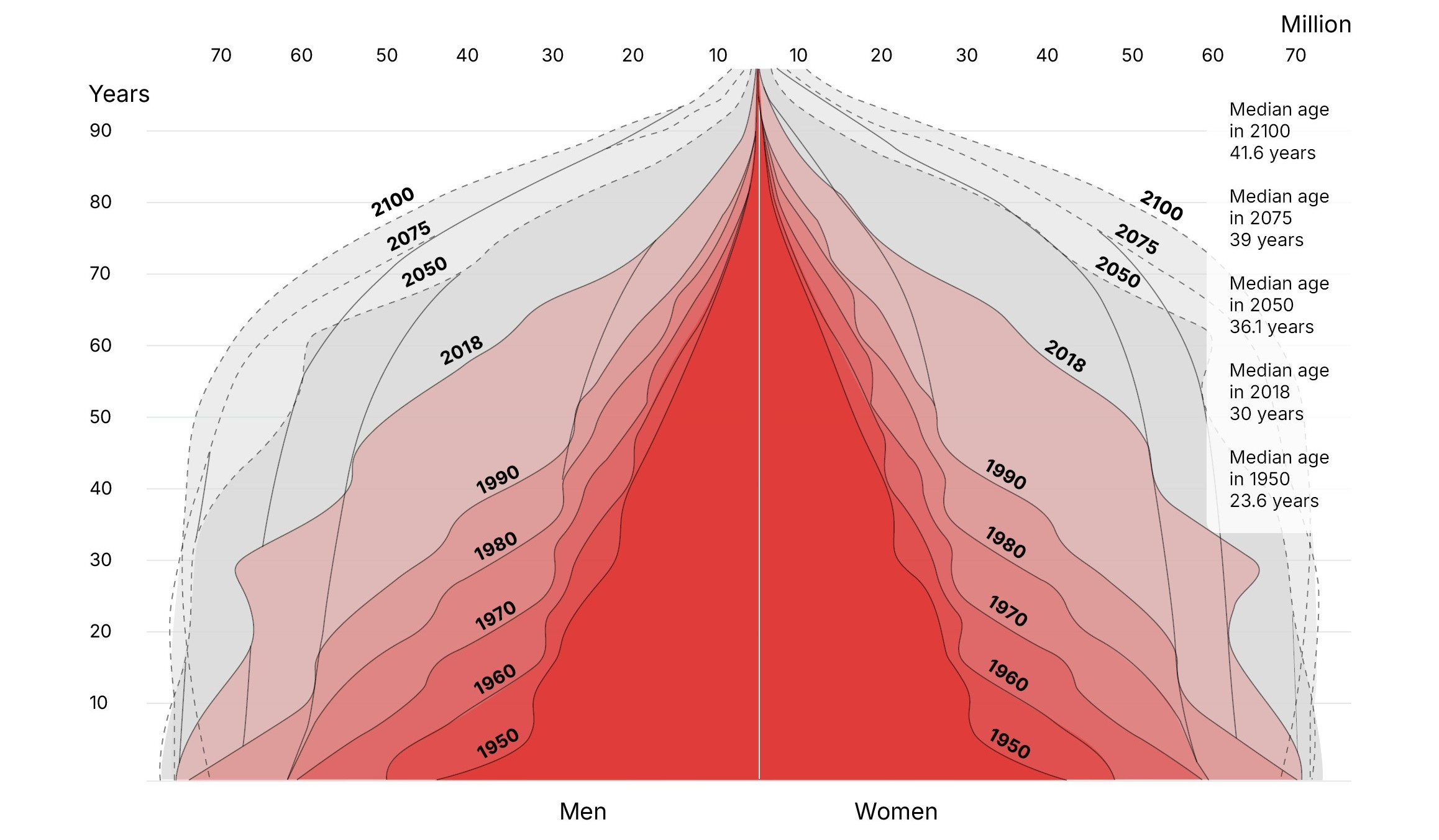
Lower fertility rates, improved mortality, and the resultant slower population growth have precipitated a significant demographic transformation of societies, albeit with regional variations.10 What was historically referred to as a global population pyramid by demographers increasingly resembles a dome (Figure 2). The over-40s cohort is set to grow significantly in the next 75 years, raising profound questions about issues including productivity, consumption, labour markets, health, and caregiving
FIGURE 2: THE GLOBAL DEMOGRAPHIC TRANSITION 1950-2100
Source: Our World in Data11
Longevity trends have a significant influence on savings behaviour and consumption patterns. As populations, especially in advanced economies, age and life expectancy increases, individuals and households will need to adapt their financial planning to maintain living standards throughout an extended period. Longer life spans are also expected to increase healthcare expenditures, necessitating higher savings during working years and restrained consumption during retirement.12 Current trends, however, fall short of meeting future requirements.
Recent decades have seen a persistent decline in personal-sector savings rates, particularly in developed economies such as the US and parts of Europe. In the US, for instance, this rate hovered around 10% in the early 1980s but fell to a mere 1% in the 2000s before recovering slightly following the Global Financial Crisis.13 Multiple factors have contributed to this decline, including real wage stagnation, the expansion of consumer credit, and the ‘wealth effect’ resulting from rising asset prices, particularly in the housing market.14 Many emerging economies, such as China, have traditionally maintained higher savings rates, driven by cultural predispositions toward saving in the absence of comprehensive social safety nets. However, China’s savings rate has also begun to decrease as its economy shifts toward a more consumption-driven model.15
As the proportion of retirees to working-age individuals rises, this depletion of savings will continue to intensify, placing strain on both personal financial reserves and public pension systems. Many pension systems, particularly pay-as-you-go models, face sustainability challenges due to longer retirements and fewer active contributors. As a result, the onus of funding retirements will increasingly fall on individuals, highlighting the critical need to revisit long-term savings strategies.16
The prolonged low-interest-rate environment from 2008–2022 has compounded these challenges. In response to the Global Financial Crisis, central banks in developed economies, such as the US Federal Reserve and the European Central Bank, implemented near-zero interest rate policies to stimulate economic growth. Although these measures encouraged borrowing and investment, they significantly diminished the appeal of traditional savings vehicles, such as bank deposits, due to their minimal returns. Consequently, many savers sought higher yields in riskier asset classes, including equities and real estate, exacerbating asset price inflation and contributing to wealth inequality.17 As such, longevity planning for today’s asset-rich generation may look very different to that of other generations.
The greying workforce is reshaping labour markets as increased longevity and novel medical treatments enable people to work beyond traditional retirement age.18 In the US, the labour force participation rate for those aged 65 and older rose from 27% in 2003 to 35% in 2023.19 European countries show similar trends, with an average employment rate of 22% for those aged between 65 and 74 in the Euro area in 2022, up from 10% in 2002.20
Yet current policies and institutional structures lag behind this unfolding reality, especially concerning retirement age. For instance, under current retirement policies, countries such as Japan are likely to experience a 20% workforce shrinkage by 2040 due to low fertility rates.21 Emerging markets are also facing this transition; China is at the forefront22 but India, perceived as a country with a burgeoning young population, is also affected.23 Consequently, 20th century institutional parameters of defining retirement age are now under the spotlight.
The shift to working longer is driven by both necessity and choice. The sluggish growth of retirement savings is pushing more people to remain in the workforce.24 Others seek continued intellectual stimulation and social engagement. The rise of ‘bridge jobs’ offers flexibility between career employment and full retirement.25 The gig economy has also emerged as another significant driver of ‘silver working’, providing retirees with flexible opportunities to remain active in the labour force.26
But ageism persists. Contrary to stereotypes, older workers often maintain or increase productivity, especially in less physically demanding roles. BMW’s experiment with an older production line workforce demonstrated that with minor ergonomic adjustments, productivity could match younger cohorts.27 Intergenerational collaboration is becoming crucial in this context. Companies are implementing mentorship programmes pairing seasoned professionals with younger colleagues. The need for lifelong learning and upskilling are also increasingly evident. Challenges persist, however, including age discrimination.28
These trends suggest that the very concept of a fixed retirement age may become obsolete. The future may even bring a more fluid approach to work and retirement, with individuals switching between periods of employment, education, and leisure throughout extended lifespans.29 Such an approach underscores the importance of health over life span to bolster such a reality.
Over half the global population aged 60 and over suffers from multiple chronic conditions.30 The past decade has seen a marked slowdown in mortality improvement,31 leading some experts to question whether longevity gains are reversing. The trend is not universal, however, and may partly be explained by the COVID-19 pandemic. But there are specific cases, such as the US and UK, where recent life expectancy declines have been somewhat harder to interpret and may be significantly linked to socio-economic disparities.32 While the conclusions remain unclear, these cases raise critical questions about:
TABLE 1: LIFE SPANS VERSUS HEALTH SPANS
| Average life span at birth | Average health span at birth | Difference | |
|---|---|---|---|
| Brazil | 72 | 62 | 10 |
| China | 78 | 69 | 9 |
| France | 82 | 70 | 12 |
| Germany | 80 | 69 | 11 |
| India | 67 | 58 | 9 |
| Italy | 82 | 71 | 11 |
| Japan | 84 | 73 | 11 |
| Mexico | 71 | 61 | 10 |
| South Korea | 84 | 72 | 12 |
| Spain | 83 | 71 | 12 |
| UK | 80 | 69 | 11 |
| US | 76 | 64 | 12 |
| AVERAGE | 78 | 67 | 11 |
Source: Geneva Association, based on data from WHO42
The importance of informal care in ageing societies and its complex relationship with labour markets is increasingly difficult to ignore. Valued at 9% of global GDP, informal care has become an economic cornerstone, with 60% of the elderly population in OECD countries relying exclusively on friends and family.51 A UK study revealed informal carers provide 43–65 hours of weekly care, significantly easing the strain on overstretched public services.52 This trend exposes a policy and service vacuum for carers, who often endure the dual burden of work and caring responsibilities or sacrifice income to support family. Research from the Netherlands indicates many carers, predominantly women, exit the labour market prematurely, a cohort with a higher life expectancy who already experience a significant pension and health protection gap.53
The landscape of longevity is undergoing a profound transformation. Societies, businesses – including insurers – and policymakers must embrace a paradigm shift to realise a future that recognises the intricate interplay between two previously isolated components that collectively shape life span: health span and wealth span. These are integral to the quality of longevity and thus the rate of accumulation and decumulation of personal assets.
Here, wealth span refers to the period during which an individual maintains financial independence, supporting their standard of living without significant lifestyle downgrades or reliance on external financial aid. As life expectancy rises, a sustainable wealth span becomes crucial for ensuring that extended longevity equates to a period of financial security and well-being, rather than financial vulnerability.54 Health span refers to the duration of an individual’s life during which they remain in good health, without chronic diseases and disability.55
The framework shown in Figure 3 underpins the idea of health and wealth spans expanding to match life spans, with shaded red areas denoting stages when preparedness and risk protection are most compromised. For health span, this signals the premature onset of disease and expensive sickness and social care in the absence of interventions that prolong health and support longer asset accumulation. For wealth span, there are periods early and late in life where lack of financial independence, financial literacy, and preparedness hamper the ability to accumulate wealth, followed by a longer, riskier, and poorer decumulation period.
FIGURE 3: THE MISALIGNMENT OF LIFE, HEALTH AND WEALTH SPANS
Source: Geneva Association, based on data from WHO, Our World in Data, and WEF56
The interplay between health and wealth spans cannot be overstated. Take the example of a woman in France with an average life expectancy of 86 years at birth and a healthy life expectancy of 67 years, i.e. a 19-year gap between the two.57 Advancements in medical science and technology have enhanced the ability to forecast her potential health outcomes as she ages and offer opportunities to alter the trajectory by addressing behavioural, genetic, commercial, and environmental determinants of health. On the other hand, financial well-being requires integrated planning that also accounts for health needs and risks and the impact they will have on her asset accumulation and decumulation capabilities and decisions. It is therefore essential for policymakers, insurers, and financial planners to address wealth and health spans in tandem58 rather than pursuing siloed discussions on extending retirement age alone.
Doing so, specifically in the context of insurance, would mean collaborating with consumers, service providers, and policymakers to create more strongly integrated products that cover risks across both health and wealth spans.59 Alongside this, insurers need to contemplate four strategic dimensions that reflect the socio-economic implications discussed in the preceding section: 1) How the insurance customer base may evolve with demographic shifts and what that means for insurers’ conventional risk threshold; 2) How trends in consumer behaviour in response to longevity might influence insurance products; 3) The conditions for scalability in the altered state of risk, especially when some risks may be prone to market failures; and 4) What new market developments could influence how insurers deal with those risks.
The current insurance business model uses data to assess and price risks while mitigating adverse selection and moral hazard. However, as ill health becomes more prevalent in societies, there is an increasing need to complement price differentiation with other interventions such as service differentiation. It will become even more important for insurers to revisit/increase their own risk tolerance, otherwise they may exhaust the pool of customers with ‘a clean bill of health’ and face limited growth opportunities, or simply lose out on the opportunities rendered by additional years of life.
Economic theory, particularly the lifecycle hypothesis and human capital theory, offers a strong framework for understanding the wealth span.60 The lifecycle hypothesis, which examines how individuals allocate resources throughout their lives, emphasises the importance of accumulating savings during working years and decumulation in retirement. However, with people now potentially spending 20 years or more in retirement, the traditional model of saving and dissaving is becoming increasingly strained. Human capital theory suggests that individuals invest in their education, skills, and health to enhance their productivity and earnings over their lifespan. In response to rising life expectancy, flexible retirement, unretirement, ongoing career training, opportunities for part-time jobs, or consultancy are also fast becoming part of this equation to extend income-generating years.61 Understanding how this dynamic wealth span can be enhanced by positioning both existing and new insurance products more innovatively is essential.
Wealth and health inequality tends to exacerbate as people age, with lower-income individuals often experiencing shorter spans due to limited access to health services, few opportunities to modify the environmental determinants of health, inability to access employer-sponsored retirement plans, lower wages, and fewer opportunities to save. Public safety nets no doubt will remain crucial to help extend wealth and health spans for those who lack the capacity to do so adequately on their own.62 But as public coffers come under pressure, insurers have an opportunity to collaborate with governments on solutions to scale up protection to segments where pure private-sector solutions would not be feasible.
Data (health and non-health) are increasingly accessible, with artificial intelligence now capable of interpreting vast datasets and driving sophisticated analytics. This raises important questions for insurers about how best to use data against the backdrop of existing policy frameworks designed to uphold consumer privacy while also improving risk assessment and outcomes. These issues are further exacerbated by the personalisation of medicine and medical technology, which generates even more data to aid more accurate prediction,63 diagnosis, and treatment of risks, raising several concerns about mutualisation in insurance and affordability.
The future of medical innovation also demands that insurers carefully start to weigh the use of genetic data in underwriting decisions, balancing benefits against ethics. For instance, 45% of the risk factors for dementia are modifiable.64 A strategic question could therefore be, ‘To what extent should insurers rely on genetic data alone (a possible future scenario) to understand insurability over positively influencing the wider determinants to mitigate the risks they pose?’ Also, when new disease diagnoses enabled by genetics are not accompanied by proven treatments, ‘To what extent should this influence decision-making?’
This section outlines the key findings from a survey commissioned by the Geneva Association to explore people’s general perceptions of longevity, their concerns, preparedness as they age, and the institutions they value for supporting their preparation for a longer life. A total of 15,000 respondents were surveyed across 12 countries.65 Four key messages emerge from the results:
People’s estimation of longevity differs between developed and developing countries. Individuals in developing countries generally overestimate their longevity, while those in developed countries tend to underestimate it (except in the UK and US, where estimates are largely accurate). Globally, concerns about rising longevity extend beyond financial considerations to include health and loneliness, underscoring a growing focus on quality of life in later years.
People worry about the challenges of living longer but also overestimate their preparedness. Over two thirds of respondents express concerns about access to healthcare, the adequacy of retirement savings, and the robustness of public safety nets. But self-reported preparedness in these areas is unexpectedly optimistic. This highlights the challenge of translating broad awareness of issues into individual action.
Insurance is identified as a key institution to support longevity. Insurance is ranked highly alongside family and government, but engaging young adults remains a challenge, indicating the need to simplify products to enhance their appeal.
People want to remain independent as they age. There is an opportunity for insurers to create products and services centred on autonomy and innovative risk-reward models that complement traditional indemnity solutions.
There is a noticeable divide in longevity estimations between developed and developing countries (see Table 2). Developed nations tend to underestimate their longevity, with Japan in particular underestimating life spans by seven years. Conversely, developing countries like Brazil, China, and India often overestimate life expectancy, with Brazil standing out at an overestimate of 5.9 years. This is consistent with other research findings on cross-country differences in perceived life expectancy. For example, the 2024 Longevity Survey by the Oxford Longevity Project and Roundglass highlighted that emerging markets show growing optimism about longevity. Respondents in Brazil and China predicted some of the longest lifespans, while those in India expressed the highest optimism about ageing.66
TABLE 2: COMPARING QUANTITATIVE PERCEPTIONS OF LIFE EXPECTANCY WITH GLOBAL AVERAGES
Surveyed countries | Respondents' self-assessed longevity | Actual life expectancy |
|---|---|---|
Brazil | 81.7 | 75.8 |
China | 80.1 | 78 |
France | 80.7 | 83.3 |
Germany | 79.8 | 81.4 |
India | 74 | 72 |
Italy | 81.2 | 83.7 |
Japan | 77.7 | 84.7 |
Mexico | 751 | 751 |
South Korea | 81 | 84.3 |
Spain | 81.8 | 83.7 |
UK | 81.4 | 81.3 |
US | 79.5 | 79.3 |
Source: Geneva Association, using data from the UN67
Qualitative data collected from the survey suggest that attitudes toward living longer are predominantly negative, characterised by emotions of sadness and fear. Again, there is a clear divide between developed and developing countries. For instance, while in Italy or the US words such as ‘retirement’ and ‘loneliness’ feature prominently in responses, respondents in Brazil and Mexico relate old age to ‘tranquillity’ and ‘experience’. The term ‘health’ emerged consistently and most frequently across all regions, followed by ‘pension/ retirement’ and ‘loneliness’. This indicates that concerns about longevity extend beyond financial security, with a significant emphasis on quality of life in later years.
Health was identified as the primary concern by 72% of respondents in the context of increased longevity (Figure 4). Concerns about the adequacy of retirement savings and social safety nets were similarly prominent, with 67% and 68% of respondents, respectively, expressing apprehension. Such views on financial security align closely with recent research on retirement savings in the US and Europe.68
FIGURE 4: CONCERNS ABOUT INCREASED LONGEVITY
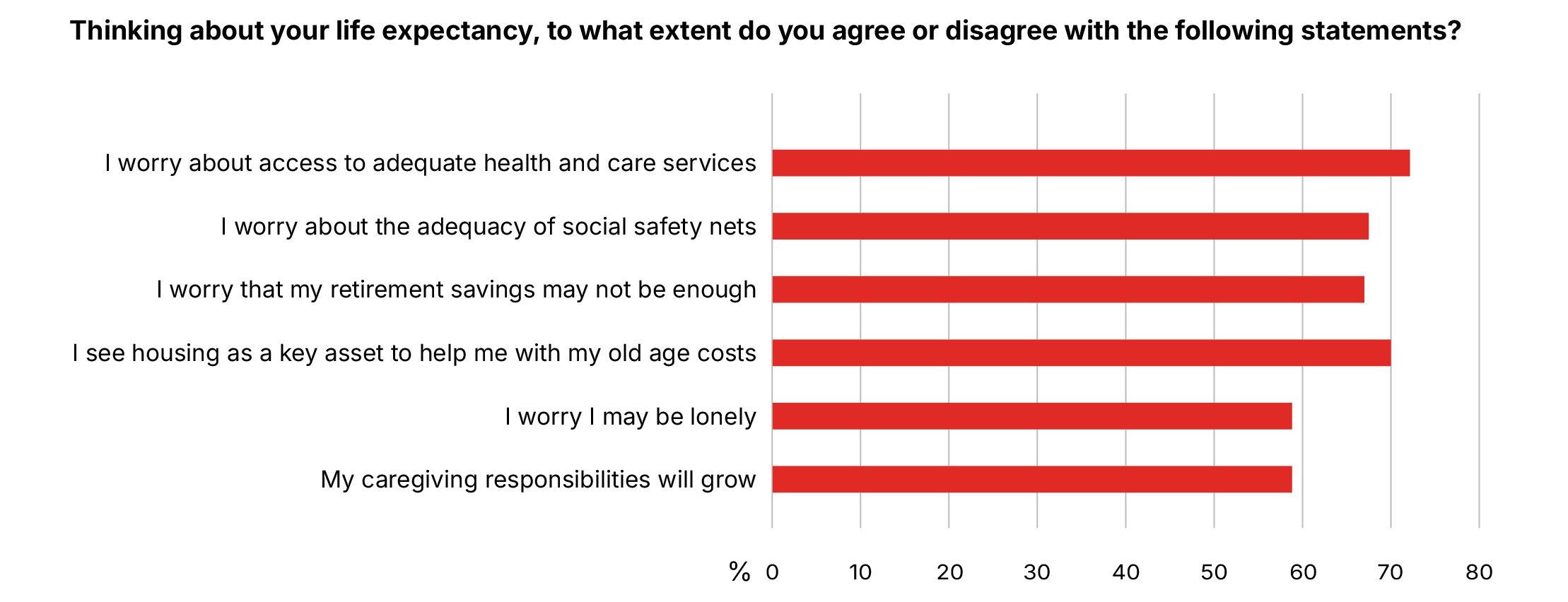
Note: % of respondents who somewhat or strongly agree
Source: Geneva Association
Notably, 59% of respondents highlighted concerns about caregiving and loneliness, adding a new dimension to longevity-related considerations and reinforcing findings from the qualitative analysis.69 Caregiving concerns, which encompass both responsibilities and needs, were more (less) pronounced in countries with weaker (stronger) social welfare systems, (62% vs. 56%) and greater reliance on family for care (61% vs. 50%).70
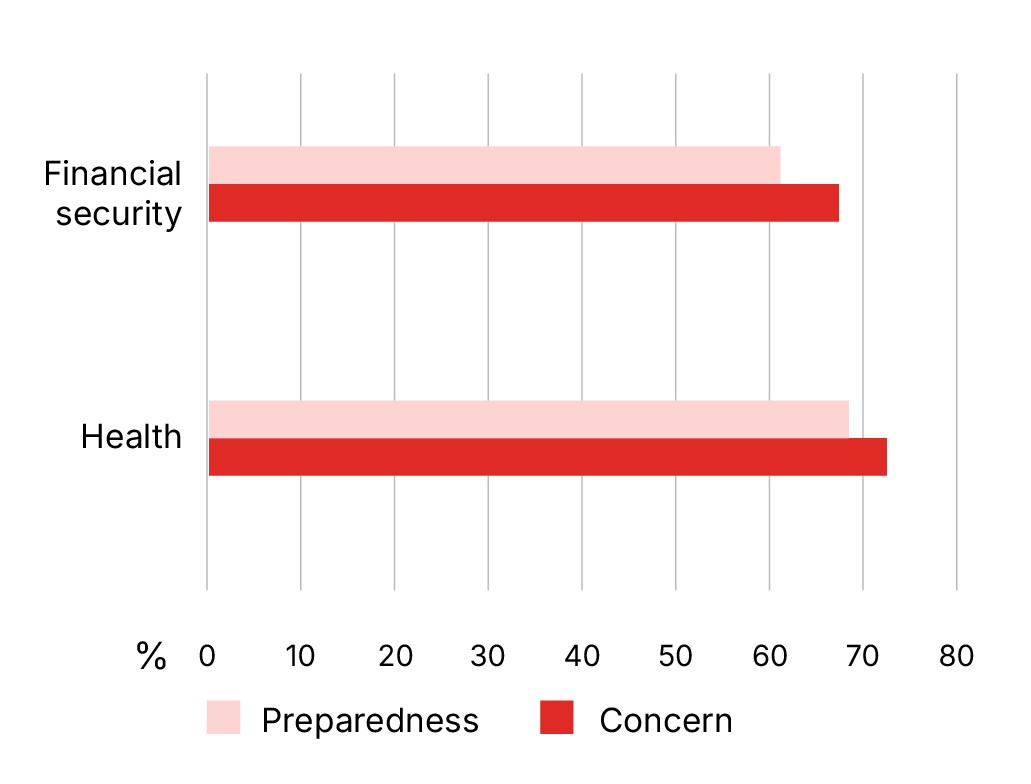
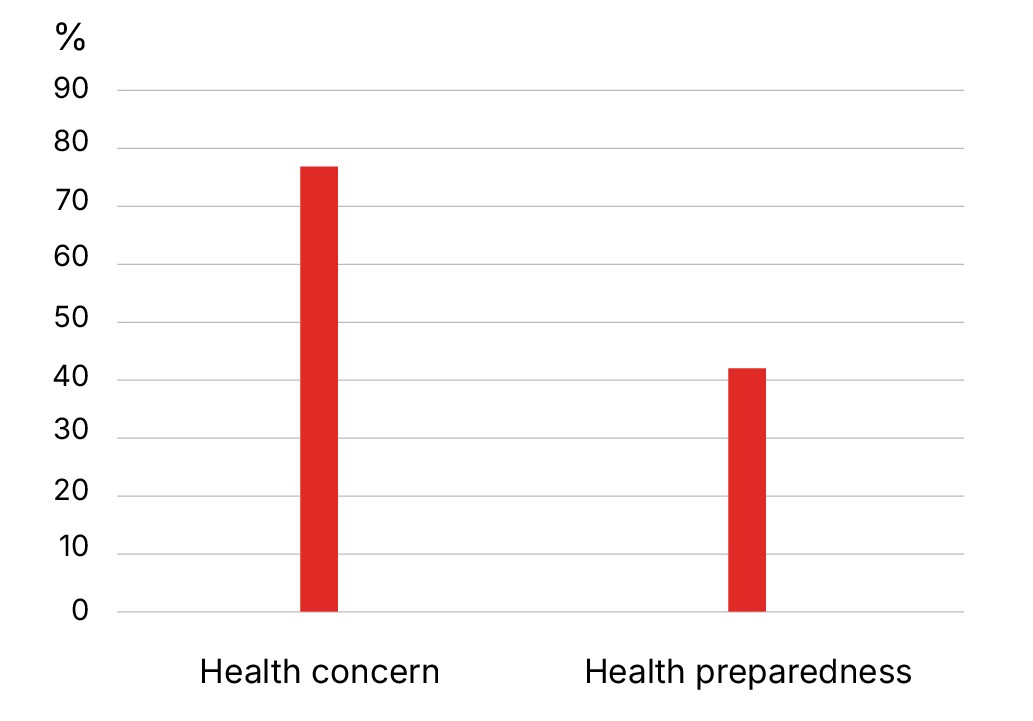
Incongruities emerge when awareness is juxtaposed with individual-level preparedness. For example, 61% and 68% of respondents feel prepared to address their financial and health needs, respectively,71 despite more than two thirds expressing concerns in these areas (Figure 5). This disconnect between awareness and an apparent optimism about personal preparedness for longer lives is particularly striking in relation to health, where the difference between concern and confidence is only a few percentage points. The most pronounced divergence from this overall trend is observed in South Korea, where concerns about health closely align with a notable lack of preparedness (Figure 6). With the world’s lowest fertility rate at just 0.72, it is plausible that respondents from South Korea are keenly aware of the extraordinary pressures facing their health and care systems.
FIGURE 5: COMPARING CONCERN WITH FIGURE 5: COMPARING CONCERN WITH PERSONAL PREPAREDNESS
Source: Geneva Association
The overarching picture may reflect overconfidence driven by limited longevity literacy. Respondents may underestimate the complexities and costs associated with an extended lifespan, relying on assumptions that project current circumstances into the future. These behavioural biases underscore the significant challenge insurers face in converting ‘awareness’ into practical action. For instance, a study of individuals aged 40–65 in the US found that 60% did not anticipate needing any long-term care, despite evidence suggesting that 70% are likely to require such services.72 Similarly, a recent survey by Prudential Financial revealed that the average 55 year old had less than USD 50,000 saved for retirement – far below the recommended goal of eight times their annual income by this age.73
FIGURE 6: STANDING OUT FROM THE FIGURE 6: STANDING OUT FROM THE CROWD: SOUTH KOREA
Source: Geneva Association
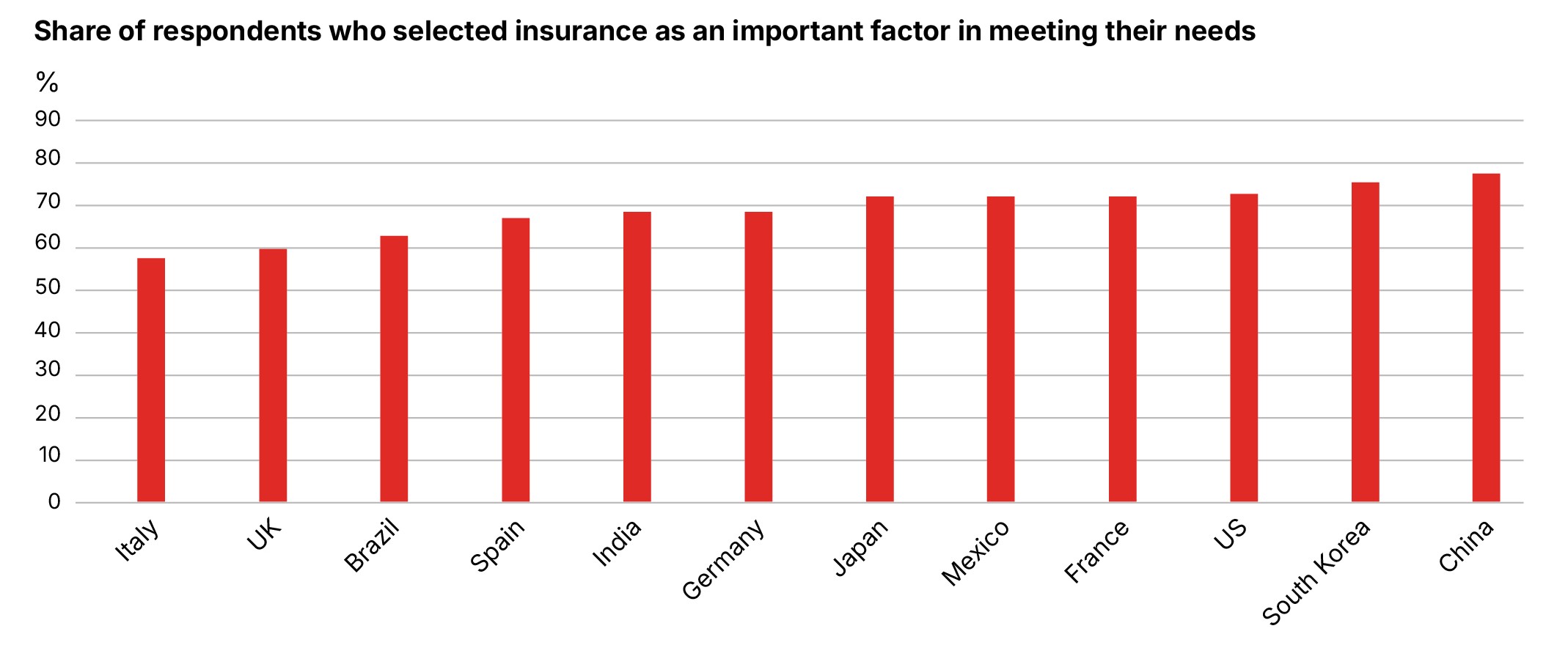
Respondents ranked family, insurance, and government as the top three institutions to help them prepare for increased longevity. Across countries, 58% to 77% viewed insurance as essential for meeting their needs. Its importance was notably higher in low-public-welfare countries (73% vs. 66% in higher-welfare states), as shown in Figure 7. The only exceptions to this trend are France and Japan (high-welfare countries), likely due to familiarity with private complementary and supplementary insurance plans alongside statutory schemes. The highest value is in China (77%), reflecting a surge in insurance demand consistent with recent studies highlighting growing interest in savings-oriented life insurance products.74
FIGURE 7: THE IMPORTANCE OF INSURANCE IN MEETING LONGEVITY NEEDS
Source: Geneva Association
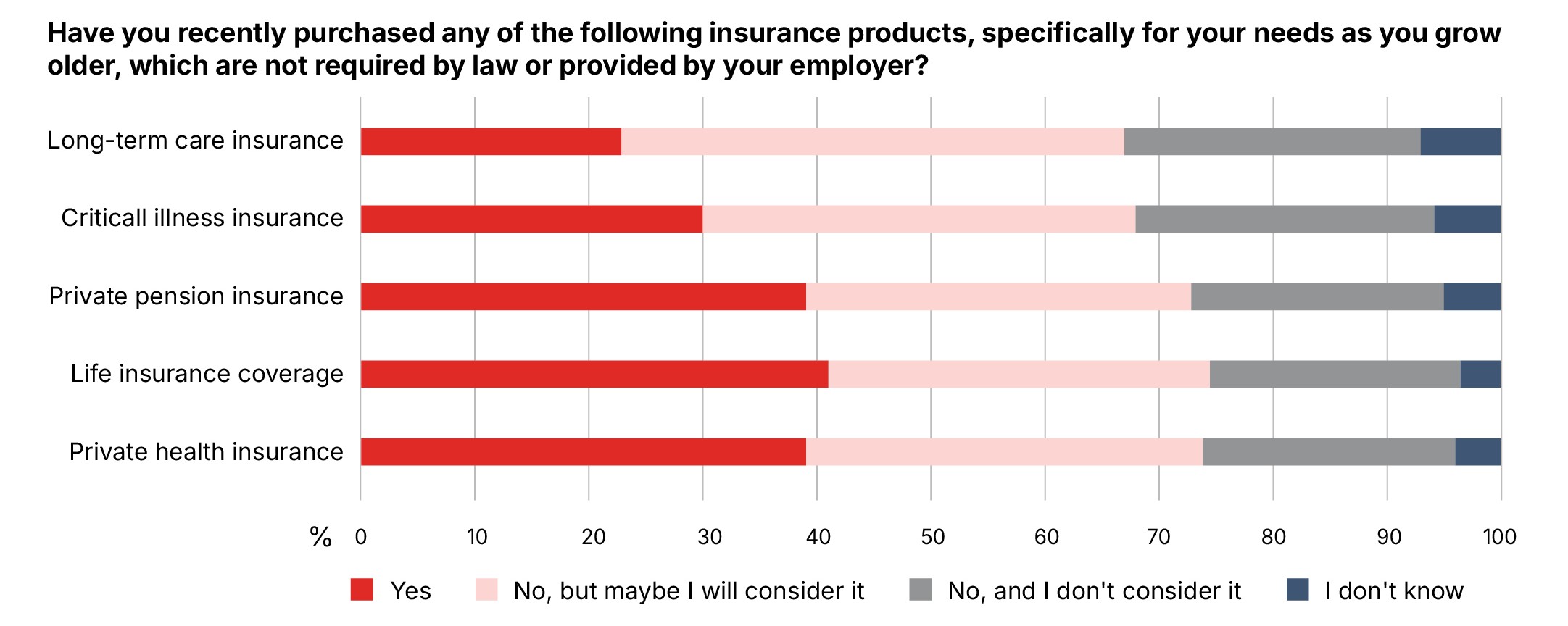
While interest in insurance is high, converting it into actual demand remains challenging. For example, respondents were most interested in long-term care insurance (44%) but this was the least owned insurance product (23%) (Figure 8). This interest in long-term care insurance corresponds with growing needs in OECD countries, where long-term care spending is projected to outpace health spending in the coming years.75
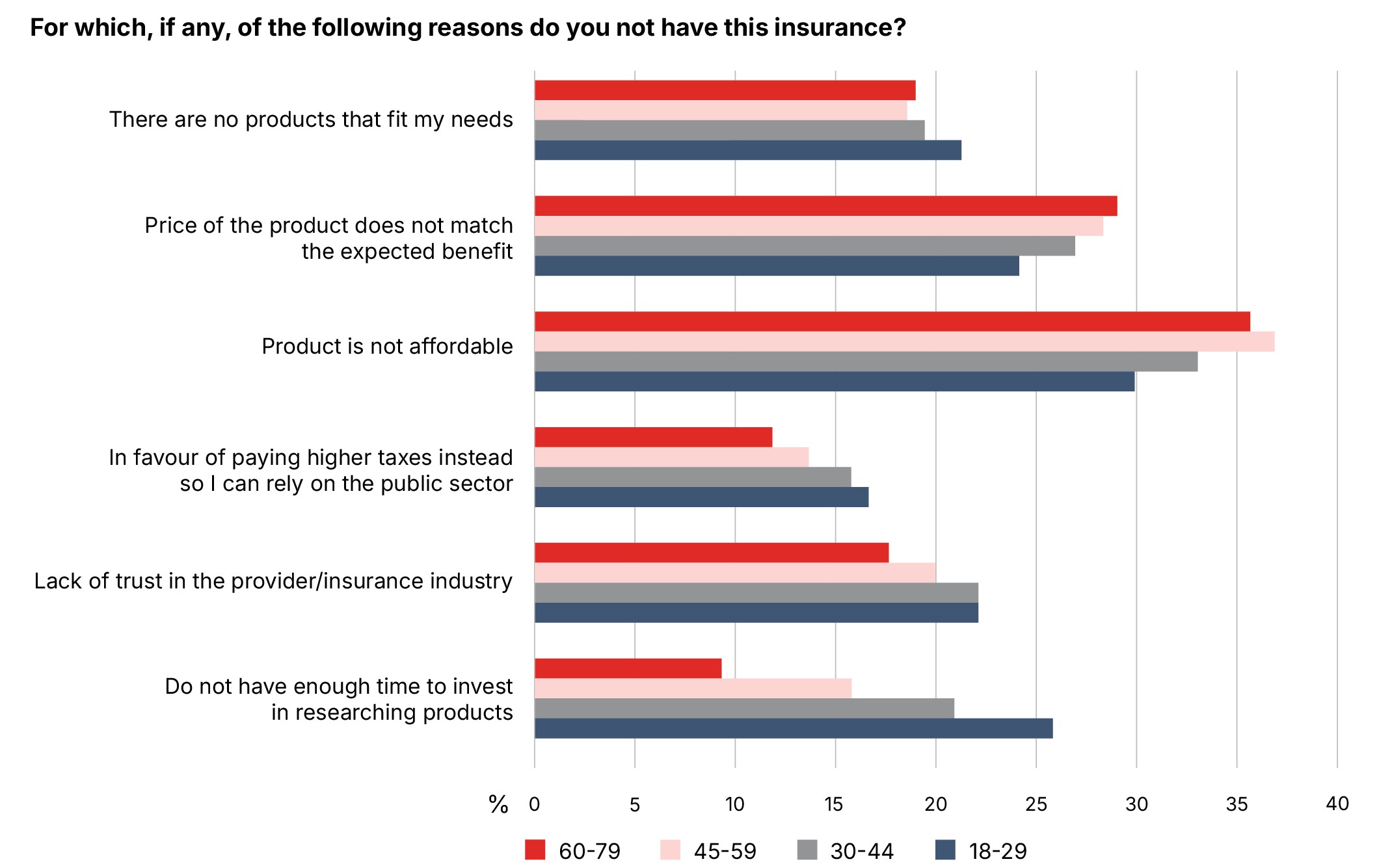
Over a third of respondents across most age groups cited affordability as the primary reason for not having any insurance. Cost-benefit considerations are especially important for older respondents (Figure 9). Lack of time to research products is an important stumbling block for the youngest respondents, indicating that the complexity of policies may be negatively influencing insurance take-up.
FIGURE 8: INSURANCE FOR LONGEVITY NEEDS – INTEREST AND OWNERSHIP
Source: Geneva Association
FIGURE 9: REASONS FOR NOT OWNING INSURANCE
Source: Geneva Association
The survey results clearly highlight the weight people put on independence in later years (Figure 10). While health remains a key priority, respondents appear less swayed by marketing perks and technological add-ons. This may indicate a greater focus on core insurance principles – risk protection and mitigation – or a reaction to the overcrowded digital app market, which has led to fragmentation and limited meaningful choice in recent years.76
The importance of independence may signal the type of longevity people desire and, as such, how products may be positioned for different cohorts and insurance business lines. A shift away from indemnity-focused products to those that proactively address the diverse risks of living longer may be more appealing. The qualitative survey responses are particularly useful in this regard, which suggest that respondents interpret independence broadly to encompass physical autonomy, ageing with dignity, financial self-sufficiency, and caregiving support that safeguards the independence of both carers and recipients.
FIGURE 10: MOST IMPORTANT FEATURES OF FUTURE INSURANCE PRODUCTS
Source: Geneva Association
Societies everywhere face an aggregate shift to rising life expectancy, despite slower gains in mortality improvement seen more recently. The survey results in section 4 show that consumers’ perspectives on longevity extend well beyond finances to encompass health, caregiving, autonomy, and social issues. These findings validate the notion put forward in this report that living longer transcends financing a fixed retirement period, contrary to how longevity has been typically perceived in the insurance industry.
This evolving concept of longevity offers insurers fertile ground for experimentation with existing and new products. It also enables the industry to look beyond chronological age and associated parameters (i.e. pensionable age) and focus on health span as a potential driver of improved longevity outcomes, thereby creating wholly new templates for asset accumulation and decumulation. These could be further supported by advancements in automation and AI that tend to reduce productivity differences across age groups, potentially transforming future labour markets. Strengthening partnerships with government and service providers will also help to create an enabling environment.
Demand for insurance products will evolve with increased longevity. As people live longer, insurance products now not only have to consider traditional risks like premature death, disability, and health expenses but also tackle risks associated with longevity more broadly (i.e. risk factors that influence ill health, exposures of carers/care receivers, or obsolescence of skills demanding new career paths in middle-age for continued asset accumulation77) as well as financial market volatility that affects the accumulation and decumulation of assets.78 Here, insurers hold a distinct advantage over other financial services. They can double down on emerging integrated health and wealth strategies and upscale them by combining protection, savings, and services and breaking down traditional distinctions between ‘health and life’ and ‘accumulation and decumulation’.
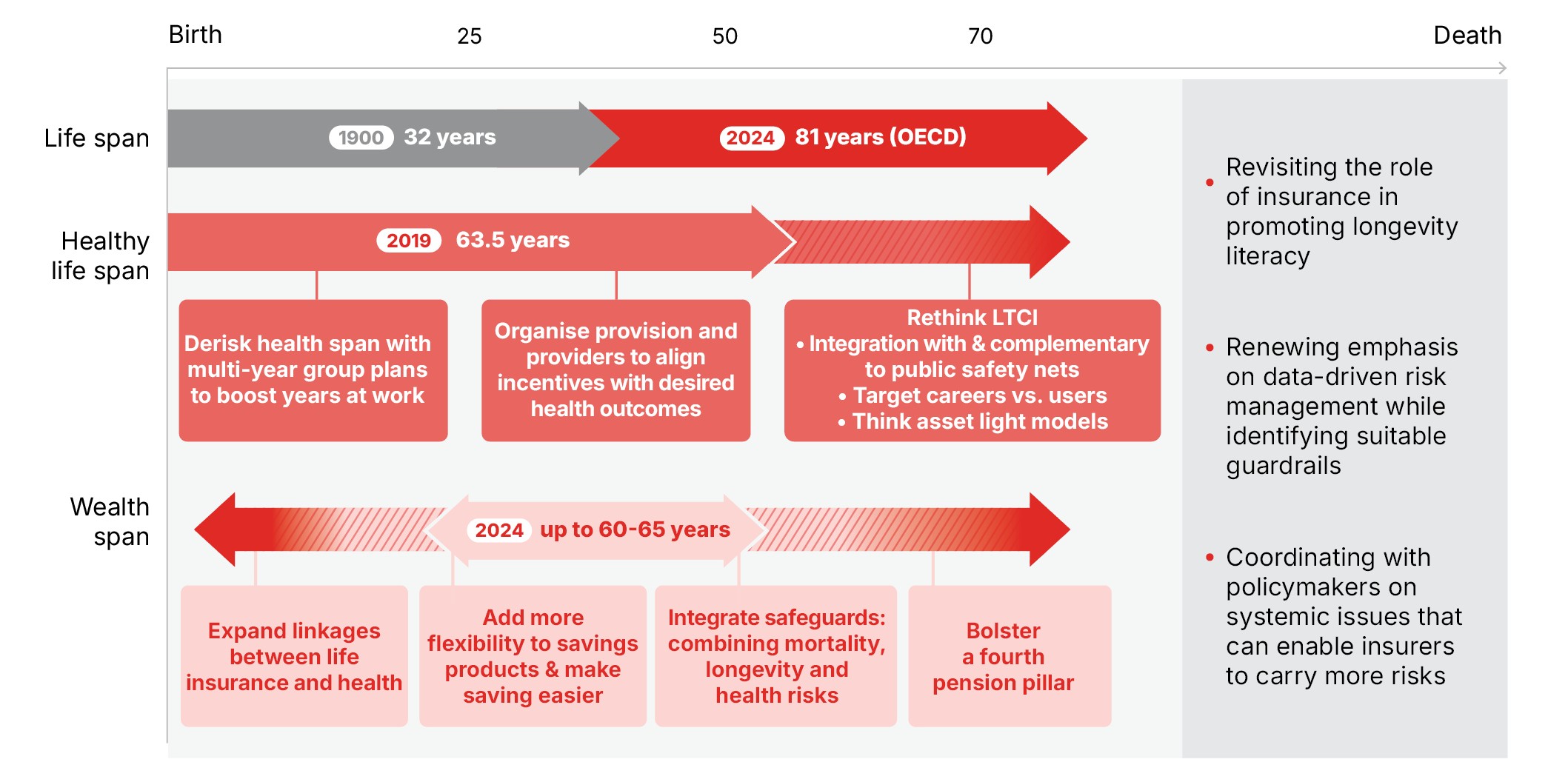
This section outlines ideas for such a future, proposing that more of the same may not lead to success for insurers in a longevity economy. Instead, novel approaches that enable existing and new products to operate at the intersections of life, health, and wealth spans will be required (Figure 11).
"We cannot talk about longevity risk and decumulation without addressing issues with accumulation."
Ed Moncrieffe, HSBC
FIGURE 11: THE INSURANCE-LED LEVERS TO ALIGN LIFE, HEALTH, AND WEALTH SPANS
Source: Geneva Association
When people amass wealth through labour, investments, pension contributions, and other savings, myriad risks – such as untimely death (affecting dependents), incapacity, poor health, and market fluctuations – can impede asset growth. Insurance solutions tailored to address these risks are crucial in ensuring financial stability and protecting both health and wealth spans.
5.1.1 Linking life insurance with healthy behaviours
Term and whole life insurance
These products have long been a cornerstone of financial planning, offering beneficiaries financial security during the asset accumulation phase. This provides dependents with monetary protection in the event of the policyholder’s premature death, ensuring that mortgages or children’s education are paid. Even though mortality continues to serve as the primary trigger for payouts, some life insurers are already expanding their role beyond safeguarding against untimely death. Harnessing medical science and technology advancements, they are mitigating mortality risks by enabling individuals to live healthier lives whilst enhancing their overall capacity to accumulate and decumulate their savings safely. Well-established examples include wearable technology for policyholders, such as fitness trackers, which also promote policyholder engagement.
As technology unearths more data and becomes more affordable, reliable, and prevalent, it also paves the way for more strategic use cases. These may include incorporating personalised health metrics through services such as annual health checks and resultant tailored, technology-based interventions such as glucose monitors, accompanied by lifestyle support for nutrition and a health coach. These measures have significant potential to highlight how life insurance can contribute to longer, healthier lives.
Over time, aggregated health data could also be used to develop more customised and dynamic underwriting and pricing models, allowing for more precise risk assessment and potentially enabling lower premiums for consumers, thereby boosting demand. This may be especially true for some consumers whose risks are not fully understood for a specific cover and/or where it is believed that modern medicine and technology can play an effective role in reducing risks.
Data-enabled customisation can also enable cohorts that would have been otherwise denied coverage.79 Conditional life insurance for people suffering from diabetes is one example.80 By leveraging such innovation and technology, life insurance can become more adaptable to health trends and more relevant for financial planning as chronic and age-related illness increase in prevalence.81 However, high-risk individuals may still be priced out, which could warrant appropriate regulatory guardrails.
Disability
Another major risk to financial stability during the asset accumulation phase is disability, which can disrupt an individual’s ability to earn an income. While disability insurance has traditionally offered income protection, the need to make these policies more accessible and proactive is growing.82
A first important consideration is to identify where demand may have been overlooked to date. Changing working patterns, including the rise of gig economy workers and freelancers, many of whom do not have access to traditional employer-based benefits, underscore the need for more flexible disability insurance products to provide protection during the accumulation phase.
The second consideration is to understand the nature of disabilities and how they are evolving. Disability insurance is particularly important for addressing the increasing prevalence of mental ill health and associated chronic illnesses, which can significantly impair people’s ability to work.83 But indemnifying fallow periods (of no income) alone may not be enough. Proactive steps are needed to restore independence through episodes of illness and recovery, without jeopardising preparations for old age.84
5.1.2 Revisiting savings for greater flexibility and ease
Reimagining annuities
Financial market volatility poses significant risk during the accumulation phase, especially where retirement savings are not guaranteed. Retirement savings vehicles, such as 401(k) plans in the US, are vulnerable to market downturns, particularly as individuals near retirement. One offering that has helped to mitigate such financial market volatility is variable annuities85 with guaranteed minimum benefits, which allow for investment growth while offering downside protection. With interest rates now normalising, there is potential to amplify and further develop such approaches. These products ensure a minimum guaranteed return, regardless of market performance.
"The onus is now on us [insurers] to address unfulfilled demand. Our research from the US demonstrates significant demand for protected income solutions, with 71% of 55 year olds saying they were interested in annuities. This presents a tremendous opportunity to help more people build and strengthen retirement security. With the right planning and strategy to protect their life’s work, we can ensure this generation is well prepared to live not only longer, but better."
Scott Gaul, Prudential Financial
However, insurers would also need to build adequate safeguards against a severe drop in interest rates. Some have argued that this guarantee could even be provided by governments for the fundamental reason that the state can protect against severe financial market risks that cannot be insured through other means.86 Targetdate annuities are also an emerging alternative, where riskier investments are replaced by safer ones as the target retirement date approaches, safeguarding against late-stage market downturns.87,88
More flexible products
As living and working templates change, insurers must figure out how to transition from rigid savings regimes that dictate absolute amounts to be put aside to more flexible products. This may include auto save features like round ups,89 auto escalation, where savings contributions rise automatically annually, or auto rewards that incentivise longer-term savings by providing discounts for grocery, car, or home insurance. Other options may include developing hybrid products with banks that combine credit and savings features, such as cashback, that can go towards pension savings; or savings with integrated insurance features, such as guaranteed one-year sabbatical funding for retraining/upskilling or funeral insurance in countries where this is of great social importance.
But policy consideration will also be crucial. As countries transform from traditional brokerage to advisory,90 there is a danger that understanding of these products and the associated risks may be compromised. Revisiting distribution-related regulatory policy concurrently with product innovation will therefore be key.
In developing countries, potential savers are often deterred by inflexible savings schemes that are ill-suited to their unpredictable cashflow. A paradigm shift is also needed here to replace fixed-sum commitments that often feature in mature markets with percentage-based savings (of income), allowing for weekly or even daily contributions, especially for low-income workers. The majority of these innovative solutions assume a strong digital front end for enrolment and lowered distribution costs that could dramatically simplify uptake, particularly among the young.
"In emerging markets, the credit trap is eroding savings foundations. Dish out financial security in bite-sized, habit-friendly portions. It’s time to align wealthbuilding with people’s daily rhythms, making saving as natural as spending."
Gautam Bhardwaj, pinBox
5.1.3 Derisking health span to boost years in work
As diseases become increasingly chronic and age-related, both insureds and insurers require longer cycles to effectively manage health spans. There is already an emerging trend of multiyear retail health insurance in some countries.91 These are largely aimed at locking in the levels of premiums paid over several years. While these products may appeal to consumers, they can present challenges for insurers if they are not accompanied by reforms to the type of and way in which health services are delivered to policyholders. But if such reforms are embraced, they can become an important vehicle for derisking health spans as a growing number of (chronic) illnesses can no longer be treated within a year. They can even go some way toward helping to tackle global medical inflation by carrying and managing some risks rather than simply repricing them annually.92 Finally, they may provide insurers with the necessary incentives and timeframes needed to invest in a demandand supply-side ecosystem that can proactively support health rather than simply paying for sickness.
"We’re caught in a paradox: short-term insurance cycles versus the longevity economy’s marathon needs. We need to reconsider traditional models of care and insurance to guarantee the sustainability and affordability of health insurance. In this new reality, the cornerstone of prevention must be at the core of the insurance model."
Nils Reich, AXA
"Ditch annual health plans that passively pay; embrace multi-year schemes that actively manage health. Don’t sell ‘five-year insurance’ – market ‘five years of seamless, quality-assured healthcare’..."
Rushika Fernandopulle, Iora Health
(part of One Medical Amazon)
Group health plans (over retail plans) can be a credible and commercially viable vehicle for multiyear health plans. A different vision for them may include transitioning from annual or two-year plans to three-year plans with clear benchmarks that can address the need of employers and employees. These plans can begin to pool heterogenous risks, stratify them by need and cost drivers, target intervention with an emphasis on prevention, and spread costs over time, allowing insurers to demonstrate their value proposition to employers in terms of boosting productivity, ensuring employee well-being, and retaining talent. However, implementing such a product requires confidence that the health risks in question are amenable to change in the timeframe allowed, following an initial assessment of the insured. Evidence suggests that when managed effectively, conditions such as type 2 diabetes can be reversed. Similarly, while the long-term effects of GLP-1 drugs (weight loss injectables) is unknown, right now they have proven to be remarkably effective in reducing obesity, which in turn lowers the risk of diabetes or musculoskeletal conditions. Therefore, multiyear plans, even if relatively short-term initially, have the potential to focus on specific conditions and reduce their prevalence. Concurrently, improved data enables earlier identification of individuals at risk of developing these conditions.
Health insurers increasingly use third-party service providers. These contracts are based on a fee-for-service reimbursement per sickness episode as opposed to reimbursement models that share risk and incentivise providers to manage care and preserve health. Under such a model, insurers have the opportunity to carefully create a constellation of providers who are best able to deliver care and use value-based reimbursements. Key metrics might include higher screening rates, improved cholesterol or blood glucose management, or greater use of standardised diagnostic protocols, such as rationalised approaches to MRI and CT scans, with risks and rewards distributed fairly.
In this context, insurers must also heed the rise of provider groups directly managing health plans for large employers. Already gaining ground in the US, with companies like Firefly93 and Amazon One Medical (formerly Iora)94 leading the charge, these models prioritise service integrated with technology, prevention, and primary care while crafting bespoke risk management systems out of sight – essentially becoming a form of ‘stealth insurers’ for self-funded health plans that are often outside the purview of traditional insurance regulation.95 As such, it is possible that the appeal of seamless managed care for employee pools may lure large employers away from traditional group health insurance models. But joining forces with these market-shaping models96 also presents opportunities for innovative risk-reward sharing partnerships with service providers.
Once individuals begin drawing on their accumulated savings they face key risks include longevity risk – the possibility of outliving one’s savings – and the need for long-term care.97 This was validated by the literature review and the survey conducted for this report, which shows significant appetite for long-term care insurance, making it imperative for insurers to not only address wealth accumulation but guide individuals through what could be a complex decumulation phase.
5.2.1 Integrated safeguards: Combining mortality, longevity, and health risks
Insurers can further augment their customisable annuities that combine a varied mix of protection, income, and services.
5.2.2 Rethinking long-term care insurance
Traditional long-term care products have faced challenges, including high premiums and limited consumer uptake, in part due to reliance on public safety nets where they exist.105
Private markets struggle with long-term care, but public policy remains undefined. Expecting innovation without clear roles is a misnomer. We need policymakers to draw the boundaries before the private sector can effectively build solutions.
Adelina Comas-Herrera, London School of Economics
Public-private solutions
Long-term care insurance theoretically defies the law of insurance, as the need for it is almost certain, but the timing is not. As a result, insurers face three key challenges: 1) pricing difficulties due to the unpredictable ‘longevity of dependence’; 2) misalignment between when people buy long-term care insurance (often in their 50s) versus when they should (much earlier); and 3) the fact that long-term care insurance is sold rather than bought in non-mandatory contexts due to competition with more immediate priorities. A pure private solution therefore seems doubtful but there remains scope for innovative public-private partnerships.
For instance, integrating long-term care savings across firstand second-pillar pensions would not only help to compel savings but also raise public awareness of the issues at hand. Privately funded long-term care insurance or a deferred annuity could then be used to supplement additional costs. For instance, whilst people may live three years in dependence on average, voluntary insurance could cover up to a certain amount for additional years and take on the expensive tail-end risks.106 However, aligning this with public financing would be critical to ensure effectiveness and adequacy of protection where treatment and care costs are likely to be at their peak.
New marketing strategies
It may also be timely for insurers to rethink marketing strategies for long-term care insurance. Instead of targeting those already needing long-term care – and risking adverse selection – focus could be given earlier to carers and children to boost adoption. This approach could resonate with those facing growing caregiving responsibilities and financial strains that threaten their future inheritances. This not only addresses the cultural value of preserving family assets but also the practical realities of changing family structures and gender roles that are reshaping caregiving patterns globally. Whilst these products would need to address the practical implications of underwriting policies based on beneficiaries’ risks (rather than their carers, who the products are targeted at), if successful they could begin to bridge the substantial protection gap for long-term care and address the risk of impoverishment or a dual burden of work for caregivers.
We’re flipping the script on longevity planning for the 35–40 crowd. By offering financial products with elder care value-added services that can be offered to their parents, we’re making the distant future tangible today. It’s not just about their retirement anymore – it’s about safeguarding their parents’ golden years. Suddenly, longevity isn’t a far-off concept; it’s a present reality they can invest in and see the benefits of right now.
Sanjeev Kapur, MetLife
Long-term care insurance: Some actuarial and regulatory considerations
Modelling long-term care risk requires astute actuarial judgement and medical underwriting capabilities as it is a multi-dimensional risk combining inflation, expense, market, distribution, and biometric risks.
The main biometric risk drivers are: (a) the longevity of an insured (i.e. mortality by age and cohort) to ensure that sufficient premiums are collected, (b) the incidence risk of an insured to become dependent and to which degree based on the underlying definitions of dependency (usually per age), and (c) the probabilities of an insured staying dependent in the same degree or experiencing a deterioration and for how long.
Non-biometric risks to be considered, depending on the insurance product features, include indexation of the benefits to reflect inflation, the risk of the insured lapsing/surrendering the policies, and the risk of distribution channels not complying with their fiduciary duty at the point of sale. Finally, as long-term care products usually last for decades, the adequacy between asset returns and technical interest rate are critical and should be stress-tested.
Contributed by Christophe Heck, Swiss Re
A whole new approach
Making long-term care insurance affordable now demands a bold shift away from costly, institutionalised care settings such as hospitals and care homes where people experience a rapid deconditioning.107 Instead, the future of long-term care insurance could be in embracing asset-light approaches (fewer clinical institutions and more at-homeand community-based care) and technology that preserve consumer independence through a blend of assets, protection, prevention, and services.
Insurers can also play a significant role in promoting healthy, independent ageing through housing solutions. This could include investing in assisted living and inclusive housing models, especially as private housing in its traditional sense (often used to fund long-term care) becomes unaffordable and increasingly out of reach for many.
For example, co-housing communities are designed to meet the needs of ageing populations by fostering community living, providing accessible housing, and offering social and health services. The Senboku Hottokenai Network Project in Japan is a budding example, turning vacant buildings and dwindling neighbourhoods into thriving, age-friendly communities.108 Another example is the UK’s Belong Villages, premised on a household model that provides intergenerational experiences (mixed with kindergarten facilities), with emphasis on social connectedness as well as care.109
Insurers (including property and casualty insurers) can support these models through investments, innovative funding mechanisms with governments as well as partnerships with healthcare providers, housing developers, and mobility and hospitality companies. This, in turn, may help reduce reliance on expensive long-term institutional care.110
Long-term care insurance may also benefit from greater adoption of technology-aided prevention of risks from geriatric syndromes. These include frailty-induced falls, urinary incontinence and infections, and pressure ulcers resulting from immobility,111 which are some of the leading causes of hospitalisation among the elderly. While typical measures like activities of daily living help assess baseline risk factors, insurers could go a step further and upstream. They might offer a safer home environment through remote monitoring devices, retrofitting bathrooms and staircases, installing handrails, and providing alarms and interactive home appliances to support ageing in place.112 Such measures enable insurers to think of more comprehensive solutions for long-term care (as opposed to institutional care) through innovative partnerships with providers. Such an approach could not only enhance physical resilience but also address social connectedness by leaving people in surroundings they value, potentially mitigating the adverse effects of loneliness.113
5.2.3 Bolstering a fourth pillar
Kahneman and Tversky argue that when governments establish ages as references for retirement, workers perceive them as normal and tend to adhere to avoid the psychological discomfort of deviating from this norm.114 However, as age structures in society begin to shift, these reference points have knock-on effects. An ageing workforce comes with pertinent considerations for employers regarding talent retention. And employees need to boost understanding of ways in which to navigate the transition from saving to dissaving, given the need to fund, on average, an additional 20 years of life. For the majority of the global workforce, this would mean a form of continuous employment, ideally with pride, purpose, and joy.
Governments are beginning to trial innovative approaches to pension reforms for keeping people in the workforce beyond the notional retirement age. Singapore offers valuable lessons with its Senior Employment Credit Programme,115 which incentivises employers to hire individuals over the age of 60. Additionally, the country offers part-time re-employment grants to retain talent through flexible work arrangements, as well as retraining grants for those aged over 40.116 These initiatives have yielded impressive results, with increases in the employment rate of those aged between 65 and 69 (47%) and 55 and 64 (70%), thereby boosting accumulation which would have otherwise ended prematurely.117
The Geneva Association previously explored the idea of a fourth pension pillar, in which people would continue to accumulate while in part-time retirement, challenging the bifurcation of accumulation and decumulation.118 As new working patterns emerge and are strongly supported by policy, there remains scope for insurers to envision what savings vehicles at this stage might look like to enable a gradual end-of-career transition.
Insurers could aid corporate clients in analysing workforce demographics and retirement readiness, highlighting the potential impact on productivity – especially as relying solely on younger talent becomes increasingly unrealistic, not to mention discriminatory. Any comprehensive retirement readiness assessments could extend beyond financial metrics, encompassing psychological factors such as sense of purpose, social connectivity, and health. Such holistic evaluations may encourage extended careers, prompting employers to implement flexible working arrangements, and reskilling and upskilling programmes not out of benevolence, but because they make commercial sense.119
This report has delineated several avenues through which insurers can progress towards a more cohesive approach to ‘wealth’, ‘health’, ‘accumulation’ and ‘decumulation’. However, these options raise salient considerations regarding public policy and regulation. Whilst these topics warrant dedicated research, it would be remiss not to highlight three areas deserving particular attention.
5.3.1 Insurers’ role in longevity literacy
Some of our survey findings reinforce a stark reality – people woefully underestimate the complexities of longterm financial planning. Yet, addressing this issue has been far from straightforward. While auto-enrolment pension schemes in Italy, New Zealand, the UK, and the US have thrust certain aspects onto people’s radar and bolstered protection,120 savings adequacy remains problematic.121
Independent financial advice in its traditional sense remains a luxury for the privileged. The advice landscape is also a battleground of vested interests, including employers, asset managers, insurers, financial advisers, ‘finfluencers’ (social media figures providing financial advice), and other open digital sources.122 While the emergence of the latter two has to an extent certainly helped to democratise financial advice, data on levels of literacy is nonetheless sobering with most consumers navigating solo, unable to access nuanced strategies that speak to their personal circumstances, such as ‘maximise accumulation by X, defer withdrawal until Y’. Recent data from the US shows that levels of financial literacy have been stagnant for the past eight years.123 Only 18% of EU citizens demonstrate a high level of financial literacy.124 In the UK, 70% of people who accessed their pension for the first time did so without any advice in 2022/23.125
Policy action is needed to improve financial literacy and facilitate insurers’ crucial role in providing optimal advice and combating underinsurance. Whilst recent European and Australian measures curtailing commissions from financial planning advice may help to curb mis-selling and elevate standards,126,127 they fall short of tackling the substantial risks of under-planning stemming from an ineffective advice landscape for the broader population. In other words, insurance and regulatory communities need a renewed and constructive dialogue about the consequences of regulation for peoples’ financial literacy and well-being.
5.3.2 Revisiting the use of data in insurance
Public policy on data regulation significantly influences insurance product development. Health data in particular is a double-edged sword – it can enhance outcomes through targeted interventions, but it may also compromise access to protection as more risks are identified. Population-based genetic screening programmes in Australia for cancers128 and newborn screening programmes in Minnesota in the US129 are examples where these interventions can unearth new health risks before they even manifest. But they may also compromise access to protection in the long run. Such genetic advancements can now also identify risks for conditions without solutions, which poses ethical challenges. Understandably, most regulators therefore take a prudent approach to insurers’ use of data.130
The sustainability of insurance as a risk management vehicle may be threatened as information asymmetry grows between consumers and payers due to the proliferation of B2C medical technology and diagnostics products. There is thus an urgent need to renew policy dialogues with measured intervention and guardrails to make personalisation of insurance a meaningful reality. Insurers may advocate a balanced use of data for underwriting and service customisation based on needs.
Beyond genetic data considerations, intelligent pooling of large datasets (aided by AI) can be leveraged to enable a transition to dynamic underwriting across life and health insurance. For instance, adjusting premiums based on behaviours can allow for more personalised pricing, giving individuals a clear incentive to lower risk factors they can influence. However, these can be sensitive topics, with insurers risking accusations of discriminatory practices. Moreover, when mapped against existing data privacy regulation in many countries, the implementation of such a model can face myriad challenges. As such, moving in this direction is not only an operational consideration but also requires a thorough assessment of data protection laws and policy dialogue to ensure proportionality, which is critical for insurers to manage longevity outcomes more effectively and sustainably.
5.3.3 Coordination with public policymakers
Survey responses underscore the significant role people want insurers to play in enabling them to lead longer, healthier lives with adequate wealth and protection. However, the prevalent policy environment is not entirely conducive to insurers taking on the kinds of emerging longevity and health risks identified in this report.131
Like governments, life and health insurers are grappling with the challenges posed by the rise in life expectancy. Such aggregate longevity risks can neither be easily diversified across policyholders, nor can they be perfectly hedged by selling mortality protection products. Instead, insurers must hold capital to cover the potential for unexpected losses, which is costly.
The global pension protection gap is estimated at an extraordinary USD 1 trillion annually. As public policymakers look to the private sector to take on additional longevity and health risks, this requires regulatory policy frameworks that attract additional capital resources to back innovative annuities, guaranteed return savings and health insurance products. Achieving this, however, will be a delicate balancing act: promoting broader societal objectives of optimal risk protection for individuals while developing insurance-specific regulations that promote financial stability and consumer protection.
Insurers have a critical role to play in augmenting public safety nets. This calls for dialogue between insurers and policymakers at both the national and international levels and on key topics such as solvency capital standards, taxation, social care provision, and public-private insurance solutions. Coordinated efforts in these areas are essential to harmonise life, health, and wealth spans, ensuring sustainable outcomes for individuals and societies.
This report is a modest exploration of the vast topic of longevity. It highlights how demographic shifts are reshaping and will continue to reshape individuals’ health outcomes and financial trajectories. Central to this is the concept of health or biological age, which is much more significant in determining how effectively people accumulate and deplete their personal assets than chronological age.
The report highlights significant opportunities for insurers to enhance their relevance by adopting innovative approaches to products and services. The unfolding reality is that all stakeholders, including insurers, must chart a new vision for longevity.
Measuring the growth of the longevity economy through increased sales of adult nappies offers a bleak and reductive perspective. Yet clinging to the status quo could lead us to such an undesirable endpoint. Similarly, while the Boomer generation has been able to enjoy old-age cruise tours and travel insurance post-retirement, these benchmarks may soon become irrelevant as future generations face markedly different socio-economic circumstances. The real opportunity now lies in identifying a sustainable middle ground.
While uncertainties persist, they should serve as catalysts for action and experimentation. By harnessing the power of technology, fostering creativity, and building strong partnerships, insurers can transcend the arbitrary constraints of chronological age. And with a century’s worth of wisdom on managing longevity risks, they are uniquely positioned to spearhead this transformation. We hope that this report offers meaningful insights to support the insurance industry’s continued evolution in this critical context.
Geneva Association 2012b.
Geneva Association 2023.
Pitacco 2021.
Scott 2024.
Standard Life 2023.
Szweda-Lewandowska 2019.
WHO.