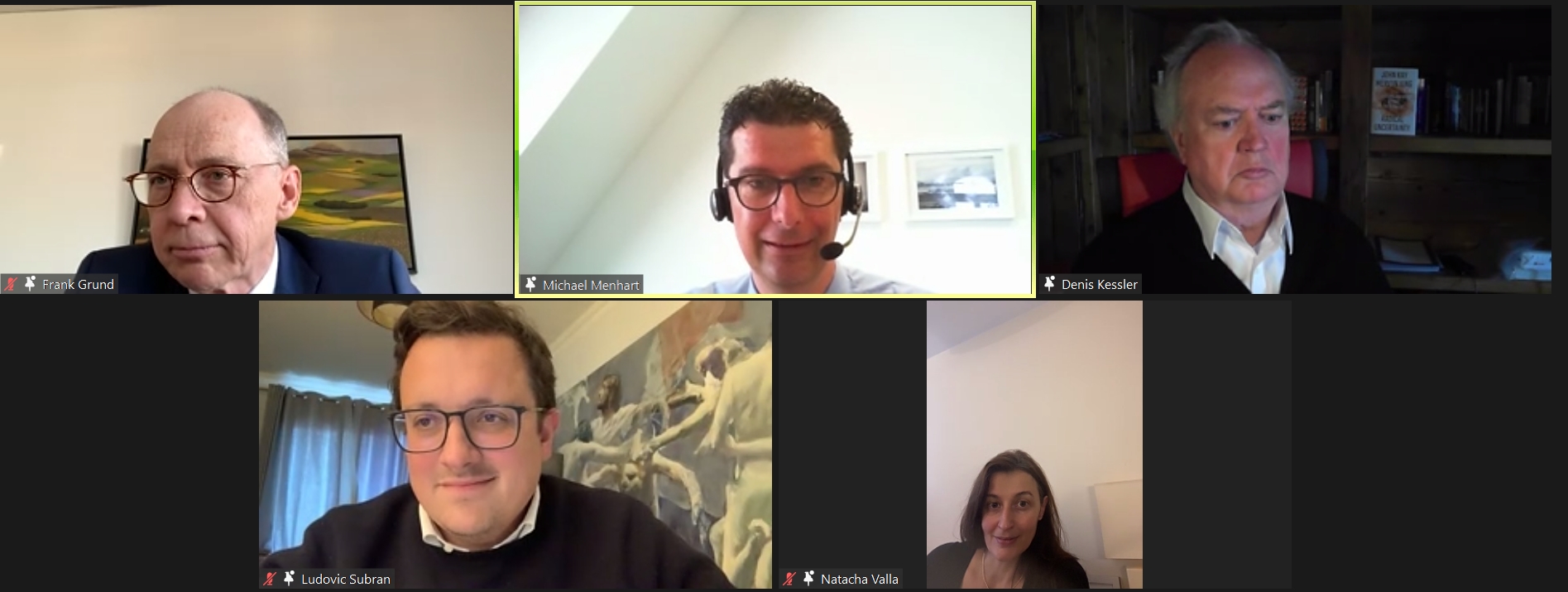
(Top) Frank Grund, Chief Executive Director, Insurance and Pension Funds Supervision, BaFin; Michael Menhart, Head of Economics, Sustainability and Public Affairs, Munich Re; Denis Kessler, Chairman, SCOR. (Bottom) Ludovic Subran, Chief Economist, Allianz; Natacha Valla, Dean, Sciences Po School of Management and Innovation.
With negative interest rates, inflated balance sheets and potentially lower growth, it is difficult for central banks to increase interest rates. ‘War economics’ coupled with volatile energy and commodity prices make modelling inflation difficult. Panellists expected inflation in Europe to be persistent at between 5% and 9% this year. Considering countries’ and corporates’ high state of indebtedness, high inflation may not necessarily be negative for everyone. Although the insurance sector is robust, the effect of the geopolitical crisis will vary depending on the business line. In life insurance, massive surrenders are unlikely, not least as many policies are unit-linked.
The trigger point for central banks to start raising rates is the biggest open question. They have listened to the markets for too long, making it difficult to act today. However, remaining inactive is not an option as this will negatively affect central banks’ credibility. The panel concluded that, to avoid a combination of low growth and high inflation (‘stagflation’) or even a depression, with lasting negative growth, policy mistakes need to be avoided. The longer central banks wait, the steeper the interest rate increase will need to be. To positively impact insurers, at least 100 basis points are needed in Europe and 250 in the U.S. Even this, however, will not lead to a return of products with high guaranteed yields.