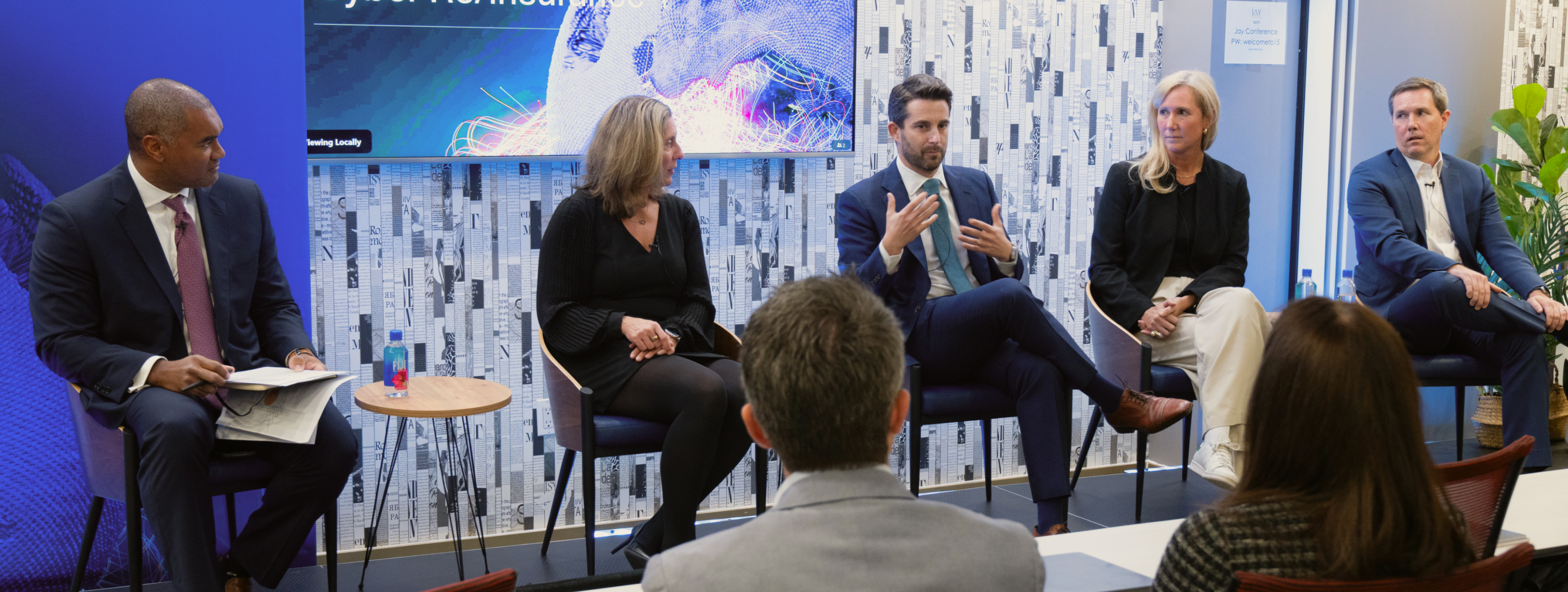
Simon DeJung, AXIS; Aidan Flynn, Beazley; Tom Johannesmeyer, University of Kent, Canterbury; Institute of Cyber Security for Society (iCSS); John Kelly, Envelop Risk Analytics; Joanna Syroka, Fermat Capital Management; Josephine Wolff, Tufts University
This session explored how to facilitate the transfer of catastrophic cyber risks to balance sheets best able to absorb them and examined institutional innovations that could overcome related challenges. There are gaps in market capacity for extreme cyber losses, and it is difficult to model and underwrite systemic cyber risks, such as nation-state attacks, critical infrastructure failures or widespread internet outages. Quantifying and pricing such risks is complex, and there is limited appetite for covering them in traditional re/insurance markets, particularly without governmental backstops or further innovation in risk-sharing mechanisms.
Reinsurance and ILS have a role to play in absorbing large-scale risks, with some stakeholders advocating for broader adoption of non-proportional (i.e. excess-of-loss) reinsurance solutions. However, a lack of industry consensus on event definitions, such as cyber war and critical infrastructure failure, and on the implications of policy exclusions hinders market growth.
Government backstops are part of a potential solution, though there are differing views on whether such intervention would stifle innovation or provide the necessary confidence among re/insurers to expand capacity. Examples from other lines of insurance, like terrorism or natural catastrophes, were referenced to illustrate possible frameworks for collaboration between the public and private sectors. It is important to foster greater market maturity and improve modelling capabilities to better understand catastrophic cyber events.
Overall, balanced approaches that enable risk sharing without discouraging innovation or creating unintended gaps in coverage are needed.