
Climate Change & Environment
The Geneva Association. 2024.
Bringing Climate Tech to Market: The powerful role of insurance.
Author: Maryam Golnaraghi. April.
Maryam Golnaraghi, Director Climate Change & Environment, The Geneva Association
Meeting global climate targets requires industries to adopt a range of new technologies and processes that accelerate their decarbonisation. Substantial efforts are underway to expedite the decarbonisation of heavy industries, such as steel, aluminium and aviation, which contribute to over 30% of global carbon emissions. As climate risks intensify and the window to cap global warming at 1.5°C above pre-industrial levels closes, the need to accelerate the deployment of climate technologies widely and at scale is becoming more acute.
Though significant progress has been made in developing innovative climate technologies, most remain in the pre-commercialisation stages. Reasons for this include huge funding gaps, challenges with scaling and scarcity of data on the risks.
Huge amounts of funding need to be deployed annually towards financing climate tech innovation and demonstration. But financing pilot projects from the demonstration and early deployment stages is capital and risk intensive. It is at this stage – the ‘Valley of Death’ – that many potentially viable technologies die and never make it to market. Closing this gap will require massive amounts of private capital; relying solely on public capital will not be sufficient.
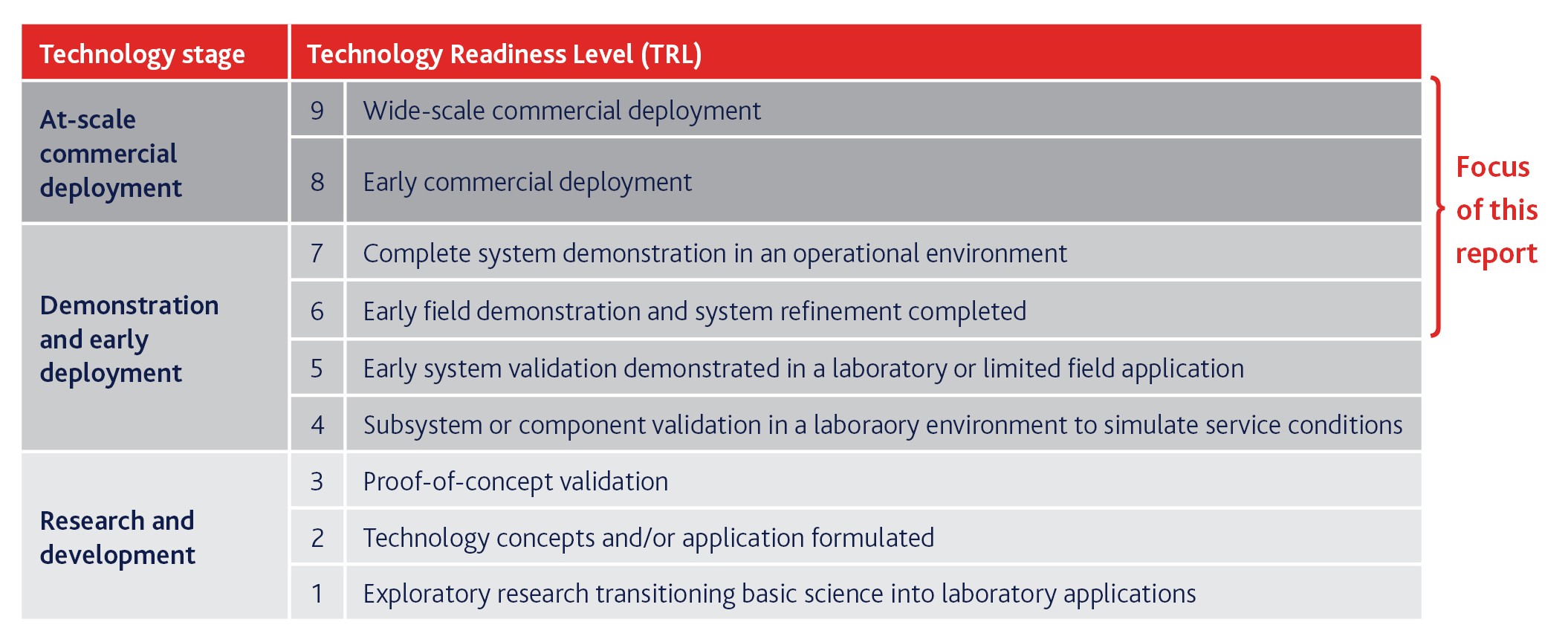
Demonstrating and deploying emerging technologies at scale will also require new ways of doing business as well as changes to traditional commercialisation pathways – specifically, the Technology Readiness Level (TRL) framework (Figure 1), which does not capture many risks that hinder the market readiness of climate tech. Strong cross-sectoral collaboration will be needed to assess and manage risks from very early phases of projects to attract investors, expedite execution and achieve scale.
FIGURE 1: THE TRADITIONAL TECHNOLOGY READINESS LEVEL FRAMEWORK AND VALLEY OF DEATH
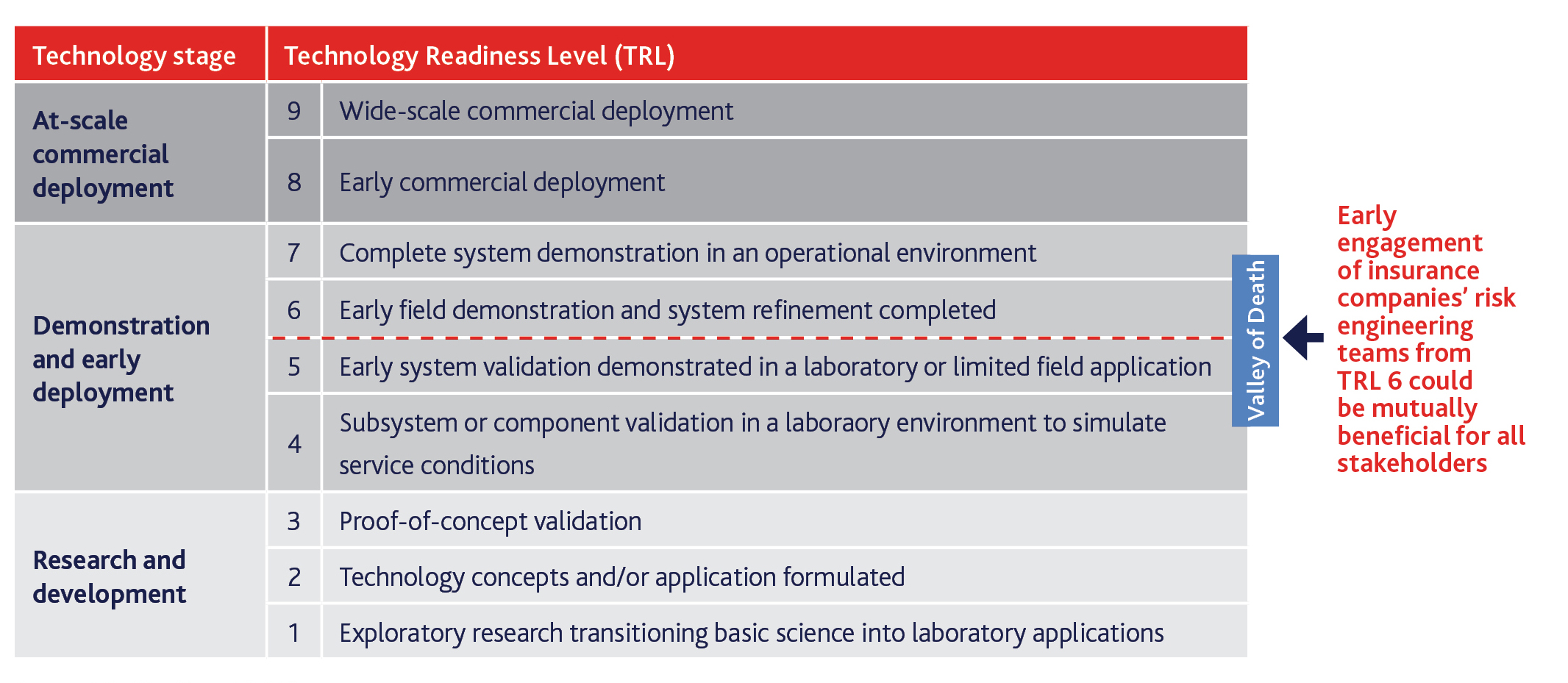
Source: Modified from NASA1
Re/insurers can play a key role in helping to accelerate the deployment of climate tech through the provision of risk engineering services. A Geneva Association survey of insurance C-level executives indicated that early engagement of re/insurers in climate tech projects – from the demonstration and early deployment stages – is critical.
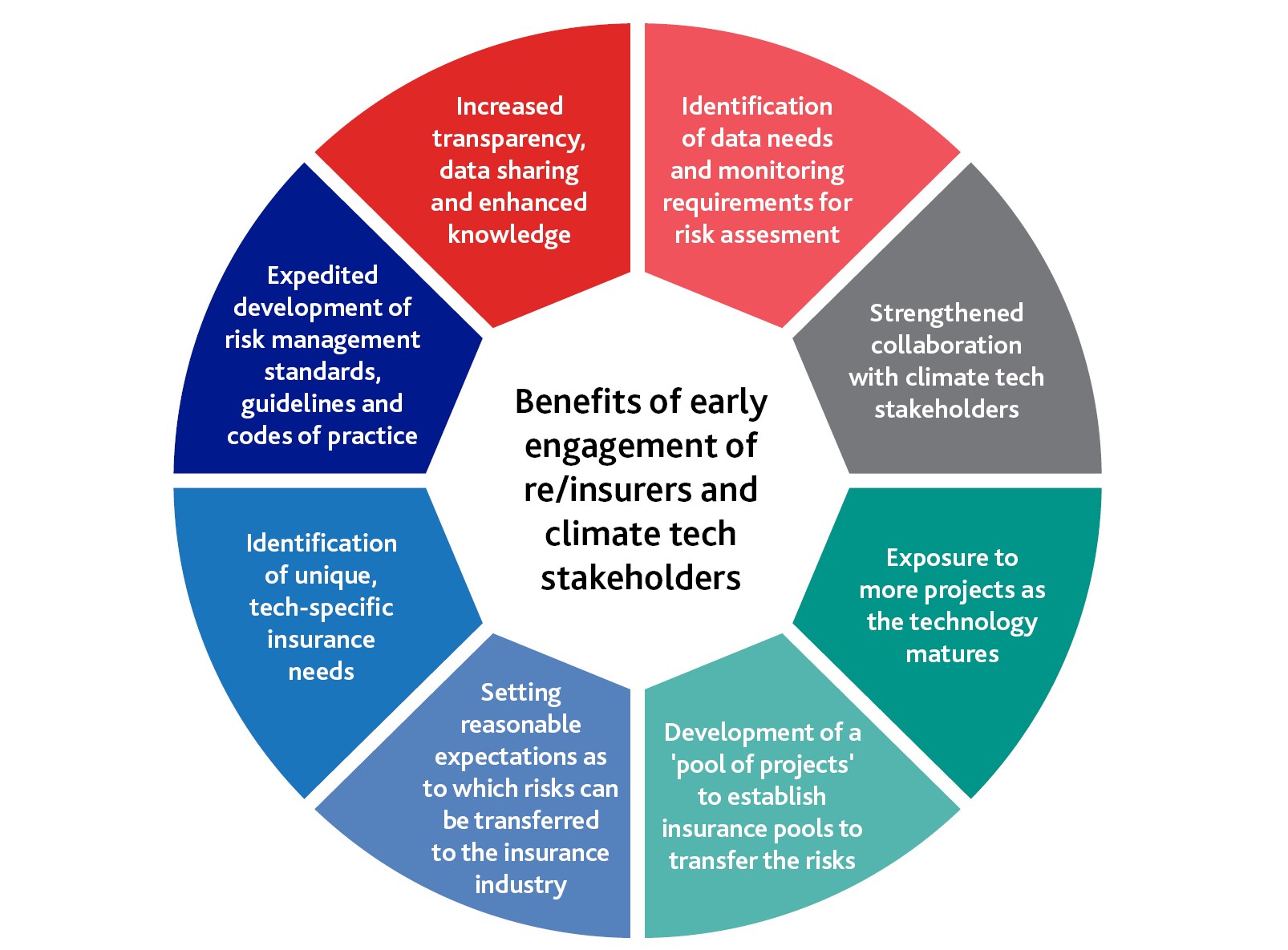
At the industry level, this would enhance data sharing and allow re/insurers to increase their knowledge in this space; facilitate the identification of data needs and monitoring requirements for risk assessment; strengthen collaboration between re/insurers and climate tech stakeholders; give re/insurers exposure to more projects as technologies mature; allow the development of ‘pools of projects’ for better risk transfer and spreading; help with the identification of tech-specific insurance needs for product innovation; and expedite the development of risk management standards, guidelines and codes of practice.
At the project level, very early engagement of re/insurers would ensure that risks are considered, assessed and managed more holistically to enhance the project’s insurability and potentially shorten the due diligence period for obtaining insurance. By getting involved before the project site is selected and approved, re/insurers can provide important feedback on decisions such as where and how to build facilities and what risk mitigation strategies to consider to maximise insurability against extreme weather events.
TABLE 1: ADOPTION READINESS LEVEL FRAMEWORK WITH INSURANCE INCLUDED AS A KEY ELEMENT
Value proposition | Market acceptance | Resource maturity | License to operate |
|---|---|---|---|
1. Delivered cost 2. Functional performance 3. Ease of use/complexity | 4. Demand maturity/market openness 5. Market size 6. Downstream value chain | 7. Capital flow and availability 8. Project development, integration and management 9. Infrastructure 10. Manufacturing & supply chain 11. Materials sourcing 12. Workforce | 13. Regulatory environment 14. Policy environment 15. Permitting & siting 16. Environmental & safety 17. Community perception |
| 18. Insurability and availability of affordable insurance Risks associated with the lack of data and technical capacity to identify, frame and assess risks of new climate technologies and related insurability conditions; delays with the development of risk management frameworks, standards and codes of practice for project replication; addressing unique insurance needs on a techby-tech basis which could delay scaling; and the development and availability of a full range of insurance solutions to meet financing and market needs. |
Source: Modified from U.S. DoE2
Efforts are underway to enhance approaches to climate tech financing and deployment:
Affordable insurance solutions are essential for getting climate technologies market ready, securing financing and managing project liabilities. Assessing the insurability conditions and developing insurance solutions for new climate technologies is complex and time consuming. Greater risk sharing among stakeholders in the early stages could lead to the development of structured risk management solutions and better risk allocation among parties based on risk appetite and ability to bear risk, thereby attracting more capital and ensuring optimal risk financing. As technologies mature, deployment increases and standards are developed, insurability will increase, allowing insurers to take a greater share of the overall risk pool. Specific risks may not be insurable through the commercial insurance market and may require other interventions.
To help view the risks of climate tech projects from an insurance perspective, The Geneva Association developed a novel ‘Insurability Readiness Framework’ (IRF) through multi-stakeholder collaborations. The IRF breaks down risks into seven insurance-relevant categories and demonstrates how they relate to risks identified in the ARL framework (Table 1). These categories are: 1) technology risk; 2) project information and organisation risk; 3) legal, finance and compliance risk; 4) location-specific physical climate risks; 5) business interruption and supply chain risk; 6) long-term risk; and 7) environmental, social and governance risk.
For each of the seven categories, the IRF specifies key issues that need to be considered by climate tech stakeholders when framing risks in their dialogue with re/insurers as well as in the information project developers compile for risk and insurability assessment.
At the strategic level, the IRF will enable more informed conversations among climate tech stakeholders and re/insurers and help identify the most challenging risks from an insurability perspective. It can also help to pinpoint risks that may be uninsurable from a commercial insurance market perspective and therefore require different interventions, such as public-private partnerships or government backstops.
At the project level, transparency around insurance requirements will enable climate tech project developers, their partners and investors to identify and address project risks in a more targeted way to ensure that insurance considerations and risk mitigation strategies are reflected in project design.
U.S. DoE 2023.
Accelerating the commercialisation of climate technologies to decarbonise industries over the next decade will require new ways of doing business. Demonstrating and deploying these emerging technologies at scale is capital intensive and comes with many challenges and risks. Strong cross-sectoral collaboration will be required to develop innovative risk management measures to improve insurability, design appropriate insurance solutions and unlock the needed capital. The task will be complex and will necessitate changes to traditional commercialisation pathways and financing frameworks.
To explore the role re/insurers can play, The Geneva Association launched a two-part research series on climate tech and insurance. The first report in the series describes the climate tech commercialisation landscape and related challenges. It also offers perspectives from key stakeholders and insurance C-level executives on the benefits of and difficulties with engaging re/insurers in climate tech commercialisation. A lack of mechanisms to bring re/insurers and other key stakeholders together, profitability concerns and the limited number of projects available were found to hinder their early engagement in projects.
This second report examines the changes that need to be made to traditional approaches to developing and financing emerging technologies for climate tech and focuses on the importance of insurability and the development of affordable insurance solutions for market readiness. It makes clear the benefits of engaging P&C re/insures from the pre-commercialisation stages of projects to frame risks and develop risk management strategies. The report also offers a novel ‘Insurability Readiness Framework’ to help climate tech stakeholders pinpoint specific areas of projects that pose problems from an insurance perspective.
Key findings
The report offers recommendations for stakeholders including insurers, investors, climate tech associations and developers, and governments on how they can leverage these findings to help expedite the commercialisation and at-scale deployment of climate technologies.
The 28th United Nations Conference of Parties (COP28), held in Dubai in December 2023, stressed again that limiting global warming to 1.5oC requires reducing greenhouse gas (GHG) emissions by 43% by 2030 and 60% by 2035 – relative to 2019 levels – with the goal of reaching net zero by 2050.1 The conference ended with the release of a climate deal, referred to as ‘The UAE Consensus’, which explicitly calls for transitioning away from fossil fuels, tripling renewable energy capacity globally and accelerating zeroand low-emission technologies for the decarbonisation of industrial sectors with heavy GHG emissions by 2030.2 Decarbonisation is highly capital intensive, with an estimated USD 7–9.2 trillion annual investment gap between now and 2050.3
In 2022, The Geneva Association (GA) launched a multi-stakeholder, two-part research project, Accelerating Climate Technologies for Industrial Decarbonisation and the Insurance Industry, to explore how re/insurers can help accelerate the deployment of new climate technologies for adoption by ‘hard-to-abate’ sectors – the steel, cement, aluminium, chemicals, aviation, trucking and shipping industries – which account for over 30% of global GHG emissions.4,5
The first report examines the climate tech commercialisation landscape and traditional approaches to developing new technologies based on the Technology Readiness Level (TRL) framework (Figure 1)6. It highlights major barriers to expediting climate tech commercialisation – including huge funding gaps, technical challenges with scaling and market readiness, and scarcity of data on the risks – and presented perspectives of C-level insurance executives on the topic.7 It stressed that new ways of doing business will be needed to expedite climate tech financing and market readiness, which will require stronger cross-sectoral collaboration among stakeholders in the climate tech ecosystem. The report concludes that re/insurers can play a pivotal role in their capacity as risk engineers and underwriters, but that they need to get involved in projects from much earlier stages. Currently, however, mechanisms to bring this about do not exist. Further, there is a lack of awareness among climate tech stakeholders of what re/insurers can offer and how insurance solutions could help unlock financing for projects and impact market readiness.
This second report:
Section 2 takes a deeper look at existing frameworks and how they may be modified to gain a more holistic view of the risks associated with climate technologies, as well as the implications for insurability and the development of insurance solutions. Section 3 examines the insurability issues associated with new climate technologies. Section 4 highlights the benefits of engaging re/insurers in climate tech projects from the pre-commercialisation (demonstration and early deployment stages) phases. The IRF is presented in section 5 along with the results of its application to two technologies. Section 6 offers concluding remarks, highlights remaining issues and suggests recommendations for the way forward.
A significant portion of the estimated USD 7–9.2 trillion annual investment gap to fund the transition of the global economy by 2050 needs to be mobilised towards the development, demonstration and at-scale commercial deployment of emerging climate technologies.8 Massive amounts of public and private capital will need to be raised through financial institutions, but institutional investors and banks are reluctant to fund these technologies.9 Reasons for this include the complex risk profile of projects; low risk appetite from investors due to their limited resources and expertise in this area; financial regulatory constraints, such as high cost of capital for investing in risky projects; an inconducive public policy and regulatory environment; limited accessibility to investable-grade projects; and investors’ commitment to fiduciary responsibility.10
Cross-sectoral collaboration to identify, understand and manage the risks will be central to mobilising capital and expediting climate tech market readiness. These solutions could also have a material impact on the cost of capital for borrowers and enhance risk-adjusted returns for investors. This section will take a deeper look at frameworks that are currently used for the development of new climate technologies and examine the collaborations needed to develop proactive risk management solutions.
The TRL framework (Figure 1) has been used as the main framework for assessing the evolution of the maturity of a new technology from laboratory research (TRL 1) to widescale commercial deployment (TRL 9).11 It has helped to align discussions between innovators, entrepreneurs, project developers and investors on issues such as technological performance and safety risks, which need to be addressed through pilots and scaled projects before operational deployment.
However, the TRL framework does not address a number of factors that contribute to a technology’s market readiness; for example, market demand, equipment manufacturing and supply chain issues, availability of a sufficiently skilled workforce, or the public policy and regulatory environment. These factors, if not dealt with from the pre-commercialisation stages, could significantly delay or compromise the at-scale commercial deployment of climate technologies. Solar and wind power (onshore and offshore) technologies, for example, took over four decades to commercialise12 but have still not realised their full market potential due to manufacturing and supply chain issues, project developers’ or offtakers' credit risk, and long permitting processes.
FIGURE 1: TECHNOLOGY READINESS LEVEL FRAMEWORK
Source: NASA13
Furthermore, first-of-a-kind (FOAK)14 pilots and early commercialisation projects are capital intensive, complex and involve many stakeholders, such as project owners and developers, Engineering, Procurement and Construction Companies (EPCs), suppliers, contractors and offtakers.15 Traditional growth venture capital financing is no longer sufficient for funding and scaling these new technologies. Project finance is increasingly being utilised for the development and deployment of newer climate technologies. While more prominently used in TRL 8 (early commercial-scale projects) to TRL 9 (wide-scale commercial deployment projects), it is occasionally being used for FOAK to nth-of-a-kind (NOAK) pilot projects in TRL 7.16
The emergence of project finance in this space is helping to facilitate discussions among key stakeholders and opening up further channels for financing these projects.17
The Adoption Readiness Level (ARL) framework (Table 1, risks 1–17) was developed to complement the TRL framework, to allow climate tech stakeholders to assess the market readiness of emerging climate technologies. It was released by the U.S. Department of Energy (DoE) in 2023 for consultations and introduced 17 risk types under the following four categories:
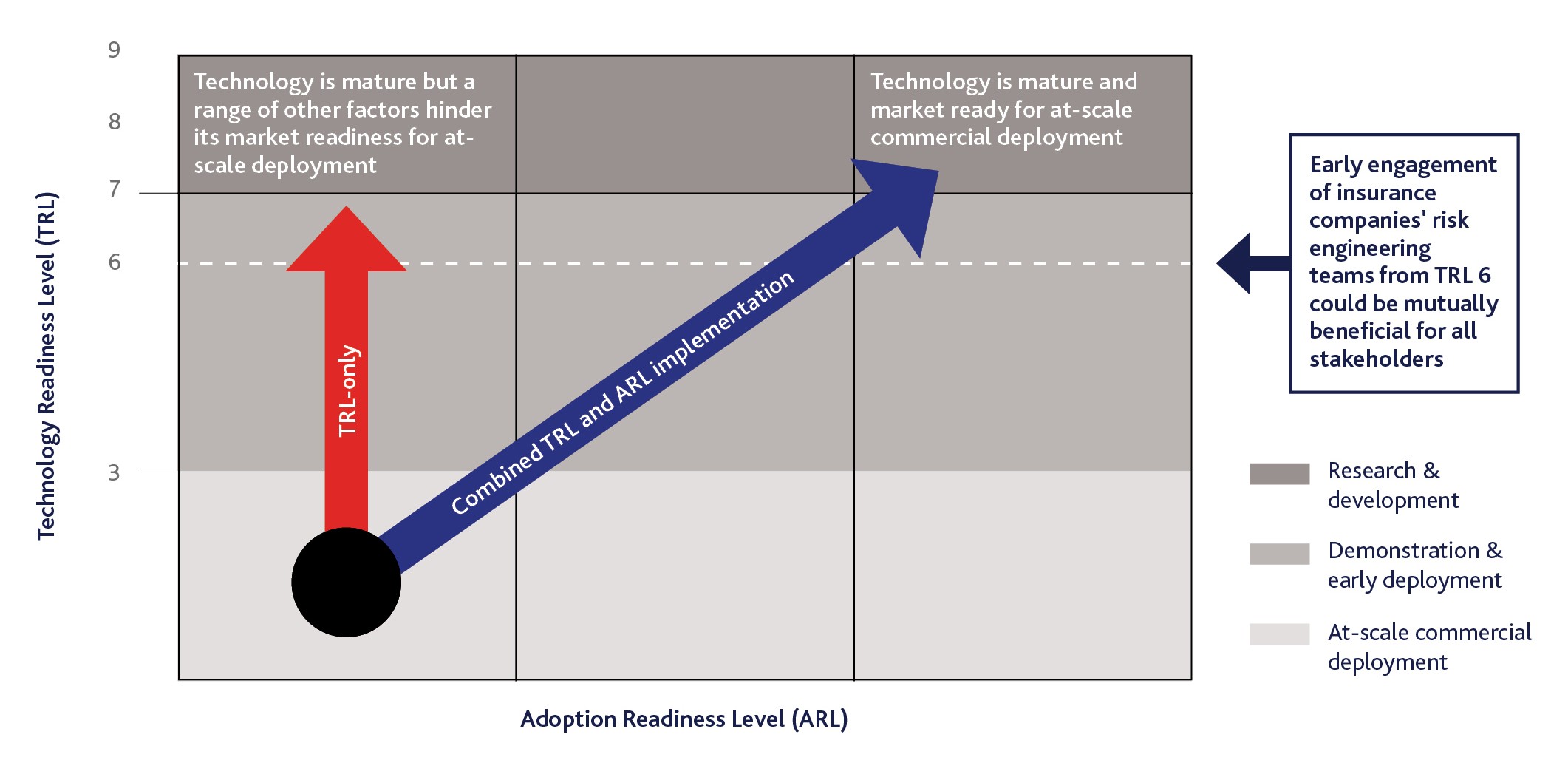
Consideration of the risks defined in the TRL and ARL frameworks from the pre-commercialisation stages is critical to accelerating the commercial deployment of climate technologies. A complex ecosystem of stakeholders – including manufacturers and suppliers, infrastructure owners and regulators – is engaged in addressing market readiness factors. They need to align priorities, engage proactively and work together in a more concerted and interactive fashion (Figure 2).
TABLE 1: ADOPTION READINESS LEVEL FRAMEWORK WITH INSURANCE INCLUDED AS A KEY ELEMENT FOR MARKET READINESS
Value proposition | Market acceptance | Resource maturity | License to operate |
|---|---|---|---|
1. Delivered cost 2. Functional performance 3. Ease of use/complexity | 4. Demand maturity/market openness 5. Market size 6. Downstream value chain | 7. Capital flow and availability 8. Project development, integration and management 9. Infrastructure 10. Manufacturing & supply chain 11. Materials sourcing 12. Workforce | 13. Regulatory environment 14. Policy environment 15. Permitting & siting 16. Environmental & safety 17. Community perception |
| 18. Insurability and availability of affordable insurance Risks associated with the lack of data and technical capacity to identify, frame and assess risks of new climate technologies and related insurability conditions; delays with the development of risk management frameworks, standards and codes of practice for project replication; addressing unique insurance needs on a techby-tech basis which could delay scaling; and the development and availability of a full range of insurance solutions to meet financing and market needs. |
Source: Modified from U.S. DoE18
As new climate technologies are demonstrated and scaled from TRL 7 to 9, feedback based on lessons learned could help address market readiness factors. Mechanisms are needed to harness the knowledge and experience gained from project execution, for example on the performance and resilience of equipment, gaps and challenges in the value chain and special requirements for training the workforce.
The development of climate-tech-specific hubs, which aim to bring together technology developers and customers to leverage existing infrastructure systems, create a business marketplace and develop safety standards to expedite scaled deployment, are a step in the right direction.19
FIGURE 2: EXPEDITING CLIMATE TECH MARKET READINESS UTILISING THE TRL AND ARL FRAMEWORKS
Source: Modified from U.S. DoE20
Available and affordable insurance solutions will be essential for getting new climate technologies market ready, securing financing and managing the liabilities associated with the execution of projects. However, assessing insurability conditions and developing such solutions for new climate technologies is complex and time consuming because of the myriad new risks, and lack of historical data and relevant experience. It is important to begin assessing conditions at the pre-commercialisation stages to determine what may be insurable through commercial insurance markets and how to address uninsurable aspects, for example through public-private partnerships (PPPs) or government backstops.
The development and implementation of risk management solutions is fundamental for improving insurability conditions. Beyond risk management efforts at the project level, industry-level efforts are needed to help change the risk profile of climate technologies. Such actions may include building extreme-weather-resilient equipment (e.g. thicker or vertical solar panels for protection against hail) and more resilient infrastructure systems, targeted workforce training (e.g. contractors, operators), and developing public policy and regulatory requirements that mitigate environmental and safety risks.
As understanding of the risks associated with new climate technologies improves and risk management solutions are developed and tested, industry associations and standard-setting and certification bodies will be able to engage and collaborate with insurers to develop risk management frameworks, standards and codes of practice. These in turn will have a significant impact on insurability conditions and the development of affordable insurance solutions.
As such, we propose to include an additional risk, ‘Insurability and Availability of Affordable Insurance,’ under ‘Resource Maturity’ in the ARL framework (Table 1, risk 18).
Assessing the insurability conditions for new technologies is not straightforward and decisions will not be binary (‘yes’ or ‘no’). They will instead fall somewhere on a scale that will evolve as the technology matures and risks are identified, understood and mitigated, or at the very least become more measurable. In the early stages of commercialisation, greater risk sharing among stakeholders, i.e. insurers, project owners, project developers, investors and government agencies, is required. As the technology matures, deployment increases and more data on the performance and efficacy of risk mitigation strategies becomes available, new technologies become more insurable and insurers can take a greater share of the overall risk pool.
Table 2 outlines the fundamental criteria of insurability21 as well as related issues for emerging climate technologies.22
An essential criterion of insurability is the randomness and independence of loss occurrence. For example, insurability is compromised if there is a systemic foreseeable risk, such as design flaws, which are only discovered once a technology has been in operation for a period of time. At the time of discovery, multiple units would typically already have been manufactured, delivered and installed. As a result, units may need to be fixed in the field at increased costs. Real-world examples include design flaws of rotor blades and gear boxes in wind turbines.
Re/insurers also need to be able to assess and measure the maximum possible loss (MPL) and average loss per event in monetary terms. For proven technologies, this analysis is carried out using scenarios that are developed based on previous experience. For new technologies, scenarios are developed based on assumptions and thus bear significant uncertainty.
Data transparency and knowledge sharing between project developers and re/insurers is critical for assessing the MPL. It is difficult for re/insurers to gain the same level of insight as project developers, especially in the earlier stages of development (e.g. TRL 7–8), and they may have no or limited access to information on technological risks. Ultimately, the project developer needs to ensure effective communication of complex technical information with the insurer, as project finance relies on convincing investors to assume well-mitigated technology risk.
The number of exposure units is another important consideration. From an insurance perspective, risk should be spread over a sufficiently large number of independent exposure units (i.e. projects) to reduce the variability of the loss experience. As the technology matures and the number of projects expands across different jurisdictions, more favourable conditions are created to form insurance pools. However, if the number of projects is limited – as has been the case for nuclear power, for example – government interventions are needed to cover the liabilities. This is the reality for emerging climate technologies, which are high risk and have a limited number of exposure units.
TABLE 2: CRITERIA OF INSURABILITY AND ISSUES RELATED TO EMERGING CLIMATE TECHNOLOGIES
| Criteria of insurability | Issues for emerging climate tech |
|---|---|
| 1. Randomness and independence of loss occurrence Losses should be uncorrelated and the insured should not be able to influence them through their actions. The loss must be uncertain but there should be a chance of occurrence. Insurers only pay out claims for loss events brought about through accidental means to protect against intentional acts of loss. |
|
| 2. Maximum possible loss (MPL) The aggregate maximum loss should be measurable in monetary terms and manageable for the insurer. |
|
| 3. Average loss per event Should be predictable, measurable and manageable. This allows the insurer to accurately estimate the expected cost of insuring the risk. |
|
| 4. Number of exposure units Risk should be spread over a sufficiently large number of independent exposure units (i.e. projects), which can form an insurance pool. This reduces the variability of the loss experience. |
|
| 5. Information asymmetries The insurer and insured should have access to the same information about the risk. Information asymmetries lead to inaccurate risk assessment and adverse selection. |
|
| 6. Insurance premiums Should be economically viable and reflect the expected cost of the risk. |
|
| 7. Cover limits Should be clearly defined at reasonable complexity. |
|
| 8. Public policy Coverage must be in accordance with public policy and societal values (e.g. does not promote criminal behaviour). |
|
| 9. Legal and regulatory restrictions Coverage should be in accordance with current and future legal restrictions (e.g. governments might change legal frameworks and make insurance compulsory if the consequences of climate change become too extreme). |
|
Source: The Geneva Association
Assessing the ‘insurable interest’ of the stakeholders involved in climate tech projects is also complex. This refers to the financial interests of each stakeholder and the potential financial losses that each may experience in case of damage or destruction of the insured asset(s) or injury or death of the insured person(s).
Though there are insurability issues associated with climate technologies, in general, these are not expected to be unmanageable (as opposed to pandemic business interruption or catastrophic cyber risks, for example). However, there may be tech-specific risks that may not be insurable through the commercial insurance market. These will require other interventions. If not solved, these risks may hold back the scaling of the technology indefinitely (see the case study on carbon management provided in section 5).
This section outlines the benefits of engaging re/insurers through their risk engineering services from the early stages of climate tech projects (TRL 6).
The benefits of involving re/insurers as early as the demonstration and early deployment stages of climate tech projects are manifold (Figure 3):
Appendix 1 offers an overview of the issues that may arise for project developers as emerging climate technologies move from TRL 6 to 9. Project developers need to start thinking about insurance needs as early as TRL 6, as they start planning their FOAK pilot.24 Insurance-related issues will also change significantly from TRL 6 to 9; for example, the insurable value of assets at TRL 6 is relatively low but risks and insurance needs evolve markedly for projects over TRL 7–9 (see Appendix 1).
FIGURE 3: BENEFITS OF ENGAGING RE/INSURERS AND CLIMATE TECH STAKEHOLDERS FROM THE PRE-COMMERCIALISATION STAGES
Source: The Geneva Association
It is important to note that many emerging climate technologies in TRL 6–7 are being developed by smallto medium-sized entrepreneurial technology firms, which often do not have strong balance sheets, risk management expertise, knowledge about insurance requirements or the management skills required to run a successful business in the growth stage.25 There is a unique opportunity for these project developers to leverage the risk engineering expertise of re/insurers.
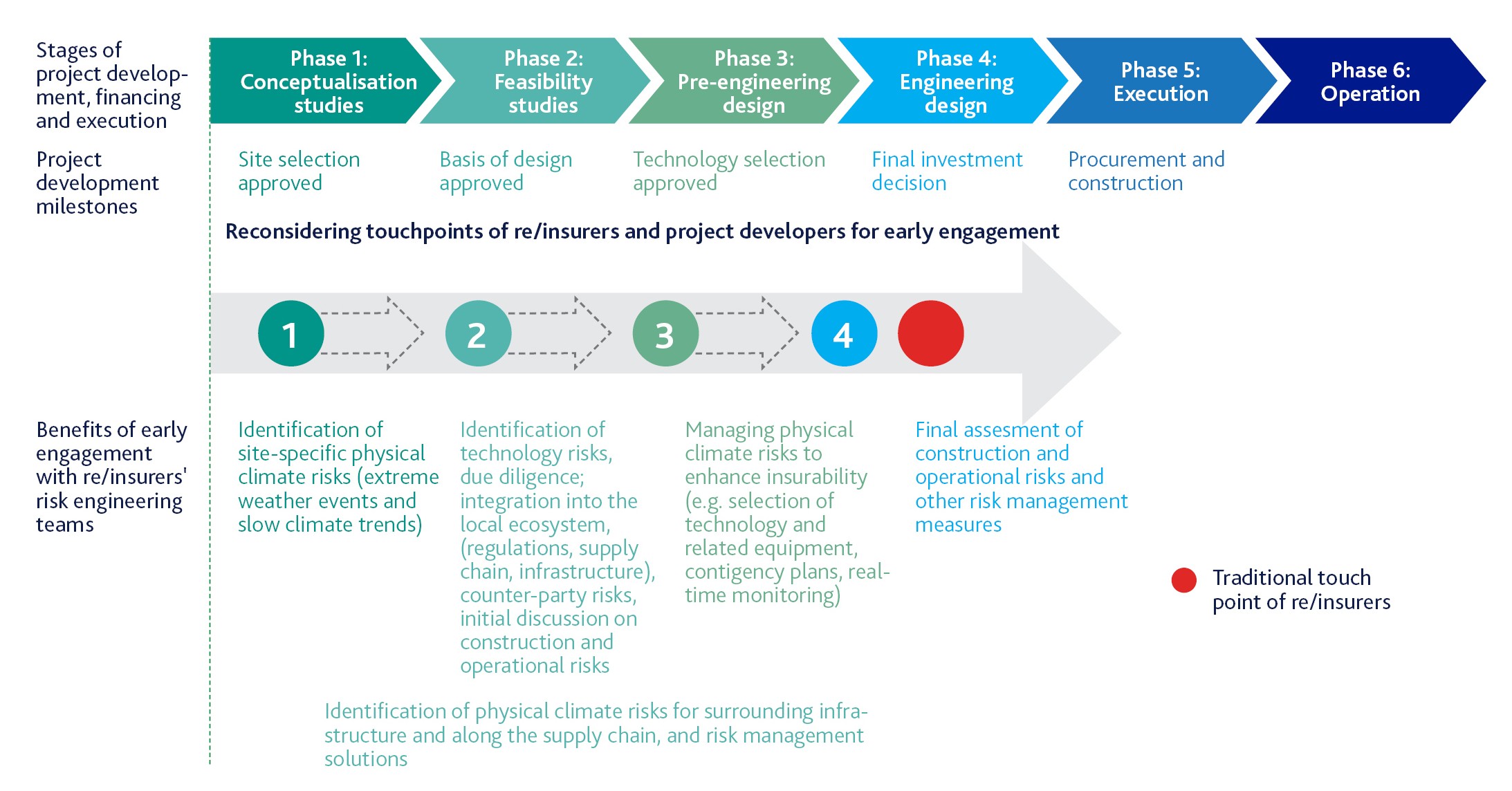
Climate technologies are demonstrated, scaled and implemented in an operational capacity from TRL 7. Given the complexities and large capital requirements of these projects, traditional technology financing mechanisms, such as growth venture capital funding, are not sufficient and project finance is increasingly being utilised. Figure 4 demonstrates the six phases of project development, financing and execution, with related milestones. Decisions that are made during the early development phases have significant implications for the insurability of the project, with subsequent impact on its financing and execution.
Traditionally, re/insurers are contacted after the project has been designed for development at an approved site (red circle in Figure 4). However, this often means that insurance-related considerations may not have been made during project design, potentially leading to unanticipated surprises, both for untested (or not-fully-tested) and known risks that may have been overlooked. Such oversight could result in insurability challenges, delays or compromises in financing and executing the project.
Engaging re/insurers’ risk engineering teams much earlier on would ensure that risks are considered, assessed and managed more holistically, enhancing the insurability of the project and potentially shortening the due diligence period for obtaining insurance. For example, extreme weather events can significantly damage or destroy industrial assets.26,27,28 Between 2019 and 2023, wildfires, floods and hailstorms have resulted in major losses for renewable energy facilities.29,30 Rising insurance costs and difficulty finding coverage are starting to limit where such projects can be built, particularly where the risk of weather-related events is above average. With trillions of publicand private-sector funding being mobilised to expedite the commercial deployment of new climate technologies over the coming decades, deciding where and how to build facilities will be critical to keeping them insurable over their life cycle. Specifically:
FIGURE 4: ENGAGING RE/INSURERS IN EARLY PROJECT DEVELOPMENT FOR ENHANCED INSURABILITY
Source: The Geneva Association
When risk management standards and codes of practice have been insufficient or non-existent for projects, with implications for insurability, re/insurers have been known to initiate the development of guidelines (Box 1). Early engagement of re/insurers in climate tech projects will improve their expertise in this area, help build relationships with key stakeholders and potentially lead to the development and fine-tuning of insurability requirements, best practices, standards and codes of practice for project replication.
Box 1: Standards and codes of practice for offshore wind initiated by re/insurers
Codes of practice for the offshore wind industry were initiated by insurers, who had limited experience assessing risk and offering solutions for these types of emerging projects, during a meeting of the European Wind Turbine Committee. The focus was on the German market to limit the number of possible participants and keep the process manageable, with the intention of sharing the results with other markets. The German Insurance Association (GDV) and German Offshore Wind Energy Foundation helped organise the meetings, which involved more than 90 representatives from a diverse range of sectors, including re/insurers, brokers, manufacturers, developers and investors. Working with organisations and associations of stakeholders proved successful in engaging these representatives.
The goal was to develop a best-practice paper on state-of-the-art risk management for constructing offshore wind farms. This extensive process included building a virtual offshore wind farm and developing working groups that addressed different aspects. More than 500 risks were identified and categorised as very high, high, medium or low, and risk mitigation measures were described. The guidelines are intended as best practice for industry adoption and project replication.
Similar initiatives may be carried out for emerging decarbonisation technologies, through closer collaboration between standard-setting bodies and re/insurance companies. For example, for the hydrogen industry, the development of standards is recommended, with the U.S. market a potential starting point.
Source: Verband der Sachversicherer (VdS)31
In this section, we present a novel ‘Insurability Readiness Framework’ (IRF), which will help climate tech stakeholders to think about risks from an insurance lens. This will enable more informed conversations with re/insurers around framing risks, exploring insurability conditions and considering risk management strategies. Developed by The Geneva Association in collaboration with other stakeholders, it builds on the risks identified in the ARL framework.
The IRF (Appendix 2) breaks down the risks of new technologies into seven categories relevant to insurance and demonstrates how they relate to risks identified in the ARL framework. Table 3 provides a breakdown.
For each of the insurance-relevant risk categories, the IRF specifies key issues that need to be considered by climate tech stakeholders when framing risks in their dialogue with re/insurers, the information project developers need to compile to share with re/insurers for risk and insurability assessment, and risk mitigation strategies that would help enhance insurability conditions. The full template is provided in Appendix 2.
Table 4 shows the issues specified under ‘technology risk’. The types of data and information needed for discussion with re/insurers range from a basic overview of the technology and the scale-up strategy to material selection, proof of performance, quality control and risk management in the development process.
Table 3: Insurance-relevant risks provided in the IRF and their relation to ARL risk types
| Insurance-relevant risks | Related ARL risk types |
|---|---|
| 1. Technology risk: Potential risks for applied technologies, such as key components for upscaled features, prototypical designs, integration of technologies and processes, and risks of technology and equipment underperformance or failure. |
|
| 2. Project information & organisation risk: Risks associated with the development, organisation and management of the project with a system-based approach. |
|
| 3. Legal, financial & compliance risk: Encompasses any legal or contractual aspect of the project and interactions between stakeholders that could halt the project, such as issues with licences, contractual obligations and statuary compliance. It also includes any financial aspects, such as solvency or sanction-related topics. Additionally, it covers issues related to inadequate compliance by stakeholders that could halt the project, such as not adhering to antitrust rules, and potentially lead to financial troubles. |
|
| 4. Location-specific physical climate risks extreme events and slow-changing climatic trends): Extreme events (Nat Cat, e.g. severe storms, floods, wildfires, extreme heat) that may impact the project over its lifetime. Takes into account any risk management measures that are being considered to build resilience. |
|
| 5. Business interruption & supply chain risk: Any aspect that can lead to delays in the project, such as supply chain issues, as well as any aspect that can impact production during operation and impact profitability. |
|
| 6. Long-term risk: Issues that could have a significant impact on the long-term profitability and success of the project. |
|
| 7. Environmental, social and governance: Risks related to factors such as labour practices, human rights, board diversity, community engagement, biodiversity and nature-related management, and transparent reporting. |
|
Source: The Geneva Association
Table 4: Insurance-relevant issues related to technology risk32
| Technology risk |
|---|
1.1. Basic technology overview and the scale up strategy, for example:
|
1.2. Material selection, for example:
|
1.3. Development process, for example:
|
1.4. Technology performance, for example:
|
1.5. Risk assessment of technology and level of technology maturity, for example:
|
1.6. Due diligence activities and results, for example:
|
1.7. Quality assurance and control, for example:
|
1.8. Risk management of the development process, testing and validation in real-world environment, for example:
|
1.9. Regulatory standards, for example:
|
Source: The Geneva Association
As another example, Table 5 shows the ‘location-specific physical climate risks’ section of the IRF, which provides more clarity on the types of issues that need to be considered for managing these risks.
Table 5: Insurance-relevant issues related to location-specific physical climate risks
| Location-specific physical climate risks |
|---|
4.1. Geographical exposure to extreme events, accumulation of risks for portfolios and mitigation approaches in place, for example:
|
| 4.2. Design/resilience of the project, including equipment and processes, supply chain, underlying infrastructure |
Source: The Geneva Association
It is important to note that the issues associated with the seven risk categories in the IRF are not meant to be exhaustive. Individual re/insurance companies may add other issues that are relevant to their own assessment processes.
Utilising the IRF for enhanced strategic risk conversations at the industry level
At the strategic level, the IRF can be used to identify and frame risks that may be considered uninsurable from a commercial insurance market lens and may require different interventions, such as PPPs or government backstops. Using the IRF in climate tech project development from the demonstration and early deployment stages (TRL 6–7) could help to identify the most challenging risk areas and develop structured risk management solutions. It may also aid in allocating risks among parties based on appetite and ability to bear risk, thereby attracting more capital and ensuring optimal risk financing. As technologies mature and re/insurers become engaged in more projects, they can engage with standard-setting and certification bodies to identify effective risk management strategies to help with the development of risk management standards and codes of practice.
Utilising the IRF at the project level
Transparency around insurance requirements will enable climate tech project developers and their engineering partners to address them in a more targeted way during different phases of project development, with the following benefits:
Through three technical multi-stakeholder workshops,33 we utilised the IRF to frame and facilitate a dialogue around the range of risks associated with two major emerging technologies: green hydrogen and carbon management (with focus on geological storage technologies and related carbon markets) to identify the risks that pose the most challenges from insurability perspective. A summary of findings is provided in this section.
Green hydrogen
The least emissions-intensive pathway to produce hydrogen is referred to as green hydrogen.34 It is produced through electrolysis using renewable energy as the power source, mainly solar and wind power. As of December 2023, globally announced green hydrogen production capacity is 32 million tons per annum (Mt p.a.) by 2030, with approximately 2 Mt p.a. already having passed the final investment decision.35
As of October 2023, the total investment gap for both green and blue36 hydrogen projects (collectively known as clean hydrogen) is USD 961 billion by 2030,37 with 50% allocated to hydrogen production and supply, 25% to infrastructure including hydrogen transportation and storage, and the remaining 25% to support end-use applications such as electric power or mobility. While an estimated USD 570 billion in direct investments has been announced, only USD 39 billion has passed the final investment decision. Further development and commitment are required to close the gap.38 The establishment of hydrogen hubs is playing a crucial role in expediting the market, boosting supply chains and facilitating infrastructure for the commercial-scale deployment of clean hydrogen.39,40
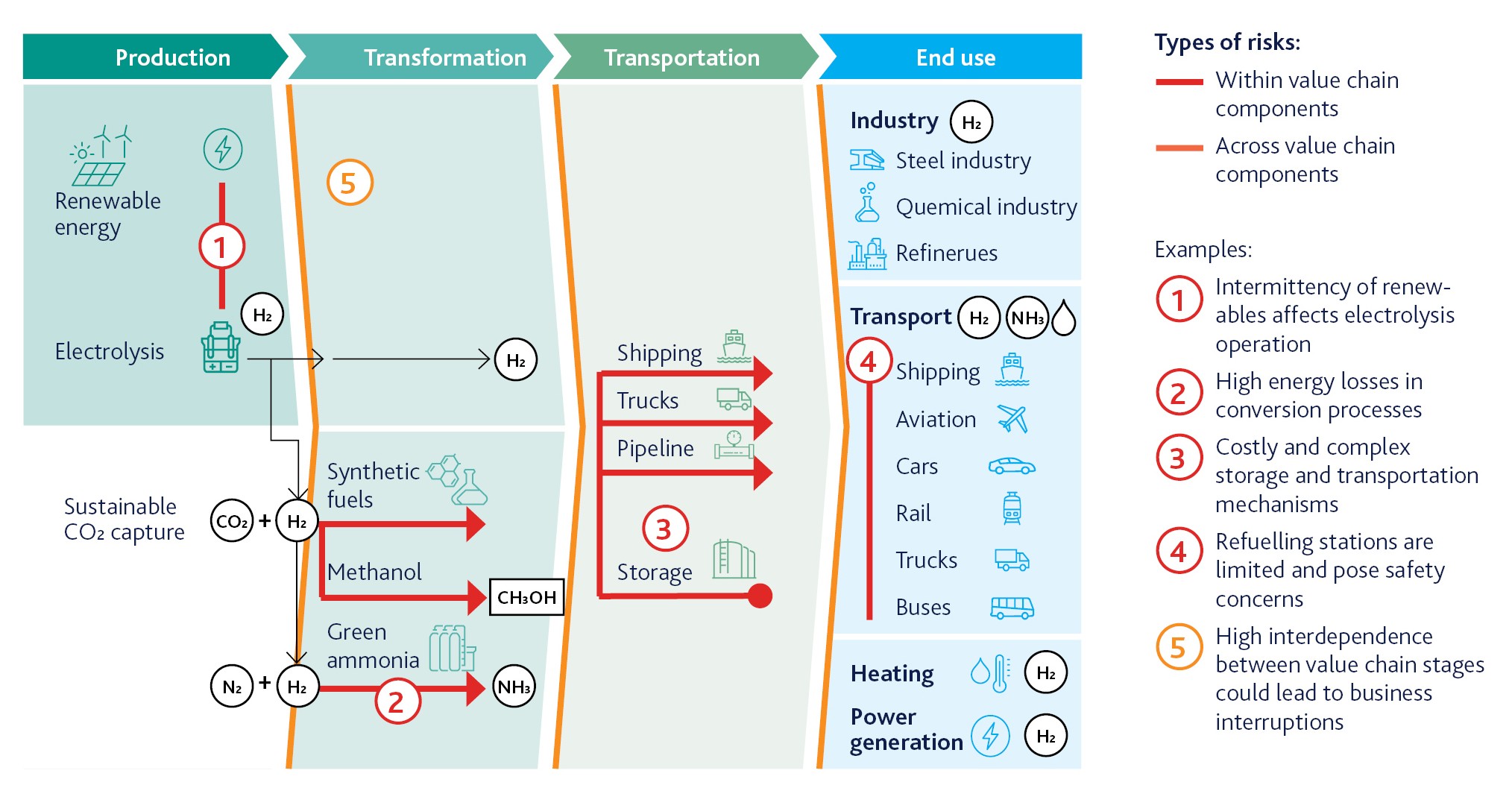
This case study considers complex and large-scale green hydrogen projects (Figure 5). The value chain consists of hydrogen production, transformation into transportable products (such as ammonia or methanol), storage and transportation (via ships, pipelines, etc.) to the end user. At the point of end use, there may be a need for final deconversion of the transported product (e.g. ammonia) back to hydrogen. An overview of the major risks as well as the most challenging risk categories from the IRF is provided in Box 2.
FIGURE 5: COMPLEX GREEN HYDROGEN PROJECTS AND RISKS ALONG THE VALUE CHAIN
Source: Modified from IRENA41
Box 2: The most challenging risks associated with complex green hydrogen projects from an insurance perspective
1. Within each component of the value chain
2. Across value chain components. A failure in one component can disrupt the entire value chain and affect business continuity. For example, failure to produce sufficient renewable energy would lead to disruptions in transformation, storage, transportation and delivery to the end user, with implications for insurability if not anticipated and mitigated.
The following risks specified in the IRF have been identified as the most challenging:
Technology risk
Project information and organisation risk
Long-term risk
How are public policy and government programmes mitigating risks?
A number of actions are being undertaken through new public policy, regulations and subsidies to mitigate some of the risks associated with hydrogen.
Source: The Geneva Association48
Carbon management (with focus on carbon storage and carbon markets)
The carbon management value chain includes CO2 capture, transportation, and utilisation or storage, usually summarised by the term carbon capture utilisation and storage (CCUS). The intended outcome can be to either reduce ongoing emissions at their source, or to undo past emissions independently from their original source (carbon dioxide – or simply carbon – removal). The processes involved in CCUS can be carried out through natureor technology-based solutions, or a combination of both.49 In nature-based solutions, the CO2 capture step is performed in biological systems. Technological solutions capture CO2 in one of two ways:
CO2 can either be directed to dedicated geological storage sites or utilised for other purposes, such as the production of concrete or synfuels. There are two approaches for storing in deep geological formations:
As of July 2023, there are 41 operational CCUS facilities worldwide, with a collective total CO2 capture capacity of 49 Mt p.a.50 Of these facilities, 40 are dedicated to emission reduction through point-source capture. Only one facility is dedicated to carbon removal, namely the Direct Air Capture and Storage (DACS) pilot ‘Orca,’ located in Iceland.51 To achieve the decarbonisation of heavy industries, approximately 700 Mt p.a. of CO2 would need to be captured and stored by 2030.52 According to the Intergovernmental Panel on Climate Change (IPCC), maintaining global emissions at net-negative levels will be necessary throughout the second half of the current century. Globally, the carbon removal sector would need to achieve around 6 billion tonnes of negative CO2 emissions annually by 205053 to limit global warming below 1.5°C and a cumulative total of up to 1,000 billion tonnes of negative emissions by 2100, depending on how fast and at what scale global emissions are reduced.54 The carbon removal industry must continue developing at an unprecedented pace to deliver such enormous negative emissions on time.
Increasing the establishment of CCUS networks or clusters (hubs) has been key to bolstering the supply chain, facilitating infrastructure, and bringing together producers and consumers.55
Furthermore, the development of robust and trustworthy carbon markets with verifiable carbon credits is important for incentivising carbon management projects. They provide a platform to monetise carbon reduction or removal efforts through the trading of carbon credits. There are two types:56
In recent years there has been increased scrutiny on the integrity of carbon credits, especially for credits from nature-based solutions projects. There is also growing interest in unlocking carbon finance via the sale of credits from technological solutions that involve geological CO2 storage and in-situ mineralisation. To ensure the credibility of these markets, more robust project methodologies and certification standards need to be developed, including stringent monitoring, reporting and verification practices.58 Using the IRF in discussions with stakeholders indicated that the scalability of the carbon management industry is heavily reliant on the long-term durability of carbon storage systems, i.e. long-term liabilities associated with potential future storage reversal events (release of CO2 back into the atmosphere). Carbon markets involving long-term CO2 storage operations face the same challenges and related uncertainties. Box 3 captures the issues in more depth.
Box 3: The biggest risks related to carbon management scalability from an insurability perspective
Long-term risks associated with the durability of carbon storage are the ‘elephant in the room’. If not solved, they could hold back the scaling of the entire carbon management value chain indefinitely. In addition:
PPPs are recommended for the development of insurance solutions, with governments as potential insurers of last resort. Such partnerships are crucial to bridging the insurability gap and enabling innovative risk transfer solutions for technological carbon storage mechanisms. This approach is similar to past situations involving low-frequency/high-risk sectors such as nuclear power and brownfields,61 where PPPs helped overcome long-term liability issues. Better data availability and analytics, and more robust monitoring, reporting and verification tools are also crucial for assessing, framing and managing the risks associated with storing CO2.
How are government programmes mitigating risks?
Government programmes have been developed to:
Source: The Geneva Association67
Implementing climate technologies at the scale needed for industrial decarbonisation over the next decade will require new ways of doing business. Demonstrating and deploying these technologies is capital intensive and comes with many challenges. Available, accessible and affordable insurance solutions will be essential for getting new climate technologies market ready, securing financing and managing the liabilities associated with projects. Assessing insurability conditions for climate tech projects and developing insurance solutions is complex and time consuming due to the myriad risks involved and the lack of historical data and experience.
Most new climate technologies are being developed by smallto medium-sized firms, which may not have a strong balance sheet, sufficient risk management expertise and/or broader knowledge about insurance and related requirements. This report outlines why and how climate tech developers, their partners and other stakeholders could benefit from working with re/insurers, particularly through leveraging their risk engineering expertise.
Collaboration from the very early stages of projects will enable insurability conditions to be determined and insurance tools to be developed on a tech-by-tech basis. Furthermore, the development and implementation of risk mitigation strategies will help to improve insurability conditions. The costs associated with involving re/insurers’ risk engineering teams should also be acknowledged and evaluated very early on in the project. The long-term benefits – risk prevention, financial optimisation, commercial opportunities – would potentially outweigh the initial costs.
This report sheds light on issues that need to be considered for assessing and improving the insurability of new climate technologies. The Insurability Readiness Framework (IRF) offers guidance on how to think about risks from an insurance perspective and will enable more informed conversations between re/insurers and climate tech stakeholders.
Recommendations
We hope the findings and recommendations presented in this report help advance dialogue and collaboration among climate tech stakeholders and re/insurers. The re/insurance industry has a crucial role to play in supporting the rollout of new climate technologies, but significant progress needs to be made in order to unlock their potential contributions. This includes:
| TLR | Types of projects | Financing | Insurance-related issues of concern to project developers | |
|---|---|---|---|---|
| Demonstration and early deployment | TRL6 – Early field demonstration and system refinements are completed |
|
|
|
| TRL 7 – Complete system demonstration in an operational environment |
|
|
| |
| At-scale commercial development | TRL 8 – Early commercial deployment |
|
|
|
| TRL 9 – Wide-scale commercial deployment |
|
|
|
Source: The Geneva Association, based on deliberations with re/insurers, MGAs EPCs and investors.
This Insurability Readiness Framework (IRF) has been developed as a guide to translate risks associated with the TRL and ARL frameworks into seven risk categories from the insurance lens. IRF enables all stakeholders involved in the climate tech ecosystems to have a more holistic view of the risks and their interconnectivities. This enables more informed dialogue about various risks, related issues and data needs to explore insurability conditions, consider risk management strategies, what may or may not be insured through the commercial insurance markets, motivate insurance product innovation for the insurable aspects and explore ways to address the uninsurable aspects through other means, such as public-private partnerships or even the government as the insurer of the last resort. 74
| 1. Technology risk |
Potential risks for applied technologies, such as key components for upscaled features, prototypical designs, integration of technologies and processes, and risks of technology and equipment underperformance or failure. Relevant risks from ARL framework (Table 1): Functional performance (no. 2); Ease of use/complexity (no. 3); Manufacturing & supply chain (no. 10); Materials sourcing (no. 11) |
1.1. Basic technology overview and the scale-up strategy, for example:
|
1.2. Material selection, for example:
|
1.3. Development process, for example:
|
1.4. Technology performance, for example:
|
1.5. Risk assessment of technology and level of technology maturity, for example:
|
1.6. Due diligence activities and results, for example:
|
1.7. Quality assurance and control, for example:
|
1.8. Risk management of the development process, testing and validation in a real-world environment, for example:
|
| 2. Project information and organisation risk |
Risks associated with the development, organisation and management of the project. Relevant risks from ARL framework (Table 1): Functional performance (no. 2); Ease of use/complexity (no. 3); Project development, integration & management (no. 8); Infrastructure (no. 9); Manufacturing & supply chain (no. 10); Materials sourcing (no.11); Workforce (no. 12) |
2.1. Risk identification, for example:
|
2.2. Risk assessment/benchmarking, for example:
|
| 2.3. Risk monitoring and communication approach75 |
| 2.4. Risk philosophy (i.e. broad overview of risk identification and management policy and key addressable considerations) |
2.5. Risk management process and results (with a life cycle approach to ensure continuous improvement), for example:
|
| 2.6. Certification and warranties |
| 2.7. Due diligence information for stakeholders (i.e. investors, insurers) |
| 2.8. Standard erection all risk evaluation |
2.9. Critical operational risk aspects76
|
| 2.10. Access to materials, equipment, supply chain, workforce |
| 2.11. Readiness of the underpinning infrastructure (physical and digital large-sale systems that need to be in place to support, enable and facilitate project deployment), and alternative options |
2.12. Change management, for example:
|
2.13. Testing and handover process, standards and requirements, for example:
|
2.14. Contingency plan/business continuity plan
|
| 3. Legal, finance, compliance and litigation risk |
Encompasses any legal or contractual aspect of the project and interactions between stakeholders that could halt the project, such as issues with licences, contractual obligations and statuary compliance. It also includes any financial aspects, such as solvency or sanction-related topics. Additionally, it covers issues related to inadequate compliance by stakeholders that could halt the project, such as not adhering to antitrust rules, and potentially lead to financial troubles. Relevant risks from ARL framework (Table 1): Delivered cost (no. 1); Capital flow & availability (no. 7); Regulatory environment (no. 13); Policy environment (no. 14); Permitting & siting (no. 15); Environmental & safety (no. 16); Community perception (no. 17) |
| 3.1. Risk provisions in the budget |
| 3.2. Budgets for warranties/solvency management of project |
| 3.3. Company’s legal aspects |
| 3.4. Licences and patents |
| 3.5. Legal framework of project and status of testing |
3.6. Approval processes and responsible authorities, for example:
|
| 3.7. Project financing arrangements (e.g. financing structure and structure of interdependencies between all stakeholders) |
| 3.8. Directors & Officers (D&O) relevant topics of involved management team (e.g. liabilities from legal actions, regulation/ legislation, and/or from shareholders) |
| 3.9. Contractual requirements from subsidies, guarantees, feed-in tariffs and provisional acceptance certification |
| 3.10. Litigation risk associated with environmental aspects or brought forward due to community perception |
| 4. Location-specific physical climate risks (extreme events and slow-changing climatic trends) |
Locationor portfolio-location-specific extreme events (Nat Cat, e.g. severe storms, floods, wildfires, extreme heat) that may impact the project over its lifetime. Takes into account any risk management measures that are being considered to build resilience. Relevant risks from ARL framework (Table 1): Infrastructure (no. 9); Manufacturing & supply chain (no. 10); Workforce (no. 12) |
4.1. Geographical exposure to extreme events, accumulation of risks for portfolios and mitigation approaches in place, for example:
|
| 4.2. Design/resilience of the project, including equipment and processes, supply chain, underlying infrastructure |
| 5. Business interruption and supply chain risk |
Any aspect that can lead to delays in the project, such as supply chain issues, as well as any aspect that can impact production during operation and impact profitability. Relevant risks from ARL framework (Table 1): Downstream value chain (no. 6); Infrastructure (no. 9); Manufacturing & supply chain (no. 10); Material sourcing (no. 11); Workforce (no. 12) |
5.1. Risk assessment – which risks could lead to business interruption and have mitigation measures been considered from an early stage? For example:
|
5.2. Business continuity plan, for example:
|
| 5.3. Emergency response plan |
| 5.4. Redundancy and backup systems to ensure continued operations |
| 5.5. Supply chain diversification |
| 5.6. Data protection and cybersecurity |
| 5.7. Employee training |
| 5.8. Regular testing and drills |
| 6. Long-term risk |
Any long-term issues that could have a significant impact on the profitability and success of the project. Relevant risks in ARL framework (Table 1): Market size (no. 5); Downstream value chain (no. 6); Infrastructure (no. 9); Manufacturing & supply chain (no. 10); Material sourcing (no. 11); Workforce (no. 12); Regulatory environment (no. 13); Policy environment (no. 14); Environmental & safety (no. 16); Community perception (no. 17) |
6.1. Liability or emerging risks, for example:
|
| 6.2. Litigation risks |
| 6.3. Long-term risks of extreme events and slow-changing climatic trends on the project |
| 6.4. Climate-related public policy and regulatory risks (e.g. changing laws to hinder operations, water laws, environmental policies) |
| 6.5. Any change in ESG risk |
| 6.6. Long-term warranty obligations |
| 7. Environmental, social and governance risk |
Risks related to issues such as carbon footprint, labour practices, human rights, board diversity, community engagement, biodiversity and nature-related management, and transparent reporting. Relevant risks from ARL framework (Table 1): Workforce (no. 12); Permitting & siting (no. 15); Environmental & safety (no.16); Community perception (no. 17) |
7.1. Environmental impact assessment, for example:
|
| 7.2. Sustainability strategy (e.g. environmental protection, sustainable use of resources) |
7.3. Supply chain and resource sustainability, for example:
|
7.4 Carbon footprint, for example:
|
7.5. Biodiversity and nature-related financial risks
|
| 7.6. Labour practices, community engagement and human rights (e.g. displacement of indigenous communities, modernday slavery, promoting local content) |
| 7.7. Board diversity |
| 7.8. Transparent reporting |
Business continuity plan: strategic playbook created to help an organisation maintain or quickly resume business functions in the face of disruption, whether that disruption is caused by a natural disaster, civic unrest, cyberattack or any other threat to business operations.77
Business interruption insurance: coverage that replaces business income lost in a disaster, such as fire.78
Delay in startup insurance: coverage for project owners for the financial consequences of a delay in project completion arising from an insured physical damage event.79
Directors & officers insurance: covers the liability from legal actions as a result of serving as a director or an officer of a business or other type of organisation from regulators, legislators and shareholders, e.g. class action against company.80
Engineering, procurement and construction contract: contractual agreement between a project owner and the contractor that enables the owner to transfer the complete risk of design, procurement and construction to the contractor. The contractor is solely responsible for completing the project and handing it over to the owner in a turnkey condition.81
Erection all risk insurance: covers losses arising from the erection and installation of machinery, plant and steel structures, including physical damage to the project, equipment and machinery, and liability for third-party bodily injury or property damage arising out of these operations.82 Also known as builders all risk or construction all risk in the U.S.
Operation & maintenance: Combination of maintenance, management, training, budgeting and business to run an organisation.83
Operation all risk: considerations that are typically covered by project safety management requirements, including hazard and operability analysis undertaken during design, construction and pre/post-commissioning phases. For example, maintainability (including inspection), spares availability, operator selection and training, health and safety of operations.
Original equipment manufacturer: company whose goods are used as components in the products of another company.84
Power purchase agreement: long-term agreement to buy power from a company that produces electricity.85
Provisional acceptance Certification: typically outlined in a contract between the project owner and the construction/ design/technology licensor company. It is granted upon the fulfilment of various contractual obligations, such as meeting performance criteria and confirming compliance with safety standards. While the criteria can be complex, the key feature of a PAC award (or equivalent) is the transfer of 'care, custody and control' of the facilities to the plant owner. From this point onward, the owner assumes responsibility for operating and maintaining the facilities. Subsequently, the contractors are typically only obligated to meet longerterm performance criteria, such as efficiencies and power consumption, and address equipment warranty-related issues for a defined period. Upon expiration of this period, a 'Final Acceptance Certificate' or equivalent is issued, relieving the contractor/designer of further liabilities for the plant, except as defined through legal action.
| ARL | Adoption Readiness Level |
| BCP | Business Continuity Plan |
| BI | Business Interruption |
| CBAM | Carbon Border Adjustment Mechanism |
| CCM | Compliance Carbon Market |
| CCUS | Carbon Capture, Utilisation & Storage |
| CDR | Carbon Dioxide Removal |
| D&O | Directors & Officers |
| DAC | Direct Air Capture |
| DACS | Direct Air Capture and Storage |
| DoE | Department of Energy |
| DSU | Delay in Start Up |
| EAR | Erection All Risk |
| EPC | Engineering, Procurement & Construction |
| ESG | Environmental, Social & Governance |
| FID | Final Investment Decision |
| FOAK | First-of-a-Kind |
| GA | The Geneva Association |
| GHG | Greenhouse Gas |
| HAZOP | Hazard & Operability |
| IE | Independent Engineering |
| IRF | Insurability Readiness Framework |
| LD | Liquidated Damage |
| LDES | Long Duration Energy Storage |
| MGA | Managing General Agent |
| MPL | Maximum Possible Loss |
| MRV | Measurement, Reporting & Verification |
| Mt p.a. | Million Tonnes Per Annum |
| Nat Cat | Natural Catastrophe |
| NOAK | Nth-of-a-Kind |
| O&M | Operation & Maintenance |
| OAR | Operation All Risk |
| OEM | Original Equipment Manufacturer |
| P&C | Property & Casualty |
| PAC | Provisional Acceptance Certification |
| PPA | Power Purchase Agreement |
| PPP | Public-Private Partnership |
| QA | Quality Assurance |
| QC | Quality Control |
| SAF | Sustainable Aviation Fuel |
| SMR | Small Modular Reactor |
| TRL | Technology Readiness Level |
| VCM | Voluntary Carbon Market |
Fernandez 2023.
Norton Rose Fullbright 2023.
The Geneva Association 2023b.
The Geneva Association 2023d.
The Geneva Association 2023e.
U.S. DoE 2023a.