Climate Change & Environment



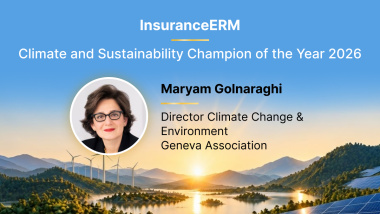
Maryam Golnaraghi, the Geneva Association’s Director of Climate Change & Environment, has been named Climate and Sustainability Champion of the Year 2026 as part of InsuranceERM's Climate Risk & Sustainability Awards.
The judges recognised her more than 25 years of leadership in climate risk and resilience, particularly her work to help the insurance industry support the energy transition and strengthen resilience to growing physical climate risks.
To mark this recognition, InsuranceERM published the following interview with Maryam.
What does winning climate and sustainability champion of the year mean to you personally, and what are you most proud of from your work over the past year?
This award means a great deal as I see it as recognition of an approach I have championed throughout my career: making climate and sustainability core business priorities, and building strategic partnerships to think beyond conventional approaches and develop solutions.
I have focused on strengthening climate resilience of the built environment, operations and supply chains, while supporting energy security and industrial competitiveness through expediting the scaled deployment of emerging low-carbon technologies and solutions for industrial decarbonisation.
Over the past year, I am most proud of demonstrating the value of bringing re/insurers' unique risk management expertise to the table early, alongside governments, hard-to-abate industries and other key partners. The Geneva Association's collaborative research has taken a strategic and holistic approach to identifying and managing emerging risks to improve insurability and investability. My focus on building trust and credibility across stakeholders to make this happen has been central to these efforts.
What do you see as the biggest challenge facing insurers as they try to turn climate and sustainability ambitions into practical action?
I believe the biggest challenge is realising the transformations needed to maximise insurers' enabling role. Specifically:
Can you point to one initiative, project or piece of work you have been particularly proud of, and explain the impact it has had?
Through the Geneva Association's research, I have sought to identify transformative yet pragmatic ways to enable meaningful R&D collaboration with stakeholders. I am particularly proud of the partnerships that grew from our research on Bringing Climate Tech to Market and Expediting Industrial Decarbonisation.
We demonstrated the benefits of early re/insurer engagement to identify and manage risks, as well as exploring innovative risk-sharing mechanisms to overcome barriers to financing and scaling.
To show how this could work, we then forged a further research collaboration with the Oil and Gas Climate Initiative and Clean Energy Ministerial to address the insurability challenges of carbon management projects as they scale.
This effort has produced guiding tenets for early re/insurer engagement, whole-value-chain risk assessment and allocation, and regulatory alignment to make Carbon Capture and Storage (CCS) projects more insurable, bankable, investable and scalable.
How has the role of climate and sustainability professionals within insurance changed in recent years, particularly as the political and regulatory environment has become more complicated?
Reflecting on my nearly 30-year career, I have seen the role of climate and sustainability professionals in insurance evolve. Insurers were early adopters of climate science, hiring scientists and investing in research to understand the changing characteristics of extreme-weather risks and develop catastrophe models, leading to their notable expertise in physical climate risk assessment and management.
The focus later expanded to CSR, ESG, corporate targets, climate-related financial risk and disclosure.
More recently, amid rising physical climate risks, the focus has shifted towards accelerating the deployment and scaling of climate resilience and decarbonisation solutions.
Against a backdrop of geopolitical uncertainty, cost pressures and interconnected risks, governments, businesses and investors increasingly recognise the enabling role of re/insurers.
In response, re/insurers are strengthening multidisciplinary expertise, research and AI capabilities, organisational governance and distribution channels to engage clients earlier, forge strategic partnerships, advance risk modelling, address emerging technology and physical climate risks, and co-develop innovative solutions.
Looking ahead, where do you think the industry needs to make the most progress over the next few years?
As scientific evidence indicates that limiting global warming to 1.5°C without overshoot is increasingly unlikely, the greatest progress we can make is to leverage the insurance industry's expertise in climate risk assessment and adaptation to help society move from reacting to physical climate risks to proactively reducing them and building resilience.
This means reducing the vulnerability of homes, businesses, industrial facilities and critical infrastructure, while strengthening the communities and natural systems around them.
Our Safeguarding Home Insurance report highlights how decisions by a complex landscape of stakeholders could drive up exposure and the vulnerability of homes and communities to extreme weather. Reducing these risks requires integrating resilience into land-use planning, construction, operations and maintenance, retrofitting, valuation, financing and insurance, supported by incentives.
Insurers cannot achieve this alone, but they can help assess risks, develop and promote preventive measures, inform decisions and develop products and services that support risk reduction.
With trillions [of dollars] being invested in housing, industry and infrastructure, resilience must become integral to investment and development decisions from the outset.