




Digital & AI Transformation

Geneva Association. 2025.
Gen AI in the Insurance Customer Journey.
Authors: Ruo (Alex) Jia, Martin Eling, and Tianyang Wang. November.
Ruo (Alex) Jia, Director Digital Technologies, Geneva Association Associate Professor of Insurance, Peking University
Contributing authors:
Martin Eling, Director of the Institute of Insurance Economics and Professor of Insurance Management, University of St. Gallen
Tianyang Wang, Professor of Finance, Colorado State University
Generative AI (Gen AI) is poised to transform the insurance customer journey end to end – from researching policies to filing claims. To investigate customer perceptions of Gen AI in insurance, the Geneva Association conducted a survey of 6,000 insurance customers across the six largest insurance markets – China, France, Germany, Japan, the UK, and the US. Overall, the results reveal a generally positive attitude toward Gen AI tools – over 80% of customers are either in favour or neutral about insurers using Gen AI in customer interactions, indicating minimal outright resistance. Around 50% of respondents report that these tools have made interactions more efficient and intuitive, while another third find them somewhat helpful. Notably, customer openness and usage are highest in markets like China and the US, whereas continental Europeans are more cautious. The survey highlights four priorities among customers related to Gen AI in insurance: a ‘human touch’ when needed, and ensuring data privacy, accuracy, and transparency in AI-driven services. These concerns frame the conditions under which customers will embrace Gen AI in their insurance experience.
FIGURE 1: PRIMARY FORMS OF GEN AI FOR INSURANCE CUSTOMERS
Source: Geneva Association
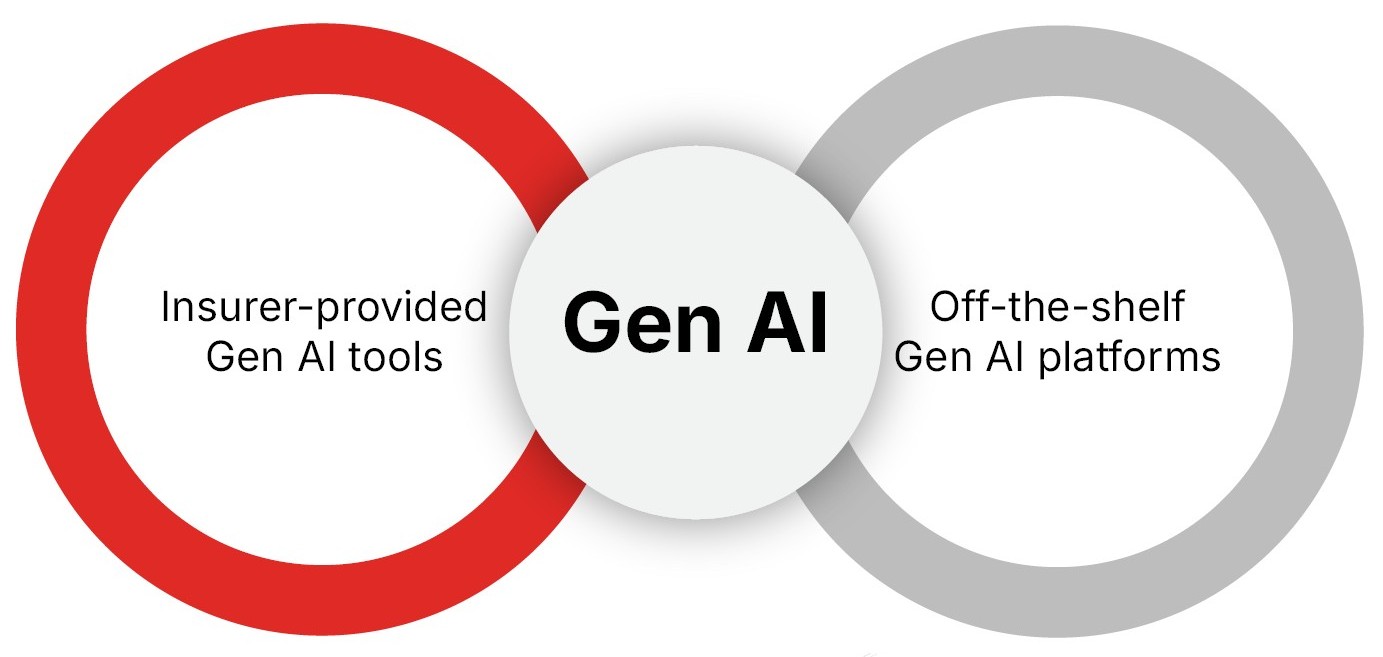
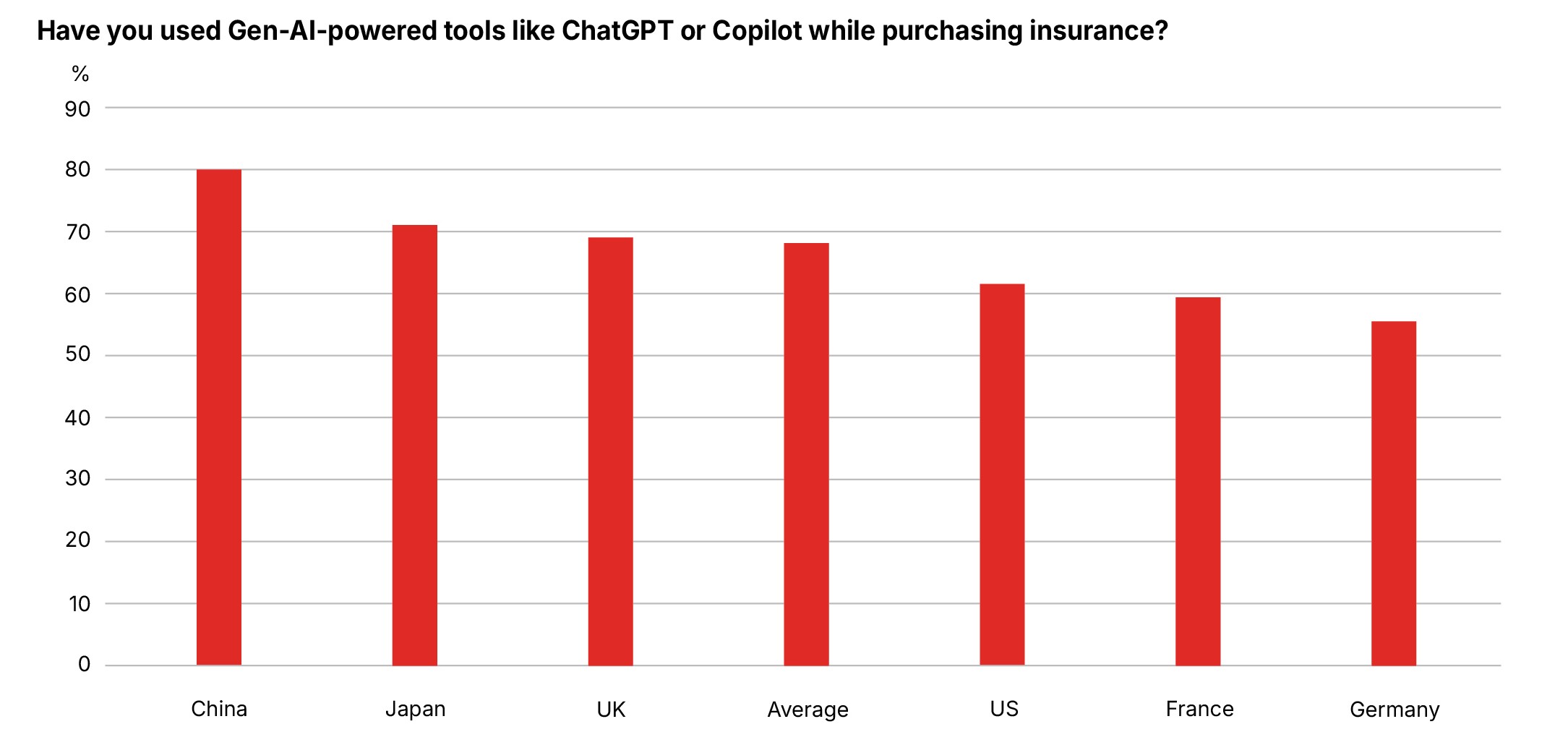
Customers encounter two main forms of Gen AI: insurer-provided Gen AI tools, e.g. AI chatbots and automated claims assistants, and off-the-shelf Gen AI tools – general-purpose platforms like ChatGPT or DeepSeek (Figure 1). Sixty-eight percent of respondents have used. Gen AI assistants when buying insurance. Such independent use of Gen AI is especially common in Asia (China and Japan) and less so in continental Europe (France and Germany); English speaking countries (the UK and the US) fall somewhere in between. Customers leverage these tools to research products, compare coverage, and clarify policy terms before even contacting an insurer. As a result, Gen AI is empowering customers to be more informed, better prepared, and more demanding in their expectations. Insurers must recognise this shift: the customer journey may now start as a Gen AI query before an insurer is even aware of their interest.
Gen AI offers clear benefits to insurance customers. Gen-AI-driven assistants and chatbots are making insurance services faster, more responsive, and highly personalised, which goes far beyond what price comparison websites and robo-advisors can do. Routine tasks that once felt complex or time-consuming – from getting a quote to submitting documents – are being simplified by Gen AI’s ability to deliver instant, tailored responses. These tools can provide 24/7 support, guide users through policy options, and even proactively recommend coverage adjustments as needs change. By augmenting human advisors, Gen AI is helping demystify insurance for consumers with limited knowledge, thus bridging gaps. It also enhances self-service capabilities, enabling tech-savvy customers to find answers and compare offerings on their own, which can build confidence and satisfaction.
Despite these advantages, customers have concerns that insurers must heed. Foremost is the fear of losing the human element: nearly 40% of customers worry that Gen AI tools lack the personal engagement or empathy that a human agent provides. This concern was most pronounced in markets like France, the UK, and the US, where over 40% cited the lack of human touch as a major issue. Privacy and data security are also critical concerns – many are uneasy about how their personal information is used or protected when handled by AI systems. Further, customers also question the accuracy and reliability of AI-generated information, as Gen AI can sometimes produce errors or ‘hallucinations’. Over 40% expressed concern about the accuracy of Gen AI outputs and the risk of misinformation in AI-driven processes. Transparency is another issue – consumers want clarity on when and how AI is involved in decisions, fearing ‘black box’ algorithms that make opaque choices about claims or coverage.
FIGURE 2: IMPORTANCE OF GEN AI FEATURES
Source: Geneva Association insurance customer survey
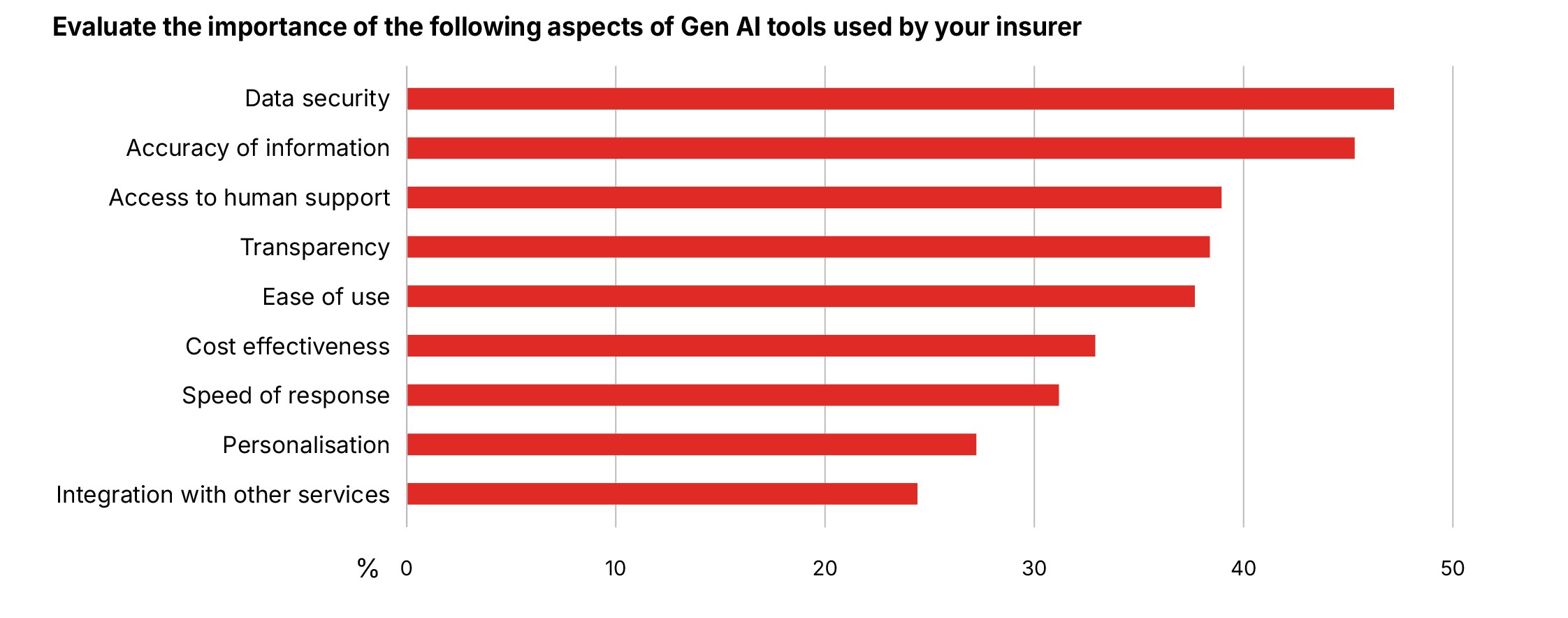
In summary, while customers appreciate the efficiency of Gen AI, it must not come at the cost of privacy, correct information, clear explanations, or the ability to reach a human when necessary.
From the insurer perspective, Gen AI presents a strategic opportunity to improve service and efficiency, but it also raises new challenges. Used well, Gen AI can be a ‘digital concierge’ that automates routine queries, provides instant information, and frees up human staff to focus on complex, high-touch interactions. It promises cost savings and scalability, allowing insurers to serve more customers, including underserved segments, with personalised attention. However, insurers must balance tech-driven gains with trust. The survey results show that customers are not ready to accept fully autonomous AI handling complex or sensitive insurance decisions. Thus, Gen AI should complement rather than replace human expertise. We recommend insurers pursue the following actions:
Embrace empowered customers. Acknowledge that customers are using off-the-shelf Gen AI tools for independent research. Rather than viewing this as a threat, insurers should provide complementary services to add value – for example, ‘second-opinion’ AI services that validate or clarify information obtained from ChatGPT. By positioning themselves as trusted partners who enhance and correct AI-derived insights, insurers can deepen customer trust and loyalty.
Keep humans in the loop. To address concerns around the human touch, insurers adopt hybrid AI-human service models. Gen AI can handle straightforward inquiries or document processing, while human agents step in for complex, emotional, or high-stakes cases. This retains empathy and reassurance in the customer experience, preventing Gen AI from inadvertently alienating customers.
Ensure data quality, privacy and security. The power of Gen AI depends on high-quality data. Insurers should invest in robust data infrastructure and governance to feed AI models accurate, unbiased information. Equally important is protecting customer data – insurers should employ privacy-preserving techniques (e.g. encryption, federated learning) so that deploying Gen AI does not compromise confidentiality. Compliance with emerging AI regulations (such as the EU’s AI Act and existing laws like GDPR) is essential to uphold transparency and avoid data misuse.
Embed AI governance and ethics. Gen AI deployment requires an ethical framework and oversight. Insurers should establish dedicated AI governance teams or committees to monitor Gen AI systems for fairness and accuracy. Regular audits of AI decision outcomes (e.g. checking for discriminatory patterns) and explainability mechanisms will increase transparency and accountability. Investing in employee reskilling and training is also critical. Front-line staff should be trained to work alongside AI (e.g. interpreting AI outputs, handling exceptions), and new roles like Gen AI model reviewers or ethicists may be needed. By building internal expertise in responsible Gen AI, insurers can ensure that human judgment remains at the core of AI-augmented processes.
Box 1: Customer priorities when using insurer-provided Gen AI
Data security. Customers may feel uncomfortable with insurers tracking their financial habits, lifestyle choices, and health data. While personalised policies offer benefits, excessive data-driven profiling may be perceived as intrusive. Clear data governance policies and explicit customer consent mechanisms are essential to ensuring responsible AI implementation and maintaining policyholder trust. Unauthorised access or disclosure of customer data, e.g. sharing financial records or health histories with third parties without explicit consent, violates data protection laws.
Accuracy of information. AI-generated recommendations must be rigorously validated to prevent misinformation or hallucinations that could lead to incorrect premium estimates, misleading policy details, or flawed underwriting assessments. It is important that, when deploying Gen AI tools, insurers ensure AI systems are accurate and robust through rigorous validation processes. It is equally important that customers are aware that any independent use of general-purpose Gen AI tools might lead to accuracy problems.
Access to human support. While Gen AI enhances efficiency and convenience, it lacks the human touch that many customers prefer, particularly in complex or sensitive insurance matters. High-stakes claims, such as those involving bodily injury or medical emergencies, often require human intervention to provide reassurance and support. To maintain customer trust, insurers must establish clear dispute resolution mechanisms and ensure human involvement in customer interactions.
Transparency. Many customers may not realise they are interacting with Gen AI or understand how AI-driven models are used in premium setting, risk assessment, or claims approval processed. The opacity of AI-generated decisions can lead to confusion and undermine trust. Insurers should disclose Gen AI usage in customer interactions and offer explainable Gen AI recommendations to help policyholders understand coverage options, pricing adjustments, and claims outcomes. Additionally, insurers must ensure transparency in data collection, provide customers with control over their personal information, and establish effective grievance redress mechanisms.
Source: Geneva Association and Tianyang WANG, Colorado State University
By following these recommendations, insurers can harness Gen AI to streamline operations and innovate offerings without eroding customer trust. The goal is a balanced approach where gains in customer experience and operational efficiency from Gen AI go hand in hand with fairness, accountability, and the preservation of customer confidence and trust.
The adoption of Gen AI by both customers and insurers is likely to accelerate, but its ultimate impact will depend on trust, technological maturity, and regulatory clarity. Insurers should take a proactive, strategic stance – integrating Gen AI into their services with strong ethical safeguards and alignment to customer needs and expectations. This is not just a technology issue but a matter of maintaining the core values of insurance in a new, AI era. Human access, transparency, and fairness must remain central as automation expands. The way insurers and regulators navigate these challenges will determine whether Gen AI truly fulfills its promise as a force for innovation, enhanced customer trust, and societal benefit.
Generative AI is shaping how people search, learn, and make decisions in daily life. For insurers, this transformation reaches right to the heart of the customer relationship. Insurance has always been about understanding individuals’ needs and earning their confidence – and Gen AI is redefining both.
This second report in our two-part series on Gen AI and insurance shifts the focus from risk to relationship. Whereas our first study examined how Gen AI introduces new forms of risk exposure, this one looks at how it is transforming the customer journey itself – from research and advice to claims and service. What makes this change especially significant is its two-way nature: insurers are adopting Gen AI to improve service and efficiency, while customers are using AI tools independently to guide their own insurance choices.
Our customer survey across the world’s six largest insurance markets shows that customers welcome Gen AI’s accessibility, speed and personalisation. But they also have four clear expectations: the ability to reach a human when needed, protection of personal data, accuracy of information, and transparency about when and how AI is used. These findings underline a simple truth: trust remains the currency of the insurance business, even in the AI age.
As Gen AI matures, insurers have a chance to strengthen that trust by combining human judgment with technological intelligence. Doing so will not only enhance service and transparency, but also ensure that innovation deepens – rather than disrupts – the connection between insurers and their customers.
Jad Ariss
Managing Director
Generative AI (Gen AI) has the potential to significantly transform how customers interact with insurers throughout their entire journey – from researching products and selecting policies to filing claims and managing coverage. This report explores two angles: Gen AI’s impact on the insurance customer journey, based on a survey, and the implications for insurers’ business strategies.
Drawing on a customer survey conducted in the six largest insurance markets (China, France, Germany, Japan, the UK, and the US), the findings reveal that insurance customer attitudes towards Gen AI tools are generally positive, particularly in China and the US, where usage is more advanced. The survey identifies four customer priorities when it comes to the use of Gen AI in the provision of insurance services: the so-called ‘human touch’ when needed, data privacy and security, accuracy of information, and transparency.
Customers interact with Gen AI not only through the tools and procedures provided by insurers but also independently and often in preparation for or during their interactions with insurance companies. In markets where Gen AI usage is more prevalent, some customers are starting to use off-the-shelf Gen AI tools such as ChatGPT or DeepSeek to analyse, interpret, and compare insurance products. Thus, Gen AI not only transforms insurance processes – it also empowers customers, making them more informed, better prepared, and more demanding in their expectations of insurance services.
From the insurer perspective, Gen AI potentially enables greater efficiency, more personalised engagement, and broader access to underserved segments. However, misinterpreted Gen AI outputs and hallucinations may unintentionally lead to incorrect insurer decisions that affect customers – for example, related to the terms and conditions of available coverage or assessment of claims. This may undermine trust and result in adverse reputational or legal consequences. Insurers should invest in aligning AI-generated content with service reliability and local customer expectations. Successful Gen AI deployment should be accompanied by clear communication, human support options, and safeguards for fairness and accountability.
Looking ahead, the adoption of Gen AI by both insurers and customers will accelerate, but the pace will depend on consumer trust, technological maturity, and regulatory clarity. To succeed, insurers should take a proactive approach that integrates customer needs, ethical safeguards, and evolving regulations. Ultimately, how insurers and regulators navigate these transitions will determine whether Gen AI fulfils its promise as a tool for innovation, trust, and societal benefit.
Generative AI (Gen AI) is transforming the way customers interact with insurers. These transformations occur throughout the insurance customer journey, both before the purchase of an insurance policy – when searching for information, comparing products, and seeking advice – and after in policy services, claims handling, and ongoing communication. Gen AI introduces new possibilities for personalised, efficient, and responsive insurer-customer engagement, but also raises questions about trust, fairness, privacy, and transparency in the insurer-customer relationship.
Gen AI is a continuation of the broader digitalisation of insurance customer journey, which has already reshaped traditional models of insurer-customer interaction. Over the past decade, digital channels, platforms, and tools have increasingly influenced how insurance customers obtain information, compare products, and request services. Online comparison portals, mobile apps, chatbots, and robo-advisors have streamlined insurance transactions and enabled more direct access to insurance, altering both the expectations and behaviour of customers. These digital developments provide the essential backdrop against which the additional contributions of Gen AI must be understood.
Gen-AI-driven tools may represent not just incremental progress but a more radical change in the customer-insurer relationship. Pre-Gen-AI chatbots were limited to scripted, pre-programmed interactions – they could answer pre-defined queries and often frustrated customers when questions fell outside their rule set. By contrast, Gen-AI-powered systems can interpret natural language more flexibly, generate personalised responses, and simulate human-like dialogue across the whole customer journey. They blur the line between human and digital advice in ways that earlier digital advances arguably could not.
This report investigates how Gen AI may further amplify or reconfigure the ongoing digitalisation of the insurance customer journey, focusing on individuals’ attitudes towards and experience of Gen AI in their interactions with insurers. It complements an earlier Geneva Association report on Gen AI risks for businesses.1
By analysing Gen AI’s potential to redefine the customer journey across all touchpoints with insurers, this report seeks to clarify both the opportunities and challenges for the insurance sector. This includes how Gen AI might enhance personalisation, transparency, and efficiency, while also raising bias, privacy, and accountability issues. The report also provides a forward-looking assessment of how insurers can harness Gen AI responsibly to strengthen customer trust and create more sustainable, customer-centric models of insurance engagement.
Insurance customers primarily come into contact with two forms of Gen AI tools: insurer-provided and off-theshelf, general-purpose Gen AI tools like ChatGPT (Figure 1). Insurer-deployed Gen AI tools such as chatbots or underwriting assistants automate and personalise customer engagement, while customer-driven use of general-purpose Gen AI platforms allows people to review insurance policies, clarify terms, and simulate the costs and benefits of different products without relying on insurers.
FIGURE 1: PRIMARY FORMS OF GEN Ai FOR INSURANCE CUSTOMERS
Source: Geneva Association
Insurer-provided Gen AI tools: Initial applications included chatbots for customer interactions,2 later expanding to claims assessment and fraud detection. More advanced applications involve AI-driven client advisory services, where insurers develop and utilise Gen AI tools to provide personalised insurance recommendations.3 Table 1 outlines representative Gen-AI-powered tools and applications that insurers are developing and employing.
TABLE 1: SELECTED INSURER-PROVIDED GEN AI TOOLS AND APPLICATIONS
| Tool/application | Insurer | Description | Customer touchpoint | Region |
|---|---|---|---|---|
| Gen Al underwriting model | Hiscox | Gemini LLM autogenerates specialty insurance quotes (terrorism/sabotage) in minutes instead of days | Underwriting | UK (London market) |
| Claims email GPT | Alistate | GPT drafts nearly all claims settlements/status emails; adjusters only review/edit | Claims (customer communication) | us |
| Al claims triage | Tokio Marine | Gen Al tool triages incoming claims, routing to autosettlement or human adjusters, reducing cycle times | Claims (triage & automation) | Japan |
| Gen Al service assistant | Ping An Insurance | Gen Al chatbot handles millions of customer queries, drafts policy/ claims documents, and provides financial advice in natural language | Customer service & policy admin | China |
Source: Geneva Association
Off-the-shelf Gen AI tools: These help customers analyse, interpret, and compare insurance products, recommending the most suitable coverage and company. In this capacity, Gen AI offers scope to reduce search and transaction costs. Traditionally, providing product recommendations has been the domain of human advisors, and later of price comparison websites and robo-advisors. Gen AI is increasingly taking over this role by delivering highly personalised, data-driven solutions, which price comparison websites and robo-advisors cannot do.
Table 2 illustrates how Gen AI may advance existing digital technologies across the insurance customer journey. While these hypotheses are based on the authors’ own assessment and literature, they are consistent with the findings of the insurance customer survey conducted for this report.
TABLE 2: IMPACTS OF GEN Al VS. EXISTING DIGITAL TOOLS ON THE INSURANCE CUSTOMER JOURNEY
| Gathering information | Seeking advice | Purchasing a policy | After-sales service | Making a claim | |
|---|---|---|---|---|---|
| Existing digital technologies (internet, mobile, social media, etc.) | High | Low to medium | Medium | High | Medium |
| Additional impact of Gen Al | High | High | Low to medium | Medium to high | Medium to high |
Note: The impacts are based on our own assessment, drawing from Oracle and Swiss Re for existing digital technologies,4 as well as the insurance customer survey conducted for this report.
Source: Geneva Association
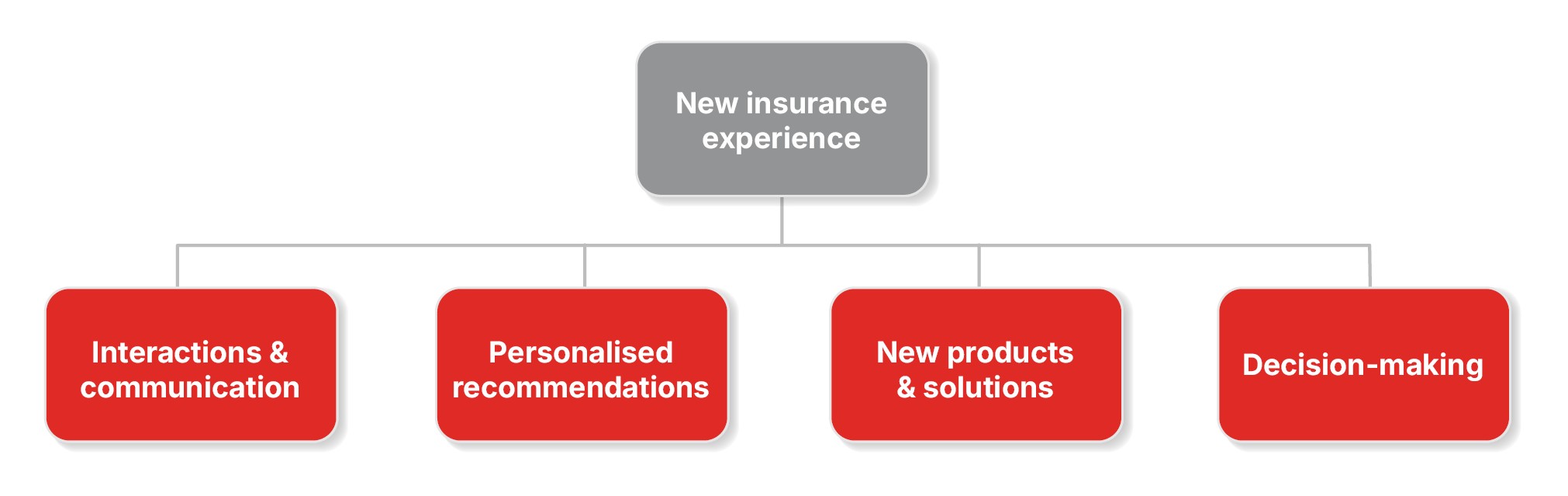
While both Gen AI and earlier digital tools (such as internet, mobile, and social media) significantly enhance information gathering, Gen AI has a particularly strong impact on advice seeking, advancing the capabilities of robo-advisors and price comparison websites. Looking ahead, Gen AI may have a stronger impact over time in the purchasing step (e.g. through personalised product design, automated underwriting, and conversational interfaces), after-sales services, and claims handling (e.g. customer engagement, personalised assistance, claims automation, image recognition, and conversational claims handling).5 Overall, Gen AI is expected to complement and extend the reach of existing digital technologies, particularly in advisory, after-sales service, and claims processes, thereby reshaping the insurer-customer relationship more holistically. Gen AI could enhance the customer experience in four main ways (Figure 2).
FIGURE 2: GEN AI FUNCTIONS FOR INSURANCE CUSTOMERS
Source: Geneva Association
These range from basic automation for interactions and communication to more advanced decision-making capabilities:
While insurers are rapidly experimenting with Gen AI across their underwriting, claims, and customer service activities (see Box 1), it remains uncertain whether customers welcome these innovations, understand their implications, or worry about them. The successful adoption of Gen AI in insurance depends on customer acceptance of the underlying technology, given that trust and long-term relationships with customers are paramount in the insurance sector.
Box 1: The impact of Gen AI on insurance – The view from insurers
Recent insurance industry surveys indicate that insurers see Gen AI as both a major opportunity and a significant organisational challenge. An EY–Parthenon survey of 200 insurance executives finds strong momentum, with over a quarter of active Gen AI teams reporting directly to the C-suite.15 Leaders expect efficiency gains across underwriting, claims, servicing, and distribution, but cite governance and uncertain returns as critical hurdles. Similarly, a McKinsey survey of more than 50 executives from Europe’s largest insurers reports that over half of respondents anticipate 10–20% productivity improvements, 1.5–3% premium growth, and 1.5–3 percentage point improvements in technical results from Gen AI adoption, yet many initiatives remain confined to pilots.16
Other findings reinforce these trends. In a survey of 200 US insurance executives conducted by the Deloitte Center for Financial Services, 76% of respondents said that their organisations are experimenting with Gen AI in one or more business functions, while the majority of them are still in the scoping stage.17 Meanwhile, a broader Deloitte survey of over 2,800 global leaders indicates that while 48% of respondents anticipate substantial business transformation from Gen AI within one to three years, prevailing governance concerns have made monitoring regulatory requirements for compliance the primary risk mitigation measure.18 Accenture reports that 56% of insurers consider Gen AI pivotal for reinventing customer relationships, although most acknowledge significant skill and change-management gaps.19
Source: Contributed by Qinyu LI, Peking University, and Tianyang WANG, Colorado State University
To find out more about customers’ perceptions of the use of Gen AI in insurance, the Geneva Association carried out a global survey – the first to focus on insurance customers’ views of Gen AI.20 The results provide valuable insights and illustrate the transformative potential of Gen AI in the insurance customer journey.
The report is framed around the following two questions:
By analysing these questions in tandem, the study provides a comprehensive understanding of how Gen AI is reshaping consumer interactions with insurers. If (prospective) insurance customers are distrustful of insurer-provided Gen AI tools, then the ability of insurers to deliver meaningful product or process innovations may be significantly constrained, regardless of the underlying technological potential of Gen AI. Similarly, as customers increasingly rely on off-theshelf Gen AI tools to inform their insurance decisions, important questions arise about the quality of this guidance, which could lead to suboptimal choices on risk retention and transfer.21
The report makes two original contributions. First, it offers a novel perspective by examining the role of Gen AI in insurance from the customer point of view, which has received limited attention in existing research. The report addresses a significant gap by investigating how Gen AI influences insurance customers, their perceptions of Gen AI deployment, their understanding of its benefits, and concerns they may have.
Second, the report introduces a novel distinction between two types of Gen AI usage in the insurance customer journey: 1) Gen AI tools deployed by insurers to interact directly with customers, and 2) customers’ independent use of general-purpose, off-the-shelf Gen AI to support their own insurance decisions. By analysing these two types, the study provides a more comprehensive understanding of how Gen AI is reshaping the insurance customer experience and journey.
The remainder of the report is structured as follows. Section 2 explores the impact of Gen AI on insurance customers based on the results of the customer survey, including both benefits and concerns. Section 3 discusses the implications for insurers. Section 4 offers concluding insights.
The Geneva Association conducted a survey of 6,000 insurance customers across the world’s six largest insurance markets to find out their perspectives on Gen AI (see Box 2). This section outlines the main empirical findings. Overall, many customers already interact with Gen AI in their communications with insurers and, in the future, Gen AI is likely to play an increasingly central role in these interactions. A large proportion of insurance customers are also independently using off-the-shelf Gen AI tools to assist their insurance purchases. However, despite its transformative potential for service delivery and improving the customer experience, Gen AI also presents important challenges.
Box 2: The insurance customer survey on Gen AI
The online survey was conducted in February 2025 across the world’s six largest insurance markets (China, France, Germany, Japan, the UK, and the US). In each of the markets, a sample of 1,000 individual insurance customers was surveyed. These samples were designed to be representative of the insurance customer profiles in their respective markets.
To qualify for the survey, respondents were required to meet the following criteria: 1) Have a basic understanding of what Gen AI is (pass a test question), 2) have purchased or renewed insurance for themselves or their families within the past three years, and 3) be aged between 21 and 70. The survey consisted of 19 questions.
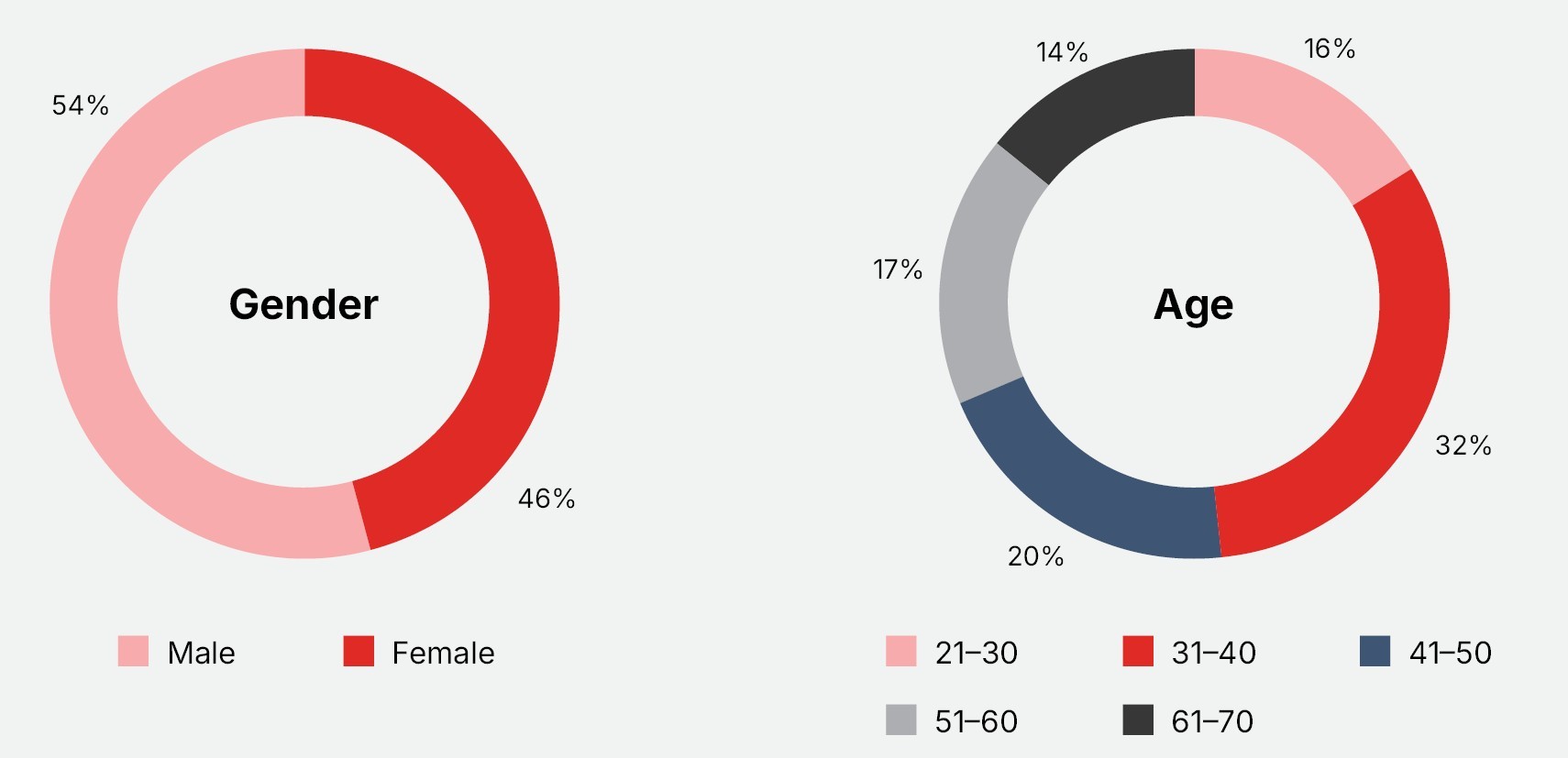
Figure 3 provides an overview of the sample by gender and age group. The gender distribution is well balanced (46% male and 54% female respondents), while the 31–40 age cohort is more strongly represented.
FIGURE 3: INSURANCE CUSTOMER SAMPLE
Source: Geneva Association insurance customer survey
A limitation of the survey is that respondents had to pass a basic Gen AI knowledge test to qualify. While this ensured informed responses, it may bias the sample toward more digitally literate and Gen-AI-familiar individuals, potentially inflating acceptance and experience ratings.
Source: Geneva Association
2.1.1 Insurer-provided Gen AI tools
Customer awareness
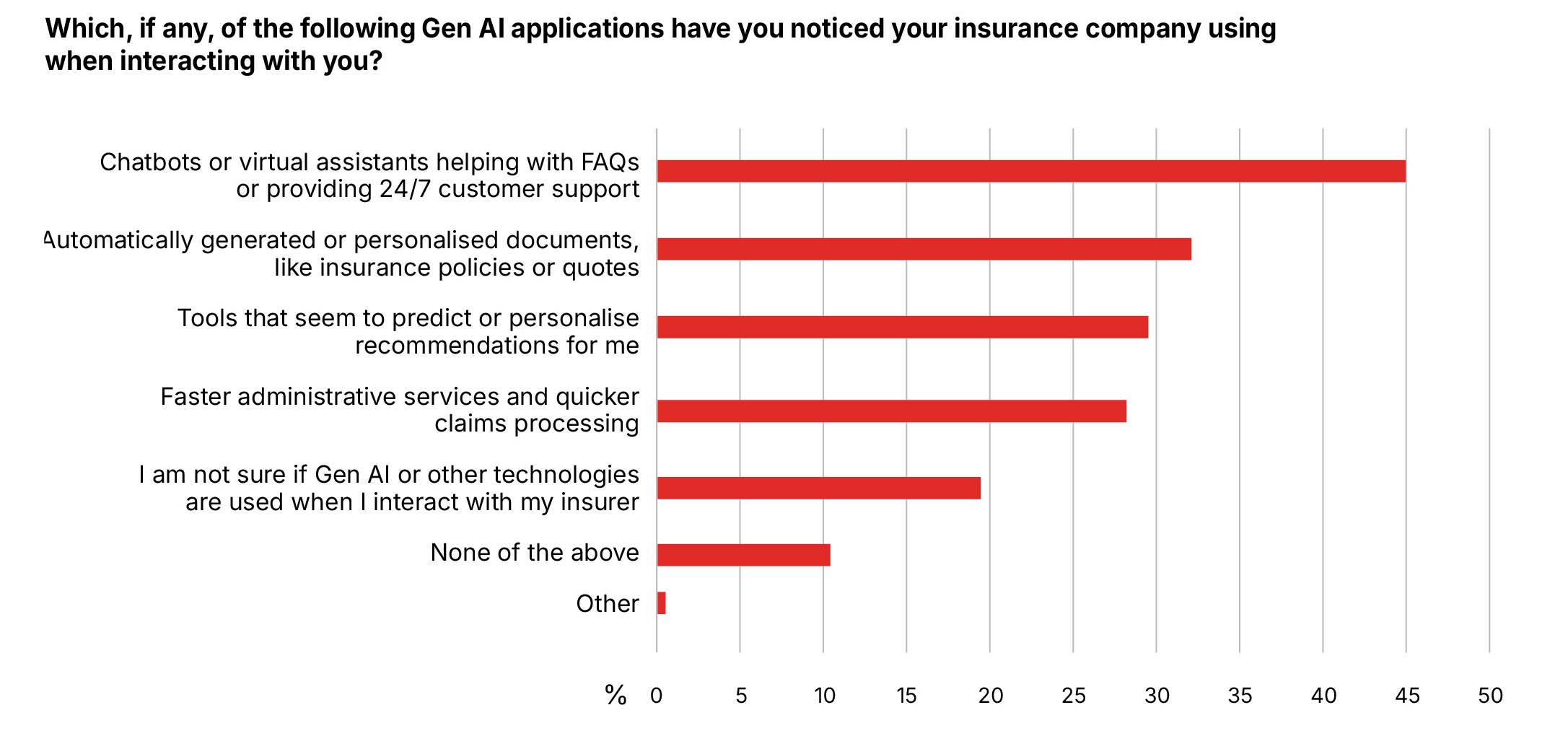
Chatbots and virtual assistants are the most commonly noticed Gen AI applications among customers (45%), followed by automatically generated/personalised documents (32%) (Figure 4). Eighteen percent of respondents are uncertain whether Gen AI or other technologies are being used during their interactions with insurers.22
FIGURE 4: GEN AI IN INSURER-CUSTOMER INTERACTIONS
Source: Geneva Association insurance customer survey
Customer sentiment
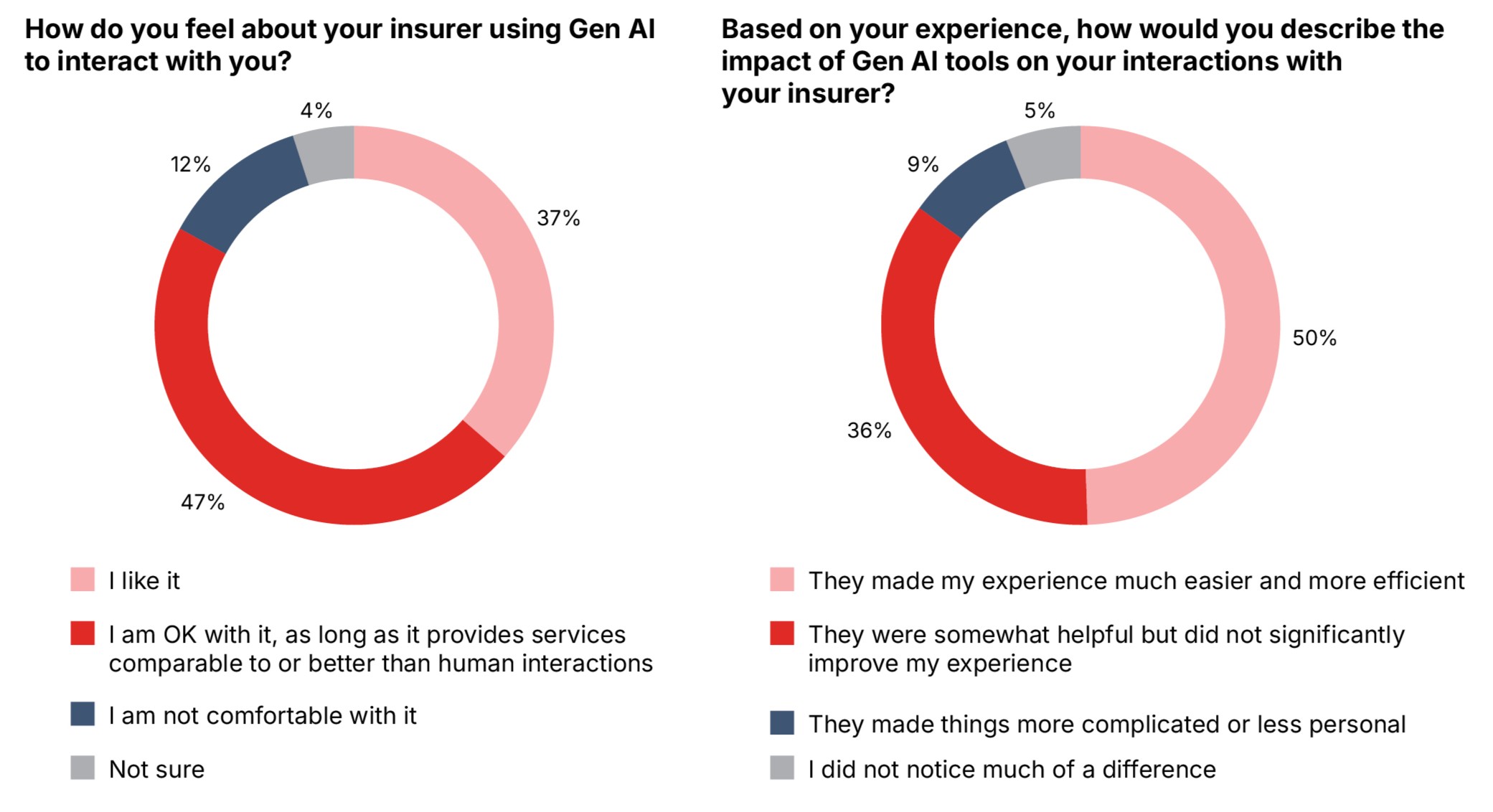
Over 80% of insurance customers either favour (37%) or are neutral (47%) toward insurers using Gen AI in customer interactions (Figure 5). While this indicates limited outright resistance, the high share of neutrality also suggests that many customers may be indifferent or have yet to form strong opinions, pointing to both opportunities and challenges for deeper integration of Gen AI in customer service and engagement. Twelve percent of customers remain uncomfortable with Gen-AI-driven services.
As shown in Figure 5, 50% of respondents find Gen AI tools improve their interactions with insurers by making processes more efficient and intuitive. Meanwhile, 36% find the tools somewhat helpful but not significantly transformative. These results are comparable with the percentage of surveyed individuals who like (37%) or are OK with (47%) insurers using Gen AI to interact with customers. The findings suggest that while Gen AI enhances the customer experience overall, there is room for improvement.23
FIGURE 5: CUSTOMER SATISFACTION AROUND THE USE OF GEN AI IN INTERACTIONS
Source: Geneva Association insurance customer survey
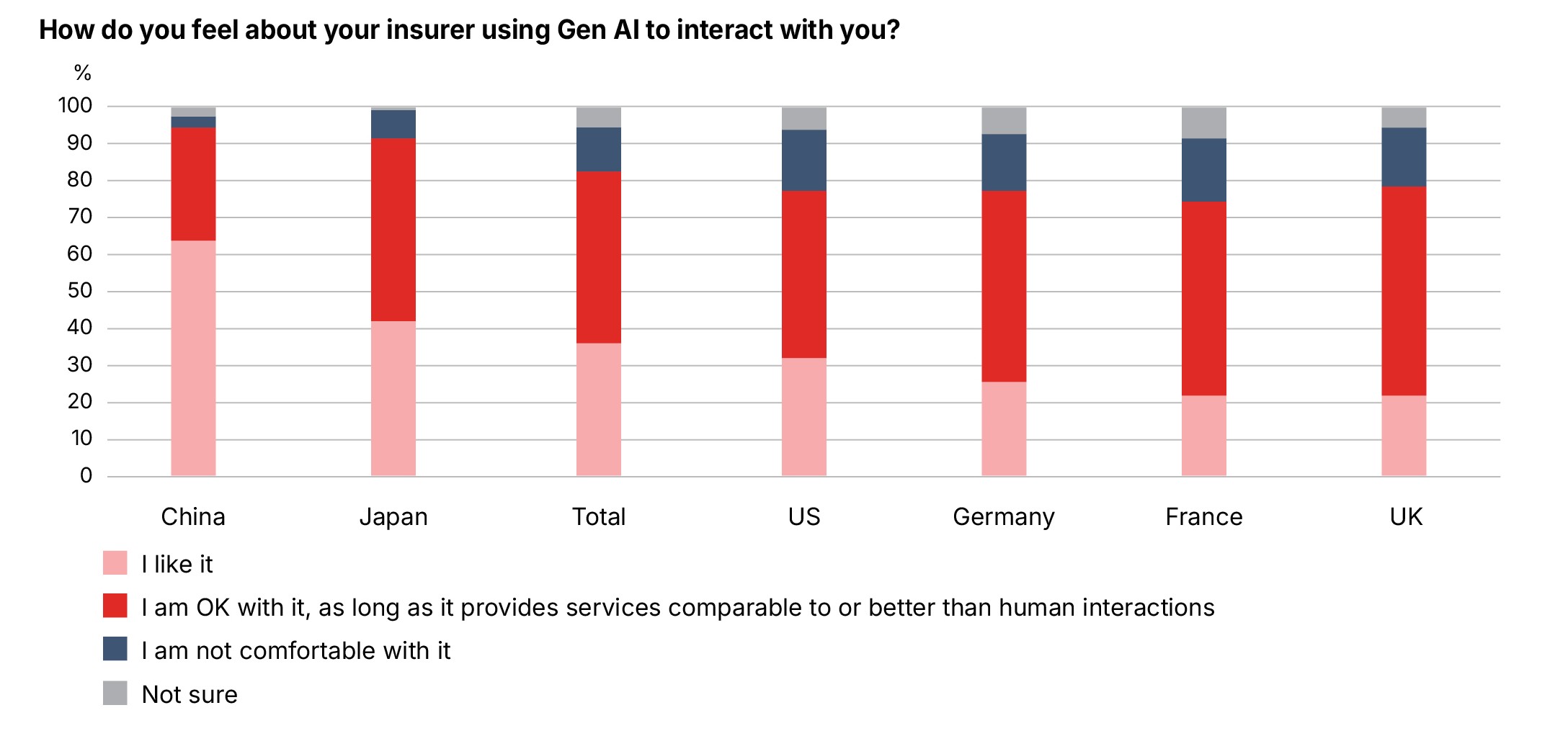
Enthusiasm for insurers’ use of Gen AI tools varies significantly across countries. Customers in Asian markets show higher favourability than those in Europe and the US (Figure 6).
FIGURE 6: CROSS-MARKET COMPARISON OF GEN-AI-DRIVEN INTERACTION
Source: Geneva Association insurance customer survey
Customer acceptance by insurance activity
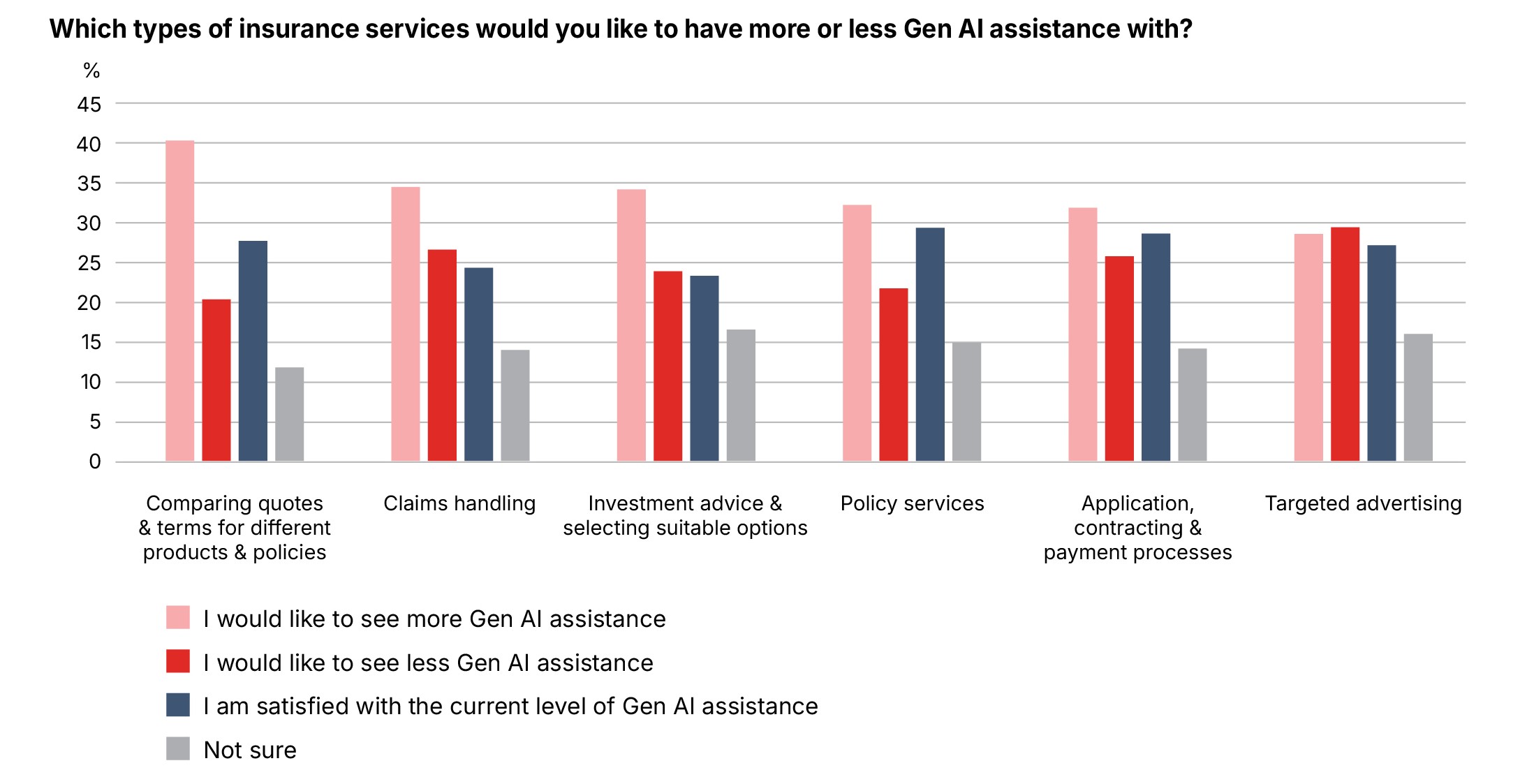
Figure 7 demonstrates a positive inclination among customers toward using more Gen AI tools in insurance interactions. Across all surveyed use cases, respondents expressing a desire for increased Gen AI involvement (red bars) exceeded those preferring less Gen AI involvement (light gray bars). The exception is targeted advertising, for which the highest percentage of respondents prefer less AI involvement. The strongest demand for Gen AI is in product/quote comparisons, where twice as many respondents would prefer more Gen AI involvement than those who would like less.
FIGURE 7: DEMAND FOR INSURER-PROVIDED GEN Al SERVICES
Source: Geneva Association insurance customer survey
Customer considerations and priorities
Figure 8 ranks key Gen AI features based on their importance from the insurance customer perspective. Data security and the accuracy of AI-generated information are the top priorities for insurance customers. Access to human support, transparency, and ease of use are also highly valued. These findings suggest that customers prioritise trust and reliability when engaging with Gen-AI-driven insurance services. Box 3 provides a detailed overview of the features of Gen AI tools that customers consider most important.
FIGURE 8: IMPORTANCE OF GEN AI FEATURES
Source: Geneva Association insurance customer survey
Box 3: Customer priorities when using insurer-provided Gen AI
Data security. Customers may feel uncomfortable with insurers tracking their financial habits, lifestyle choices, and health data. While personalised policies offer benefits, excessive data-driven profiling may be perceived as intrusive. Clear data governance policies and explicit customer consent mechanisms are essential to ensuring responsible AI implementation and maintaining policyholder trust. Unauthorised access or disclosure of customer data, e.g. sharing financial records or health histories with third parties without explicit consent, violates data protection laws.
Accuracy of information. AI-generated recommendations must be rigorously validated to prevent misinformation or hallucinations that could lead to incorrect premium estimates, misleading policy details, or flawed underwriting assessments. It is important that, when deploying Gen AI tools, insurers ensure AI systems are accurate and robust through rigorous validation processes. It is equally important that customers are aware that any independent use of general-purpose Gen AI tools might lead to accuracy problems.
Access to human support. While Gen AI enhances efficiency and convenience, it lacks the human touch that many customers prefer, particularly in complex or sensitive insurance matters. High-stakes claims, such as those involving bodily injury or medical emergencies, often require human intervention to provide reassurance and support. To maintain customer trust, insurers must establish clear dispute resolution mechanisms and ensure human involvement in customer interactions.
Transparency. Many customers may not realise they are interacting with Gen AI or understand how AI-driven models are used in premium setting, risk assessment, or claims approval processed. The opacity of AI-generated decisions can lead to confusion and undermine trust. Insurers should disclose Gen AI usage in customer interactions and offer explainable Gen AI recommendations to help policyholders understand coverage options, pricing adjustments, and claims outcomes. Additionally, insurers must ensure transparency in data collection, provide customers with control over their personal information, and establish effective grievance redress mechanisms.
Source: Geneva Association and Tianyang WANG, Colorado State University
2.1.2 Off-the-shelf Gen AI platforms
Insurance customers are increasingly comfortable using Gen AI tools independently when purchasing insurance. The survey results indicate strong adoption of Gen-AIpowered solutions: 68% of respondents have utilised Gen AI assistants like ChatGPT or Co-pilot in their insurance buying process (Figure 9). There are significant differences in the independent use of Gen AI tools across markets: customers in China and Japan are more inclined to use Gen AI independently when purchasing insurance, those in continental Europe are relatively conservative, and the English-speaking markets are somewhere in between. These findings highlight the growing role of Gen AI in helping customers navigate insurance complexities and bridge knowledge gaps between insurers and policyholders.
FIGURE 9: INDEPENDENT USE OF GEN Al WHEN PURCHASING INSURANCE
Source: Geneva Association insurance customer survey
Despite the rapid rise of ‘AI-sation’ of distribution, sales through traditional intermediaries continue to dominate in most markets, especially for more complex product types. Gen AI tools are more likely to disrupt specific stages of the customer journey – information gathering, product comparison, or routine servicing – than to fully replace existing channels.
The impact of Gen AI will likely depend on the type of insurance – standardised products like auto insurance are more susceptible to Gen-AI-driven processes, whereas complex offerings such as retirement or health insurance involve long-term commitments and intricate trade-offs, where overreliance on Gen AI recommendations could expose consumers to significant decision risks. This highlights the need for a differentiated view of Gen AI’s role across insurance lines that balances gains with customer protection.
Box 4 highlights the importance of independent Gen AI use and outlines how Gen-AI-empowered customers will communicate and interact with insurers more effectively and make more professional insurance decisions.24,25
Box 4: Off-the-shelf Gen AI – Empowering the customer and reshaping the insurer-customer dialogue
Customers now increasingly access Gen AI tools independently, often before engaging with insurers. Gen AI is shaping a new generation of customers – more informed, more prepared, and more conscious in their decision-making, with higher expectations for personalised and responsive service.
When both customers and insurers use Gen AI, it fosters more integrated and effective interactions. Customers are able to ask more precise questions, while insurers can deliver more accurate and tailored responses. The use of ‘off-the-shelf’ Gen AI platforms by customers – and even insurance employees – adds value by improving communication quality and enhancing mutual understanding throughout the customer journey.
Health insurance is undergoing an intense transformation due to the evolution of clients towards health consumerisation, where the ‘patient is increasingly less patient’ and seeks to reduce information asymmetry with the help of Gen AI tools, even on specific topics such as clinical matters. This trend is not without risks, including reputational, privacy, and commercial risks, but insurers must equip themselves to manage them effectively.
It is important to cultivate a broader ‘Gen AI culture’ within insurance companies – one that acknowledges the emotional and behavioural shifts in how customers engage. An informed customer should not be seen as arrogant, but as a reflection of today’s digital reality, where access to risk and insurance knowledge is fast and ubiquitous. Insurers should evolve their corporate mindset to meet this new standard, embracing the empowered customer and responding with empathy, agility, and relevance.
Source: Contributed by Massimo Piana, Unipol
The growing use of off-the-shelf Gen AI platforms by customers may have profound implications for insurers. As customers increasingly turn to these tools for independent research and support with decisions, brand loyalty to a specific insurer may weaken. Instead of relying solely on insurer-provided advice, customers can now ask Gen AI to compare products (46% of survey respondents already do so), clarify policy terms, and evaluate coverage options, making it easier to identify value across competing offerings. Here, Gen AI outperforms price comparison websites and traditional robo-advisors. This shift elevates the strategic importance of product design and transparency, as wellcrafted, high-value insurance products are more likely to stand out when scrutinised through Gen AI. It also places pressure on insurers to offer AI-enabled services that match or exceed the capabilities of publicly available tools, or risk losing customers to third-party platforms.
Our survey findings align with broader market evidence showing rapid consumer adoption of public Gen AI platforms for financial decision-making. For example, multiple industry surveys across financial services indicate that a growing proportion of consumers are already using general-purpose AI assistants to research products and compare providers.26 By benchmarking against this wider trend, our results reinforce that insurers are increasingly interacting with AI-empowered customers, and that this shift is not isolated but part of a broader behavioural transformation in the digital economy.
While customers are increasingly engaging with Gen AI tools, significant challenges remain around trust, privacy, accuracy, and transparency.
2.2.1 Insurer-provided Gen AI tools
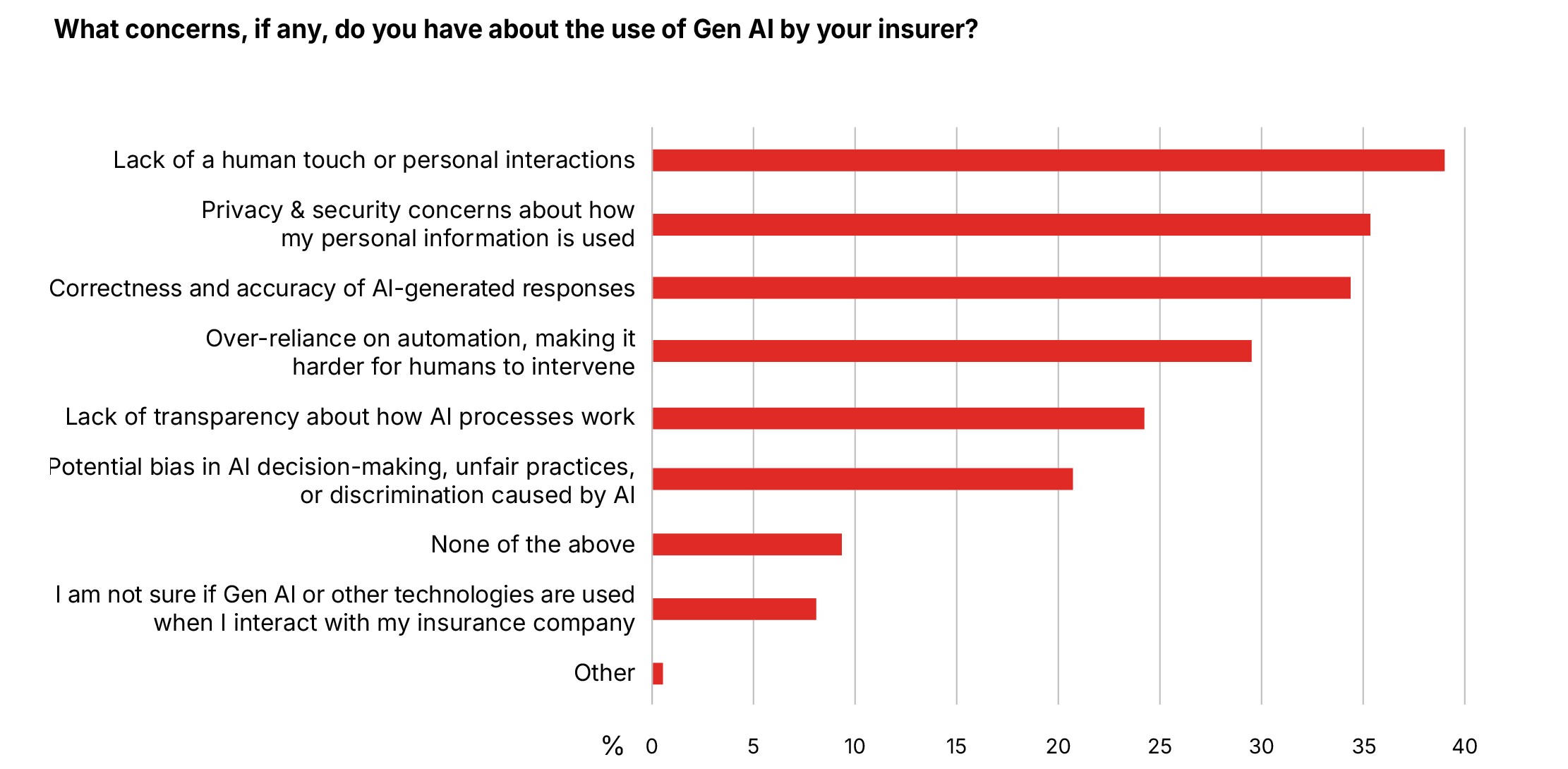
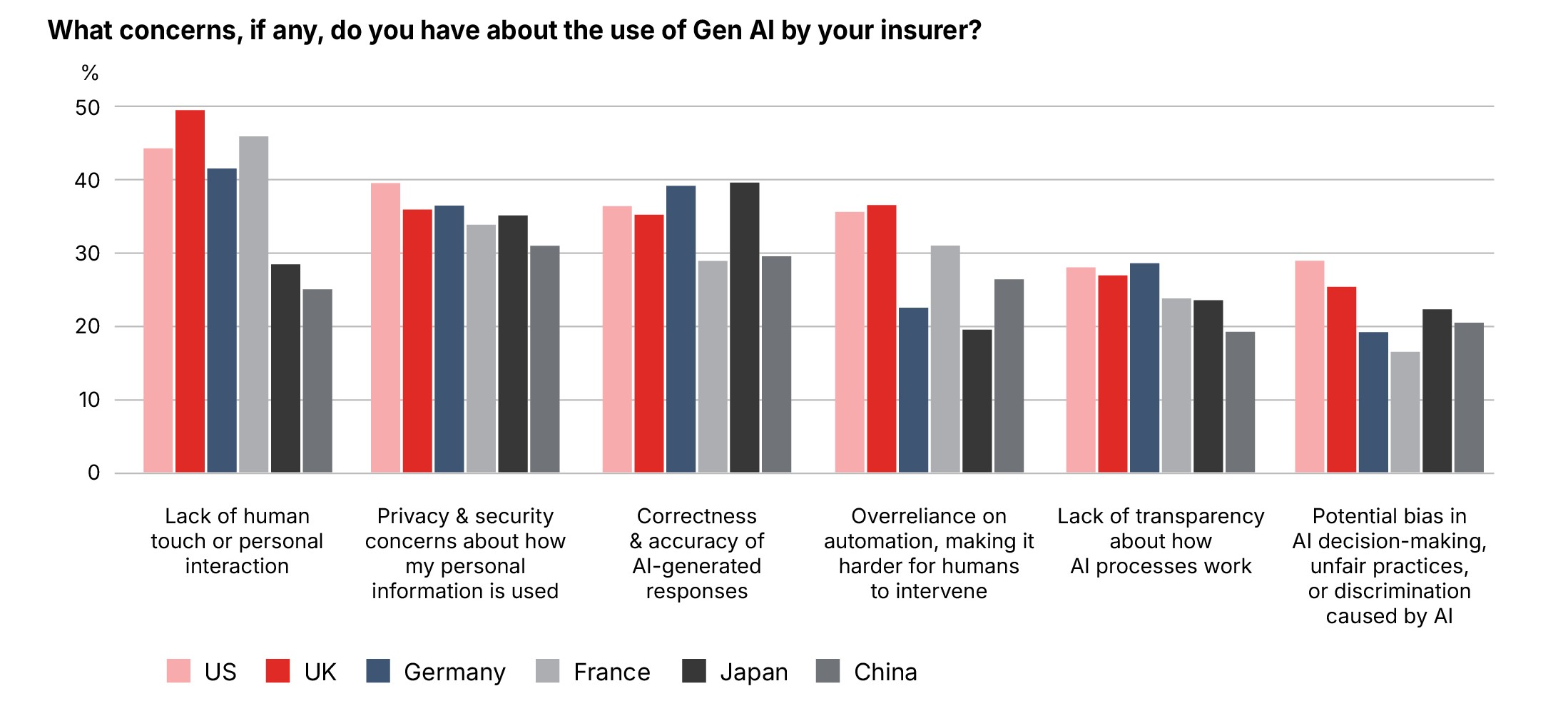
As illustrated in Figure 10, nearly 40% of insurance customers express concerns about the lack of human touch or personal engagement with Gen AI tools, making this the most prominent concern. This is particularly pronounced in France, the UK, and the US, where over 40% of respondents highlight it as an issue. It ranks notably lower in Japan and China (below 30% of respondents) (Figure 11).
FIGURE 10: CONCERNS ABOUT INSURER-PROVIDED GEN AI SERVICES
Source: Geneva Association insurance customer survey
Many customers remain hesitant about AI-generated responses due to privacy and security concerns or the potential for biases. This hesitancy reflects broader societal concerns about the accuracy and transparency of algorithmic decision-making and the ‘black box’ nature of advanced AI systems. A particularly critical issue is the risk of Gen AI ‘hallucinations’, instances where AI generates plausible-sounding but factually incorrect information. In the context of claims processing, this could result in AI erroneously denying a valid claim due to fabricated policy exclusions or misinterpreted contractual terms, leading to financial harm and loss of customer trust. Box 5 introduces one suite of tools that may help mitigate some of the challenges: retrieval-augmented generation (RAG).
Although Gen AI increases operational efficiency, misinterpreted outputs or hallucinations may unintentionally lead to incorrect claim decisions, resulting in reputational or legal consequences.
René Wissing, Achmea
Box 5: Gen AI hallucination and mitigation strategies
To mitigate hallucination risks, insurers should implement robust validation processes and ensure human oversight in high-stakes, AI-generated decisions. To build trust, insurers must not only implement technical safeguards to reduce hallucinations but also communicate transparently about when and how Gen AI is used in customer interactions. Proactive education campaigns can help demystify AI processes.
Retrieval-augmented generation (RAG) can improve the relevance and accuracy of AI outputs by grounding them in authoritative knowledge bases.
Instead of relying solely on the model’s internal patterns, RAG retrieves structured and verified information from trusted sources – such as policy documents, regulatory guidelines, or medical references – and integrates it into the generated response. This anchoring mechanism reduces the risk of misinformation, ensures consistency with established facts, and enhances the reliability of AI-generated recommendations. Ultimately, the quality and effectiveness of AI-generated insights will play a critical role in determining the scope of Gen AI applications in the insurance industry.
Source: Geneva Association
Retrieval-augmented generation is a mitigation strategy that helps reduce, but not completely eliminate, hallucinations. Continued human oversight and vigilant monitoring are necessary procedures for the accuracy of Gen AI outputs.
Antoine Sasseville, Intact Financial Corporation
Customers are also concerned about cybersecurity threats associated with the use of insurer-provided Gen AI tools. These concerns are legitimate: many Gen AI systems often process sensitive personal data, making them potential targets for cyberattacks. Malicious actors could also exploit AI-generated content to impersonate insurers or policyholders, enabling sophisticated phishing or identity theft. To maintain trust, insurers must adopt robust AI-specific cybersecurity measures and clearly communicate data protection practices.
The level of concern regarding insurer-provided Gen AI services varies significantly by market. As indicated in Figure 11, customers in Asian countries exhibit the lowest levels of concern, while English-speaking countries express the highest levels of apprehension. Continental European markets fall in between. This cross-country variation may reflect differences in cultural attitudes, regulatory environments, and levels of trust in insurers. In Asian markets, widespread exposure to digital ecosystems and a cultural openness to technological innovation have fostered greater acceptance of Gen AI, resulting in comparatively low levels of concern. In contrast, in English-speaking countries, stronger public debate around privacy, fairness, and algorithmic bias, combined with lower baseline trust in insurers, heightens apprehension about Gen AI use. In continental European markets, strict consumer protection frameworks such as GDPR provide reassurance, yet some unease remains regarding insurers’ adoption of advanced technologies.
FIGURE 11: CONCERNS ABOUT INSURERS’ USE OF GEN AI ACROSS MARKETS
Source: Geneva Association insurance customer survey
2.2.2 Off-the-shelf Gen AI platforms
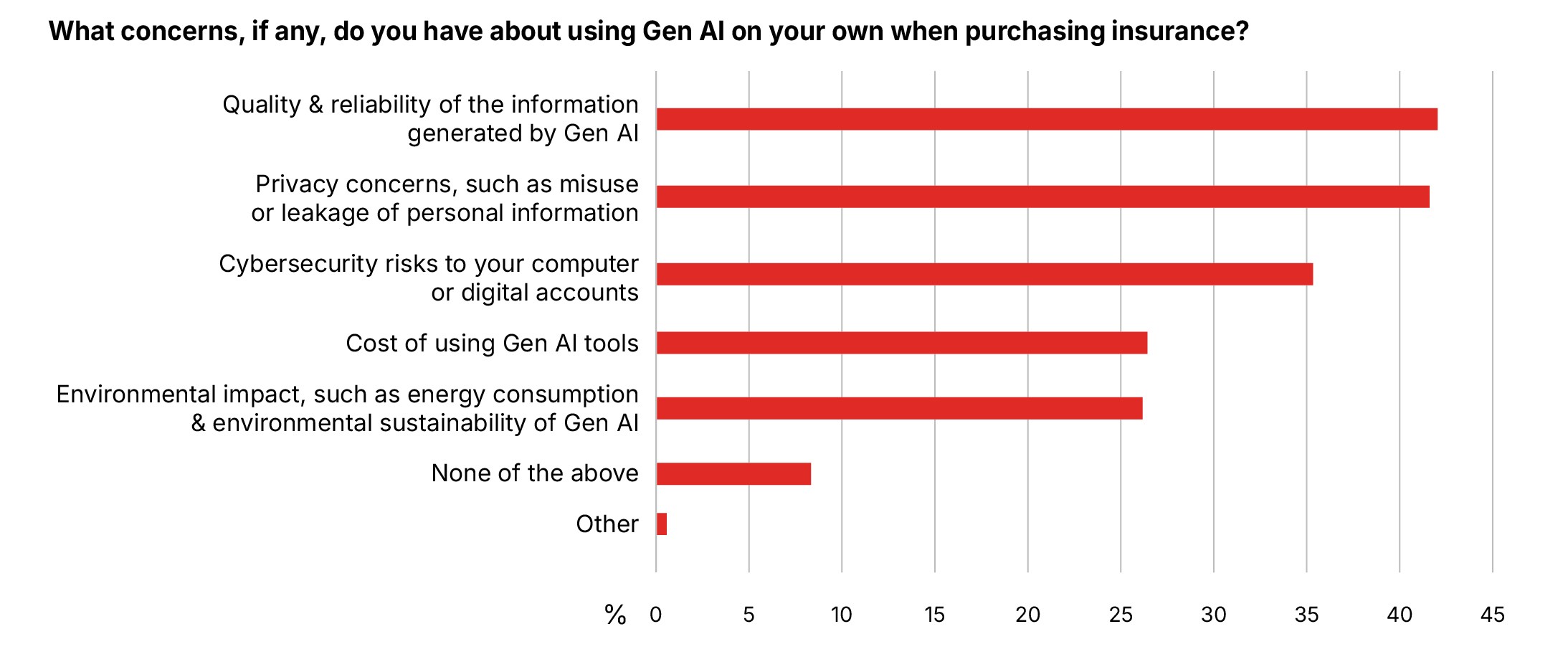
Over 40% of users express concerns about the accuracy and reliability of AI-generated information, as well as the privacy and security of their data, when using Gen AI independently to purchase insurance (Figure 12). This number is comparable to that of insurer-provided tools.
FIGURE 12: CONCERNS ABOUT USING GEN Al INDEPENDENTLY FOR INSURANCE PURCHASES
Source: Geneva Association insurance customer survey
The survey results highlight both opportunities and challenges for insurers around integrating Gen AI in the customer journey. Insurers must balance tech-led efficiency gains with core principles of trust and transparency.
On one hand, Gen AI can act as a ‘digital concierge’, handling routine queries and freeing up human agents’ time for higher-touch interactions. On the other, the limited acceptance of AI in complex decisions suggests that fully autonomous, agentic AI insurance agents may be premature. Insurers should therefore position Gen AI as a complement to human expertise rather than attempting to completely replace human services. This section provides recommendations for insurers on how to embed Gen AI responsibly in their operations, enhancing efficiency while safeguarding customer trust and human connection.
Embrace the reality of customers’ use of off-the-shelf Gen AI. As customers increasingly use Gen AI independently to deepen their insurance knowledge, insurers should respond by creating complementary, Gen-AIdriven advisory services that validate and expand on what customers learn. Rather than viewing well-informed customers as a challenge, insurers can position themselves as trusted partners by offering better advice and more accurate information that clarify trade-offs, correct misconceptions, and personalise recommendations in line with professional standards. For instance, an insurer might develop a ‘second opinion’ Gen AI service that reviews customer-generated insights from off-the-shelf Gen AI tools and provides transparent, regulator-compliant guidance. Paired with employee training to engage empathetically with Gen-AI-informed customers, this approach ensures that insurers harness customers’ growing knowledge as an opportunity to build trust, loyalty, and more meaningful engagement.
Keep humans ‘in the loop’. While Gen AI can automate some tasks within underwriting, claims processing, and fraud detection, human participation remains critical for complex cases and scenarios. Insurers are addressing the ‘lack of human touch’ by adopting hybrid AI-human models that combine automation with human interventions – especially in emotionally sensitive contexts like claims handling, where over-reliance on Gen AI can heighten customer dissatisfaction.
For example, Allstate now uses OpenAI’s GPT models to draft nearly all of its 50,000 daily claims emails, removing jargon and adding compassionate phrasing, before human agents review and personalise the messages.27 Another widely used approach is the chatbot model with an option to speak to a live human agent, enabling Gen AI to manage routine communications while reserving human involvement for nuanced, high-emotion interactions. Insurers should formalise a hybrid support model where AI handles routine queries and human agents manage sensitive issues.
Support and guide Gen-AI-enabled customers. Insurers must continue to scrutinise their own Gen AI tools to ensure efficiency, accuracy, and fairness. They should also support Gen-AI-enabled consumers, for example, by providing clear information that third-party AI tools can easily process and reference, in a bid to reduce the scope for misunderstandings or hallucinations. Taken together, these steps can help insurers not only safeguard customer trust but also differentiate themselves as proactive leaders in an evolving, Gen-AImediated marketplace.
Ensure data quality and privacy protection. The effectiveness of Gen AI models depends on highquality, comprehensive data. Insurers should invest in robust data infrastructure that facilitates accurate collection, storage, and analysis. To protect customer privacy while leveraging AI’s capabilities, insurers can adopt privacy-preserving techniques such as federated learning and synthetic data generation. Compliance with regulations like GDPR and the EU AI Act will also be crucial for maintaining customer confidence and avoiding regulatory penalties.
The introduction of the EU AI Act in July 2024 marks a significant milestone for both insurance customers and insurers. As the world’s first binding horizontal AI legislation, it mandates transparency, bias mitigation, and consumer challenge rights for high-risk AI applications, including those used in insurance (Box 6).
Global insurers face heterogeneous data protection and security requirements across jurisdictions. To manage this complexity, they need governance frameworks that combine regulatory compliance with ethical standards. Such frameworks should define AI risk management policies, fairness audits, and accountability structures to ensure responsible use of Gen AI.
Box 6: Impact of the EU AI Act on insurance customers
When the European Commission first proposed the EU AI Act in 2021, insurance was not considered a highrisk sector and was thus excluded from the regulation’s scope. However, later drafts included AI applications in life and health insurance, driven by concerns over fairness, discrimination, and privacy.28 The scope gradually expanded to cover not only eligibility decisions but also risk assessment, premium setting, underwriting, and claims handling. While the aim is to protect fundamental rights, the insurance industry argues that existing regulations, such as Solvency II,29 the Insurance Distribution Directive, and GDPR, already address many of these concerns, and that additional oversight risks stifling innovation.30
That said, the AI Act potentially introduces several benefits for consumers. It enhances transparency by requiring insurers to inform customers when AI is involved in life and health insurance decisions. It mandates safeguards against bias through representative training data and regular audits, while also ensuring human oversight of automated decisions,31 giving consumers the right to challenge outcomes.32 Data protection and cybersecurity requirements, as well as mandatory risk management processes, are designed to build trust in the safe and responsible use of AI in insurance.
However, the EU AI Act, while aiming to regulate highrisk AI applications, may unintentionally limit innovation in the insurance sector, to the detriment of consumers. By classifying life and health insurance AI systems as high risk, resulting in extensive and costly compliance requirements, the Act discourages the development and use of AI tools, including those that could be used for risk mitigation and prevention. At the same time, the high cost of compliance – estimated to consume up to 17% of AI budgets – may lead insurers to scale back AI investments, foregoing efficiency gains in underwriting and claims processing and preventing cost reductions that could have been passed on to consumers.33 Restrictions on technologies like real-time biometric identification could also hinder improvements in the digital customer experience.
Source: Contributed by Dennis Noordhoek, Geneva Association
Embed Gen AI governance and invest in employee reskilling. To underpin customer trust, insurers should establish dedicated AI accountability teams to audit fairness and performance, monitor for potential biases, and oversee complex decisions. Investment in employee reskilling is also crucial – preparing staff to take on strategic, relationship-driven, and emerging roles such as AI governance and model validation. By positioning Gen AI as an empowerment tool, insurers can enhance operational efficiency while enabling richer, more trusted AI-customer interactions.
Gen AI will transform positions in insurance companies, replace some employees who cannot use AI, and create more Gen-AI-related jobs.
Jing XIAO, Ping An
Moreover, responsible AI adoption can serve as a competitive differentiator. Insurers that demonstrate leadership in ethical AI deployment will not only strengthen customer loyalty but also gain reputational advantages and play an influential role in shaping future regulatory standards and industry norms. Insurers should adopt explainability mechanisms that make AI decisions interpretable, conduct regular fairness audits to identify and correct bias, and establish ethical guidelines that demand greater transparency than traditional human decision-making. By embedding these practices, insurers can strengthen trust and reduce customer resistance to AI-driven insurance solutions.
Gen AI, whether in business operations or customer interactions, must be measurable, despite its fluid boundaries and integration with other processes. A clear measurement framework is essential to mitigate black box risk as algorithmic complexity increases.
Massimo Piana, Unipol
Adopt customer-centric Gen AI solutions. Gen AI must enhance, rather than hinder, insurer-customer interactions. Insurers have two broad strategic options: 1) Locally deploy and customise open source Gen AI solutions to improve customer service and productivity and 2) develop in-house or InsurTech-partnered proprietary Gen AI solutions, allowing deeper customisation and integration. A hybrid approach combining both strategies can also be effective.
By aligning technological innovation with customer expectations and societal values, Gen AI can fulfil its promise as a tool for innovation and efficiency in the insurance industry. Key actions to achieve this include regular AI audits to identify and mitigate biases in pricing and claims, the adoption of ethical AI frameworks that prioritise consumer protection, and the deployment of privacy-preserving tools such as federated learning and synthetic data generation.34 Equally important are strong governance structures that guarantee accountability, maintain human oversight in critical decisions, and make AI processes more transparent. Through this alignment of innovation with responsibility, insurers can unlock Gen AI’s full potential, enhancing efficiency and profitability while fostering fairness, trust, and stronger customer relationships.35
Gen AI is transforming how customers interact with insurers. It offers opportunities for personalisation and greater convenience – from tailored policy recommendations to streamlined claims handling, Gen AI is making insurance services faster, more responsive, and more intuitive. Gen-AI-powered chatbots and virtual assistants are simplifying processes that were previously complex or dense, especially for individuals with limited insurance literacy. Many insurers are already deploying Gen AI tools to assist customers, a trend which will only accelerate.
The survey conducted for this report shows that insurance customers exhibit high overall acceptance of current Gen AI applications. Notably, customers are increasingly using off-the-shelf, general-purpose Gen AI platforms like ChatGPT to compare products and interpret policy terms, sometimes before even contacting their insurers. This empowers them to make more informed decisions and bridge knowledge gaps.
However, there are also challenges. Gen AI must enhance, rather than hinder, customer interactions. The survey findings show substantial variation in Gen AI service quality across markets. Customers in China and the US report the most positive experiences, while those in Germany and France are more sceptical. Meanwhile, a significant share of customers is concerned about data privacy, reduced human interaction, inaccuracies, and lack of transparency.
These findings underline the importance of responsible Gen AI implementation. While Gen AI holds immense promise, insurers must strike a balance between technological innovation and ethical considerations.
Human oversight is critical – especially for high-stakes decisions – to prevent over-reliance on automated systems and maintain customer trust.
By strategically adopting Gen AI, insurers can redefine customer engagement, enhance efficiency, and unlock new growth opportunities. This transformation is not merely technological, it is a fundamental shift in how insurance is delivered and experienced. Over the next decade, Gen AI’s role in insurance will continue to expand, with the speed of adoption varying by market and regulatory environment.
Future research should examine how Gen AI adoption affects long-term outcomes in insurance, balancing innovation with consumer protection and societal values. Ongoing assessment of Gen AI’s implications will be essential for building effective, transparent, and trustworthy insurance models in the years to come.
EY 2024.